
Have you ever made a joke based on a clever use of words and added “pun intended” afterward? While Pun Intended Meaning may seem straightforward, this phrase can add a playful twist to a sentence and tell readers that a wordplay was deliberate.
“Pun intended” is a phrase used after someone makes a pun to point out that the wordplay was intentional. It often appears in conversations, social media posts, jokes, captions, and casual writing when someone wants to draw attention to a clever double meaning.
Examples:
- I have a lot of work on my plate, and that’s a pun intended.
- That joke was pretty cheesy, pun intended.
The confusion is understandable. People often search for what does pun intended mean, pun intended meaning in text, pun intended meaning in chat, or what does pun intended mean in a sentence because the phrase can be used both humorously and sarcastically. In many cases, it signals that the speaker deliberately chose a word with two related meanings.
In this guide, you’ll learn the complete Pun Intended Meaning, its definition, origin, pronunciation, and correct usage. You’ll also see pun intended examples, learn how to use the phrase in a sentence, and understand the difference between “pun intended” and “no pun intended.”
What Does “Pun Intended” Mean?
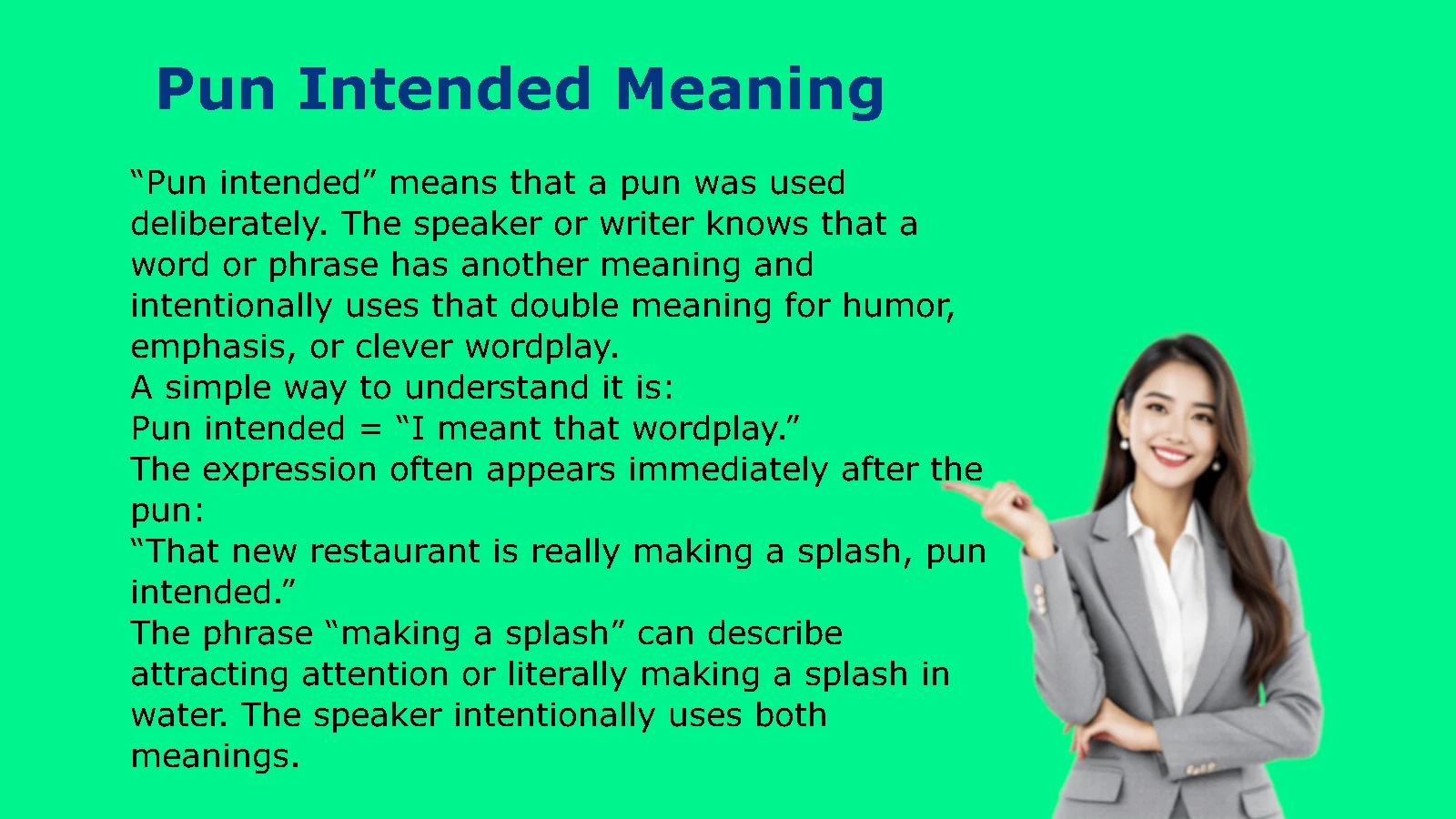
“Pun intended” means that a pun was used deliberately. The speaker or writer knows that a word or phrase has another meaning and intentionally uses that double meaning for humor, emphasis, or clever wordplay.
A simple way to understand it is:
Pun intended = “I meant that wordplay.”
The expression often appears immediately after the pun:
“That new restaurant is really making a splash, pun intended.”
The phrase “making a splash” can describe attracting attention or literally making a splash in water. The speaker intentionally uses both meanings.
According to the Cambridge Dictionary, a pun is an amusing use of a word or phrase that has several meanings or sounds like another word.
So, when someone adds “pun intended,” they’re essentially telling you:
“There are two meanings here, and I chose this wording on purpose.”
Pun Intended Meaning in Simple English
If you want the shortest possible definition:
Pun intended means the wordplay in a sentence was intentional.
For example:
“The electrician had a bright future, pun intended.”
The word “bright” can describe something that gives off plenty of light. It can also describe a promising or successful future.
Because the writer deliberately used the word “bright” for both ideas, the writer can add “pun intended.”
What Is a Pun?
Before understanding the phrase completely, it helps to understand what a pun is.
A pun is a form of wordplay that uses two or more meanings of a word or phrase, or words that sound alike or nearly alike. The goal may be humorous, clever, playful, or sometimes rhetorical.
For example:
“The bicycle couldn’t stand on its own because it was two tired.”
The joke plays on “two tired” and “too tired.”
Another example:
“I used to be a baker, but I didn’t make enough dough.”
Here, “dough” refers to the mixture used for baking. In informal English, “dough” can also mean money.
The humor comes from bringing those meanings together.
How Puns Create Double Meanings
Most puns depend on a word or phrase that can be understood in more than one way.
Common forms include:
- Multiple meanings: One word has different meanings.
- Similar sounds: Two words sound alike but have different meanings.
- Similar spellings: Words look alike while carrying different meanings.
- Literal and figurative meanings: A phrase works literally and figuratively.
- Contextual wordplay: A word takes on a second meaning because of the situation.
Consider this example:
“The gardener’s career really took root, pun intended.”
“Took root” can describe a plant developing roots. It can also mean that an idea, habit, relationship, or career became firmly established.
That’s the kind of double meaning that “pun intended” highlights.
How Does “Pun Intended” Work in a Sentence?
The phrase usually comes after the word or expression that creates the pun.
It can appear in several forms:
| Format | Example |
| At the end | “The baker finally rose to the occasion, pun intended.” |
| In parentheses | “The bakery is on a roll (pun intended).” |
| Between commas | “That was a moving experience, pun intended.” |
| Between dashes | “Her career has — pun intended — taken off.” |
| As a separate sentence | “The joke was a little cheesy. Pun intended.” |
All of these forms communicate essentially the same idea.
The exact punctuation isn’t what creates the meaning. The important part is the phrase “pun intended.”
Why Do Writers Add It?
Sometimes a pun is obvious. Other times, readers might miss it.
Adding “pun intended” acts like a small wink to the audience. It says, “Notice that word. There’s another meaning hiding there.”
For example:
“The new manager really knows how to steer the team, pun intended.”
Without the final phrase, a reader might simply understand “steer” as guiding the team. With “pun intended,” the reader is encouraged to notice the connection between leadership and physically steering something.
That extra signal can make the joke easier to catch.
Pun Intended Examples With Explanations
The easiest way to understand pun intended meaning is to see the phrase in real sentences.
Food Examples
“The bakery is on a roll, pun intended.”
Why it works: “On a roll” means doing very well, while a roll is also a type of baked food.
“That restaurant has really raised the bar, pun intended.”
Why it works: “Raised the bar” means improved standards. A bar can also refer to a physical object or a place that serves drinks.
“The chef’s career is really cooking, pun intended.”
Why it works: “Cooking” can describe food preparation and something developing successfully.
Work Examples
“She finally got promoted, so her career is taking off, pun intended.”
Why it works: “Taking off” can mean becoming successful. It can also describe an aircraft leaving the ground.
“The manager handled the issue with great tact, pun intended.”
This example only works as a pun if the surrounding context creates a second interpretation of “tact.” That distinction matters because not every clever sounding sentence is actually a pun.
Science Examples
“That chemistry experiment had a strong reaction, pun intended.”
Why it works: A reaction can mean a person’s response to something. In chemistry, it also describes a chemical process.
“The scientist has a bright idea, pun intended.”
Why it works: “Bright” can describe intelligence or something that produces light.
Nature Examples
“Her new business has taken root, pun intended.”
Why it works: A plant takes root in soil. An idea or business can also become established.
“The conversation grew quickly, pun intended.”
Why it works: “Grew” can describe physical growth and the development of an idea or conversation.
Travel Examples
“Her career really took off, pun intended.”
Why it works: “Took off” means became successful. It also describes an airplane leaving the ground.
“The travel company is going places, pun intended.”
Why it works: “Going places” can mean becoming successful. It can also refer literally to traveling.
Pun Intended vs. No Pun Intended
One of the most common points of confusion involves “pun intended” and “no pun intended.”
The basic distinction is straightforward:
| Phrase | Meaning |
| Pun intended | The wordplay was deliberate. |
| No pun intended | The wordplay was supposedly accidental. |
| Pun very much intended | The speaker strongly emphasizes that the pun was deliberate. |
| No pun intended used ironically | The speaker may actually have intended the pun but pretends otherwise. |
For example:
“The bakery is on a roll, pun intended.”
The speaker intentionally created the wordplay.
Compare that with:
“The bakery closed after running out of dough. No pun intended.”
Taken literally, the speaker is saying that the double meaning wasn’t planned.
However, real world usage isn’t always that neat.
What Does “No Pun Intended” Mean?
“No pun intended” traditionally tells the audience that the speaker didn’t deliberately create the wordplay.
However, people also use it ironically. In that situation, the speaker clearly recognizes the pun and may have deliberately used it.
Dictionary.com notes that “no pun intended” can acknowledge wordplay that was either unintentional or intentionally used for humorous effect.
For example:
“The pilot’s career really took off — no pun intended.”
The speaker probably knows exactly what they are doing. The humor comes from pretending the pun was accidental.
Scribbr similarly explains that “no pun intended” can highlight a pun while jokingly claiming that it wasn’t intentional.
So, context and tone matter.
Pun Intended vs. Pardon the Pun
Another related expression is “pardon the pun.”
Both expressions acknowledge wordplay, but they aren’t identical.
“Pun intended” focuses on the speaker’s intention.
“Pardon the pun” works more like a playful apology for using a pun.
Compare:
“The new manager has really raised the bar, pun intended.”
This says the wordplay was deliberate.
Now consider:
“The new manager has really raised the bar, pardon the pun.”
This sounds more like:
“Yes, I know I just made a pun. Please forgive the cheesy wordplay.”
The second expression often has a more self aware or playful tone.
Why Do People Say “Pun Intended”?
The phrase serves a practical purpose in communication. It isn’t merely decoration.
It Makes the Wordplay Obvious
A reader may miss a subtle pun. Adding “pun intended” points directly toward it.
It Signals Deliberate Humor
The phrase tells the audience that the unusual wording wasn’t an accident.
It Adds Personality
A small pun can make otherwise ordinary writing feel more lively.
It Creates a Shared Joke
The phrase invites the reader to recognize the second meaning along with the writer.
It Shows Awareness
A writer who uses a pun and then says “pun intended” demonstrates that the wording was deliberate.
Think of it as a wink in written form.
When Should You Use “Pun Intended”?
“Pun intended” works best when the wordplay genuinely adds something to the sentence.
You might use it in:
- Casual conversations
- Text messages
- Social media posts
- Blog posts
- Humor writing
- Advertising
- Headlines
- Creative writing
- Informal presentations
- Lighthearted emails
For example, a social media caption might say:
“This workout really had me sweating the small stuff, pun intended.”
The phrase fits because the writer deliberately draws attention to the double meaning.
When “Pun Intended” Works Well
A good pun usually feels connected to the subject.
For example:
“The fisherman finally hooked a great opportunity, pun intended.”
The word “hooked” fits both fishing and successfully attracting something.
That connection makes the joke feel natural.
When Should You Avoid “Pun Intended”?
Not every sentence needs a pun. In fact, forcing one can make good writing worse.
Avoid the phrase when:
- There isn’t an actual pun.
- The wordplay feels forced.
- The sentence already makes the joke obvious.
- The subject is extremely serious or sensitive.
- The phrase distracts from the main point.
- You use it repeatedly throughout the same piece.
For example, adding “pun intended” after every clever phrase quickly becomes predictable.
One good pun can make a reader smile. Ten can feel like a language class taught by a comedian who won’t leave the stage.
Don’t Force a Pun
A natural pun should fit the sentence.
Compare:
“Her career took off, pun intended.”
This works naturally when you’re talking about a pilot or aviation career.
Now imagine forcing an unrelated aviation pun into a paragraph about accounting. The joke might technically work, but it could distract from the topic.
Good wordplay serves the sentence. It shouldn’t hijack it.
Can “Pun Intended” Be Used in Formal Writing?
Yes, but context matters more than grammar.
The expression is understandable and grammatically normal. The bigger question is whether the tone fits the situation.
Appropriate Settings
You might see “pun intended” in:
- Opinion articles
- Creative nonfiction
- Humor columns
- Marketing copy
- Lifestyle writing
- Informal business communication
- Personal blogs
Less Appropriate Settings
It may feel out of place in:
- Academic research papers
- Legal documents
- Technical reports
- Official government documents
- Serious medical communication
- Formal policy documents
Imagine a research report stating:
“The treatment had a significant reaction, pun intended.”
That wording could distract readers from the scientific meaning of “reaction.”
In a humorous article about chemistry, however, the same phrase might work perfectly.
The rule is simple: match the expression to your audience and purpose.
Is “Pun Intended” Sarcastic?
Not necessarily.
“Pun intended” is usually playful rather than sarcastic. It can become sarcastic depending on the context, but sarcasm isn’t part of its basic definition.
For example:
“The movie was a real spectacle, pun intended.”
That’s simply playful wordplay.
Sarcasm may appear when someone deliberately uses an obvious or cheesy pun and comments on it in a mock serious way.
Tone matters. Spoken language makes this easier because facial expressions and voice can signal irony. Written language has fewer clues, so punctuation and context often do more of the work.
Common Places You’ll See “Pun Intended”
The expression appears across many forms of casual communication.
Social Media
Social media favors short, clever language, which makes puns particularly useful.
Example:
“Having a whale of a weekend, pun intended.”
The phrase can make a caption more playful without requiring a long explanation.
Text Messages
Friends may use “pun intended” after an obvious joke:
“That plan was pretty sketchy, pun intended.”
Headlines
Headlines often use wordplay because a clever phrase can attract attention.
A headline about a swimming competition might use words such as “making waves” or “diving into success.”
Advertising
Brands frequently use puns because wordplay can make a slogan memorable.
A bakery, for instance, might build an advertising message around words such as dough, rise, roll, or knead.
Comedy
Comedians often rely on wordplay. In this setting, saying “pun intended” can become part of the joke itself.
“Pun Intended” in Texting and Social Media
In digital communication, the phrase often appears in a casual format:
“That joke was pretty cheesy 😂 pun intended.”
or:
“I’m feeling grate today. Pun intended.”
The second example plays on “great” and “grate.”
Parentheses are also common:
“That was a pretty sweet deal (pun intended).”
Because texting doesn’t provide vocal tone, expressions like “pun intended” can clarify that a strange or clever word choice was deliberate.
Pun Intended Example Sentences for Everyday Use
Here are more examples grouped by topic.
| Topic | Example | Wordplay |
| Food | “The bakery is on a roll, pun intended.” | Success + bread roll |
| Money | “He made a mint, pun intended.” | Money + mint |
| Travel | “Her career really took off, pun intended.” | Success + airplane |
| Nature | “The idea has taken root, pun intended.” | Growth + establishment |
| Music | “The singer struck the right chord, pun intended.” | Music + emotional connection |
| Sports | “The team really scored a point, pun intended.” | Sports score + making a valid point |
| Technology | “That software update was a real breakthrough, pun intended.” | Technical advancement + breaking through |
| Weather | “The forecast looks bright, pun intended.” | Optimistic + full of light |
| Fishing | “He hooked a great opportunity, pun intended.” | Catching fish + securing an opportunity |
| School | “The student rose to the occasion, pun intended.” | Meeting a challenge + rising |
The strongest examples have a clear relationship between the two meanings.
How to Use “Pun Intended” Naturally
A simple formula can help:
Meaningful sentence + deliberate double meaning + “pun intended.”
For example:
“The gardener’s business has really grown, pun intended.”
First, the sentence makes sense normally.
Then, “grown” introduces another meaning connected to plants.
Finally, “pun intended” signals that the double meaning was deliberate.
A Simple Three Step Method
Choose a word with two useful meanings.
Words such as these can create natural wordplay:
- rise
- roll
- root
- bright
- charge
- strike
- wave
- current
- point
- pitch
- field
- break
- take off
- branch
- hook
Build a sentence where both meanings make sense.
For example:
“Her career is really taking off.”
Then add:
“Pun intended.”
The final version becomes:
“Her career is really taking off, pun intended.”
Don’t Explain More Than Necessary
A pun usually works best when the reader can discover the second meaning.
Compare:
“Her career is taking off, pun intended.”
with:
“Her career is taking off, pun intended, because she works with airplanes and airplanes take off.”
The second version kills the joke.
Once the reader understands the wordplay, let the sentence breathe.
Common Mistakes With “Pun Intended”
Using It After an Ordinary Sentence
Not every unusual phrase is a pun.
“The meeting was long, pun intended.”
Unless “long” creates a meaningful second interpretation in context, the phrase doesn’t add anything.
Confusing It With “No Pun Intended”
Remember:
Pun intended: “I meant the wordplay.”
No pun intended: “I didn’t mean the wordplay.”
The second phrase can also be used ironically, but the literal distinction remains important.
Using It Too Often
If every paragraph ends with “pun intended,” the device loses its impact.
Use it selectively.
Explaining the Pun
A strong pun often doesn’t need a paragraph of explanation.
Give the reader enough context to understand it, then move on.
Creating a Forced Pun
The best wordplay grows naturally from the topic.
A forced pun can make the writing sound artificial rather than clever.
Is “Pun Intended” Grammatically Correct?
Yes. “Pun intended” is a grammatically acceptable informal expression.
It functions as a short comment about the writer’s intention.
The phrase doesn’t need to appear in one specific punctuation pattern. You may see:
The choice depends largely on style and sentence structure.
Should “Pun Intended” Be Capitalized?
If it begins a new sentence, capitalize it:
“Pun intended.”
If it appears in the middle of a sentence, lowercase is natural:
“The bakery is on a roll, pun intended.”
When placed in parentheses at the end of a sentence, either capitalization style may appear depending on whether the parenthetical phrase functions as a separate sentence.
The key is consistency.
What Does “Pun Intended” Mean in Text?
In texting, “pun intended” has the same basic meaning as it does in speech or other writing.
It tells the reader that the sender deliberately created wordplay.
For example:
“I guess our friendship has really blossomed, pun intended.”
The sender deliberately uses “blossomed” because friendship can grow while flowers blossom.
Texting often makes the phrase more playful because people use it alongside emojis, abbreviations, and casual punctuation.
What Does “Pun Intended” Mean on Social Media?
On social media, the phrase usually signals a deliberate joke based on a word’s meaning.
For example:
“This coffee gave me the energy to grind through Monday. Pun intended.”
“Grind” can refer to working hard. It can also refer to grinding coffee beans.
The phrase helps readers recognize the connection.
This matters on social media because users often skim content quickly. A short signal can make a subtle joke easier to catch.
Is “Pun Intended” the Same as “Wordplay Intended”?
Not exactly.
“Wordplay intended” is understandable, but it isn’t as common or natural as “pun intended.”
A pun is a specific type of wordplay. Therefore, “pun intended” gives a more precise signal when the joke depends on a double meaning or similar sounding words.
Other possible expressions include:
- Pardon the pun
- Pun very much intended
- I meant that pun
- That pun was intentional
- Wordplay intended
However, these expressions can carry slightly different tones.
A Closer Look at “No Pun Intended”
The phrase “no pun intended” deserves special attention because its literal meaning and actual usage can differ.
Literally, it means:
“I didn’t deliberately make that pun.”
But speakers sometimes use it after an obvious pun for comic effect.
For example:
“The new restaurant really knows how to make an entrance — no pun intended.”
The phrase can be funny precisely because the pun appears too deliberate to deny.
Dictionary.com notes that “no pun intended” has been used for a long time as a humorous aside and that its use can range from genuinely accidental wordplay to knowingly ironic wordplay.
That makes it more flexible than the simple dictionary style distinction suggests.
Real Communication Purpose Behind the Phrase
The phrase isn’t really about grammar. It’s about audience awareness.
Imagine that someone writes:
“The company’s profits are soaring.”
If the article discusses an airline company, the word “soaring” may carry a second meaning. The writer might add:
“The company’s profits are soaring, pun intended.”
The phrase tells the reader that the writer noticed the aviation connection and deliberately selected the word.
In that sense, “pun intended” works like a spotlight. It directs attention toward a particular piece of language.
Case Study: How One Phrase Changes the Tone
Consider this sentence:
“The company’s sales are taking off.”
Without any additional comment, the sentence sounds like ordinary business writing.
Now add:
“The company’s sales are taking off, pun intended.”
Suddenly, the sentence feels playful.
Why?
Because “taking off” has a figurative business meaning and a literal aviation meaning. The phrase tells readers to notice both.
Now change it again:
“The company’s sales are taking off, no pun intended.”
The tone becomes more ironic. The writer appears to deny responsibility for a word choice that readers can clearly recognize as wordplay.
The basic sentence hasn’t changed. The short phrase at the end changes the relationship between writer and reader.
Why Puns Are Effective
Puns can do more than make people laugh.
They can also:
- Make phrases memorable
- Create emotional connections
- Add personality
- Make headlines more noticeable
- Compress two ideas into one phrase
- Make advertising language more memorable
- Create a playful tone
- Encourage readers to pause and think
A strong pun works because the reader experiences two meanings almost at once.
That’s why wordplay can be especially effective in short formats such as headlines, captions, slogans, and social media posts.
Frequently Asked Questions About Pun Intended Meaning
What does “pun intended” mean?
“Pun intended” means the speaker or writer deliberately used a pun. It signals that the wordplay was intentional rather than accidental.
What does “pun intended” mean in texting?
In texting, it means the sender deliberately used a word or phrase because it creates a second meaning or humorous connection.
What is an example of “pun intended”?
“The bakery is on a roll, pun intended.”
The phrase “on a roll” means doing well and also refers to a bread roll.
What is the difference between “pun intended” and “no pun intended”?
“Pun intended” says the wordplay was deliberate.
“No pun intended” literally says the wordplay was accidental. However, speakers sometimes use “no pun intended” ironically after an obvious intentional pun.
Does “pun intended” mean the joke was intentional?
Yes. More precisely, it means the pun or wordplay was intentional.
A pun isn’t necessarily a complete joke. It can also be a clever use of language in an otherwise serious or informative sentence.
Is “pun intended” correct English?
Yes. It is a common informal expression used to acknowledge deliberate wordplay.
Can you use “pun intended” in a professional email?
You can, but only when the relationship and subject make playful language appropriate. It generally fits casual or friendly communication better than highly formal correspondence.
Is “pun intended” sarcastic?
Not by definition. It is primarily a playful acknowledgment of intentional wordplay. Context can make it sarcastic or ironic.
What are synonyms for “pun intended”?
There isn’t a perfect one word synonym. Depending on context, alternatives include:
- Pardon the pun
- Pun very much intended
- That pun was intentional
- I meant that pun
- Wordplay intended
Each expression has a slightly different tone.
Should “pun intended” go in parentheses?
It can. Parentheses are common:
“The bakery is on a roll (pun intended).”
However, they’re not required. You can also write:
“The bakery is on a roll, pun intended.”
Both forms communicate the same basic idea.
Why do people say “pun intended”?
People say it to draw attention to deliberate wordplay. It can make a subtle double meaning easier for the audience to recognize.
Is every double meaning a pun?
No. A word can have multiple meanings without creating a pun. A pun generally involves deliberately exploiting those meanings or similarities for a humorous, clever, or rhetorical effect.
The Cambridge Dictionary’s definition of “pun” emphasizes the use of multiple meanings or similar sounding words.
Key Takeaway: Pun Intended Meaning
The pun intended meaning is straightforward: the speaker or writer deliberately created a pun or piece of wordplay.
When you see:
“Pun intended.”
read it as:
“Yes, that double meaning was intentional.”
The phrase commonly appears after a sentence containing deliberate wordplay. It can make humor easier to recognize, add personality to writing, and signal that an unusual word choice has a second meaning.
The most important distinction is between “pun intended” and “no pun intended.” The first openly acknowledges deliberate wordplay. The second traditionally claims that the wordplay happened accidentally, although people often use it ironically when they clearly intended the joke.
Ultimately, good puns don’t need to shout for attention. When the wordplay fits naturally, a simple “pun intended” can act like a wink between writer and reader. Use it when it adds something. Skip it when the joke already speaks for itself.