
What Is the Pro Meaning?
Pro can mean a professional, someone highly skilled in a particular field, or something that supports or favors an idea. It is also commonly used as a prefix meaning “in favor of” or “professional.”
Examples:
- She is a pro at graphic design.
- They are pro environmental policies.
- He plays golf as a pro.
The confusion is understandable. While many people associate pro with someone who is highly skilled, it can also mean professional, in favor of something, or simply refer to an expert in a particular field. But here’s the kicker: using or interpreting the word incorrectly can completely change the meaning of a sentence.
In this guide, you’ll discover the Pro Meaning, including the definition of pro, what does pro mean, pro abbreviation, pro pronunciation, and pro examples in different contexts. You’ll also learn how to use pro in a sentence, explore its different meanings, and understand when each definition is appropriate
What Does Pro Mean?
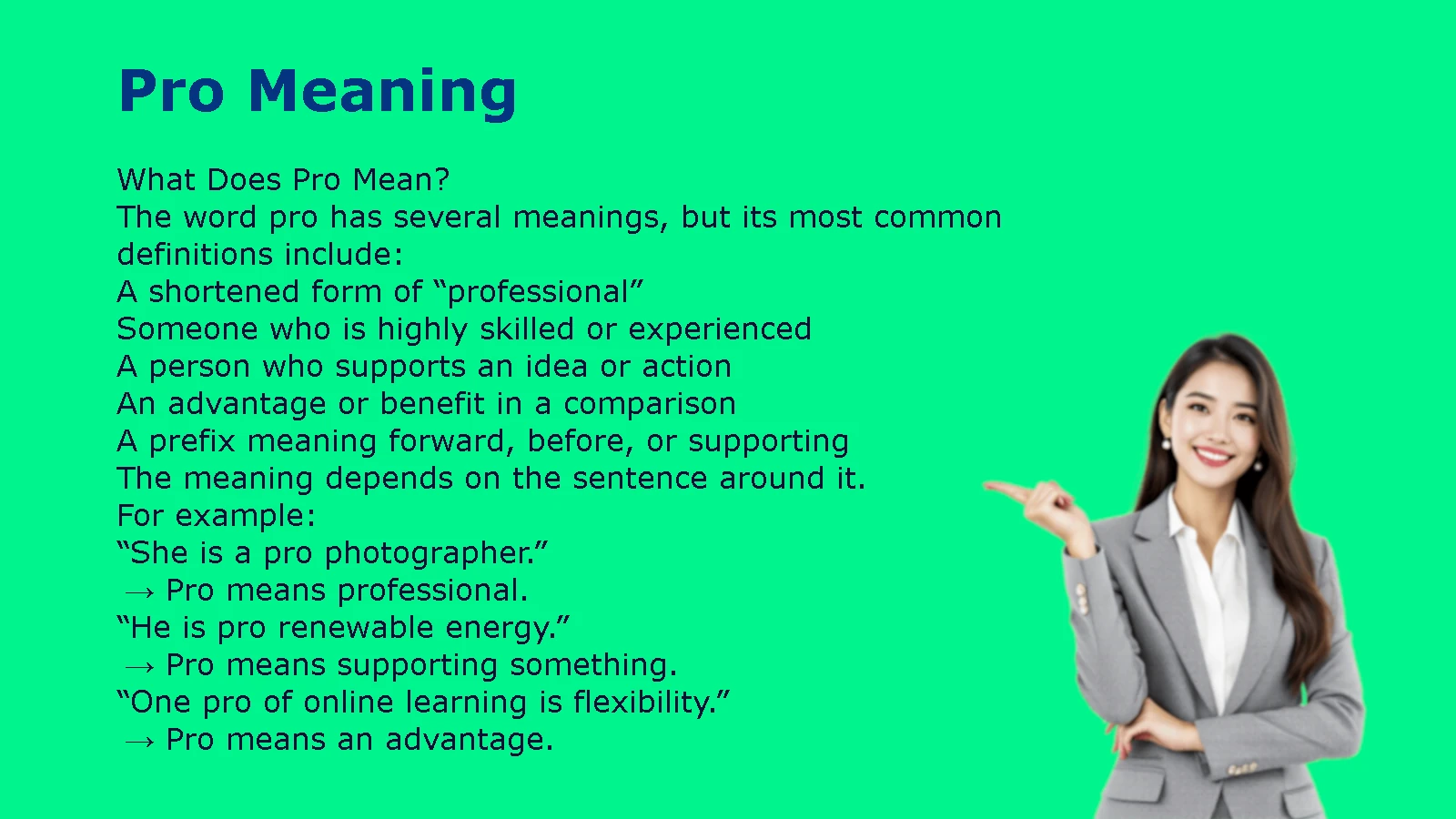
The word pro has several meanings, but its most common definitions include:
- A shortened form of “professional”
- Someone who is highly skilled or experienced
- A person who supports an idea or action
- An advantage or benefit in a comparison
- A prefix meaning forward, before, or supporting
The meaning depends on the sentence around it.
For example:
- “She is a pro photographer.”
→ Pro means professional. - “He is pro renewable energy.”
→ Pro means supporting something. - “One pro of online learning is flexibility.”
→ Pro means an advantage.
The same three letters can carry different meanings, which makes context extremely important.
Pro Meaning as Professional
The most common pro meaning is professional. In this sense, “pro” describes someone who does something as a career or someone who has reached a high level of skill.
A professional usually has:
- Training or experience
- Advanced knowledge
- A strong reputation in a field
- The ability to perform at a high standard
For example, a professional basketball player is not simply someone who enjoys basketball. They compete at an elite level and usually earn money through the sport.
Similarly, a “pro photographer” is someone who takes photographs professionally rather than only as a hobby.
Examples of Pro Meaning as Professional
Here are some common examples:
| Sentence | Meaning of Pro |
| She is a pro chef. | She works professionally as a chef. |
| He plays soccer as a pro. | He plays soccer professionally. |
| My friend is a pro designer. | My friend has advanced design skills. |
| This mechanic is a real pro. | This mechanic is highly skilled. |
The word “pro” often carries a feeling of respect. When someone calls another person a pro, they usually mean that person knows what they are doing.
For example:
“You fixed that computer in five minutes. You’re a pro!”
This does not always mean the person earns money from computer repair. It can simply mean they are extremely good at it.
What Does Pro Mean in Everyday Conversation?
In casual speech, people often use pro as a compliment. It describes someone who handles a task with confidence and skill.
You might hear phrases like:
- “She’s a pro at organizing events.”
- “He’s a pro when it comes to cooking.”
- “You handled that situation like a pro.”
In these examples, “pro” does not necessarily describe a job title. Instead, it highlights ability.
A teenager who edits amazing videos for fun might be called a “video editing pro.” A friend who always gives great travel advice might be called a “travel pro.”
The word creates an image of someone who has mastered a skill.
Pro vs Beginner
The difference between a pro and a beginner usually comes down to experience and knowledge.
| Pro | Beginner |
| Has advanced skills | Is learning basic skills |
| Understands complex situations | Needs more guidance |
| Makes decisions confidently | Often needs practice |
| Has more experience | Has limited experience |
However, becoming a pro does not happen overnight. Most professionals spend years learning, practicing, and improving.
A chef does not become a great chef after cooking one meal. A professional athlete does not reach the top without thousands of hours of training.
Pro Meaning in Business and Work
In professional settings, pro often connects to expertise and experience. Companies use the term to describe people who provide specialized skills.
A professional may work in fields such as:
- Healthcare
- Technology
- Finance
- Education
- Design
- Engineering
- Sports
- Entertainment
For example:
- A pro consultant helps businesses solve problems.
- A pro developer creates advanced software.
- A pro marketer understands branding and customer behavior.
Businesses value professionals because they bring knowledge that saves time, reduces mistakes, and improves results.
Why Businesses Use the Word “Pro”
The word “pro” creates an impression of:
- Reliability
- Experience
- Quality
- Expertise
A company might describe a service as “pro support” because it wants customers to expect a higher level of assistance.
However, the word can also be used as a marketing term. A product labeled “Pro” is not automatically the best option for everyone.
Pro Meaning in Sports
The pro meaning in sports refers to athletes who compete professionally.
A professional athlete usually:
- Trains regularly
- Competes at a high level
- Earns income through sports
- Follows strict performance standards
Examples include:
- Pro football players
- Pro basketball players
- Pro tennis players
- Pro golfers
- Pro esports players
The difference between an amateur and a professional athlete is not only skill. Professionals usually have formal competition experience and earn money from their performance.
Amateur vs Pro Athlete
| Amateur Athlete | Pro Athlete |
| Plays mainly for enjoyment | Competes as a career |
| May have limited training | Follows intense training schedules |
| Usually unpaid | Usually earns income |
| Competes at local levels | Competes at professional levels |
A person can be extremely talented but still not be considered a “pro” until they compete professionally.
For example, someone might be the best basketball player in their neighborhood. However, they become a pro only when they enter professional competition.
Pro Meaning in Technology and Products
One of the most common modern uses of pro appears in technology products.
Companies often add “Pro” to product names to show that a version has additional features, improved performance, or advanced tools.
Examples include:
- Pro laptops
- Pro smartphones
- Pro cameras
- Pro software plans
- Pro editing tools
A “Pro” version often includes:
- Faster performance
- More storage
- Extra features
- Better materials
- Advanced settings
However, “Pro” does not always mean the product is designed only for professionals.
Many companies create Pro versions for regular users who want premium features.
For example, a person who enjoys photography might buy a professional-level camera even if photography is only a hobby.
What Does Pro Mean in Product Names?
| Product Label | Usually Suggests |
| Standard | Basic features |
| Plus | Added features or larger size |
| Pro | Advanced features |
| Ultra | Premium or highest tier |
The exact meaning depends on the company. “Pro” is often a branding choice rather than a strict technical category.
Pro Meaning in “Pros and Cons”
Another major use of pro appears in the phrase “pros and cons.”
In this context, a pro means an advantage, benefit, or positive point.
A con means a disadvantage, problem, or negative point.
People use pros and cons when comparing choices or making decisions.
For example:
“Before buying a new car, consider the pros and cons.”
This means you should look at both the good and bad sides before deciding.
Examples of Pros and Cons
Choosing Remote Work
Pros:
- Flexible schedule
- No daily commute
- More control over your workspace
Cons:
- Less personal interaction
- Possible distractions at home
- Harder separation between work and personal life
Buying an Electric Vehicle
Pros:
- Lower fuel costs
- Reduced emissions
- Quiet driving experience
Cons:
- Charging availability can vary
- Higher upfront cost for some models
- Longer trips may require planning
Looking at both sides helps people make smarter decisions instead of focusing only on benefits.
How to Use Pros and Cons Correctly
Understanding the pro meaning in “pros and cons” helps you explain choices clearly. When you list pros, you highlight the benefits. When you list cons, you point out the drawbacks.
A simple way to remember it:
- Pro = Positive point
- Con = Negative point
For example, imagine you are deciding whether to start exercising at home.
Pros:
- You save travel time.
- You can choose your own schedule.
- You do not need an expensive gym membership.
Cons:
- You may have fewer workout machines.
- Staying motivated can be difficult.
- You might miss social interaction.
By comparing both sides, you get a more realistic picture.
A good decision rarely comes from looking at only one side. It comes from weighing the advantages and disadvantages together.
Pro vs Con: What Is the Difference?
The difference between pro and con depends on the situation.
In arguments, debates, and decision making:
- Pro means supporting something or showing a benefit.
- Con means opposing something or showing a disadvantage.
For example:
Topic: Should schools use tablets instead of textbooks?
Pro arguments:
- Tablets can store many books.
- Students can access updated information quickly.
- Digital tools can make lessons interactive.
Con arguments:
- Devices can be expensive.
- Students may become distracted.
- Technical problems can interrupt learning.
Both sides matter because they help people understand the full picture.
Pro and Con Comparison Table
| Feature | Pro | Con |
| Basic meaning | Advantage or support | Disadvantage or opposition |
| Used for | Benefits and positive opinions | Problems and negative opinions |
| Common phrase | Pros and cons | Pros and cons |
| Example | “A pro is the low cost.” | “A con is the limited features.” |
Pro Meaning in Arguments and Opinions
When people discuss ideas, pro means being in favor of something.
For example:
- Someone who supports environmental protection is pro conservation.
- Someone who supports animal rights is pro animal welfare.
- Someone who supports technology growth may be described as pro innovation.
In this use, “pro” shows agreement or support.
Examples of Pro in Opinions
| Phrase | Meaning |
| Pro education | Supports education |
| Pro business | Supports business growth |
| Pro technology | Supports technology development |
| Pro choice | Supports having choices |
The opposite is usually formed with words like:
- Anti
- Against
- Opposed to
For example:
- Pro technology = supports technology
- Anti technology = opposes technology
What Does Pro Mean as a Prefix?
The word pro also appears as a prefix at the beginning of many words.
A prefix is a group of letters added to the beginning of a word to change its meaning.
The prefix pro- can have different meanings, including:
- Forward
- Before
- Supporting
- In favor of
The meaning depends on the original word.
Common Words With the Prefix Pro-
| Word | Meaning |
| Progress | Moving forward or developing |
| Promote | To support or help something grow |
| Proactive | Taking action before a problem happens |
| Produce | To create or bring forward |
| Professional | Related to a profession |
Understanding Pro in Words Like Progress and Proactive
Although these words contain “pro,” they do not always connect to the everyday meaning of “professional.”
For example:
Progress
The word progress means moving forward or improving over time.
Example:
“She made great progress in learning Spanish.”
This does not mean she became a professional Spanish speaker. It means she improved.
Proactive
The word proactive means taking action before something happens.
A proactive person does not wait for problems to appear. They try to prevent them.
Example:
A homeowner who checks their roof before storm season is being proactive.
A student who studies before an exam instead of waiting until the night before is also being proactive.
Common Words and Phrases Using “Pro”
The word “pro” appears in many everyday expressions.
Understanding these phrases helps you recognize different meanings.
Professional
Meaning: A person who has training, experience, or works in a specific field.
Examples:
- Professional writer
- Professional athlete
- Professional photographer
Sentence:
“She hired a professional designer to create the company logo.”
Pro Level
Meaning: A very high level of ability or quality.
People use this phrase to describe advanced performance.
Examples:
- Pro level gaming skills
- Pro level photography
- Pro level cooking
Sentence:
“His editing skills are almost at a pro level.”
Pro Version
Meaning: A more advanced edition of a product.
Companies often create multiple versions of the same product.
Example:
- Basic version → Simple features
- Pro version → More advanced features
A professional photographer may need a Pro camera because they require better controls and image quality. A casual user may not need those extra features.
Pro Tip
Meaning: Helpful advice from someone experienced.
Examples:
“Pro tip: Save your work regularly so you do not lose important files.”
People often use this phrase online, especially in tutorials and guides.
Is Pro Formal or Informal?
The word pro is usually informal. It works well in conversations, social media posts, and casual writing.
However, in formal writing, the full word professional is often better.
Informal Examples:
- “He is a pro at fixing cars.”
- “She handled the meeting like a pro.”
- “This app has a pro version.”
Formal Examples:
- “He is an experienced automotive technician.”
- “She demonstrated excellent professional skills.”
- “This software includes an advanced version.”
Choosing the right word depends on your audience.
A business report might use “professional,” while a friendly blog post might use “pro.”
Common Mistakes When Using Pro
Even though “pro” seems simple, people sometimes misunderstand its meaning.
Mistake: Thinking Pro Always Means Professional
Many people assume “pro” always means a person with a career.
However, that is not always true.
Example:
“My brother is a pro at video games.”
This may mean he is extremely skilled, not necessarily that he plays professionally.
Mistake: Confusing Pro With “The Best”
A product labeled “Pro” does not automatically mean it is the best option.
Companies often use “Pro” to describe:
- More features
- Higher performance
- Premium options
However, the standard version may work better for some people.
For example:
A beginner photographer may not need an expensive Pro camera. A simpler model might meet their needs.
Mistake: Using Pro and Con Incorrectly
Remember:
- Pro = benefit, advantage, support
- Con = drawback, disadvantage, opposition
Incorrect:
“The con of this plan is that it saves money.”
Correct:
“The pro of this plan is that it saves money.”
Real Life Examples of Pro Meaning
The word “pro” appears everywhere in daily life.
Example: Career
“She became a pro chef after years of training.”
Meaning:
She became a professional chef.
Example: Skill
“You are a pro at solving puzzles.”
Meaning:
You are very skilled at solving puzzles.
Example: Opinion
“He is pro recycling.”
Meaning:
He supports recycling.
Example: Decision Making
“One pro of this job is flexible hours.”
Meaning:
Flexible hours are an advantage.
Example: Technology
“I bought the Pro version of the software.”
Meaning:
The software has advanced features.
Case Study: How the Meaning of Pro Changes With Context
Consider the sentence:
“This is a pro solution.”
Without context, the meaning is unclear.
It could mean:
In business:
A professional solution created by experts.
In technology:
An advanced software or product version.
In casual conversation:
A very effective solution.
The surrounding words reveal the intended meaning.
This is why context matters when understanding short words like “pro.”
Why Understanding Pro Meaning Matters
Learning the different meanings of “pro” helps you:
- Understand conversations more accurately.
- Write clearer sentences.
- Avoid misunderstandings.
- Recognize product descriptions.
- Communicate opinions effectively.
Many English words have multiple meanings. “Pro” is a perfect example of how a small word can carry different ideas.
A person who understands context can quickly identify what the speaker means.
Frequently Asked Questions About Pro Meaning
What Does Pro Stand For?
The most common pro meaning is a shortened form of professional. People use it to describe someone who has advanced skills, experience, or works in a specific field.
For example:
“She is a pro photographer.”
This means she is a professional photographer or someone highly skilled in photography.
However, pro does not always stand for professional. In other situations, it can mean:
- Supporting an idea
- An advantage in a comparison
- A product version with extra features
- A prefix meaning forward or before
The sentence around the word tells you the correct meaning.
Does Pro Mean Good?
The word pro can suggest something positive, but it does not always mean “good.”
For example:
“He is a pro at chess.”
This suggests he is highly skilled.
However:
“The Pro version of this software costs more.”
Here, “Pro” describes an advanced version, but whether it is good depends on what the user needs.
A professional product may have powerful features, but those features might not be useful for everyone.
For example, a beginner photographer may prefer a simple camera instead of a complex professional model.
What Is the Opposite of Pro?
The opposite of pro depends on the meaning.
When pro means professional:
The opposite is usually:
- Amateur
- Beginner
- Nonprofessional
Example:
- Pro athlete → Professional athlete
- Amateur athlete → Someone who competes mainly for fun
When pro means support:
The opposite is:
- Anti
- Against
- Opposed
Example:
- Pro recycling → Supports recycling
- Anti recycling → Opposes recycling
When pro means advantage:
The opposite is:
- Con
Example:
- Pro: Saves money
- Con: Takes more time
Is Pro Short for Professional?
Yes, in many situations, pro is short for professional.
People commonly shorten words in everyday speech. For example:
- Professional → Pro
- Advertisement → Ad
- Application → App
- Photograph → Photo
The shortened form sounds more casual and conversational.
Examples:
- “He became a pro golfer.”
- “She works as a pro designer.”
However, formal documents usually use the complete word professional.
What Does Pro Mean in an Argument?
In an argument or debate, pro means supporting a position or idea.
For example:
Topic:
Should students use artificial intelligence tools for learning?
A pro argument might be:
- AI tools can provide quick explanations.
- Students can learn at their own pace.
- Technology can support teachers.
A con argument might be:
- Students may rely on technology too much.
- Some information may require verification.
- It may reduce independent problem solving.
In this situation, “pro” does not mean professional. It means someone or something that supports a particular side.
Frequently Used Expressions With Pro
The word “pro” appears in many phrases people use every day.
Understanding these expressions makes conversations easier.
“Like a Pro”
The phrase “like a pro” means doing something with confidence, skill, or experience.
Examples:
- “She decorated the room like a pro.”
- “He handled the difficult customer like a pro.”
It does not necessarily mean the person earns money from that activity. It simply praises their ability.
“Become a Pro”
This phrase means becoming highly skilled or becoming a professional.
Examples:
- “He wants to become a pro gamer.”
- “She trained for years to become a pro athlete.”
The phrase often suggests dedication, practice, and improvement.
“Pro-Level”
The phrase pro-level describes something that meets a very high standard.
Examples:
- Pro-level equipment
- Pro-level skills
- Pro-level performance
A beginner may use pro-level tools, but they may not use all of the advanced features.
“Pro Tip”
A pro tip is a helpful suggestion based on experience.
Examples:
“Pro tip: Always back up your important files.”
The phrase is common in:
- Tutorials
- Blogs
- Online videos
- Training materials
A good pro tip usually saves time, prevents mistakes, or improves results.
How to Remember the Different Pro Meanings
Because “pro” has several definitions, remembering the context is the easiest approach.
Here is a simple guide:
| Situation | Pro Meaning | Example |
| Person’s skill | Professional or expert | “She is a pro writer.” |
| Opinion or debate | Supporting something | “He is pro education.” |
| Decision making | Advantage | “A pro is the low price.” |
| Product name | Advanced version | “I bought the Pro model.” |
| Word prefix | Forward or before | “Progress means moving forward.” |
A single word can have multiple meanings. The surrounding words provide the clues.
How Businesses Use the Word Pro
Companies often use “Pro” because it creates a feeling of quality and expertise.
A product with “Pro” in its name often suggests:
- Better performance
- More features
- Higher quality
- Advanced users
For example:
A basic editing program might offer simple tools. A Pro version may include:
- More editing options
- Higher export quality
- Additional customization
However, companies also use “Pro” as a marketing strategy. The label does not always guarantee that the product fits your needs.
Before choosing a Pro product, consider:
- Your budget
- Your experience level
- The features you actually need
The best product is not always the most advanced one. It is the one that solves your problem.
Pro Meaning in Different Industries
The word “pro” appears across many industries.
Technology
Examples:
- Pro software plans
- Pro laptops
- Pro editing tools
Meaning:
Advanced features or premium versions.
Sports
Examples:
- Pro football player
- Pro athlete
Meaning:
Someone who competes professionally.
Photography
Examples:
- Pro photographer
- Pro camera equipment
Meaning:
Professional skill or professional quality tools.
Gaming
Examples:
- Pro gamer
- Pro gaming team
Meaning:
A player who competes at a high level.
Business
Examples:
- Pro consultant
- Pro service package
Meaning:
Professional expertise or advanced service.
The Importance of Context When Understanding Pro
Words do not exist alone. Their meaning comes from how people use them.
Consider this sentence:
“I bought the Pro.”
The meaning is incomplete.
What does “Pro” refer to?
It could mean:
- A professional product model
- A software subscription
- A device with advanced features
Now consider:
“I bought the Pro camera because I need better image quality.”
The context explains that “Pro” refers to an advanced camera model.
Good communication depends on understanding these small details.
Final Thoughts on Pro Meaning
The word “pro” may look simple, but it has several important meanings.
Most often, pro means professional, describing someone with advanced skills or experience. In other situations, it can show support for an idea, represent an advantage in a decision, describe an upgraded product version, or appear as a prefix in words related to movement and progress.
The easiest way to understand pro meaning is to look at the context.
Remember:
- Pro = professional when talking about skilled people.
- Pro = support when discussing opinions.
- Pro = advantage when comparing choices.
- Pro = advanced version when describing products.
- Pro- = forward or before when used as a prefix.
Once you understand these meanings, you can use the word “pro” more confidently in conversations, writing, and everyday situations.