
What Is the Criticize Meaning?
Criticize means to express disapproval of someone or something by pointing out faults, mistakes, or weaknesses. It can be constructive when intended to help improve something or negative when it is unfair or overly harsh.
Examples:
- The teacher did not criticize the student without offering advice.
- It is important to criticize ideas respectfully during a discussion.
The confusion often comes from how the word is used in different contexts. You might be looking for the meaning of criticize, how to pronounce criticize, criticize definition, or how to use criticize in a sentence. And here’s the kicker: understanding the difference between constructive and harsh criticism can help you communicate more effectively in both personal and professional settings.
In this guide, you’ll learn the Criticize Meaning, explore the definition of criticize, discover its pronunciation, synonyms, examples, and word origin, and see how to use it correctly in everyday English. You’ll also learn the difference between criticize, criticise, and related words so you can choose the right form with confidence.
What Does Criticize Mean?
The word criticize means to express disapproval of someone or something by identifying faults, mistakes, or weaknesses.
According to common dictionary usage, criticize can mean:
- To point out what is wrong with something.
- To judge the quality or value of something.
- To express disagreement or disapproval.
- To give feedback about areas that need improvement.
The word is usually connected with evaluation. When someone criticizes something, they examine it and share their opinion about what could be better.
For example:
- “The reviewer criticized the movie because the story lacked depth.”
- “The manager criticized the report because it contained several errors.”
- “The scientist criticized the study’s methods.”
In each example, the person identifies a problem or weakness.
However, criticize does not always have a negative intention. A person can criticize something to help improve it.
For example:
“A good teacher criticizes mistakes because they want students to grow.”
The goal is not to discourage someone. The goal is improvement.
Criticize Meaning in Simple Words
In simple terms, criticize means to say what you think is wrong or could be improved about something.
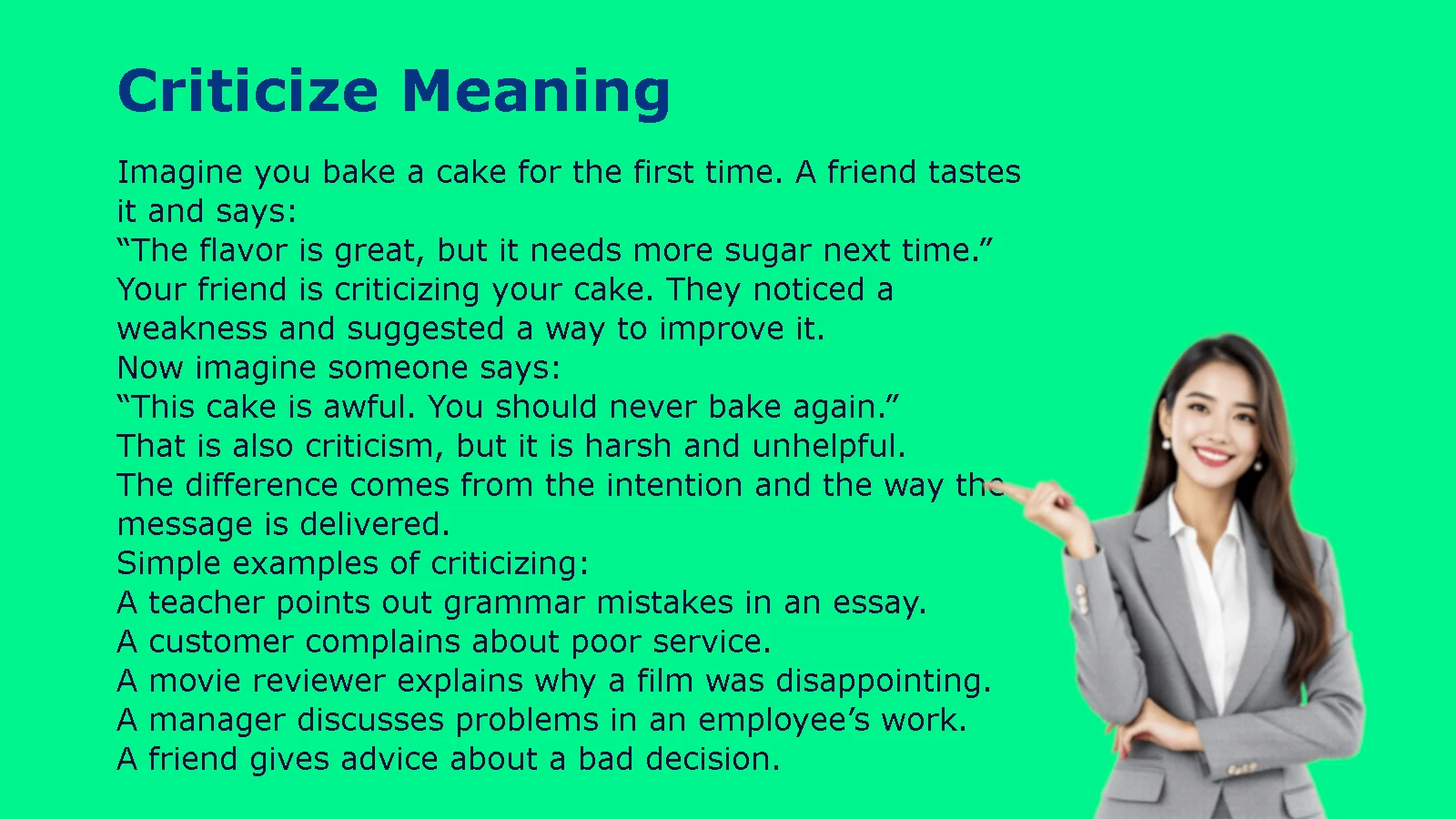
Imagine you bake a cake for the first time. A friend tastes it and says:
“The flavor is great, but it needs more sugar next time.”
Your friend is criticizing your cake. They noticed a weakness and suggested a way to improve it.
Now imagine someone says:
“This cake is awful. You should never bake again.”
That is also criticism, but it is harsh and unhelpful.
The difference comes from the intention and the way the message is delivered.
Simple examples of criticizing:
- A teacher points out grammar mistakes in an essay.
- A customer complains about poor service.
- A movie reviewer explains why a film was disappointing.
- A manager discusses problems in an employee’s work.
- A friend gives advice about a bad decision.
Criticism is a normal part of communication. People criticize ideas, products, actions, decisions, and performances every day.
Criticize Definition and Word Class
as a Verb
Criticize is mainly used as a verb. A verb describes an action, and criticizing is the action of expressing an opinion about problems or weaknesses.
Common sentence structures with criticize:
Criticize + Person or Thing
This structure shows who or what receives criticism.
Examples:
- “Many customers criticized the new update.”
- “The audience criticized the singer’s performance.”
- “Experts criticized the government policy.”
Criticize Someone for Something
This structure explains the reason behind the criticism.
Examples:
- “The teacher criticized him for not completing his homework.”
- “She criticized her colleague for missing the deadline.”
- “The coach criticized the team for poor communication.”
Criticize Something as Something
This structure describes how someone views a situation.
Examples:
- “Analysts criticized the plan as unrealistic.”
- “Critics criticized the movie as boring.”
- “Experts criticized the proposal as expensive.”
Pronunciation of Criticize
The pronunciation of criticize is:
CRIT-i-cize
Phonetic spelling:
/ˈkrɪtɪsaɪz/
The stress falls on the first syllable:
CRIT-i-cize
Many learners confuse criticize with criticism because they look similar but have different endings.
| Word | Part of Speech | Pronunciation |
| Criticize | Verb | CRIT-i-cize |
| Criticism | Noun | CRIT-i-sizm |
| Critic | Noun | CRIT-ik |
Examples:
- “She criticized the article.” (verb)
- “His criticism helped me improve.” (noun)
- “The critic reviewed the movie.” (noun)
Origin and History of the Word Criticize
The word criticize comes from the older word critic, which is connected to the idea of judging or evaluating.
The root comes from the Greek word kritikos, meaning “able to judge.” Over time, the meaning developed from simply evaluating something to pointing out problems or faults.
Originally, criticism was not always negative. A critic was someone who carefully examined art, literature, or ideas.
For example:
- A literary critic studied books and explained their strengths and weaknesses.
- A theater critic evaluated performances.
- An art critic analyzed paintings.
Today, the word has a broader meaning. People criticize almost anything, including:
- Decisions
- Products
- Behavior
- Policies
- Arguments
- Performances
Examples of Criticize in Sentences
Seeing the word in different situations makes the meaning easier to understand.
Everyday Examples of Criticize
- “My sister criticized my driving because I was too nervous.”
- “He criticized the restaurant because the service was slow.”
- “They criticized my choice of clothing.”
These examples show personal opinions about everyday situations.
Professional Examples of Criticize
In professional settings, criticism often focuses on improvement.
Examples:
- “The supervisor criticized the report because it lacked important data.”
- “The client criticized the design for being difficult to use.”
- “The team criticized the marketing strategy during the meeting.”
Workplace criticism can help organizations find problems and create better solutions.
A useful workplace criticism usually includes:
- The problem.
- Why it matters.
- A possible solution.
For example:
Instead of:
“This presentation is bad.”
A better approach:
“The presentation has strong ideas, but adding more statistics would make the argument more convincing.”
Academic Examples of Criticize
Students and researchers often use criticism as part of learning.
Examples:
- “The student criticized the author’s argument by showing missing evidence.”
- “Researchers criticized the study because the sample size was too small.”
- “The professor criticized the essay’s weak organization.”
Academic criticism does not mean attacking someone. It means examining information carefully.
Difference Between Criticize and Critique
Many people confuse criticize and critique because both involve evaluation.
Although they are related, they often carry different meanings.
| Word | Meaning | Typical Tone |
| Criticize | Point out faults or express disapproval | Often negative |
| Critique | Analyze and evaluate carefully | Usually balanced |
Examples:
Criticize:
“The reviewer criticized the movie for its weak ending.”
This focuses mainly on the problem.
Critique:
“The reviewer critiqued the movie by discussing its acting, writing, and themes.”
This suggests a deeper analysis.
A critique can include both positive and negative points. Criticism often focuses more strongly on what is wrong.
Difference Between Criticize and Judge
Although criticize and judge can seem similar, they are not exactly the same.
To criticize means to point out problems, weaknesses, or mistakes in a specific thing, action, or idea.
To judge means to form an opinion or make a decision about someone or something.
The key difference is focus.
- Criticize usually examines a particular issue.
- Judge often involves making a broader opinion or conclusion.
Compare these examples:
Criticize:
“The manager criticized the employee’s report because it contained incorrect information.”
The focus is on the report.
Judge:
“The manager judged the employee as careless.”
The focus shifts from one mistake to the person.
A helpful way to remember the difference:
| Word | Main Focus | Example |
| Criticize | A problem, action, idea, or result | “She criticized the plan.” |
| Judge | A person, situation, or overall opinion | “They judged him unfairly.” |
Criticism can lead to improvement when it focuses on actions. Judgment often becomes harmful when it labels people instead of addressing specific behaviors.
Constructive vs Destructive Criticism
Not all criticism has the same purpose. Some criticism helps people improve, while other criticism only creates frustration.
Understanding the difference helps you communicate better.
What Is Constructive Criticism?
Constructive criticism is feedback that identifies a problem while offering guidance for improvement.
It does not simply point out what is wrong. It explains how something can become better.
Characteristics of constructive criticism:
- It focuses on specific actions.
- It uses respectful language.
- It provides useful suggestions.
- It recognizes strengths as well as weaknesses.
- It aims to create improvement.
Example:
Instead of saying:
“Your writing is confusing.”
Constructive criticism would say:
“Your main idea is strong, but adding clearer examples would make your writing easier to follow.”
The second statement gives the person a path forward.
Why Constructive Criticism Matters
Constructive criticism plays an important role in:
- Education
- Business
- Sports
- Relationships
- Personal growth
A student improves because a teacher explains mistakes. An athlete improves because a coach identifies weaknesses. An employee grows because a manager provides clear feedback.
Without useful criticism, people may repeat the same mistakes.
What Is Destructive Criticism?
Destructive criticism focuses on negativity without offering help.
It often attacks a person rather than addressing a specific issue.
Examples:
- “You’re terrible at this.”
- “You never do anything right.”
- “This is completely useless.”
These statements rarely encourage improvement because they create defensiveness instead of motivation.
Differences Between Constructive and Destructive Criticism
| Constructive Criticism | Destructive Criticism |
| Focuses on improvement | Focuses on blame |
| Gives specific examples | Uses general insults |
| Offers solutions | Creates negativity |
| Respects the person | Attacks the person |
| Encourages growth | Discourages effort |
A simple rule:
Good criticism opens a door. Bad criticism builds a wall.
Synonyms for Criticize
Several words have similar meanings to criticize, but each one has a slightly different use.
Understanding these differences helps you choose the right word.
| Synonym | Meaning | Example |
| Condemn | Strongly express disapproval | “People condemned the unfair decision.” |
| Blame | Say someone is responsible for a problem | “They blamed the company for the mistake.” |
| Fault | Point out an error or weakness | “The reviewer faulted the product design.” |
| Disapprove | Show that you do not support something | “Her parents disapproved of the decision.” |
| Evaluate | Judge quality or value carefully | “Experts evaluated the proposal.” |
| Review | Examine and give an opinion | “Customers reviewed the service.” |
| Question | Express doubt about something | “Scientists questioned the results.” |
| Object | Show disagreement | “Several members objected to the idea.” |
Synonyms of Criticize Based on Situation
The best synonym depends on the situation.
When You Mean “Find Fault”
Use:
- Fault
- Point out flaws
- Find weaknesses
- Identify problems
Example:
“The editor pointed out flaws in the article.”
When You Mean “Strongly Disagree”
Use:
- Condemn
- Oppose
- Reject
- Attack
Example:
“Many organizations condemned the decision.”
When You Mean “Analyze Carefully”
Use:
- Evaluate
- Examine
- Review
- Assess
- Critique
Example:
“The committee evaluated the proposal before making a decision.”
Antonyms of Criticize
Antonyms are words with opposite meanings.
The opposite of criticize is usually to express approval, support, or appreciation.
| Antonym | Meaning | Example |
| Praise | Express approval | “The teacher praised her effort.” |
| Compliment | Say something positive | “He complimented her presentation.” |
| Approve | Accept or support something | “The board approved the plan.” |
| Encourage | Give confidence or support | “The coach encouraged the players.” |
| Applaud | Show strong approval | “The audience applauded the performance.” |
| Support | Help or agree with someone | “Friends supported his decision.” |
Example comparison:
Criticism:
“The project lacks proper planning.”
Praise:
“The project shows excellent creativity.”
Both statements evaluate the project, but they express opposite opinions.
Common Phrases With Criticize
The word criticize appears in many common expressions.
Understanding these phrases helps you use the word naturally.
Criticize Someone for Something
Meaning: To express disapproval because of a specific action.
Examples:
- “The teacher criticized him for ignoring instructions.”
- “She criticized her friend for being dishonest.”
Criticize Someone’s Actions
Meaning: To disagree with what someone has done.
Examples:
- “Many people criticized the politician’s actions.”
- “The coach criticized the player’s actions during the game.”
Criticize a Decision
Meaning: To express disagreement with a choice.
Examples:
- “Experts criticized the company’s decision to increase prices.”
- “The public criticized the decision.”
Publicly Criticize
Meaning: To criticize openly where other people can see or hear it.
Examples:
- “The actor publicly criticized the unfair review.”
- “The organization was publicly criticized for its policies.”
Strongly Criticize
Meaning: To express serious disagreement.
Examples:
- “The report strongly criticized the outdated system.”
- “Leaders strongly criticized the proposal.”
How to Use Criticize in Different Contexts
The meaning of criticize can change slightly depending on where it is used.
Criticize in the Workplace
In professional environments, criticism is often connected with performance and improvement.
Managers regularly criticize:
- Reports
- Projects
- Strategies
- Communication
- Work habits
However, effective workplace criticism should focus on solutions.
Poor workplace feedback:
“This work is unacceptable.”
Better workplace feedback:
“The report includes useful information, but it needs more supporting data before we share it with clients.”
The second example gives direction.
Benefits of workplace criticism:
- Improves performance.
- Prevents repeated mistakes.
- Encourages better decision-making.
- Helps teams communicate clearly.
Criticize in Education
Teachers criticize students’ work to help them learn.
A teacher may criticize:
- Grammar mistakes.
- Weak arguments.
- Missing information.
- Poor organization.
- Incorrect answers.
Good academic criticism teaches students how to think.
For example:
A teacher might say:
“Your argument is interesting, but you need stronger evidence to support your point.”
This criticism helps the student understand what to improve.
Criticize in Media and Reviews
Criticism plays a major role in entertainment and journalism.
Reviewers criticize:
- Movies
- Books
- Music
- Products
- Restaurants
A review may discuss both strengths and weaknesses.
For example:
A movie critic might write:
“The acting is excellent, but the storyline feels predictable.”
This type of criticism gives readers a balanced view.
Real Life Examples of Criticism
Example: A Student’s Essay
Situation:
A student writes an essay with good ideas but weak organization.
Unhelpful criticism:
“This essay makes no sense.”
Helpful criticism:
“Your ideas are strong, but arranging them into clearer sections would improve the flow.”
Result:
The student knows exactly what to change.
Example: Workplace Presentation
Situation:
An employee gives a presentation with limited examples.
Unhelpful criticism:
“Your presentation was boring.”
Helpful criticism:
“Your main points are clear. Adding customer examples would make the presentation more engaging.”
Result:
The employee can improve future presentations.
Common Mistakes When Using Criticize
Confusing Criticize With Hate
Many people think criticism always means dislike.
That is not true.
Someone can criticize something while still appreciating it.
Example:
“I love this book, but I criticize the ending because it feels rushed.”
The person likes the book but identifies a weakness.
Using Criticize When You Mean Complaining
Criticism involves evaluation.
Complaining usually expresses frustration.
Compare:
Complaint:
“This restaurant is terrible.”
Criticism:
“The food quality was good, but the service was too slow.”
The second statement explains the issue.
Attacking People Instead of Problems
Effective criticism focuses on behavior or results.
Less helpful:
“You are careless.”
Better:
“You missed three deadlines this month, so we need a better tracking system.”
The second example addresses a specific problem.
Common Questions About Criticize Meaning
Understanding the meaning of criticize becomes easier when you see how people commonly ask about and use the word.
Below are answers to the most frequent questions about criticize meaning.
What Does Criticize Mean?
Criticize means to express disapproval of someone or something by identifying faults, mistakes, or areas that need improvement.
The word can describe both negative comments and helpful feedback.
For example:
- “The customer criticized the product because it stopped working.”
- “The coach criticized the player’s technique to help improve performance.”
The first example focuses on a complaint. The second focuses on improvement.
Is Criticize Always Negative?
No, criticize is not always negative.
The meaning depends on the intention, tone, and situation.
A person can criticize something because they want it to improve.
For example:
“The editor criticized the article’s structure and suggested a better organization.”
This criticism helps the writer create a stronger article.
However, criticism can become negative when it only attacks or insults.
Example:
“Your work is terrible.”
This does not explain the problem or offer a solution.
A useful way to understand criticism:
Negative criticism points out problems. Constructive criticism points out problems and helps solve them.
What Is Another Word for Criticize?
Many words can replace criticize, depending on the meaning you want.
Common alternatives include:
- Evaluate
- Critique
- Review
- Condemn
- Blame
- Fault
- Question
- Disapprove
- Object to
- Find fault with
Examples:
Original:
“Experts criticized the new policy.”
Possible alternatives:
- “Experts questioned the new policy.”
- “Experts evaluated the new policy.”
- “Experts condemned the new policy.”
Each word creates a slightly different tone.
How Do You Use Criticize in a Sentence?
The verb criticize usually appears with an object.
Basic structure:
Subject + criticize + object
Examples:
- “The reviewer criticized the movie.”
- “The teacher criticized my essay.”
- “The public criticized the decision.”
You can also add a reason:
Subject + criticize + someone/something + for + reason
Examples:
- “The manager criticized him for being late.”
- “The customer criticized the company for poor service.”
- “The coach criticized the team for weak communication.”
What Is the Difference Between Criticize and Criticism?
The difference is grammar.
Criticize is a verb.
It describes the action of giving criticism.
Example:
“She criticized my presentation.”
Criticism is a noun.
It describes the comment or opinion itself.
Example:
“Her criticism helped me improve.”
Comparison Table
| Word | Type | Example |
| Criticize | Verb | “They criticized the plan.” |
| Criticism | Noun | “Their criticism was useful.” |
| Critic | Noun | “The critic reviewed the movie.” |
What Is the Difference Between Criticize and Critique?
Both words involve evaluation, but they often have different tones.
Criticize
Usually focuses on problems or faults.
Example:
“The customer criticized the product because it was difficult to use.”
Critique
Usually suggests a detailed examination.
Example:
“The professor critiqued the research paper.”
A critique may include:
- Strengths
- Weaknesses
- Evidence
- Suggestions
A criticism may focus mainly on what is wrong.
What Is the Difference Between Criticize and Complain?
People often confuse these words because both can express dissatisfaction.
However, they have different purposes.
| Criticize | Complain |
| Evaluates a problem | Expresses dissatisfaction |
| Often explains weaknesses | Often focuses on frustration |
| Can include solutions | May not include solutions |
Examples:
Complaint:
“This service is awful.”
Criticism:
“The service was slow because the staff needed better training.”
The criticism gives more information.
Grammar Rules for Using Criticize Correctly
Using criticize correctly requires understanding a few common patterns.
Criticize + Object
Use this when saying what someone dislikes or evaluates.
Examples:
- “She criticized the design.”
- “They criticized the decision.”
- “The audience criticized the performance.”
Criticize Someone for Something
Use this when explaining the reason behind criticism.
Examples:
- “The teacher criticized the student for cheating.”
- “The manager criticized the employee for missing deadlines.”
Be Criticized For
This passive form shows that someone receives criticism.
Examples:
- “The company was criticized for misleading advertisements.”
- “The politician was criticized for the decision.”
Although passive voice has a place in English, active sentences often sound clearer.
Instead of:
“The plan was criticized by experts.”
You can write:
“Experts criticized the plan.”
The second sentence feels stronger and more direct.
Criticize in Different Tenses
The word changes depending on the tense.
| Tense | Example |
| Present | “People criticize unfair rules.” |
| Past | “People criticized the decision yesterday.” |
| Future | “People will criticize the plan if it fails.” |
| Present Perfect | “People have criticized the company before.” |
Related Words From Criticize
Learning related words helps expand your vocabulary.
| Word | Meaning |
| Critic | A person who evaluates something |
| Criticism | An opinion that points out problems |
| Critical | Showing careful judgment or importance |
| Critically | In a careful and analytical way |
| Critique | A detailed evaluation |
Examples:
- “The critic reviewed the film.”
- “Her criticism was helpful.”
- “Critical thinking improves decision-making.”
- “Students should analyze information critically.”
How to Give Better Criticism
Giving criticism requires skill. The goal should be improvement, not embarrassment.
Here are practical steps for offering better feedback.
Focus on the Situation, Not the Person
Avoid personal attacks.
Instead of:
“You are careless.”
Say:
“The report contains several errors that need correction.”
The second version addresses the issue without attacking someone.
Be Specific
General criticism does not help.
Weak:
“Your work needs improvement.”
Better:
“Your introduction is interesting, but adding more examples would make your argument stronger.”
Specific feedback gives people something they can act on.
Offer a Solution
Good criticism includes a possible next step.
Example:
“The presentation needs more visuals. Adding charts could make the information easier to understand.”
The person now knows what to do.
Balance Positive and Negative Feedback
People respond better when they understand both strengths and weaknesses.
Example:
“Your article has strong research and clear explanations. Adding more examples would make it even more useful for readers.”
This approach encourages growth.
Why Criticism Is Important
Although criticism can feel uncomfortable, it plays an important role in improvement.
Without criticism:
- Businesses would repeat mistakes.
- Students would struggle to improve.
- Products would not become better.
- Ideas would not develop.
Many successful people use criticism as information rather than as an insult.
A useful mindset is:
“Criticism is not always a rejection. Sometimes it is a roadmap for improvement.”
Benefits of Healthy Criticism
| Benefit | How It Helps |
| Encourages growth | Shows areas for improvement |
| Improves decisions | Reveals weaknesses in ideas |
| Builds awareness | Helps people recognize mistakes |
| Creates better results | Leads to stronger work |
| Improves communication | Encourages honest conversations |
Final Thoughts on Criticize Meaning
The criticize meaning goes beyond simply saying something negative. The word describes the act of identifying problems, weaknesses, or areas that need improvement.
While criticism can sometimes feel uncomfortable, it plays an important role in learning and growth. A teacher criticizes a student’s mistakes to help them improve. A coach criticizes a player’s technique to build better skills. A reviewer criticizes a product to help consumers make informed choices.
The key difference comes down to purpose.
Helpful criticism focuses on improvement. Harmful criticism focuses on negativity.
When you use the word criticize, remember that good communication is not about finding faults just to point them out. It is about understanding problems, sharing thoughtful feedback, and creating better outcomes.
Whether you are writing, speaking, teaching, or working with others, knowing the true meaning of criticize helps you express ideas with more accuracy and confidence.