
Have you ever felt completely confused by something and struggled to understand what was going on? That feeling is often described as perplexed. The Perplexed Meaning refers to being confused, puzzled, or unsure about something, especially when you cannot figure out what it means or why it happened.
Perplexed is an adjective used to describe someone who feels confused or puzzled. It often suggests that a person is unsure how to understand or deal with a situation.
Examples:
- She looked perplexed by the strange question.
- I was perplexed by his sudden change in behavior.
The confusion is understandable. People often search for what does perplexed mean, perplexed meaning in a sentence, perplexed meaning in English, or perplexed meaning in simple words because the word can sound more formal than everyday terms like “confused” or “puzzled.” And here’s the interesting part: being perplexed usually means you’re not just confused, but genuinely struggling to make sense of something.
In this guide, you’ll learn the complete Perplexed Meaning, its definition, pronunciation, synonyms, correct usage, and examples in sentences. You’ll also discover the difference between perplexed, confused, and puzzled, along with simple ways to use perplexed correctly in everyday English.
What Does Perplexed Mean?
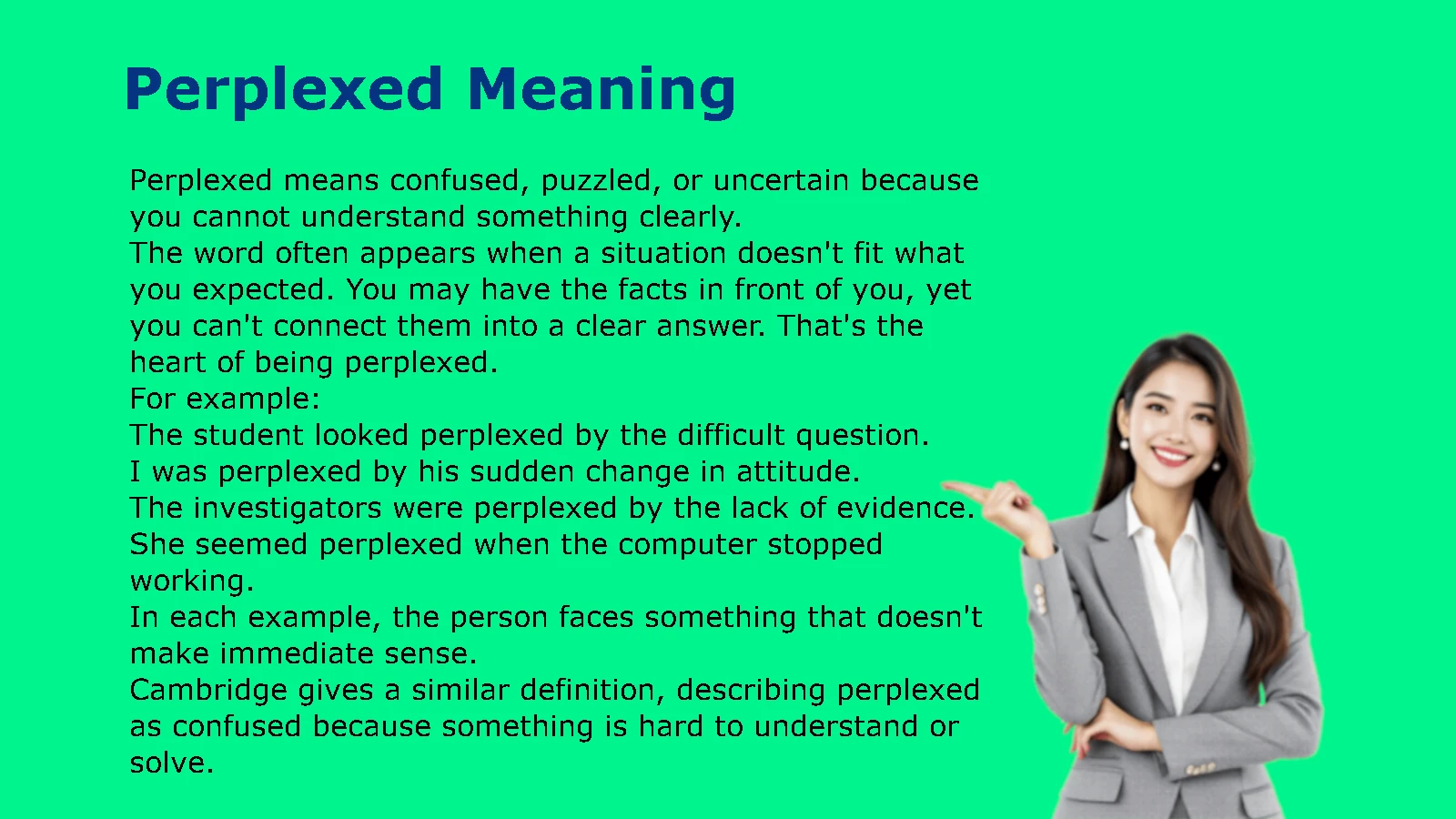
Perplexed means confused, puzzled, or uncertain because you cannot understand something clearly.
The word often appears when a situation doesn’t fit what you expected. You may have the facts in front of you, yet you can’t connect them into a clear answer. That’s the heart of being perplexed.
For example:
- The student looked perplexed by the difficult question.
- I was perplexed by his sudden change in attitude.
- The investigators were perplexed by the lack of evidence.
- She seemed perplexed when the computer stopped working.
In each example, the person faces something that doesn’t make immediate sense.
Cambridge gives a similar definition, describing perplexed as confused because something is hard to understand or solve.
Perplexed Meaning in Simple Words
A very simple way to remember the word is:
Perplexed = “I don’t understand this, and I can’t figure out why.”
Imagine opening a math problem and finding an answer that contradicts everything you learned. You’re not merely missing one fact. You’re trying to work out how the pieces fit together, but they won’t click.
That’s a perplexed state.
The word can describe confusion caused by:
- A difficult question
- An unexpected result
- A strange decision
- Contradictory information
- An unexplained event
- Complicated instructions
- Someone’s unusual behavior
- A problem that seems to have no obvious solution
Perplexed Definition: What Dictionaries Say
Several major dictionaries agree on the central idea, although they emphasize slightly different shades of meaning.
| Source | Core meaning |
| Oxford | Confused and anxious because you cannot understand something |
| Cambridge | Confused because something is difficult to understand or solve |
| Dictionary.com | Bewildered or puzzled |
| Merriam Webster | Closely associated with being puzzled or uncertain |
Oxford also gives examples such as “a perplexed expression” and “She looked perplexed.”
Dictionary.com lists perplexed as both an adjective and the past-tense or past-participle form of perplex. It also traces the word back to Middle English and Latin.
The definitions point to one central idea: something has created confusion that you haven’t been able to resolve.
Perplexed Pronunciation
In American English, perplexed is pronounced approximately:
per-PLEKST
The phonetic pronunciation is:
/pərˈplɛkst/
The stress falls on the second syllable:
per-PLEKST
Oxford and Cambridge both give the American pronunciation with the main stress on plekst.
One useful pronunciation detail is the ending. The -ed does not form a separate syllable here. You don’t say per-PLEK-sed. Instead, the ending sounds like /t/:
per-PLEKST
How to Remember the Pronunciation
Break the word into two parts:
- per
- plekst
Then put the emphasis on plekst.
per + PLEKST = perplexed
Is Perplexed an Adjective?
Yes. Perplexed is commonly used as an adjective to describe someone who feels confused or puzzled.
For example:
- The perplexed student reread the question.
- He gave me a perplexed look.
- They appeared perplexed by the announcement.
The word also comes from the verb perplex. Oxford lists perplexed as the past-tense and past-participle form of perplex, while its dictionary entry also treats perplexed as an adjective.
This distinction matters because the same word can appear in different grammatical roles depending on the sentence.
Compare:
The strange result perplexed the scientists.
Here, perplexed is the past tense of the verb perplex.
The scientists were perplexed by the strange result.
Here, perplexed describes the scientists’ state.
Both sentences communicate essentially the same event from different grammatical angles.
Perplexed Examples in Sentences
Seeing the word in context makes its meaning much easier to understand.
Everyday Examples
- I was perplexed by the message because it didn’t explain what had happened.
- She looked perplexed when everyone suddenly left the room.
- He seemed perplexed by the unusual question.
- The child was perplexed by the complicated instructions.
- We were perplexed by the sudden change in plans.
School and Learning Examples
- The student looked perplexed after reading the difficult equation.
- I was perplexed by the teacher’s explanation because it contradicted the textbook.
- Several students seemed perplexed by the final question on the exam.
- The confusing diagram left the class perplexed.
Work and Business Examples
- The manager was perplexed by the sudden drop in sales.
- The team looked perplexed when the report produced unexpected results.
- She was perplexed by the client’s decision to reject the proposal.
- The unexpected figures left the analysts perplexed.
More Formal Examples
- Researchers remain perplexed by the unusual findings.
- The investigators were perplexed by the absence of a clear motive.
- The committee appeared perplexed by the conflicting evidence.
- Experts were perplexed by the results because earlier tests had suggested a different outcome.
These examples share a common pattern: the person encounters something that resists easy explanation.
Common Ways to Use Perplexed
Certain sentence patterns appear naturally with perplexed.
Perplexed by
Use perplexed by when you want to identify the thing that caused the confusion.
Examples:
- She was perplexed by his answer.
- The researchers were perplexed by the results.
- I was perplexed by the sudden change.
This is one of the most common constructions.
Perplexed about
Use perplexed about when the confusion concerns a subject, decision, or situation.
Examples:
- He was perplexed about what to do next.
- She felt perplexed about the new policy.
- They were perplexed about why the meeting had been canceled.
Look Perplexed
You can use perplexed to describe someone’s visible expression.
Examples:
- She looked perplexed.
- He gave me a perplexed look.
- The students looked completely perplexed.
Oxford specifically includes “a perplexed expression” as an example of the word’s use.
Perplexed vs. Confused
Perplexed and confused overlap heavily, but they’re not always interchangeable in tone.
Confused is the broader and more common word. You can use it for almost any situation involving a lack of understanding.
Perplexed is more specific. It often suggests that something is puzzling, unexpected, or difficult to explain.
| Word | Main idea | Example |
| Confused | Unable to understand clearly | I was confused by the instructions. |
| Perplexed | Confused by something puzzling or difficult to explain | I was perplexed by his strange response. |
Consider these two sentences:
I was confused by the directions.
The directions weren’t clear.
I was perplexed by the directions.
The directions were difficult to make sense of, perhaps because they contained something unexpected or contradictory.
The difference is subtle. In ordinary conversation, confused will usually sound more natural.
Perplexed works especially well when you want to emphasize puzzlement.
Perplexed vs. Puzzled
Puzzled is one of the closest synonyms for perplexed.
Cambridge defines puzzled as being confused because you don’t understand something.
The two words often work in exactly the same sentence:
- She looked puzzled by the question.
- She looked perplexed by the question.
Both sentences are correct.
Still, puzzled often sounds more ordinary and conversational. Perplexed can sound slightly more formal or more emphatic.
| Perplexed | Puzzled |
| Often sounds somewhat formal | Usually sounds more everyday |
| Emphasizes confusion or uncertainty | Emphasizes difficulty understanding |
| Works well in formal descriptions | Very common in everyday speech |
| Can suggest a more complicated problem | Often suggests a question or mystery |
Neither word automatically means extremely confused. Context determines the intensity.
Perplexed vs. Baffled
Baffled means unable to understand or solve something. It can sound stronger than perplexed when the person has made little or no progress.
For example:
The detective was perplexed by the missing evidence.
The missing evidence seemed especially difficult to explain.
The distinction isn’t absolute. Dictionaries treat these words as closely related, and Cambridge lists baffle as a synonym of perplex.
A useful practical guide is:
- Confused: I don’t understand.
- Puzzled: I’m trying to figure this out.
- Perplexed: I can’t make sense of this.
- Baffled: I have no idea how to solve this.
These are shades of meaning rather than hard boundaries.
Perplexed Synonyms
If you’re looking for a perplexed synonym, several options can work depending on context.
Common Synonyms
- Confused
- Puzzled
- Baffled
- Bewildered
- Mystified
- Confounded
- Stumped
- At a loss
However, don’t treat every synonym as a perfect replacement.
For example, stumped often describes someone who can’t find an answer to a question or problem:
The difficult riddle stumped me.
Bewildered can suggest deeper confusion or disorientation:
The traveler looked bewildered by the unfamiliar streets.
Mystified often suggests that something remains mysterious:
Scientists were mystified by the unexpected result.
Perplexed Synonyms by Context
| Synonym | Best used when… |
| Confused | Something isn’t clear |
| Puzzled | You’re trying to understand something |
| Baffled | You can’t figure out a difficult problem |
| Bewildered | You’re deeply confused or disoriented |
| Mystified | Something remains mysterious |
| Confounded | Something strongly frustrates your understanding |
| Stumped | You can’t find an answer |
| At a loss | You don’t know what to do or say |
The key is context. A thesaurus can give you ten alternatives, but only a few will sound natural in a particular sentence.
Antonyms of Perplexed
The opposite of being perplexed is having clarity, certainty, or confidence.
Useful antonyms include:
- Certain
- Clear
- Confident
- Sure
- Certain
- Composed
- Untroubled
- Unfazed
The best opposite depends on what caused the original confusion.
For example:
She looked perplexed by the instructions.
Possible opposite:
She looked confident because she understood the instructions.
But if the focus is emotional rather than intellectual, calm or composed may fit better.
Perplexed vs. Perplexing
This distinction causes frequent mistakes.
The easiest rule is:
People feel perplexed. Things can be perplexing.
Perplexed describes the person experiencing confusion.
Perplexing describes the thing creating the confusion.
Compare:
The students were perplexed by the question.
The students felt confused.
The question was perplexing.
The question caused confusion.
Oxford defines perplexing as something that makes you confused or worried because you don’t understand it.
More Examples
| Perplexed | Perplexing |
| The customer was perplexed. | The instructions were perplexing. |
| I felt perplexed by the answer. | The answer was perplexing. |
| The scientists were perplexed by the findings. | The findings were perplexing. |
| She looked perplexed. | Her sudden decision was perplexing. |
A quick memory trick makes this easy:
The person is perplexed. The problem is perplexing.
Perplexed vs. Perplex
The difference between perplex and perplexed is grammatical.
Perplex is a verb. It means to confuse someone or make something difficult to understand.
Perplexed can function as the past tense or past participle of that verb. It also functions as an adjective describing a person’s state.
Cambridge defines perplex as causing someone to become confused or uncertain about something that isn’t understood.
Compare:
The unusual results perplexed the researchers.
Here, perplexed is the verb’s past tense.
The researchers were perplexed by the unusual results.
Here, perplexed describes the researchers.
The meaning remains closely connected. The sentence structure changes.
Is Perplexed a Negative Word?
Perplexed usually describes an uncomfortable or uncertain state, but it isn’t inherently a strongly negative word.
Someone can feel perplexed without feeling angry, frightened, or upset.
For example:
The scientist was perplexed by the unexpected discovery.
The sentence doesn’t tell us that the scientist felt miserable. It tells us that the discovery was difficult to explain.
Likewise:
She looked perplexed when she opened the gift.
She may simply have been trying to understand what it was.
The word describes uncertainty and confusion, not necessarily emotional distress.
Can Perplexed Describe a Facial Expression?
Absolutely.
In fact, a perplexed expression is a natural phrase.
When someone looks perplexed, their face may show that they’re trying to understand something. They might:
- Raise an eyebrow
- Frown slightly
- Narrow their eyes
- Pause before responding
- Look from one person to another
- Scratch their head
- Reread something
- Ask for clarification
For example:
He gave her a perplexed look after hearing the explanation.
The expression communicates a silent question: “Wait. What does that mean?”
Oxford specifically uses “a perplexed expression” in its definition.
Perplexed in Everyday Conversation
Although perplexed is perfectly natural English, it can sound a little more formal than confused.
In casual conversation, you might say:
I’m confused about what happened.
In a more formal setting, you could say:
I’m perplexed by what happened.
Both are correct.
The choice depends on tone.
Casual
- I’m confused.
- I’m not sure what this means.
- I don’t understand what’s happening.
More Formal
- I’m perplexed by the decision.
- The situation has left me perplexed.
- I remain perplexed by the results.
This makes perplexed useful in professional writing, journalism, academic discussion, and serious conversation.
Perplexed in Formal and Academic Writing
The word fits naturally into contexts where someone encounters unexpected evidence or a problem without an obvious explanation.
For example:
Researchers were perplexed by the results because the new data contradicted earlier findings.
That sentence works because the researchers have a specific intellectual problem: the evidence doesn’t line up.
Business writing can use the word in a similar way:
Investors were perplexed by the sudden shift in the company’s forecast.
Journalistic writing may use it to describe reactions to unexplained events:
Officials remained perplexed by the disappearance of the equipment.
The word adds precision without requiring complicated language.
A Practical Case Study: Understanding Perplexed in Context
Consider a simple workplace situation.
A company expects sales to rise after launching a new product. Instead, sales suddenly fall.
The manager checks the sales data. The numbers are accurate. The marketing campaign ran as planned. Customer traffic hasn’t changed much.
Yet sales dropped.
The manager might say:
“I’m perplexed by these results.”
Why perplexed?
Because the manager isn’t simply missing the numbers. The numbers are right there. The problem is that the results don’t fit the expected pattern.
Now compare three reactions:
Reaction 1: Confused
“I’m confused by these numbers.”
The manager doesn’t understand them.
Reaction 2: Puzzled
“I’m puzzled by these numbers.”
The manager is trying to find an explanation.
Reaction 3: Perplexed
“I’m perplexed by these numbers.”
The manager finds the unexpected result difficult to explain.
Reaction 4: Baffled
“I’m baffled by these numbers.”
The manager has found the result particularly difficult to explain.
All four can work. The choice changes the shade of meaning.
Word Forms Related to Perplexed
The perplex word family contains several useful forms.
| Word | Part of speech | Meaning | Example |
| Perplex | Verb | To confuse or puzzle | The results perplexed the team. |
| Perplexed | Adjective / past form | Confused or puzzled | The team looked perplexed. |
| Perplexing | Adjective | Causing confusion | It was a perplexing problem. |
| Perplexity | Noun | A state of confusion or uncertainty | The results caused considerable perplexity. |
| Perplexedly | Adverb | In a perplexed manner | He stared perplexedly at the screen. |
Oxford lists perplex, perplexed, perplexing, and perplexity as related forms.
Dictionary.com defines perplexity as the state of being perplexed, including confusion or uncertainty.
Perplexity
Perplexity is the noun form.
For example:
The unexpected answer caused considerable perplexity.
It refers to the state or condition of being confused.
You can think of the relationship like this:
A perplexing problem → makes you perplexed → resulting in perplexity.
The Origin of Perplexed
The history of perplexed explains why the word feels connected to something tangled or difficult to sort out.
Oxford traces perplex to the Latin perplexus, meaning “entangled.” The Latin root is connected to plexus, associated with something woven or interwoven.
Dictionary.com gives the first recorded use of perplexed as 1350–1400 and traces the Middle English form to Latin perplexus.
That origin creates a useful mental image.
Imagine several threads tangled together. You can see every thread, but you can’t immediately tell which one goes where.
A perplexing situation works much the same way.
The facts are there. The answer isn’t.
Common Mistakes With Perplexed
Even though perplexed is straightforward, a few mistakes appear regularly.
Mistake: Confusing Perplexed With Perplexing
Incorrect:
The problem was perplexed.
Better:
The problem was perplexing.
A problem can cause confusion, so perplexing describes the problem.
Correct:
The student was perplexed by the problem.
The student experiences the confusion.
Mistake: Treating Perplexed and Confused as Completely Identical
The words overlap, but perplexed can carry a stronger sense of puzzlement.
If someone says:
I’m confused about the schedule.
The schedule may simply be unclear.
If someone says:
I’m perplexed by the schedule.
The schedule may contain something strange, contradictory, or unexpectedly difficult to explain.
Mistake: Assuming Perplexed Always Means Extremely Confused
It doesn’t necessarily mean someone has no idea what’s happening.
A person can be slightly perplexed.
For example:
She looked slightly perplexed by his comment.
The person may understand most of the conversation while struggling with one particular detail.
Mistake: Using an Unnatural Construction
Natural:
I was perplexed by his response.
Natural:
I was perplexed about what to do.
Natural:
The situation left me perplexed.
These patterns sound much more natural than forcing the word into an unusual sentence structure.
Perplexed Meaning: Quick Comparison
When several similar words compete for your attention, this table can help.
| Word | Meaning | Typical feeling or situation |
| Confused | Unable to understand clearly | General lack of clarity |
| Puzzled | Unsure and trying to understand | A question or mystery |
| Perplexed | Confused by something difficult to explain | Unexpected or unclear situation |
| Baffled | Unable to understand or solve something | A particularly difficult problem |
| Bewildered | Deeply confused or disoriented | An overwhelming or unfamiliar situation |
| Mystified | Unable to explain something mysterious | Strange or unexplained events |
| Stumped | Unable to find an answer | A question or challenge |
These words form a semantic neighborhood rather than a neat ladder. Context determines which one sounds best.
Is “I Am Perplexed” Correct?
Yes.
“I am perplexed” is grammatically correct and means “I am confused or puzzled because I don’t understand something.”
For example:
I am perplexed by your decision.
This means the decision doesn’t make sense to you.
You can also say:
- I’m perplexed by the results.
- I’m completely perplexed.
- I’m still perplexed about what happened.
- I was perplexed by her response.
- He seemed perplexed by the question.
The phrase works particularly well when you want to communicate more than ordinary uncertainty.
What Does “A Perplexed Look” Mean?
A perplexed look is a facial expression that shows confusion or puzzlement.
For example:
He gave me a perplexed look when I mentioned the change.
The person probably doesn’t understand what you’re talking about.
A perplexed look might involve a furrowed brow, raised eyebrows, a pause, or an expression that seems to ask, “What am I missing?”
The phrase is common because perplexed can describe not only someone’s internal state but also the visible expression associated with it. Oxford explicitly gives “a perplexed expression” as an example.
What Is the Difference Between Perplexed and Bewildered?
Both words describe confusion, but bewildered often suggests stronger confusion or disorientation.
Compare:
The situation left her deeply confused and unsure of what to do.
You can use perplexed for a difficult idea, question, decision, or explanation. Bewildered often works especially well when a person feels lost or overwhelmed.
What Is the Difference Between Perplexed and Nonplussed?
Nonplussed is another word associated with surprise, confusion, or uncertainty. However, it has an important usage complication: in modern English, especially in North American usage, it can sometimes be used to mean either unsure how to react or, informally, unfazed.
Because of that ambiguity, perplexed is often clearer when you simply mean confused or puzzled.
For example:
The unexpected question left her perplexed.
There is little ambiguity. She was confused by the question.
Facts About the Word Perplexed
Here are the most useful facts at a glance:
- Word: perplexed
- Part of speech: adjective; also a past-tense and past-participle form of perplex
- US pronunciation: /pərˈplɛkst/
- Basic meaning: confused, puzzled, or uncertain
- Related verb: perplex
- Related adjective: perplexing
- Related noun: perplexity
- Common construction: perplexed by something
- Another construction: perplexed about something
- Common expression: a perplexed expression
- Common synonyms: confused, puzzled, baffled, bewildered, mystified
- Common opposite ideas: certain, clear, confident, sure
- Word origin: linked to Latin perplexus, meaning entangled
- Historical record: Dictionary.com dates the first recorded use of perplexed to 1350–1400.
Frequently Asked Questions About Perplexed Meaning
What does perplexed mean?
Perplexed means confused, puzzled, or uncertain because something is difficult to understand or solve.
What is the simple meaning of perplexed?
In simple English, perplexed means confused because something doesn’t make sense.
Is perplexed the same as confused?
They have similar meanings, but perplexed often emphasizes puzzlement caused by something difficult, unusual, or unexpected. Confused has a broader everyday meaning.
Is perplexed a positive or negative word?
It usually describes an uncomfortable or uncertain state, so it tends to have a negative or neutral tone. However, it doesn’t necessarily imply strong distress.
What is a synonym for perplexed?
Common synonyms include confused, puzzled, baffled, bewildered, mystified, confounded, and stumped.
What is the opposite of perplexed?
Depending on the context, useful opposites include certain, confident, clear, sure, composed, and untroubled.
Is perplexed an adjective?
Yes. Perplexed commonly functions as an adjective describing someone who feels confused or puzzled.
What is the difference between perplexed and perplexing?
Perplexed describes the person who feels confused. Perplexing describes the thing that causes confusion.
For example:
The student was perplexed by the perplexing question.
What is the difference between perplexed and puzzled?
Both mean confused because something is difficult to understand. Puzzled tends to sound more everyday, while perplexed can sound somewhat more formal.
How do you use perplexed in a sentence?
You can say:
She was perplexed by the unexpected answer.
Here, perplexed means that she couldn’t understand or explain the answer.
What does “I am perplexed” mean?
“I am perplexed” means “I am confused or puzzled because I don’t understand something.”
What does a perplexed expression mean?
A perplexed expression is a facial expression that shows confusion or uncertainty.
Final Takeaway: Perplexed Meaning
The perplexed meaning is simple once you strip away the formal wording: perplexed means confused, puzzled, or uncertain because something is difficult to understand or explain.
The word works especially well when a situation doesn’t quite add up. You have the pieces, but the picture isn’t clear yet.
Remember these three forms:
| Word | What it describes | Example |
| Perplex | The act of causing confusion | The question perplexed me. |
| Perplexed | The person experiencing confusion | I was perplexed by the question. |
| Perplexing | The thing causing confusion | The question was perplexing. |
If you need a simple memory trick, keep this sentence in mind:
A perplexing problem leaves you perplexed.
That distinction captures the word’s everyday meaning while helping you use it accurately in conversation, schoolwork, professional writing, and formal English.