
Have you ever come across the word “Worsted” and wondered what it means? While Worsted Meaning may seem confusing at first, this word has a few different uses depending on the context, sentence, and part of speech.
Worsted is the past tense and past participle of the verb worst, which means to defeat someone in a competition, argument, or conflict. It can also refer to worsted wool, a type of smooth, strong yarn or fabric made from long wool fibers.
Examples:
- She was worsted in the final round of the competition.
- He wore a suit made from fine worsted wool.
The confusion is understandable. People often search for what does worsted mean, worsted meaning in text, worsted meaning in English, or what does worsted mean in clothing because the word can have different meanings in different contexts. And here’s the kicker: worsted can describe both being defeated and a specific type of wool fabric.
In this guide, you’ll learn the complete Worsted Meaning, its definition, pronunciation, correct usage, and examples in sentences. You’ll also discover worsted meaning in clothing, what worsted wool is, how the word is used in everyday English, and the difference between worsted and similar words.
What Does Worsted Mean?
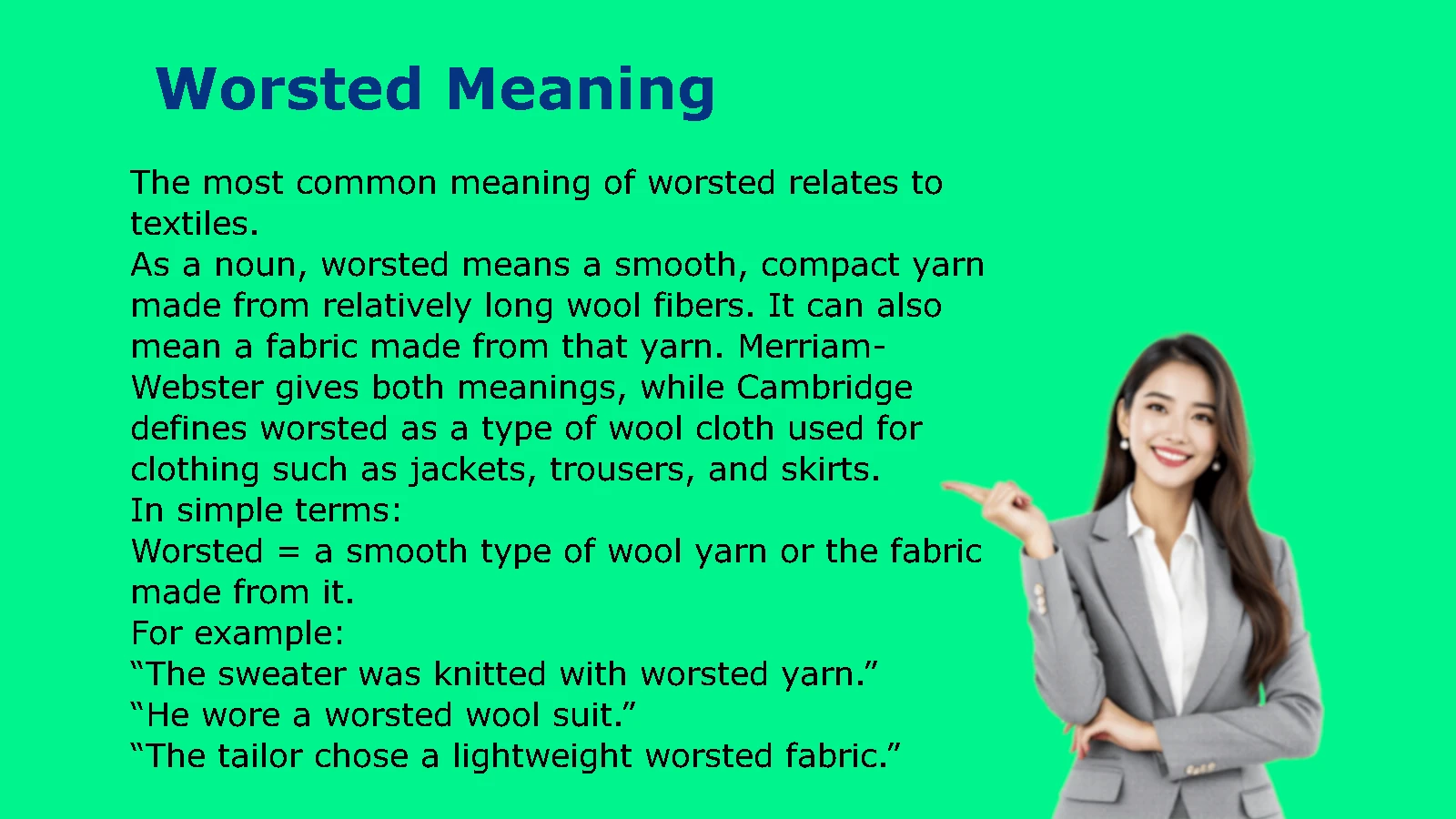
The most common meaning of worsted relates to textiles.
As a noun, worsted means a smooth, compact yarn made from relatively long wool fibers. It can also mean a fabric made from that yarn. Merriam-Webster gives both meanings, while Cambridge defines worsted as a type of wool cloth used for clothing such as jackets, trousers, and skirts.
In simple terms:
Worsted = a smooth type of wool yarn or the fabric made from it.
For example:
- “The sweater was knitted with worsted yarn.”
- “He wore a worsted wool suit.”
- “The tailor chose a lightweight worsted fabric.”
The word can also appear before another noun as an adjective:
- worsted yarn
- worsted wool
- worsted fabric
- worsted cloth
- worsted weight
The exact meaning becomes clear from the surrounding words.
Worsted Meaning at a Glance
| Word | Meaning |
| Worsted | A smooth, compact yarn or fabric associated with the worsted textile process |
| Worsted yarn | Smooth yarn traditionally made from relatively long wool fibers |
| Worsted fabric | Fabric made from worsted yarn |
| Worsted wool | Wool processed using the worsted method |
| Worsted weight | A commonly used yarn-weight category |
| Worsted as a verb | Past tense of worst, meaning defeated |
That last entry is easy to overlook. More on it later.
Worsted Definition in Plain English
The easiest way to understand worsted is to picture two wool sweaters.
One has a relatively smooth surface. The stitches look crisp and defined, and the fabric has a neat, structured appearance.
The other feels fluffier and looks somewhat fuzzier. Its fibers create a softer, more airy surface.
The first type is closer to what the term worsted traditionally describes.
Worsted yarn uses relatively long wool fibers that are arranged more closely and evenly before spinning. This produces yarn with a smoother and more compact structure. The Woolmark Company explains that worsted yarn generally uses longer, more uniform fleece fibers and is used to make flatter, lighter, smoother fabrics, including traditional tailoring fabrics.
That construction gives worsted textiles several recognizable qualities:
- Smoothness
- Compact structure
- Clear surface definition
- Durability
- A relatively clean appearance
- A tendency to produce fabrics suitable for tailoring
So, when a clothing label describes something as worsted wool, it isn’t simply saying “this contains wool.” It points to a particular way the fibers have been prepared and spun.
What Is Worsted Yarn?
Worsted yarn is yarn made through a worsted preparation and spinning process. It traditionally relies on relatively long wool fibers, which are aligned more closely before spinning.
That alignment matters.
Imagine a handful of pencils. If you throw them randomly into a pile, they point in every direction. If you line them up neatly, the bundle becomes more orderly and compact.
Worsted processing works on a similar principle with fibers. The fibers are prepared so they lie more parallel to one another. The resulting yarn tends to have a smoother surface and a more compact structure.
According to the Woolmark Company, worsted yarn generally uses high-quality fleece wool containing longer fibers with relatively consistent characteristics. The resulting yarn is particularly useful for smooth, lighter fabrics.
Why Does Fiber Length Matter?
Wool fibers vary in length, diameter, and other characteristics. Longer fibers can be arranged more effectively into a smooth, aligned structure.
That helps explain why worsted yarn tends to have a cleaner appearance than yarn produced through a more woolen-style process.
This doesn’t mean every worsted yarn feels identical. Fiber type, yarn construction, twist, finishing, and manufacturing choices can all affect the final result.
Still, fiber alignment is one of the central ideas behind the word “worsted.”
What Does Worsted Mean in Textiles?
In textile terminology, worsted describes a particular family of yarns and fabrics associated with the preparation of relatively long wool fibers.
Worsted fabrics are known for their smooth, relatively flat appearance. Cambridge specifically describes worsted as a wool cloth used for garments such as jackets, trousers, and skirts.
Traditional applications include:
- Suits
- Trousers
- Jackets
- Skirts
- Dress clothing
- Tailored garments
- Certain lightweight wool fabrics
The reason worsted fabric works well for tailoring is its combination of a relatively smooth surface, structure, and durability.
A finely made worsted suit, for example, can have a clean appearance without the bulky surface that you might associate with some heavier wool fabrics.
Worsted Fabric Meaning
Worsted fabric is fabric made from worsted yarn.
The term often appears in clothing and textile descriptions because worsted fabrics have characteristics that suit tailored garments.
A typical worsted fabric can have:
- A smooth surface
- A relatively firm hand
- A clean, refined appearance
- Good resistance to everyday wear
- A comparatively light and flat construction
However, not every fabric described as worsted will have exactly the same thickness or feel. Fiber quality, weave, yarn count, finishing, and fabric construction all matter.
For that reason, worsted doesn’t mean one specific thickness, color, or weave.
It describes a textile category and manufacturing approach.
What Is Worsted Wool?
Worsted wool is wool processed using the worsted system.
This distinction is important because worsted and wool aren’t interchangeable terms.
Wool identifies the animal fiber. Worsted identifies a type of yarn or textile construction associated with how those fibers are prepared and spun.
Think of it this way:
Wool = what the fiber is.
Worsted = how the fiber is processed into a particular textile form.
The Woolmark Company notes that worsted processing typically uses longer wool fibers and produces smoother, flatter fabrics commonly used in tailoring.
So a label saying 100% wool doesn’t automatically mean the item is worsted. Conversely, something described as worsted isn’t simply another word for “wool.”
Worsted vs. Woolen
One of the most useful distinctions in textile vocabulary is worsted vs. woolen.
Both terms relate to wool, but they describe different methods of preparing and spinning fibers.
| Feature | Worsted | Woolen |
| Fiber arrangement | More aligned | Less parallel |
| Yarn structure | Relatively compact | Relatively lofty |
| Surface | Smoother | Often fuzzier |
| Appearance | Clean and defined | Softer and more textured |
| Typical fabric character | Flat and structured | Warm and full |
| Common uses | Tailoring and smooth garments | Sweaters and softer wool fabrics |
The difference isn’t merely about whether the yarn contains wool. It concerns how the fibers are prepared and arranged.
Worsted processing emphasizes alignment and compactness. Woolen processing creates a more open, lofty structure.
Neither approach is automatically “better.” Each produces a different textile character.
What Does Worsted Mean in Knitting?
If you encountered worsted while reading a knitting or crochet pattern, the word may have a slightly different practical meaning.
In this context, worsted often appears in the phrase worsted-weight yarn.
A knitter might see instructions such as:
“Use worsted-weight yarn.”
Here, worsted refers to a commonly recognized yarn-weight category rather than simply telling you that the yarn is made from wool.
That’s an important distinction.
A yarn can be described as worsted weight without necessarily being made entirely from wool. Modern yarns can contain different fibers, including plant-based, synthetic, or blended fibers.
What Is Worsted-Weight Yarn?
Worsted-weight yarn is generally a medium-weight yarn category used for a wide range of knitting and crochet projects.
It’s popular because it provides a useful balance between warmth, thickness, stitch definition, and ease of handling.
Common projects include:
- Sweaters
- Cardigans
- Hats
- Scarves
- Blankets
- Mittens
- Baby garments
- Accessories
However, yarn labels and standards can vary. A pattern’s recommended gauge, needle size, or hook size should take priority over the word worsted alone.
In other words, don’t assume that every yarn labeled “worsted” will behave identically.
Worsted Weight vs. Worsted Yarn
These terms look almost identical, but they aren’t always saying the same thing.
Worsted yarn can refer to yarn produced through the worsted method.
Worsted weight refers to a yarn thickness category commonly used in knitting and crochet.
That distinction becomes especially important when a yarn label says something like:
“Acrylic worsted-weight yarn.”
The word acrylic identifies the fiber.
The phrase worsted weight identifies the yarn’s general weight category.
So “worsted weight” does not automatically mean “wool.”
Worsted vs. DK Yarn
Knitting terminology can get confusing because yarn-weight names describe thickness categories rather than simply the fiber or manufacturing process.
DK generally refers to a lighter yarn category than worsted.
A simplified comparison looks like this:
| Feature | Worsted Weight | DK Weight |
| General thickness | Medium | Lighter |
| Typical use | Sweaters, blankets, hats | Lightweight garments, accessories |
| Fabric character | Often more substantial | Often lighter and more drapey |
| Substitution | May alter size and texture | May alter size and texture |
The exact result depends on the specific yarn and pattern.
If a pattern calls for DK yarn, replacing it with worsted without adjusting the pattern can change the finished item’s dimensions significantly.
Worsted vs. Aran Yarn
Aran and worsted can also create confusion because yarn terminology isn’t perfectly standardized across every manufacturer or market.
In everyday knitting discussions, the terms can sometimes overlap in practical use. However, they’re not automatically identical.
The safest approach is to check:
- Yarn weight category
- Suggested needle size
- Suggested hook size
- Recommended gauge
- Yardage
- Fiber content
That information tells you more about how a particular yarn will behave than the name on the front of the label alone.
How to Pronounce Worsted
Worsted has an unexpectedly tricky pronunciation.
Cambridge gives the US pronunciation as /ˈwɝː.stɪd/ and also records a UK pronunciation beginning with a different vowel sound. Merriam-Webster gives pronunciations including /ˈwu̇-stəd/ and /ˈwər-stəd/.
A simple American-English approximation is:
WOR-stid
It has two syllables.
Is Worsted Pronounced “Worst-Ed”?
Not usually.
Although the spelling makes worsted look like worst + ed, the textile word isn’t normally pronounced like “worst-ed” with the full vowel sound of ed.
Instead, the ending sounds more like “stid” or “stəd,” depending on the speaker and accent.
For example:
“She bought a WOR-stid wool jacket.”
This pronunciation is one reason the word can surprise people who first encounter it in writing.
Worsted Word Origin
The history of worsted is closely connected to English textile production.
The word comes from Worstead, a village in Norfolk, England. Merriam-Webster identifies the textile term as deriving from Worsted, the former name associated with the place, and dates its first known use to the 13th century.
Etymonline likewise traces the textile noun to the late 13th century and connects it with Worstead, where the cloth was historically produced.
This is a classic example of a place name becoming a common noun.
The basic historical path is:
Worstead → textile production → worsted
Over centuries, the geographic association became attached to a particular type of wool textile.
That history also explains why worsted doesn’t have anything to do with the modern English word worst.
The similarity in spelling is coincidental.
Worsted vs. Worst
This is the most important word-usage distinction for general readers.
Worsted and worst look similar, but their meanings are unrelated when worsted refers to textiles.
| Word | Meaning | Example |
| worsted | A type of yarn or fabric | “He bought a worsted wool jacket.” |
| worst | Most bad, unpleasant, severe, or inferior | “That was the worst mistake.” |
Cambridge defines worst as the superlative form of bad and badly, while Merriam-Webster likewise defines it as the superlative of bad or ill.
Consider these sentences:
- “This is the worst movie I’ve seen.”
- “This sweater is made from worsted wool.”
The first sentence expresses an evaluation.
The second describes a textile.
Why Do They Look So Similar?
The spelling creates the illusion that worsted might be related to worst.
It isn’t.
The textile word comes from the place name Worstead. The adjective worst has a much older Germanic history and is connected to the comparative form worse.
So:
worst → worse → bad
but:
worsted → Worstead → textile
That simple distinction solves most confusion.
Worsted vs. Worse
It’s also useful to separate worsted from worse.
Worse is the comparative form of bad.
It means something is more unpleasant, difficult, severe, poor, or otherwise inferior compared with something else or an earlier condition.
Examples:
- “The weather is worse today.”
- “The second version is worse than the first.”
- “The problem became worse overnight.”
By contrast:
- “The coat is made from worsted wool.”
A quick memory trick:
worse = more bad
worst = most bad
worsted = textile
Worsted as a Verb
Here’s the linguistic twist that makes worsted especially interesting.
Worsted can also be the past tense and past participle of the verb worst.
As a verb, worst means to defeat someone or get the better of them. Merriam-Webster lists this verbal sense and gives worsted as its past form.
For example:
“The experienced player worsted his younger opponent.”
Here, worsted has nothing to do with wool.
It means:
defeated
Cambridge also labels this use of worst as old-fashioned and gives the sense “to defeat someone in a fight or argument.”
Textile Worsted vs. Verbal Worsted
Context tells you which meaning applies.
| Sentence | Meaning of “worsted” |
| “She bought a worsted wool coat.” | Textile |
| “The pattern uses worsted yarn.” | Textile |
| “The tailor selected worsted fabric.” | Textile |
| “The champion was worsted by an unknown player.” | Defeated |
The surrounding words usually make the meaning obvious.
If you see yarn, wool, fabric, suit, knitting, or textile, think of the textile word.
If you see opponent, match, argument, competition, or defeated, think of the verb.
Worsted in a Sentence
Seeing the word in context makes its meaning much easier to remember.
- “The manufacturer produces fine worsted for tailored clothing.”
- “The fabric has the smooth appearance associated with worsted.”
- “The shop carries several grades of worsted.”
as an Adjective
- “He ordered a worsted wool suit.”
- “The pattern requires worsted-weight yarn.”
- “The tailor selected a lightweight worsted fabric.”
- “She prefers the smooth texture of worsted yarn.”
as a Verb
- “The favorite was worsted by an unexpected challenger.”
- “The experienced team worsted its rival.”
Notice how dramatically the context changes the meaning.
What Is Worsted Fabric Used For?
Worsted fabric has traditionally been associated with garments where a smooth, neat, durable appearance matters.
Common applications include:
- Suits
- Trousers
- Jackets
- Skirts
- Tailored clothing
- Other structured garments
Cambridge specifically lists jackets, trousers, and skirts among uses for worsted cloth.
The Woolmark Company similarly notes that worsted yarn is used to produce flatter, lighter, smoother fabrics for traditional tailoring.
This makes sense when you consider the characteristics of the yarn. A smoother, more compact yarn can produce a cleaner fabric surface, which works well in tailored clothing.
What Is Worsted Yarn Used For?
In knitting and crochet, worsted-weight yarn is popular because its moderate thickness makes it useful for many projects.
Typical examples include:
- Sweaters
- Cardigans
- Blankets
- Scarves
- Hats
- Gloves and mittens
- Children’s clothing
- Home accessories
The term worsted yarn can also refer specifically to yarn produced using the worsted spinning method. That meaning should not be confused with worsted weight, which is a weight classification used by yarn makers and crafters.
Common Misunderstandings About Worsted
Several misconceptions appear repeatedly because the word serves more than one purpose.
Worsted Does Not Mean “Worst”
The spelling is similar, but the textile term comes from Worstead, not from worst.
Worsted Does Not Always Mean Wool
In textile manufacturing, worsted traditionally refers to wool processing. In knitting terminology, however, worsted weight is a yarn-weight label and doesn’t by itself guarantee that the yarn is wool.
Always check the fiber content.
Worsted Isn’t a Specific Color
A worsted fabric can come in many colors and patterns. Worsted describes the textile category, not its color.
Worsted Doesn’t Mean a Specific Weave
The word doesn’t simply identify one particular weave pattern. It primarily relates to the yarn and fiber preparation.
Worsted Isn’t Always Heavy
A worsted fabric can be relatively light and smooth. Likewise, “worsted weight” describes a yarn category rather than saying that a textile must be physically heavy.
A Simple Case Study: Understanding a Clothing Label
Imagine you find a jacket described as:
“Navy worsted wool, two-button tailored jacket.”
What does each part tell you?
- Navy tells you the color.
- Wool tells you the primary fiber.
- Worsted tells you about the textile’s yarn/process characteristics.
- Two-button describes the front closure.
- Tailored describes the garment’s cut and construction.
So worsted wool gives you more information than simply “wool.”
It suggests a wool textile associated with smooth, compact yarn and a clean appearance suitable for tailored clothing.
Now consider a knitting label that says:
“Worsted-weight acrylic yarn.”
That means something different:
- Acrylic = fiber
- Worsted weight = yarn-weight category
The word worsted doesn’t necessarily mean the acrylic fibers went through the traditional wool worsted process.
That’s why context matters.
Worsted Synonyms and Related Words
Because worsted refers to a specific textile category, it doesn’t have many exact everyday synonyms.
Depending on context, related terms include:
- Worsted yarn
- Worsted wool
- Worsted fabric
- Worsted cloth
- Worsted weight
- Wool yarn
- Woolen yarn
- Textile
- Spun yarn
However, these words aren’t interchangeable.
For example, woolen isn’t a perfect synonym for worsted. The two terms can refer to different methods of preparing and spinning wool fibers.
Likewise, wool is broader than worsted.
Calling every wool textile “worsted” would be like calling every car a sedan. The category is simply too broad.
Is Worsted a Noun or an Adjective?
Worsted can function as a noun or an adjective depending on how it’s used.
Worsted as a Noun
When the word itself identifies the textile or yarn:
“The manufacturer specializes in fine worsted.”
Here, worsted functions as a noun.
Worsted as an Adjective
When it modifies another noun:
“She chose worsted wool for the jacket.”
Here, worsted describes the wool.
The same pattern appears in:
- worsted yarn
- worsted fabric
- worsted cloth
- worsted spinning
- worsted weight
Worsted as a Verb
When it means “defeated”:
“The champion was worsted in the final.”
Here, it is the past tense or past participle of the verb worst. Merriam-Webster identifies this verbal sense as meaning “to get the better of” or “defeat.”
Frequently Asked Questions About Worsted Meaning
What does worsted mean in English?
Worsted primarily refers to a smooth, compact yarn made from relatively long wool fibers or to fabric made from that yarn. It can also be an adjective describing textiles.
What does worsted mean in yarn?
In yarn terminology, worsted can describe yarn made through the worsted process. Worsted weight, however, refers to a commonly used yarn-weight category.
Is worsted yarn wool?
Traditionally, worsted yarn is associated with wool and relatively long wool fibers. However, a yarn labeled worsted weight doesn’t necessarily have to be wool. Check the fiber content on the label.
Is worsted the same as wool?
No. Wool refers to the fiber, while worsted refers primarily to a type of yarn, fabric, or processing method.
What is worsted fabric used for?
Worsted fabric is commonly used for tailored clothing such as suits, trousers, jackets, and skirts.
How do you pronounce worsted?
In American English, a simple pronunciation guide is WOR-stid. Cambridge gives the US pronunciation as /ˈwɝː.stɪd/.
Why is it called worsted?
The textile term comes from Worstead, a village in Norfolk, England, associated historically with textile production. The word dates back to the medieval period, with Merriam-Webster recording its first known use in the 13th century.
Is worsted related to worst?
No. The textile word comes from Worstead. The word worst has a separate Germanic history and means the most bad, unpleasant, severe, or inferior.
Can worsted mean defeated?
Yes. Worsted is also the past tense of the verb worst, meaning “defeated.” This use is relatively uncommon and can sound old-fashioned.
Worsted Meaning: Quick Reference
| Question | Short Answer |
| What does worsted mean? | A smooth, compact yarn or fabric traditionally made from relatively long wool fibers |
| What is worsted yarn? | Yarn made using the worsted preparation and spinning method |
| What is worsted fabric? | Fabric made from worsted yarn |
| What is worsted wool? | Wool processed using the worsted method |
| What is worsted weight? | A commonly used yarn-weight category |
| How is worsted pronounced? | Commonly “WOR-stid” in American English |
| Where does worsted come from? | From Worstead, England |
| Is worsted the same as wool? | No |
| Is worsted the same as worst? | No, except that worsted can separately be the past tense of worst |
| What does worsted mean as a verb? | Defeated |
Final Takeaway on the Worsted Meaning
You’ll most often encounter it in phrases such as worsted yarn, worsted wool, worsted fabric, and worsted weight. In clothing, it often points to smooth wool fabrics used for tailored garments. In knitting, worsted weight usually refers to a yarn-weight category rather than automatically identifying the fiber.
And then there’s the linguistic curveball: worsted can also mean defeated when it functions as the past tense of worst. That meaning has nothing to do with wool.
The easiest way to remember the distinction is:
Worsted = textile.
Worst = most bad.
Worsted = defeated when used as the past tense of worst.
Once you know the context, this unusual word becomes much easier to understand.