
Have you ever read a sentence, noticed a clue, and understood something that wasn’t directly stated? That is where Inference Meaning comes into play. While the word inference may sound formal or complicated, it simply refers to a conclusion you reach based on evidence, clues, and what you already know.
Inference is the process of using available information to figure out something that is not clearly or directly stated. It is commonly used in reading, writing, conversations, education, and everyday situations.
Examples:
- From the dark clouds, I made the inference that it might rain.
- The teacher asked students to make an inference from the passage.
The confusion is understandable. People often search for what does inference mean, inference meaning in English, inference meaning in reading, or inference meaning with examples because the word can be difficult to understand without context. Think of it like putting together puzzle pieces: you use the clues you have to reach a reasonable conclusion.
In this guide, you’ll learn the complete Inference Meaning, its definition, pronunciation, correct usage, and examples in sentences. You’ll also discover how inference works in reading and everyday conversations, the difference between inference and assumption, and how to use the word correctly.
What Does Inference Mean?
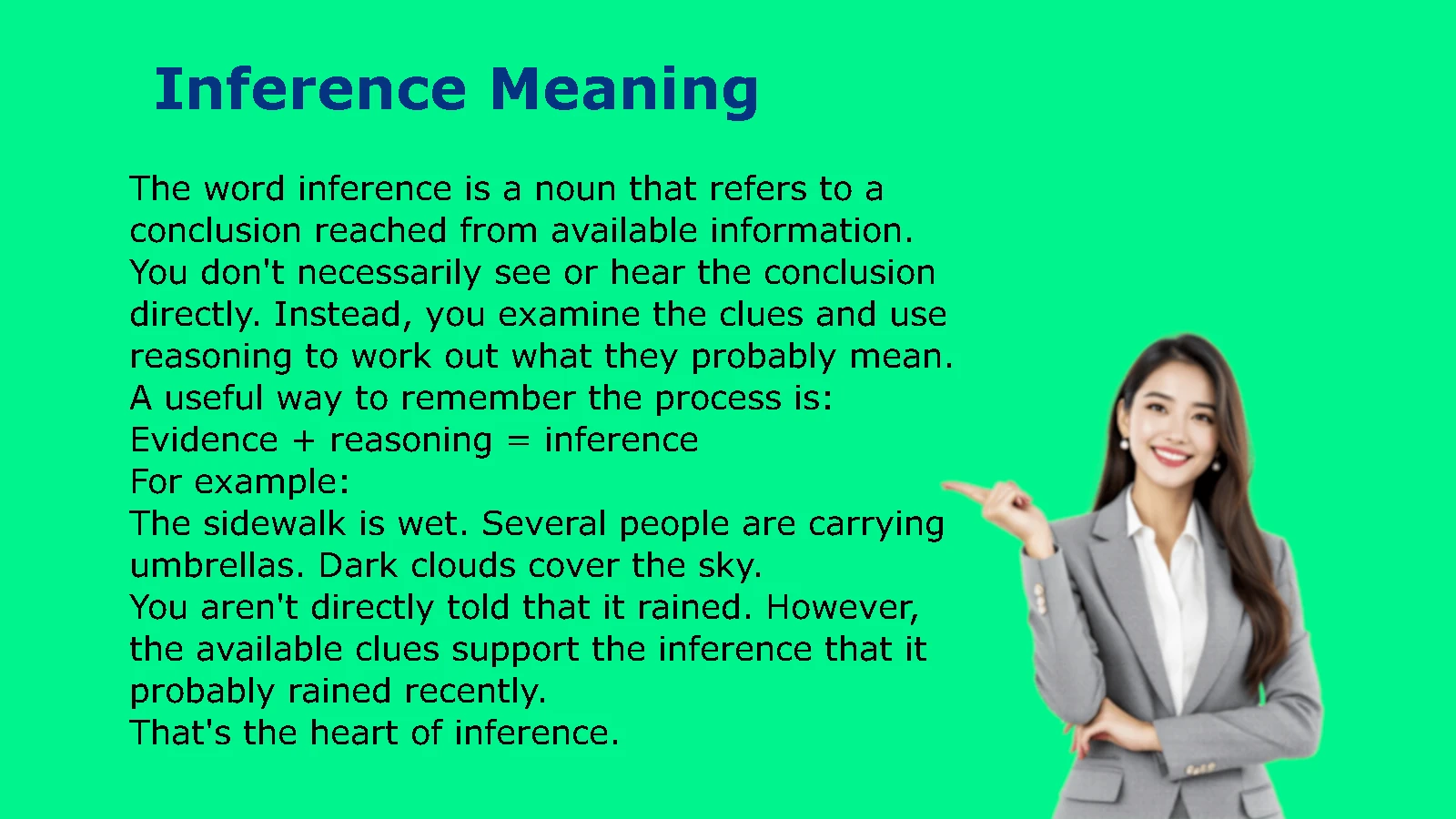
The word inference is a noun that refers to a conclusion reached from available information. You don’t necessarily see or hear the conclusion directly. Instead, you examine the clues and use reasoning to work out what they probably mean.
A useful way to remember the process is:
Evidence + reasoning = inference
For example:
The sidewalk is wet. Several people are carrying umbrellas. Dark clouds cover the sky.
You aren’t directly told that it rained. However, the available clues support the inference that it probably rained recently.
That’s the heart of inference.
Inference Meaning in Simple Words
In simple English, an inference is a conclusion you reach from clues or information.
Imagine walking into a kitchen and finding:
- An empty cake box
- Crumbs on the counter
- A dirty plate
- Chocolate frosting on someone’s fingers
Nobody has to say, “Someone ate cake.”
You can infer it.
The evidence points toward a reasonable conclusion.
However, an inference doesn’t automatically become a fact. Someone could have eaten the cake hours earlier. The crumbs could have come from another dessert. The person with frosting on their fingers could have been the one who baked it.
This is why strong inferences depend on the quality and amount of evidence available.
What Is the Difference Between Information and Inference?
The easiest way to understand inference is to separate what you know from what you conclude.
| Information or evidence | Possible inference |
| The lights are off and the doors are locked. | The store is probably closed. |
| Nina is wearing a coat and holding an umbrella. | She expects cold or rainy weather. |
| Mark keeps yawning and rubbing his eyes. | Mark is probably tired. |
| The classroom is empty after the final bell. | The class has likely ended. |
| Smoke is coming from the kitchen. | Something may be burning. |
The left column contains observations. The right column contains conclusions drawn from those observations.
That distinction matters because an inference goes beyond what is explicitly stated.
What Is an Example of an Inference?
Consider this short situation:
Daniel walked into the house, dropped his backpack by the door, and immediately went to the kitchen. He opened the refrigerator and poured himself a large glass of water.
What can you infer?
You might conclude that Daniel was thirsty.
The passage never says, “Daniel was thirsty.” Instead, his actions provide clues.
Here are more examples:
Example of Inference in Everyday Life
Evidence: The restaurant has a line stretching out the door.
Inference: The restaurant is probably busy or popular.
The evidence doesn’t prove that the food tastes good. It simply gives you a reasonable basis for thinking many people want to eat there.
Example of Inference From Behavior
Evidence: Sarah keeps checking the clock and looking toward the door.
Inference: Sarah may be waiting for someone.
Again, the conclusion remains tentative. She could be waiting for a bus, a delivery, or an important phone call.
Example of Inference From Physical Evidence
Evidence: Fresh footprints lead from the muddy yard to the back door.
Inference: Someone recently walked from the yard into the house.
The footprints provide a direct clue that supports the conclusion.
How Does Inference Work?
Inference usually involves three basic stages: identify the evidence, connect the clues, and reach a conclusion.
Identify the Information
First, determine what you actually know.
Look for facts, observations, statements, measurements, or other available evidence. Don’t start with the conclusion you want and then hunt for clues that support it.
For example:
The temperature has dropped below freezing. Water on the sidewalk has turned to ice.
Those are observations.
Connect the Clues
Next, consider how the pieces of information relate to each other.
The freezing temperature explains why the water has become ice. Together, the clues support a conclusion about the conditions outside.
Draw a Reasonable Conclusion
Finally, reach a conclusion that fits the evidence.
You could infer:
The weather is cold enough for exposed water to freeze.
A good inference stays close to the evidence. It doesn’t wander into unsupported assumptions.
For example, you couldn’t reasonably infer that the entire city will remain frozen for the next week from those two observations alone.
Inference vs. Assumption
Inference and assumption are closely related, but they aren’t the same thing.
An assumption is something you accept as true without enough evidence. An inference, by contrast, uses available information to reach a conclusion.
Consider this example:
Emma walked into the office carrying a folder and wearing a formal suit.
You might infer that she has an important meeting.
That’s possible because her clothing and the folder provide clues.
But saying Emma is the company’s new CEO would be an unsupported assumption unless you have additional evidence.
| Inference | Assumption |
| Uses available evidence | May exist without supporting evidence |
| Connects clues to a conclusion | Accepts something as true |
| Can be tested against more evidence | May rely on belief or expectation |
| Usually acknowledges uncertainty | Often treats an idea as established |
A useful question is:
“What evidence led me to this conclusion?”
If you can’t identify the evidence, you may be making an assumption rather than an inference.
Inference vs. Deduction
Deduction is a more specific form of reasoning. It typically moves from premises to a conclusion that follows logically from them.
For example:
- All birds have feathers.
- A robin is a bird.
- Therefore, a robin has feathers.
If the premises are true and the reasoning is valid, the conclusion follows necessarily.
Inference is broader. In ordinary language, inference can refer to reaching conclusions from information without requiring absolute certainty.
Consider this example:
The streets are wet, people are carrying umbrellas, and clouds cover the sky.
You can infer that it probably rained.
However, the evidence doesn’t make rain the only possible explanation. A sprinkler system, street cleaning, or another source of water could produce wet pavement.
Deduction and Inference at a Glance
| Feature | Deduction | Inference |
| Main idea | Derives a conclusion from premises | Reaches a conclusion from available information |
| Certainty | Can be certain when premises and logic support it | May involve probability or uncertainty |
| Scope | More specific reasoning method | Broader concept |
| Example | All mammals breathe air; whales are mammals; whales breathe air | Wet streets suggest recent rain |
The terms overlap in some contexts, so the exact distinction can depend on the field in which they’re used.
Inference vs. Prediction
Inference and prediction both involve reasoning, but they focus on different things.
A prediction concerns what you think will happen. An inference can concern what is happening, what happened earlier, or what something means.
Consider dark clouds gathering overhead.
Inference:
It may have rained recently because the ground is already wet.
Prediction:
It may rain again soon because dark clouds are approaching.
The first conclusion interprets existing evidence. The second anticipates a future event.
That small difference becomes important in science, reading comprehension, statistics, and everyday decision making.
Types of Inference
Inference can take different forms depending on how you reason from the available information. Three important categories are deductive, inductive, and abductive inference.
Deductive Inference
Deductive inference moves from general premises toward a specific conclusion.
For example:
All metals conduct electricity.
Copper is a metal.
Therefore, copper conducts electricity.
The conclusion follows from the premises.
Deductive reasoning is common in mathematics, formal logic, and fields where researchers work with clearly defined premises and rules.
Inductive Inference
Inductive inference moves from observations toward a broader conclusion.
Imagine that you observe several swans and each one is white. You might conclude:
The swans observed so far are white.
You could then form a broader hypothesis about swans. However, the observations don’t logically guarantee that every swan everywhere is white.
Inductive reasoning therefore often produces a probable conclusion rather than an absolutely certain one.
Abductive Inference
Abductive inference is often described as inference to the best explanation.
Suppose your car won’t start. You check the dashboard and notice that the lights are unusually dim. You might infer that the battery is discharged.
That’s a plausible explanation.
However, you haven’t proven that the battery is the only possible cause. A damaged electrical system could produce similar symptoms.
Abductive reasoning is useful when you have incomplete information and need to identify the explanation that best fits the available clues.
Inference in Reading and Literature
One of the most important uses of inference appears in reading comprehension.
Authors don’t always tell readers exactly what a character thinks, feels, or intends. Instead, they provide clues and allow readers to work out the meaning.
This is often called reading between the lines.
A reader may use:
- Character actions
- Dialogue
- Facial expressions
- Setting
- Word choice
- Tone
- Events
- Descriptions
- Context
- Relationships between characters
to infer information that the author doesn’t state directly.
Example of Inference in a Story
Consider this short passage:
Liam looked at the clock for the fifth time. He zipped his suitcase, checked his phone, and stood beside the front door. When he heard a car outside, he grabbed his jacket and smiled.
What can you infer?
A reasonable inference is:
Liam is waiting for someone to pick him up, possibly for a trip.
Notice what the passage actually gives you:
- A suitcase
- Repeatedly checking the time
- Checking his phone
- Waiting near the door
- A car arriving
- Getting ready to leave
Those clues work together.
However, the passage never explicitly says where Liam is going or who is picking him up. A careful reader shouldn’t invent those details.
Why Inference Matters in Reading
Strong readers don’t simply collect facts. They connect them.
For example, if a story says:
Maria folded the letter, wiped her eyes, and placed it carefully inside a drawer.
You might infer that the letter has emotional importance to Maria.
You shouldn’t automatically conclude that the letter contains bad news, because the passage doesn’t provide enough evidence for that specific claim.
The best inference is usually the one that explains the clues without adding unnecessary information.
Inference in Everyday Life
These conclusions help you navigate situations where people don’t explain everything explicitly.
Common Everyday Inferences
| Situation | Evidence | Possible inference |
| A friend keeps checking their phone | Repeated phone checks | They may be waiting for a message |
| Your neighbor’s driveway is empty | No car is present | They may be away |
| A child has muddy shoes | Mud on shoes | The child has probably been outside |
| A coworker closes their laptop | Meeting has ended | They may be finished working for now |
| A shop has lights off and doors locked | No visible activity | The shop may be closed |
The word may matters here.
Inference often involves uncertainty. Good reasoning leaves room for another explanation when the evidence doesn’t justify certainty.
Inference in Science and Research
Scientists also make inferences, although scientific inference requires careful attention to evidence, alternative explanations, and uncertainty.
Imagine a researcher observes that a plant placed near a light source grows toward it.
The observation is that the plant’s growth direction changed.
A possible inference is that light influences the plant’s growth direction.
That inference can then lead to further testing.
The researcher might place identical plants under controlled lighting conditions and compare their growth. The goal isn’t simply to make a plausible guess. It’s to gather evidence that can support, challenge, or refine the explanation.
This distinction is central to scientific thinking:
Observation tells you what happened. Inference helps explain what the observation may mean.
Scientific reasoning can also involve causal inference. Researchers may ask whether one factor actually causes a change rather than merely occurring alongside it.
That requires stronger evidence than simply observing that two things happen together.
Inference in Statistics and Data
Statistical inference applies reasoning to data.
Researchers often collect information from a sample and use it to learn about a larger population. Because the sample doesn’t contain every possible observation, conclusions involve uncertainty.
For example, suppose a researcher surveys a sample of voters to estimate the preferences of a much larger population.
The survey results can support an inference about the broader population. However, the researcher must account for factors such as sample size, sampling method, variability, and uncertainty.
Statistical inference therefore isn’t simply:
“We surveyed some people, so everyone thinks the same thing.”
Instead, it asks how confidently the available data support a conclusion about a larger group.
This is one reason statistical results often include confidence intervals, estimates, or margins of error.
Inference in Logic
In logic, inference describes the movement from premises to a conclusion.
A simple structure looks like this:
Premise → Premise → Reasoning → Conclusion
For example:
- Every employee must complete the required training.
- Jordan is an employee.
- Therefore, Jordan must complete the required training.
The premises provide the foundation for the conclusion.
Formal logic can become much more complex, but the basic idea remains useful: reasoning connects information to a conclusion.
How to Make a Strong Inference
A strong inference doesn’t require a mountain of evidence. It requires relevant evidence that genuinely supports the conclusion.
Start With Facts
Separate facts from interpretations.
Ask:
- What do I actually know?
- What did I observe?
- What did the source explicitly state?
- Which details can I verify?
This prevents your initial assumptions from controlling your reasoning.
Look for Relevant Clues
Not every detail matters equally.
Suppose a character walks into a room carrying an umbrella. The color of the umbrella probably tells you little about why the character brought it. If the character shakes rain from the umbrella and the pavement outside is wet, those clues are much more relevant.
Focus on evidence that connects directly to your conclusion.
Use Context
Context can change the meaning of evidence.
If someone says:
“Great job.”
the meaning could be genuine praise or sarcasm.
The surrounding situation matters. Their tone, facial expression, previous conversation, and circumstances can help you infer the intended meaning.
Consider Alternative Explanations
This step separates careful inference from snap judgment.
Suppose a student doesn’t speak during a class discussion.
You might infer that the student is shy.
But several other explanations are possible:
- The student doesn’t understand the topic.
- The student is tired.
- The student prefers listening.
- The student hasn’t had an opportunity to speak.
- The student simply doesn’t want to participate that day.
A good inference remains open to competing explanations when the evidence is incomplete.
What Makes an Inference Reasonable?
A reasonable inference has a clear connection to its evidence.
Think of inference as a bridge. Evidence forms one side, the conclusion forms the other, and reasoning is the bridge between them.
If the bridge is weak, the conclusion becomes shaky.
Several factors make an inference stronger:
- Relevant evidence: The clues directly relate to the conclusion.
- Multiple supporting clues: Several pieces of evidence point in the same direction.
- Reliable information: The evidence itself is trustworthy.
- Logical reasoning: The conclusion follows reasonably from the clues.
- Context: You understand the surrounding circumstances.
- Alternative explanations: You have considered other plausible possibilities.
An inference doesn’t need to be certain to be useful. In many real situations, the goal is to reach the best supported conclusion available at the time.
Common Mistakes When Making Inferences
Inference becomes unreliable when people stretch evidence too far.
Treating an Inference as a Fact
Compare these statements:
The dark clouds suggest that rain is coming.
and:
It will definitely rain at 3:00 p.m.
The first statement reflects reasonable inference. The second makes a much stronger claim than the evidence supports.
Making an Inference Without Evidence
If you conclude that someone is angry simply because they walked into a room quietly, you may be guessing rather than inferring.
Quiet behavior alone doesn’t tell you enough.
Adding Unsupported Details
Suppose a story says:
David packed a suitcase and left the house.
You can infer that David is leaving home for some reason.
You can’t automatically infer that he is moving to another country for a new job.
Those details require additional evidence.
Ignoring Alternative Explanations
The first explanation that comes to mind isn’t necessarily the best one.
Strong reasoning asks:
“What else could explain these clues?”
That single question can prevent many faulty conclusions.
Inference Meaning in a Sentence
The noun inference commonly appears with verbs such as make, draw, and reach.
Here are natural examples:
- We can make an inference from the evidence.
- The reader drew an inference from the character’s behavior.
- The researchers reached an inference after analyzing the data.
- That inference isn’t supported by enough evidence.
- Her expression allowed me to make an inference about how she felt.
- The conclusion was based on an inference rather than direct observation.
- Several clues support the inference that the building was abandoned.
Common Expressions With Inference
You may encounter these useful phrases:
| Expression | Meaning |
| make an inference | Reach a conclusion from evidence |
| draw an inference | Reach or derive a conclusion |
| reach an inference | Arrive at a conclusion |
| by inference | Through reasoning rather than direct statement |
| based on inference | Founded on a conclusion drawn from information |
| statistical inference | Drawing conclusions from statistical data |
| causal inference | Reasoning about whether one factor causes another |
Cambridge also lists common combinations such as causal inference and correct inference, showing how broadly the term appears in academic and professional English.
Synonyms for Inference
Several words are related to inference, but they don’t all mean exactly the same thing.
| Word | Meaning | Exact synonym? |
| Conclusion | A judgment reached after reasoning | Sometimes |
| Deduction | A conclusion derived through reasoning | Related |
| Interpretation | An explanation of meaning | Related |
| Judgment | An opinion formed after consideration | Related |
| Assumption | Something accepted without adequate proof | No |
| Hypothesis | A proposed explanation that can be tested | No |
Calling every related word a perfect synonym can create confusion.
For example, an assumption may have little or no evidence behind it, while an inference normally connects information to a conclusion.
Inference Word Forms
Knowing the related forms helps you use the word naturally.
Infer
Infer is the verb.
We can infer that the store is closed.
Cambridge defines infer as forming an opinion or guess that something is true because of available information.
Inference
Inference is the noun.
The evidence supports the inference that the store is closed.
Inferred
Inferred is the past tense and past participle of infer.
Researchers inferred the cause from the available evidence.
Cambridge lists inferred as the past simple and past participle form of infer.
Inferential
Inferential is an adjective related to inference.
The study involved inferential reasoning.
These forms are connected, but each has a different grammatical role.
How to Use “Infer” and “Inference” Correctly
The simplest distinction is grammatical:
Infer = verb
Inference = noun
Compare:
We can infer that she is upset.
with:
We can make an inference that she is upset.
The first sentence describes an action. The second names the conclusion.
Another useful structure is:
infer something from something
For example:
We can infer the character’s feelings from her actions.
Cambridge specifically gives infer something from something as a standard usage pattern.
Infer vs. Imply
Infer and imply are among the most commonly confused words in this area.
The basic distinction is:
- Imply: The speaker or writer suggests something without stating it directly.
- Infer: The listener or reader reaches a conclusion from what was said or shown.
Consider this conversation:
Alex: “It’s getting pretty late.”
Alex may imply that it’s time to leave.
The other person may infer that Alex wants to go home.
The direction matters.
The speaker implies. The listener infers.
Cambridge makes this same distinction in its usage guidance: a speaker can imply something through what they say, while a listener infers something from it.
A Simple Memory Trick
Think:
Imply = put the idea in.
Infer = take the idea out.
It’s not a complete explanation of every technical use, but it’s a useful way to remember the everyday distinction.
A Practical Inference Case Study
Consider a short workplace scenario:
A manager sends an employee a message saying, “Please stop by my office when you have a moment.” The employee notices that the manager has also scheduled a private meeting for later that afternoon.
What can the employee infer?
Several possibilities exist.
The employee might infer that the manager wants to discuss something important. However, the evidence doesn’t justify assuming that the conversation will be negative.
The manager could want to:
- Discuss a project
- Give feedback
- Ask for an update
- Share new information
- Address a problem
- Offer an opportunity
The strong inference is that the manager wants a private conversation.
The weak assumption is that the employee is in trouble.
This example shows why good inference requires restraint. The goal isn’t to imagine the most dramatic explanation. It’s to choose the conclusion that the evidence actually supports.
Inference vs. Direct Statement
A direct statement gives you the information explicitly.
An inference requires you to work it out.
Direct Statement
“The store is closed.”
There is nothing to infer about whether the store is open.
Inference
The doors are locked. The lights are off. A sign says, “Back tomorrow.”
You can infer that the store is closed.
This distinction matters in reading comprehension because questions often ask what you can infer rather than what the passage directly states.
When a question asks for an inference, don’t simply repeat a sentence from the text. Look for the conclusion that the available clues support.
How to Identify an Inference Question
In reading assignments, inference questions often use phrases such as:
- What can the reader infer?
- What can you conclude?
- What does this suggest?
- What is most likely true?
- What can be inferred from the passage?
- What does the character’s behavior suggest?
- What does the evidence indicate?
When you see these phrases, search for clues rather than a sentence that directly gives you the answer.
A useful strategy is:
Find the evidence → connect the clues → eliminate unsupported conclusions → choose the best supported answer.
Why Inference Matters
Inference is more than a vocabulary word. It’s a basic part of how people understand incomplete information.
You use it when you:
- Read between the lines.
- Interpret someone’s behavior.
- Understand indirect language.
- Analyze literature.
- Evaluate evidence.
- Interpret data.
- Solve problems.
- Develop scientific explanations.
- Assess possible causes.
- Make decisions under uncertainty.
Without inference, you’d need people to state every detail explicitly. Real communication doesn’t work that way.
A friend might say, “I have an early morning tomorrow,” and you can infer that they may want to end the conversation. A writer might describe a character’s trembling hands instead of saying, “She was nervous.” A scientist might observe a pattern and investigate what could explain it.
In each case, evidence becomes meaningful through reasoning.
Frequently Asked Questions About Inference
What does inference mean in simple words?
Inference means reaching a conclusion from information, clues, or evidence. It involves figuring out something that isn’t necessarily stated directly.
What is a simple example of inference?
If you see someone walking outside with a raincoat, wet shoes, and an umbrella, you can infer that it is raining or has recently rained.
The evidence supports the conclusion, but it doesn’t guarantee it.
What is the difference between inference and assumption?
An inference uses available evidence to reach a conclusion. An assumption accepts something as true without enough evidence.
For example, seeing someone carry an umbrella can support the inference that they expect rain. Assuming that they dislike sunny weather isn’t supported by the same evidence.
What is the difference between inference and deduction?
Deduction is a specific form of reasoning in which a conclusion follows from stated premises. Inference is a broader term for reaching conclusions from available information.
What does inference mean in reading?
In reading, inference means using clues in a text and your relevant background knowledge to reach a conclusion that the author doesn’t state directly.
Readers can infer a character’s feelings, motives, relationships, or likely actions from dialogue, behavior, setting, and other clues.
What are the three basic steps of inference?
A simple three step method is:
- Identify the evidence.
- Connect the relevant clues.
- Draw a reasonable conclusion.
Is an inference always correct?
No. An inference can be reasonable and still turn out to be wrong.
The available evidence may be incomplete, misleading, or open to multiple explanations. Strong inference means reaching the best supported conclusion while remaining willing to revise it when new evidence appears.
What is the opposite of an inference?
There isn’t one universal opposite of inference. However, a directly stated fact or explicit statement contrasts with information that you reach indirectly through reasoning.
What is the difference between infer and imply?
Infer means to reach a conclusion from information. Imply means to suggest something without stating it directly.
The speaker or writer can imply something. The listener or reader can infer something.
What does “draw an inference” mean?
Draw an inference means to reach a conclusion based on available evidence or information.
For example:
From the character’s actions, the reader draws an inference about her feelings.
Key Takeaway: What Does Inference Mean?
The simplest inference meaning is a conclusion reached from evidence, information, or clues rather than from a direct statement.
You make an inference when you connect the dots.
The process looks like this:
Evidence → Reasoning → Conclusion
A strong inference doesn’t rely on imagination alone. It stays connected to the facts and recognizes uncertainty when the evidence is incomplete.
Whether you’re reading a novel, analyzing research, interpreting statistics, solving a problem, or simply trying to understand what someone means, inference helps you move from what you know to what you can reasonably conclude.
That distinction is worth remembering: an inference isn’t just a guess. It’s a conclusion with a reason behind it.