
Have you ever come across something so interesting or mysterious that it immediately caught your attention? That is where the Intriguing Meaning becomes useful. This word describes something that sparks curiosity, holds your interest, or makes you want to learn more.
Intriguing means very interesting, fascinating, or mysterious in a way that makes you curious. It is often used to describe a person, idea, story, question, or situation that captures your attention because you want to know more.
Examples:
- The detective uncovered an intriguing clue.
- She shared an intriguing idea during the meeting.
The confusion is understandable. People often search for what does intriguing mean, intriguing meaning in English, intriguing meaning in a sentence, or another word for intriguing because the word can describe many different things. And here’s the kicker: something can be intriguing without being completely understood. Its mystery is often what makes it so interesting.
In this guide, you’ll learn the complete Intriguing Meaning, its definition, pronunciation, synonyms, antonyms, correct usage, and examples in sentences. You’ll also discover how to use intriguing in everyday conversations and writing and understand the difference between intriguing, interesting, fascinating, and curious.
What Does Intriguing Mean?
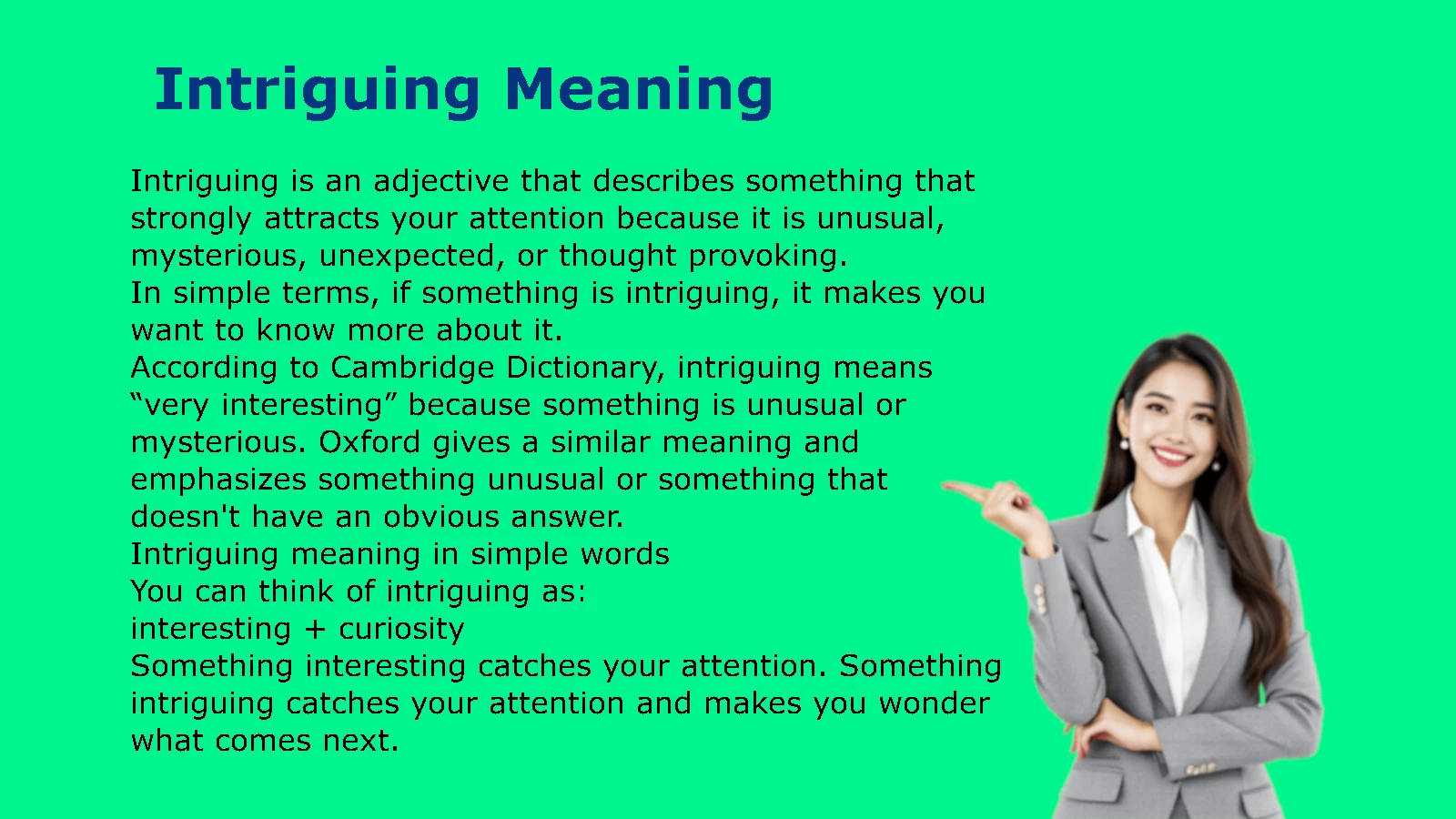
Intriguing is an adjective that describes something that strongly attracts your attention because it is unusual, mysterious, unexpected, or thought provoking.
In simple terms, if something is intriguing, it makes you want to know more about it.
According to Cambridge Dictionary, intriguing means “very interesting” because something is unusual or mysterious. Oxford gives a similar meaning and emphasizes something unusual or something that doesn’t have an obvious answer.
Intriguing meaning in simple words
You can think of intriguing as:
interesting + curiosity
Something interesting catches your attention. Something intriguing catches your attention and makes you wonder what comes next.
For example:
- “The book was interesting.”
→ You enjoyed or noticed the book. - “The book was intriguing.”
→ The book made you curious about its characters, mystery, ideas, or ending.
That small difference matters.
An intriguing thing doesn’t necessarily have to be mysterious. It might simply contain an unusual idea, surprising result, unanswered question, or unexpected possibility.
A quick definition
Intriguing means very interesting in a way that creates curiosity or makes you want to discover more.
Intriguing Definition at a Glance
| Feature | Details |
| Word | Intriguing |
| Part of speech | Adjective |
| Pronunciation | /ɪnˈtriːɡɪŋ/ |
| Basic meaning | Very interesting or curiosity provoking |
| Common associations | Unusual, mysterious, unexpected, thought provoking |
| Related verb | Intrigue |
| Related adjective | Intrigued |
| Adverb | Intriguingly |
| Example | “She presented an intriguing idea.” |
| Opposites | Boring, dull, uninteresting, predictable |
The pronunciation listed by Cambridge and Oxford is /ɪnˈtriːɡɪŋ/.
How to Pronounce “Intriguing”
The word intriguing is pronounced approximately:
in-TREE-ging
The stress falls on the second syllable.
Pronunciation
/ɪnˈtriːɡɪŋ/
The first part sounds like “in.” The middle carries the main stress: “TREE.”
You might hear the word in sentences such as:
“That’s an intriguing question.”
“The story sounds intriguing.”
“I found the result intriguing.”
Once you recognize the pronunciation, you’ll notice that intriguing often appears in conversations about ideas, mysteries, research, stories, people, and possibilities.
Is Intriguing an Adjective?
Yes. Intriguing is an adjective because it describes a person, thing, idea, situation, question, story, or possibility.
You can place it before a noun:
- an intriguing idea
- an intriguing question
- an intriguing story
- an intriguing possibility
- an intriguing personality
- an intriguing discovery
- an intriguing result
You can also use it after linking verbs:
“The result is intriguing.”
“The possibility sounds intriguing.”
“Her explanation was intriguing.”
Oxford specifically lists common patterns such as “an intriguing possibility,” “intriguing questions,” “find something intriguing,” and “sound intriguing.”
Examples of Intriguing in a Sentence
The best way to understand the intriguing meaning is to see how people actually use it.
Everyday examples
- “That sounds intriguing.”
- “She told me an intriguing story.”
- “I heard an intriguing idea today.”
- “There’s something intriguing about that old building.”
- “His answer was surprisingly intriguing.”
- “The proposal presents an intriguing opportunity.”
- “The report raises several intriguing questions.”
- “She offered an intriguing solution to the problem.”
- “The company has an intriguing new product concept.”
- “The study produced an intriguing result.”
- “The research raises an intriguing question.”
- “Scientists found an intriguing connection between the two variables.”
- “The theory provides an intriguing explanation for the phenomenon.”
- “The movie has an intriguing plot.”
- “The author created an intriguing mystery.”
- “The opening scene was intriguing enough to keep me watching.”
- “The novel presents an intriguing character.”
- “He is an intriguing person to talk to.”
- “I found her background particularly intriguing.”
- “His unusual way of thinking makes him intriguing.”
Notice the common thread. In each example, intriguing creates curiosity.
What Does “That’s Intriguing” Mean?
“That’s intriguing” usually means:
- “That’s very interesting.”
- “That makes me curious.”
- “I want to know more.”
- “That’s unusual.”
- “There may be more to this than I expected.”
Imagine this conversation:
Alex: “I found an old letter hidden behind the wall.”
Sam: “That’s intriguing.”
Sam isn’t merely saying the letter is interesting. The response suggests that the discovery raises questions.
Who wrote it? Why was it hidden? How long has it been there?
That’s the heart of intriguing.
Is “That’s intriguing” positive?
Usually, yes.
When someone says “That’s intriguing,” they generally express genuine interest or curiosity. However, tone matters. A sarcastic voice can change the meaning.
For example:
“Oh, that’s intriguing.”
Depending on the speaker’s tone, this could express sincere curiosity or mild skepticism.
In normal conversation, though, the phrase is generally a positive way to say that something has caught your attention.
What Does “Intriguing Person” Mean?
An intriguing person is someone who makes you curious because of their personality, ideas, behavior, experiences, or background.
The person doesn’t have to be mysterious in a dramatic sense.
Perhaps they:
- have an unusual life story
- think differently from most people
- know a surprising amount about a subject
- behave in an unexpected way
- have an unusual perspective
- have experiences that make you want to learn more
For example:
“She is an intriguing person.”
This means there’s something about her that captures your interest and makes you want to understand her better.
Does intriguing mean attractive?
Not necessarily.
Someone can be intriguing without being physically attractive. The word primarily describes the curiosity or interest they create.
Compare these sentences:
“She is attractive.”
This focuses on appearance or appeal.
“She is intriguing.”
This focuses on the qualities that make you curious about her.
A person could be both, of course. But the meanings aren’t identical.
Intriguing vs. Interesting: What’s the Difference?
Intriguing and interesting overlap heavily. The key difference lies in the level and type of curiosity involved.
Cambridge explains that interesting describes someone or something that keeps your attention because it is unusual, exciting, or full of ideas. Its thesaurus notes that intriguing is especially useful when something is interesting and seems mysterious in a way that makes you want to know more.
| Interesting | Intriguing |
| Holds your attention | Holds your attention and creates curiosity |
| Broad and common | More specific |
| Doesn’t require mystery | Often suggests mystery or something unusual |
| Can simply be enjoyable | Often makes you ask questions |
| “The lecture was interesting.” | “The theory was intriguing.” |
Consider these examples:
“The museum was interesting.”
You enjoyed learning about what you saw.
“The museum’s locked basement was intriguing.”
Now there’s a question hanging in the air.
What’s inside?
That sense of unfinished curiosity gives intriguing its special flavor.
Can interesting and intriguing be interchangeable?
Sometimes.
“That’s an interesting idea.”
“That’s an intriguing idea.”
Both sentences work. However, the second suggests that the idea has something unusual or curiosity provoking about it.
So intriguing often feels more specific and more compelling.
Intriguing vs. Fascinating
Both words describe strong interest, but they emphasize different things.
Intriguing focuses on curiosity.
Fascinating focuses on an unusually strong ability to hold your attention.
Cambridge includes fascinating among words used for things that are extremely interesting. It distinguishes intriguing by connecting it with mystery and the desire to know more.
Compare these examples
“The ancient map is intriguing.”
The map makes you wonder about its origin and meaning.
“The history of the ancient city is fascinating.”
The history holds your attention because it is exceptionally interesting.
The two words can overlap:
“The mystery was both intriguing and fascinating.”
That’s perfectly natural.
Intriguing vs. Curious
These words connect closely, but they usually play different grammatical roles.
Intriguing describes the thing that creates curiosity.
Curious often describes the person who experiences that curiosity.
For example:
“The strange message was intriguing.”
The message creates curiosity.
“I was curious about the strange message.”
The speaker feels curiosity.
Here’s an easy way to remember it:
Thing → intriguing
Person → curious
You can also use intrigued for the person:
Thing → intriguing
Person → intrigued
Intriguing vs. Interesting vs. Fascinating vs. Compelling
These words form a useful spectrum, but they aren’t exact substitutes in every sentence.
| Word | Main idea | Example |
| Interesting | Holds your attention | “The article was interesting.” |
| Intriguing | Creates curiosity | “The evidence was intriguing.” |
| Fascinating | Extremely interesting | “The history was fascinating.” |
| Compelling | Strongly draws you in | “She made a compelling argument.” |
| Captivating | Holds your attention strongly | “The performance was captivating.” |
| Mysterious | Difficult to explain or understand | “The disappearance was mysterious.” |
Synonyms for Intriguing
The best intriguing synonyms depend on context.
Strong synonyms
- fascinating
- captivating
- compelling
- absorbing
- riveting
- gripping
- enthralling
These words can suggest a high level of interest.
Curiosity focused synonyms
- mysterious
- puzzling
- thought provoking
- curious
- unusual
- provocative
These work especially well when something makes you think or raises questions.
Engaging synonyms
- engaging
- appealing
- absorbing
- captivating
- interesting
These emphasize the ability to hold someone’s attention.
Intriguing synonyms by context
| Context | Useful synonym |
| A mystery | Mysterious |
| A powerful story | Compelling |
| An amazing subject | Fascinating |
| A gripping movie | Captivating |
| An unusual question | Thought provoking |
| An engaging conversation | Absorbing |
| A strange possibility | Intriguing |
| A highly engaging performance | Riveting |
Don’t treat synonyms as interchangeable puzzle pieces. Each carries a slightly different shade of meaning.
Antonyms of Intriguing
The opposite of intriguing is something that fails to create interest or curiosity.
Common antonyms include:
- boring
- dull
- uninteresting
- predictable
- ordinary
- tedious
- unstimulating
- monotonous
- unexciting
For example:
“The mystery was intriguing.”
Opposite:
“The ending was predictable and uninteresting.”
The contrast becomes especially clear when you compare curiosity with predictability. An intriguing story often leaves questions open. A predictable story gives you few reasons to keep wondering.
Common Collocations With “Intriguing”
Certain words naturally appear with intriguing. Learning these combinations can help you use the word more naturally.
Intriguing idea
“She presented an intriguing idea.”
This suggests that the idea is unusual or thought provoking.
Intriguing question
“The experiment raises an intriguing question.”
This is especially common in academic and professional writing.
Intriguing possibility
“That’s an intriguing possibility.”
The possibility is appealing because of what it could mean or lead to.
Intriguing story
“He told us an intriguing story about his travels.”
The story creates curiosity.
Intriguing mystery
“The novel centers on an intriguing mystery.”
The mystery invites the audience to search for an answer.
Intriguing personality
“She has an intriguing personality.”
Something about her character makes people want to understand her better.
Intriguing discovery
“Researchers made an intriguing discovery.”
The discovery raises questions or suggests something unexpected.
Intriguing result
“The experiment produced an intriguing result.”
The result deserves further attention because it isn’t quite what someone expected.
Other common combinations
- intriguing possibility
- intriguing prospect
- intriguing detail
- intriguing theory
- intriguing concept
- intriguing explanation
- intriguing evidence
- intriguing character
- intriguing opportunity
- intriguing connection
These combinations appear naturally because the nouns themselves can involve uncertainty, discovery, curiosity, or further investigation.
How to Use “Intriguing” Correctly
Using intriguing becomes easy once you understand a few sentence patterns.
Pattern: Intriguing + noun
Place the adjective before the noun.
“That’s an intriguing question.”
“She suggested an intriguing theory.”
“We discovered an intriguing detail.”
Pattern: Something is intriguing
Use intriguing after a linking verb.
“The result is intriguing.”
“Her explanation was intriguing.”
“The possibility is intriguing.”
Pattern: Find something intriguing
Use find when expressing your personal reaction.
“I find his argument intriguing.”
“She found the documentary intriguing.”
“They found the results intriguing.”
Oxford lists find something intriguing as a common usage pattern.
Pattern: Sound intriguing
Use sound when you’re reacting to something you have heard about but haven’t experienced.
“That sounds intriguing.”
“Your idea sounds intriguing.”
“The new project sounds intriguing.”
This pattern works particularly well in everyday conversation.
Intrigue, Intrigued, Intriguing, and Intriguingly
These words belong to the same word family, but they don’t work the same way.
| Word | Function | Meaning |
| Intrigue | Verb | To interest someone strongly |
| Intrigue | Noun | A secret plan or scheme |
| Intrigued | Adjective/verb form | Feeling very interested or curious |
| Intriguing | Adjective | Creating strong interest or curiosity |
| Intriguingly | Adverb | In an intriguing way |
Cambridge defines intrigue as a verb meaning to interest someone a lot, especially because something is strange, unusual, or mysterious. It also has a separate noun meaning involving a secret plan or scheme.
That second meaning can sometimes confuse learners.
Intrigue as a verb
“The unusual evidence intrigued the researchers.”
Here, intrigued means made them very interested.
Intrigue as a noun
“The novel is full of political intrigue.”
Here, intrigue means secret schemes or plots.
The meanings connect historically through the idea of something drawing people into a complicated situation, but modern English uses the noun and verb in distinct ways.
What Does “Intrigued” Mean?
Intrigued describes someone who has become very interested or curious.
This creates one of the most important distinctions in the entire topic:
The thing is intriguing. The person is intrigued.
For example:
“The mysterious painting was intriguing.”
The painting created curiosity.
“I was intrigued by the mysterious painting.”
The speaker felt curiosity.
Cambridge defines intrigued as the past form of intrigue and explains that intrigue means to interest someone strongly, particularly through something strange, unusual, or mysterious.
Intriguing vs. intrigued
| Intriguing | Intrigued |
| Describes the source of interest | Describes the person experiencing interest |
| “The question is intriguing.” | “I am intrigued by the question.” |
| Creates curiosity | Feels curiosity |
| Adjective | Past participle commonly used as an adjective |
A simple rule makes this easy:
The movie is intriguing.
You are intrigued by the movie.
Not:
“I am intriguing by the movie.”
That sentence is incorrect if you mean that the movie made you curious.
Common Mistakes When Using Intriguing
Confusing intriguing with intrigued
This is probably the most common mistake.
Incorrect:
“I was intriguing by the story.”
Correct:
“I was intrigued by the story.”
The story itself can be intriguing.
You can be intrigued by it.
Assuming intriguing always means mysterious
Mystery is common, but it isn’t required.
An idea can be intriguing because it’s:
- unusual
- innovative
- unexpected
- thought provoking
- surprising
- difficult to explain
- full of possibilities
For example:
“The scientist proposed an intriguing solution.”
The solution doesn’t have to be mysterious. It might simply be unusually clever.
Treating intriguing as exactly the same as interesting
The words overlap, but intriguing usually adds a stronger sense of curiosity.
“The article was interesting.”
You found it worth reading.
“The article was intriguing.”
Something about it made you want to investigate further.
Assuming intriguing always means positive
The word generally carries a positive or neutral sense, but context matters.
“The evidence presents an intriguing possibility.”
Positive or intellectually exciting.
“The suspect’s behavior was intriguing.”
Potentially neutral or even slightly suspicious.
The surrounding sentence tells you how the word should be understood.
Intriguing in Different Contexts
The intriguing meaning becomes more precise when you consider the context.
Intriguing idea
An intriguing idea makes you stop and think.
“She proposed an intriguing idea for reducing food waste.”
The idea may not necessarily be proven or practical. Its unusual or promising nature simply makes you want to examine it.
Intriguing question
An intriguing question doesn’t have an obvious answer or opens up an interesting area of thought.
“The study raises an intriguing question about human memory.”
This usage is common in academic and analytical writing.
Intriguing possibility
An intriguing possibility is an option or outcome that seems particularly interesting.
“The discovery creates an intriguing possibility for future research.”
The phrase works because the possibility invites further thought.
Intriguing story
An intriguing story pulls you forward.
It might contain:
- unanswered questions
- unusual events
- unexpected characters
- hidden information
- surprising connections
That’s why intriguing appears so naturally in descriptions of mysteries and fiction.
Intriguing personality
An intriguing personality belongs to someone who makes others curious.
The person might be complex, unusual, intelligent, unpredictable, or simply different from what people expected.
Word Origin and History of Intriguing
The adjective intriguing comes from the verb intrigue.
The modern verb means to interest someone strongly, particularly through something unusual, unexpected, or mysterious. Cambridge also records a separate noun sense of intrigue involving secret plans or schemes.
The history of the word is older than its modern everyday meaning. Merriam Webster traces intrigue through French and Italian to Latin roots connected with the idea of entanglement.
That history helps explain why intrigue developed meanings involving complicated situations, secret schemes, and eventually the sense of attracting curiosity.
Today, however, when someone says:
“That’s intriguing.”
They usually aren’t talking about a secret plot.
They’re saying that something has caught their attention and made them curious.
Case Study: Why “Intriguing” Is Stronger Than “Interesting”
Consider two descriptions of the same old house.
Version one
“The house was interesting. It had old windows and a large garden.”
This tells you that the house caught someone’s attention.
Version two
“The house was intriguing. Every window was intact except one, and an old set of footprints disappeared beneath the locked back door.”
The second description creates questions.
Why is one window different?
Who made the footprints?
Why is the door locked?
That’s what intriguing does. It creates an information gap that your mind wants to close.
The word works especially well when something catches attention while leaving enough unanswered to encourage further thought.
Why “Intriguing” Works So Well in Questions and Ideas
Some things naturally invite investigation.
An intriguing question doesn’t simply provide information. It opens a door.
For example:
“Why do some people remember certain childhood events while forgetting others?”
That’s an intriguing question because it raises a problem without immediately providing an obvious answer.
Likewise:
“What if the usual explanation is wrong?”
That’s an intriguing possibility because it challenges an existing assumption.
This explains why intriguing appears frequently when people discuss research, discoveries, theories, mysteries, possibilities, and complex ideas.
Quick Examples of Intriguing in Everyday Conversation
| Situation | Example |
| Hearing surprising information | “That’s intriguing.” |
| Discussing a movie | “The plot sounds intriguing.” |
| Talking about research | “Those findings are intriguing.” |
| Discussing an idea | “That’s an intriguing idea.” |
| Meeting someone unusual | “She has an intriguing personality.” |
| Considering an option | “It’s an intriguing possibility.” |
| Reading a mystery | “The opening is really intriguing.” |
| Hearing a strange story | “That’s an intriguing story.” |
| Discussing evidence | “That’s an intriguing piece of evidence.” |
| Hearing an unexpected theory | “That’s an intriguing theory.” |
Is Intriguing a Compliment?
Usually, yes.
Calling something intriguing often means that it has qualities worth exploring.
For example:
“You have an intriguing perspective.”
That’s generally a compliment. It suggests the person’s perspective is unusual or thought provoking.
Similarly:
“Your proposal is intriguing.”
This signals that the proposal has caught someone’s attention and deserves consideration.
However, intriguing doesn’t automatically mean excellent, correct, beautiful, or successful.
An idea can be intriguing and still turn out to be wrong.
That’s an important distinction.
Intriguing means curiosity provoking, not necessarily correct or valuable.
Is Intriguing Positive or Negative?
The word is usually positive or neutral.
It often expresses admiration, curiosity, or intellectual interest.
For example:
“The scientist presented an intriguing theory.”
The speaker sounds interested in the theory.
But context can introduce a darker tone:
“The suspect’s behavior was intriguing.”
Here, the behavior may be unusual enough to attract attention without being admirable.
So the word itself doesn’t guarantee a positive judgment. It mainly tells you that something has captured attention and created curiosity.
What Is the Opposite of Intriguing?
The clearest opposites are:
- boring
- dull
- uninteresting
- predictable
- tedious
- unexciting
For example:
“The mystery was intriguing because nobody knew the answer.”
But:
“The story was predictable, so nothing surprised the audience.”
The contrast is simple:
Intriguing → makes you want to know more.
Boring → gives you little reason to keep paying attention.
Frequently Asked Questions About Intriguing Meaning
What does intriguing mean in simple words?
Intriguing means very interesting in a way that makes you curious or eager to learn more.
Does intriguing mean interesting?
Yes, but it usually carries an additional sense of curiosity, mystery, or unusualness. Something intriguing doesn’t merely hold your attention. It often makes you wonder about it.
What is another word for intriguing?
Depending on the context, synonyms include fascinating, captivating, compelling, absorbing, gripping, riveting, mysterious, engaging, and thought provoking.
What does “That’s intriguing” mean?
It usually means “That’s very interesting, and it makes me want to know more.”
What does intriguing person mean?
An intriguing person is someone whose personality, ideas, experiences, or behavior makes you curious about them.
Is intriguing a compliment?
Usually, yes. Calling an idea, person, story, or possibility intriguing generally expresses interest or admiration. However, the exact tone depends on context.
What is the difference between intriguing and intrigued?
Intriguing describes something that creates curiosity.
Intrigued describes someone who feels that curiosity.
“The mystery is intriguing.”
“I am intrigued by the mystery.”
What is the difference between intriguing and fascinating?
Intriguing emphasizes curiosity, while fascinating emphasizes extremely strong interest. They can overlap in many situations.
Can a person be intriguing?
Yes. An intriguing person has qualities that make others curious or interested in understanding them better.
Does intriguing always mean mysterious?
No. Something can be intriguing because it is unusual, unexpected, innovative, complex, or thought provoking.
What is the opposite of intriguing?
Common opposites include boring, dull, uninteresting, predictable, tedious, and unexciting.
What part of speech is intriguing?
Intriguing is an adjective. It describes nouns such as idea, question, person, story, possibility, and discovery.
Final Takeaway: What Does Intriguing Really Mean?
The intriguing meaning is simple once you break it down.
Intriguing describes something that is very interesting because it creates curiosity. It often involves something unusual, mysterious, unexpected, or without an obvious answer. Cambridge and Oxford both connect the word with unusualness and curiosity, while Cambridge’s thesaurus specifically distinguishes it from ordinary interesting by emphasizing the mysterious quality that makes you want to know more.
Remember these key points:
- Intriguing is an adjective.
- It means very interesting in a curiosity provoking way.
- It often describes unusual or mysterious things.
- It can describe people, ideas, questions, stories, discoveries, theories, and possibilities.
- Intriguing describes the thing that creates curiosity.
- Intrigued describes the person who feels curious.
- Interesting is broader, while intriguing usually suggests a stronger reason to investigate or learn more.
- Fascinating emphasizes exceptionally strong interest.
- Compelling emphasizes a powerful ability to draw someone in.
- The opposite of intriguing is usually boring, dull, predictable, or uninteresting.
In everyday language, when something is intriguing, it doesn’t merely catch your eye. It leaves a question mark hanging in the air and makes you want to find the answer.