
Have you ever come across the word Muggle and wondered what it actually means? The term Muggle Meaning has become increasingly popular, not only among Harry Potter fans but also across social media, online conversations, and everyday slang.
A Muggle is a person who has no magical abilities and was not born into the magical world. The term was popularized by the Harry Potter series, where it refers to ordinary humans who cannot perform magic and are generally unaware of the wizarding world.
Today, Muggle is also used informally to describe someone who is not knowledgeable or experienced in a particular hobby, profession, or interest.
Examples:
- My parents are Muggles, so they don’t understand all the Harry Potter references.
- I’m a complete Muggle when it comes to computer programming.
The confusion is understandable. Many people search for what does Muggle mean, Muggle definition, Muggle pronunciation, or whether the word has a meaning outside the Wizarding World. And here’s the kicker: while it originally described a non-magical person, its meaning has expanded into pop culture and is now used in different contexts.
In this guide, you’ll discover the complete Muggle Meaning, learn the official Muggle definition, explore its origin, pronunciation, and examples in a sentence, and see how the term is used in both the Harry Potter series and modern conversations. You’ll also find out whether Muggle is simply fictional or has become part of everyday English.
What Does Muggle Mean?
The simplest muggle meaning is a person without magical powers in the Harry Potter universe.
In the fictional world created by J. K. Rowling, muggles are ordinary humans who cannot perform magic. They are born without the ability to cast spells, create magical objects, or attend magical schools like Hogwarts School of Witchcraft and Wizardry.
Although muggles cannot use magic, they are still important characters in the wizarding world. They build cities, create technology, form governments, and live everyday lives without knowing about the hidden magical society around them.
A muggle is not a lesser human. The term simply describes someone’s lack of magical ability.
Think of it like this:
A wizard has access to a hidden world of spells and enchantments. A muggle lives in the same world but experiences it without magic.
Quick Definition of Muggle
| Word | Meaning |
| Muggle | A non magical person in the Harry Potter universe |
| Wizard | A male person who can perform magic |
| Witch | A female person who can perform magic |
| Squib | A person born into a magical family who cannot perform magic |
Muggle Meaning in the Harry Potter Series
The word “muggle” became famous through the Harry Potter books and films. Within this fictional universe, muggles make up the majority of the human population.
They are unaware that witches and wizards exist because the magical community works hard to keep itself hidden.
This separation between magical and non magical people creates many important conflicts throughout the story.
How Muggles Fit Into the Wizarding World
Muggles and magical people share the same planet, but they experience reality differently.
A wizard might see a magical creature hiding in a forest. A muggle might simply see an empty woodland area. A witch might travel using a flying broomstick. A muggle would consider that impossible.
The magical community created laws and systems to protect their secrecy. The most important example is the International Statute of Wizarding Secrecy, which prevents the magical world from being exposed to ordinary humans.
This secrecy creates a fascinating contrast:
| Magical World | Muggle World |
| Uses spells and potions | Uses science and technology |
| Travels with magical methods | Uses cars, trains, and airplanes |
| Studies magic at schools | Attends regular schools |
| Communicates through magical tools | Uses phones and modern devices |
However, the two worlds are not completely separate. Many witches and wizards have muggle relatives, friends, or connections.
Types of Muggles in the Harry Potter Universe
Not every muggle reacts to magic in the same way. Their attitudes vary widely.
Accepting Muggles
Some muggles are open minded and respectful toward the magical world.
A famous example is the parents of Hermione Granger.
Hermione’s parents are both muggles, yet they support their daughter after discovering she has magical abilities. They represent muggles who accept something beyond their own experience.
Their story shows that understanding does not require having the same abilities.
Fearful or Uncomfortable Muggles
Some muggles struggle when they encounter magic because it challenges everything they believe.
For example, Vernon Dursley strongly dislikes anything connected to magic. He represents people who reject unfamiliar ideas instead of trying to understand them.
This reaction is realistic because humans often feel uncertain when they encounter something outside their experience.
Hostile Muggles
Some characters view magic with fear or anger. Their reactions create tension between magical and non magical communities.
The series uses these conflicts to explore bigger themes, including:
- Prejudice
- Acceptance
- Fear of differences
- The importance of empathy
Famous Muggles in Harry Potter
Although the story focuses heavily on witches and wizards, several important characters are muggles.
Hermione Granger’s Parents
Hermione’s parents are among the most positive examples of muggles.
They are dentists and have no magical abilities. Despite this, they support their daughter’s education at Hogwarts.
Their role highlights an important idea:
A person’s value does not come from having magical powers.
Vernon Dursley and Petunia Dursley
Petunia Dursley and Vernon Dursley are muggles who dislike the magical world.
Petunia’s connection to magic comes through her sister, Lily Potter, who becomes a witch. Because of her complicated feelings about magic, Petunia treats Harry’s abilities with resentment.
Their characters show how fear and jealousy can affect relationships.
Jacob Kowalski
In the Fantastic Beasts films, Jacob Kowalski introduces another perspective on muggles.
Unlike many characters who fear the magical world, Jacob approaches it with curiosity and kindness.
His character demonstrates that a person does not need magical abilities to be brave, loyal, or important.
Muggle Meaning Outside Harry Potter
The modern muggle meaning has expanded beyond fantasy.
Today, people often use “muggle” as a humorous nickname for someone who lacks knowledge or experience in a particular area.
It usually does not describe intelligence. Instead, it describes unfamiliarity.
For example:
- Someone who avoids social media might call themselves a “social media muggle.”
- Someone who cannot understand cryptocurrency might say, “I’m a crypto muggle.”
- Someone who struggles with cooking might joke, “I’m a kitchen muggle.”
The word works because it creates a funny comparison. It suggests that every field has its own “magic” that outsiders may not understand.
How “Muggle” Became a Common Expression
The popularity of the Harry Potter series helped “muggle” enter everyday conversations.
Fans began using the term to describe people outside their interests or communities.
Over time, the word moved from fantasy discussions into normal language.
For example:
A professional photographer might say:
“Camera settings seem like magic to beginners. Most people are photography muggles at first.”
A programmer might joke:
“My grandparents are complete computer muggles.”
These examples show how language changes. A fictional word can become a useful way to describe real experiences.
Where Did the Word “Muggle” Come From?
The modern muggle meaning comes from the Harry Potter universe, but the word itself did not begin as a magical term.
Before J. K. Rowling introduced muggles as non magical humans, similar sounding words appeared in older English slang. However, those earlier uses had different meanings and were not connected to witches, wizards, or fantasy worlds.
The meaning people recognize today comes almost entirely from the success of the Harry Potter series.
When the first book, Harry Potter and the Philosopher’s Stone, was published in 1997, “muggle” quickly became part of popular culture. Millions of readers around the world learned the term and began using it in conversations.
The word became so widely recognized that it moved beyond fiction and entered everyday vocabulary.
J. K. Rowling’s Creation of the Modern Meaning
J. K. Rowling created “muggle” as a simple way to separate magical people from ordinary humans.
The term works well because it sounds slightly unusual while still feeling like a real word. It has a playful sound that matches the imaginative world of the books.
The word also helps explain the relationship between two groups:
- People who understand magic
- People who do not know magic exists
Instead of repeatedly saying “non magical person,” the story uses “muggle” as a short, memorable term.
This is common in fantasy writing. Authors often create words that make imaginary worlds feel complete.
Examples include:
| Fictional Term | Meaning |
| Muggle | A person without magical abilities |
| Hobbit | A small fictional humanlike creature |
| Jedi | A person trained in the Force |
| Klingon | A fictional alien species |
A strong fictional term can become part of everyday language when enough people understand and use it.
How the Word Muggle Entered Everyday Language
The growth of the internet and fan communities helped spread the word.
Fans began using “muggle” as a playful way to describe people who were outside a particular interest group.
The pattern looked like this:
Harry Potter universe → Fan communities → Everyday conversations → General language
For example:
- A photographer might call someone unfamiliar with cameras a “photo muggle.”
- A gamer might call a person who never plays games a “gaming muggle.”
- A technology expert might call someone uncomfortable with computers a “tech muggle.”
The word became useful because it describes a common human experience: everyone feels like an outsider when they enter a new world.
Learning something new often feels like discovering magic. At first, the rules seem confusing. After practice, they become familiar.
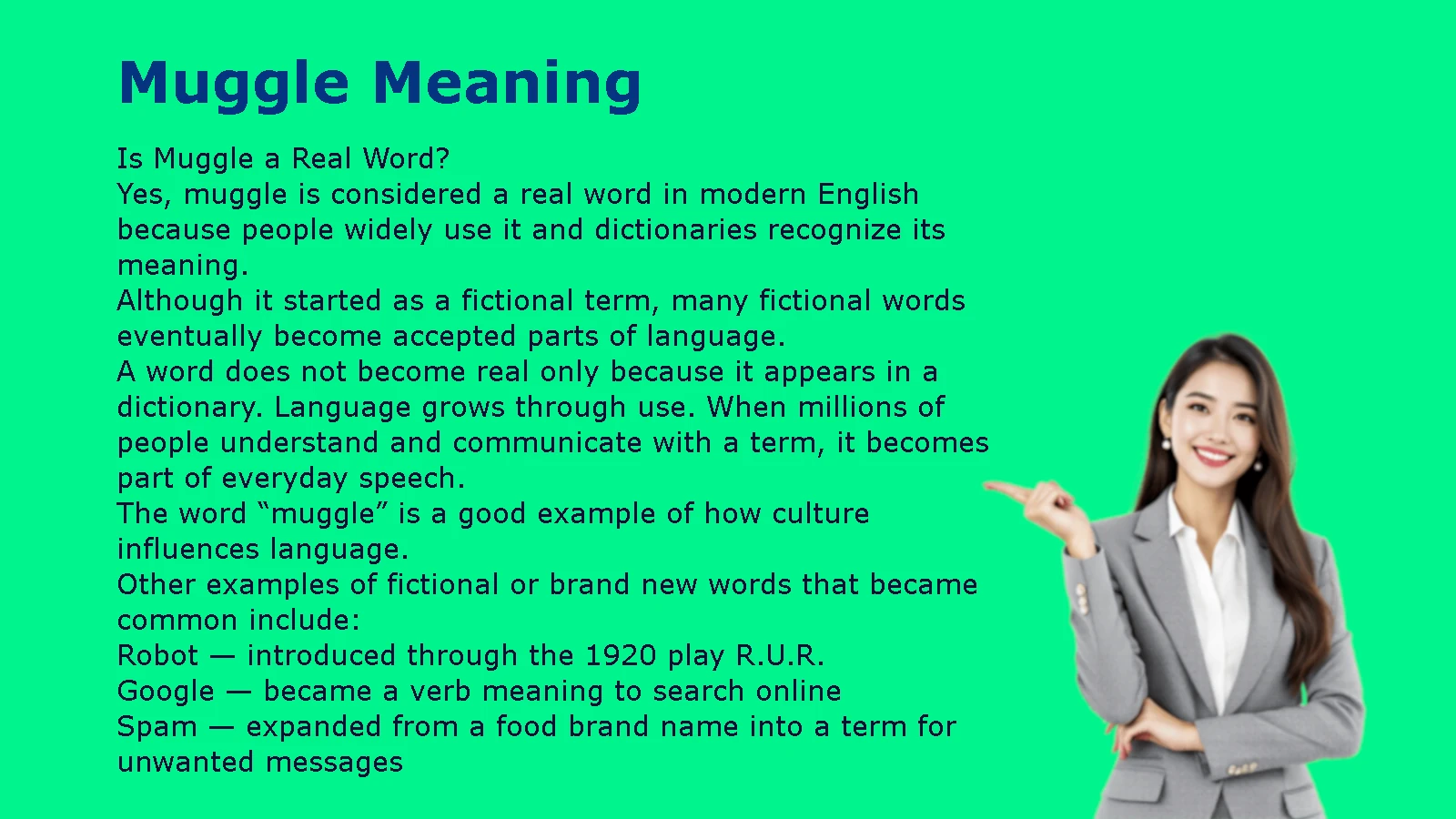
Is Muggle a Real Word?
Yes, muggle is considered a real word in modern English because people widely use it and dictionaries recognize its meaning.
Although it started as a fictional term, many fictional words eventually become accepted parts of language.
A word does not become real only because it appears in a dictionary. Language grows through use. When millions of people understand and communicate with a term, it becomes part of everyday speech.
The word “muggle” is a good example of how culture influences language.
Other examples of fictional or brand new words that became common include:
- Robot — introduced through the 1920 play R.U.R.
- Google — became a verb meaning to search online
- Spam — expanded from a food brand name into a term for unwanted messages
“Muggle” follows a similar path. A fictional idea became a familiar expression.
What Does Muggle Mean in Everyday Conversation?
Outside the Harry Potter world, people usually use muggle in a humorous or informal way.
It often means:
Someone who is unfamiliar with a certain topic, activity, or skill.
The person is not necessarily bad at something. They simply do not understand that particular area.
Common Modern Uses of Muggle
Technology Muggle
A technology muggle is someone who struggles with digital tools.
Example:
“My uncle is a technology muggle. He still asks how to attach files to emails.”
This does not mean the person cannot learn. It simply means technology feels unfamiliar.
Food Muggle
A food muggle may be someone who knows little about cooking or specialty foods.
Example:
“I’m a coffee muggle. I cannot tell the difference between espresso and cold brew.”
Fitness Muggle
A fitness muggle may feel lost in a gym environment.
Example:
“The first time I entered a gym, I was a complete fitness muggle.”
The term creates a funny image of someone entering a world with unfamiliar rules.
Is Calling Someone a Muggle an Insult?
The answer depends on context.
Most of the time, calling someone a muggle is playful. Friends often use it as a joke, especially when talking about hobbies or interests.
However, tone matters.
Friendly Example
“You’re such a coffee muggle. You think all coffee tastes the same.”
This sounds teasing and harmless.
Negative Example
“You’re just a muggle. You wouldn’t understand.”
This sounds dismissive because it suggests the other person is inferior.
The difference comes from intention.
A good rule:
| Situation | Likely Meaning |
| Friends joking | Playful nickname |
| Someone learning something new | Friendly description |
| Used to exclude people | Can sound insulting |
| Used seriously against someone | May feel disrespectful |
A person can be a muggle in one area and an expert in another.
Someone who knows nothing about coding may be brilliant at painting. Someone who struggles with cooking may be excellent at repairing cars.
Everyone starts as a beginner somewhere.
Muggle vs Wizard: Understanding the Difference
The most famous comparison is muggle vs wizard.
In the Harry Potter universe, these two groups represent completely different abilities.
| Feature | Muggle | Wizard |
| Magical ability | None | Can perform magic |
| Uses spells | No | Yes |
| Attends Hogwarts | No | Yes |
| Uses magical objects | Usually unaware | Commonly uses them |
| Lives in ordinary society | Yes | Often hidden among muggles |
A wizard might use a spell to solve a problem. A muggle might use technology, creativity, or practical skills.
Interestingly, the series does not suggest that magic automatically makes someone better.
Many magical characters need help from muggles and muggle inventions.
Muggle vs Witch vs Wizard vs Squib
These terms are often confused because they all describe people connected to the magical world.
Muggle
A muggle is a person with no magical abilities and no magical ancestry required.
Example:
- Hermione Granger’s parents
Wizard
A wizard is a male person who can perform magic.
Example:
- Harry Potter
Witch
A witch is a female person who can perform magic.
Example:
- Hermione Granger
Squib
A squib is different from a muggle.
A squib is born into a magical family but cannot perform magic.
Example:
- Argus Filch
The key difference:
| Term | Born Into Magical Family? | Has Magical Ability? |
| Muggle | Not necessarily | No |
| Wizard | Usually yes or has magical ancestry | Yes |
| Witch | Usually yes or has magical ancestry | Yes |
| Squib | Yes | No |
A squib understands the magical world because they grew up around it. A muggle usually does not know that magic exists.
Examples of Muggle Meaning in Sentences
Understanding the word becomes easier when you see it in different situations.
Fictional Examples
- “Harry discovered that he was not a muggle because he could perform magic.”
- “The wizarding world kept its existence hidden from muggles.”
Casual Examples
- “I’m a complete gardening muggle. I cannot keep a plant alive.”
- “My brother is a car muggle. He does not know how engines work.”
Workplace Examples
- “Before the software training, many employees felt like technology muggles.”
- “The new accounting system confused everyone at first, even experienced workers felt like beginners.”
Humorous Examples
- “I’m a kitchen muggle. My greatest cooking achievement is making toast.”
- “I became a travel muggle when I tried using the airport navigation app.”
Muggle Meaning in Popular Culture and Modern Language
The word muggle meaning has grown beyond its original fantasy setting. Today, it represents more than a person without magical powers. It has become a cultural shortcut for describing someone who is unfamiliar with a particular world.
Every community has its own version of “magic.”
For a musician, music theory might feel natural. For someone who has never played an instrument, those same concepts may seem impossible to understand. A professional chef may easily create a complex dish, while a beginner might struggle to boil pasta correctly.
In those moments, people often use “muggle” as a playful comparison.
The word works because it captures a universal experience:
Everyone is a muggle somewhere.
How Different Communities Use the Word Muggle
The flexibility of the word has allowed it to appear in many fields.
Technology Muggle
Technology changes quickly, and many people feel overwhelmed by new devices and software.
Someone who struggles with digital tools might jokingly call themselves a technology muggle.
Examples:
- “I’m a smartphone muggle. I only use my phone for calls.”
- “My parents are computer muggles, but they are learning.”
- “Artificial intelligence still feels like magic to many technology muggles.”
This usage is usually lighthearted. It does not suggest that someone lacks intelligence.
Finance Muggle
Financial topics often contain complicated terms that confuse beginners.
A person unfamiliar with investing, taxes, or budgeting might describe themselves as a finance muggle.
Examples:
- “I’m a stock market muggle, so I’m learning the basics first.”
- “Cryptocurrency sounds like a different language to financial muggles.”
The term highlights the learning curve rather than a lack of ability.
Sports Muggle
Sports fans often understand rules, strategies, and statistics that casual viewers may not know.
A person who rarely watches sports might joke:
- “I’m a soccer muggle. I don’t understand all the penalties.”
- “My friends are basketball experts, and I’m the basketball muggle.”
The word creates a friendly distinction between experts and newcomers.
Why People Like Using the Word Muggle
The popularity of “muggle” comes from its playful nature.
Unlike words such as “beginner” or “amateur,” muggle adds personality. It creates a small story.
Compare these sentences:
Basic version:
“I don’t understand photography.”
Muggle version:
“I’m a photography muggle.”
The second sentence feels more fun. It turns a weakness into something humorous.
The word also avoids making mistakes feel embarrassing.
Instead of saying:
“I’m bad at technology.”
Someone can say:
“I’m still a technology muggle.”
That small change makes learning feel more approachable.
Muggle Meaning and the Idea of Being a Beginner
One reason the word became popular is that it connects with a common human experience: being new at something.
When you enter an unfamiliar field, everything can feel confusing.
A beginner photographer may not understand camera settings. A new employee may struggle with workplace software. A first time traveler may feel overwhelmed by airport procedures.
At that moment, everyone starts as a “muggle.”
The learning process often follows a simple pattern:
| Stage | Experience |
| Beginner stage | Everything feels confusing |
| Learning stage | Basic rules start making sense |
| Practice stage | Skills improve through experience |
| Expert stage | Knowledge feels natural |
The difference between a beginner and an expert is usually time, practice, and curiosity.
Common Misunderstandings About the Word Muggle
Although the word seems simple, people sometimes misunderstand what it means.
Misunderstanding: Muggles Are Less Important
This is false.
In the Harry Potter universe, muggles lack magic, but they are not worthless. They have their own strengths, creativity, and achievements.
The series shows that courage, kindness, and loyalty do not depend on magical ability.
Misunderstanding: A Muggle Is the Same as a Squib
This is also incorrect.
A muggle is born without magical abilities and usually has no connection to the wizarding world.
A squib is born into a magical family but cannot perform magic.
The difference is background.
Misunderstanding: Muggle Always Means Someone Is Bad at Something
Not true.
When someone says, “I’m a photography muggle,” they usually mean they are unfamiliar with photography.
They might still become excellent with practice.
Real Life Examples of the Word Muggle
Here are examples showing how people use “muggle” naturally.
Example: Learning a New Skill
“I was a coding muggle when I started. Now I can build simple websites.”
Meaning:
- The person began with little knowledge.
- They learned over time.
Example: Entering a New Hobby
“Before joining the gardening club, I was a plant muggle.”
Meaning:
- The person knew very little about gardening.
Example: Understanding a Professional Field
“Legal documents make me feel like a law muggle.”
Meaning:
- The person finds legal language unfamiliar.
Muggle Meaning: Frequently Asked Questions
What is the simple meaning of muggle?
A muggle is a person without magical abilities in the Harry Potter universe.
In everyday conversation, it can mean someone who is unfamiliar with a specific topic or skill.
Is muggle a real word?
Yes. Although it became famous through Harry Potter, people widely use “muggle” in modern language.
Its popularity has made it a recognized term with a meaning beyond fiction.
What is the opposite of a muggle?
In the Harry Potter universe, the opposite of a muggle is usually a witch or wizard.
A witch or wizard has magical abilities, while a muggle does not.
Can muggles use magic?
No. In the Harry Potter universe, muggles cannot perform magic.
They rely on ordinary human skills, knowledge, and technology.
Why are non magical people called muggles?
The term was created by J. K. Rowling for the Harry Potter series.
It provides a simple name for people who do not have magical abilities.
Is calling someone a muggle rude?
Usually, no.
Most people use it as a joke or playful description. However, it can sound rude if someone uses it to exclude or mock another person.
Context matters.
Final Thoughts: Understanding the True Muggle Meaning
Today, “muggle” represents anyone who feels unfamiliar with a particular subject, hobby. It reminds us that every person has areas where they are experienced and areas where they are still learning.
A technology expert may be a cooking muggle. A professional athlete may be a financial muggle. A talented artist may be a science muggle.
Nobody knows everything.
That is what makes the word so relatable. It turns the feeling of being inexperienced into something fun, human, and even a little magical.
Whether you discovered the word through Harry Potter or heard someone use it in everyday conversation, the meaning remains simple: