
Have you ever noticed someone staring at you intensely and wondered what their expression meant? While Glaring Meaning may seem straightforward, the word can describe more than simply looking at someone. It often suggests an angry, annoyed, or intense look, depending on the context, tone, and situation in which it is used.
Glaring usually means looking at someone or something with a fixed, intense, and often angry expression. It can also describe something that is extremely obvious or noticeable, such as a glaring mistake or a glaring problem.
Examples:
- She was glaring at me after I interrupted her.
- The report contained a glaring error.
The confusion is understandable. People often search for what does glaring mean, glaring meaning in text, glaring meaning in chat, or what does it mean when someone is glaring at you because the word can have different meanings depending on how it is used. And here’s the kicker: glaring can describe both an angry look and something that is impossible to ignore.
In this guide, you’ll learn the complete Glaring Meaning, its definition, pronunciation, correct usage, and examples in sentences. You’ll also discover the difference between glaring, staring, and looking, along with the meaning of glaring in texting, common phrases, synonyms, and how to use the word correctly.
What Does Glaring Mean?
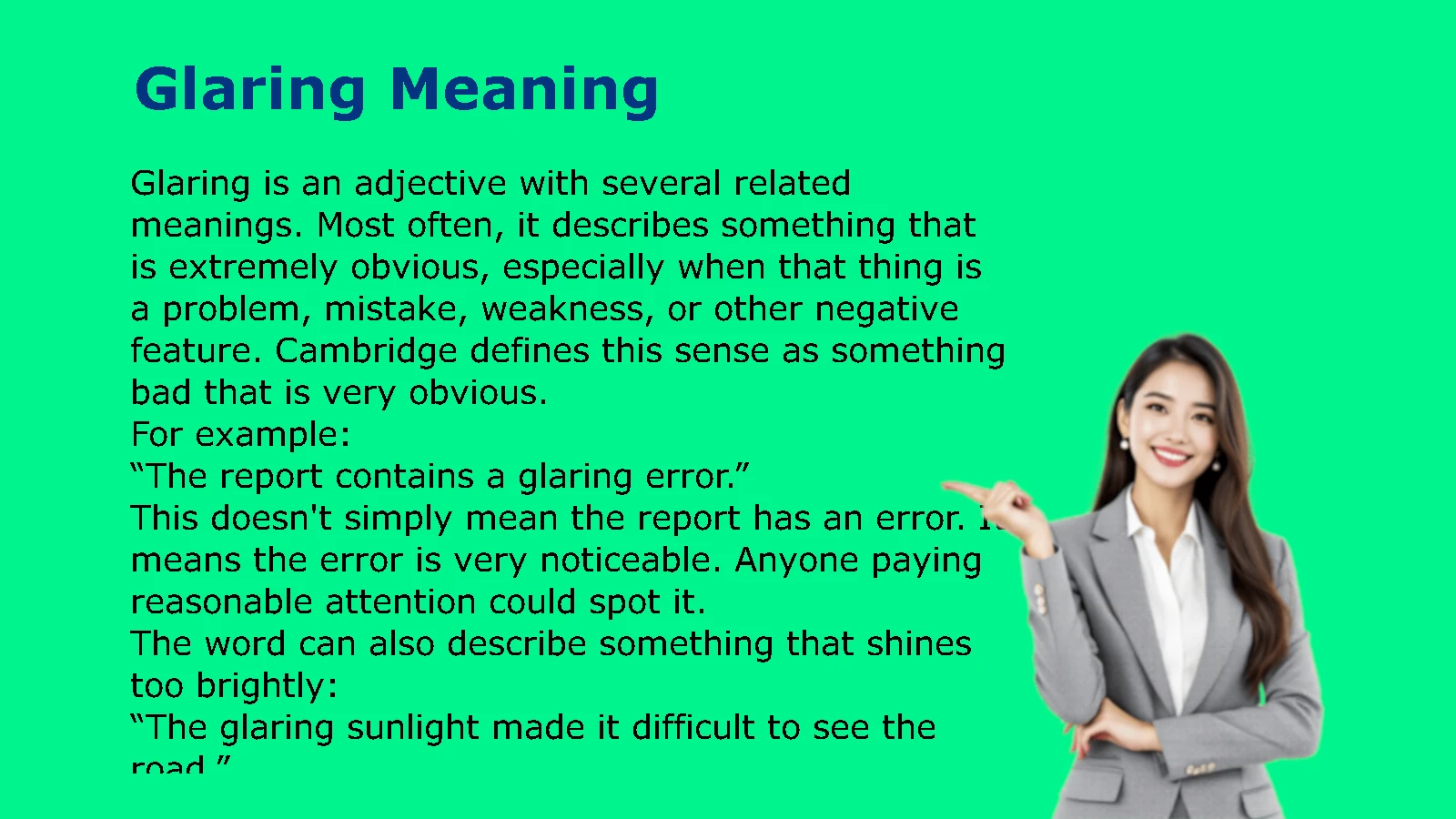
Glaring is an adjective with several related meanings. Most often, it describes something that is extremely obvious, especially when that thing is a problem, mistake, weakness, or other negative feature. Cambridge defines this sense as something bad that is very obvious.
For example:
“The report contains a glaring error.”
This doesn’t simply mean the report has an error. It means the error is very noticeable. Anyone paying reasonable attention could spot it.
The word can also describe something that shines too brightly:
“The glaring sunlight made it difficult to see the road.”
Here, glaring has nothing to do with mistakes. It describes light that feels excessively bright or difficult to look at.
There is also a third use connected to the verb glare:
“He was glaring at me from across the room.”
In this sentence, glaring means looking at someone in an angry, fierce, or hostile way. Merriam Webster lists this as one of the established adjective senses of the word.
Glaring Meaning in Simple Words
In simple English:
Glaring means very obvious, unpleasantly bright, or intensely angry looking, depending on the context.
| Meaning | Simple explanation | Example |
| Very obvious | Easy to notice, especially something wrong | “There was a glaring mistake.” |
| Too bright | Uncomfortably bright or dazzling | “The glaring sunlight hurt my eyes.” |
| Angry looking | Staring fiercely or angrily | “She was glaring at him.” |
The first meaning is especially common in phrases such as glaring error, glaring mistake, glaring omission, and glaring injustice.
Glaring Meaning in English
When glaring describes a problem or negative situation, it means that the problem is conspicuous and difficult to overlook.
Consider these examples:
- A glaring error = an extremely noticeable mistake
- A glaring omission = something important that was obviously left out
- A glaring weakness = a major weakness that is easy to see
- A glaring injustice = an obvious and serious unfairness
- A glaring contradiction = two statements or ideas that clearly conflict
- A glaring difference = a difference that stands out immediately
The adjective often adds emotional weight. Saying something is obvious tells you that it can be easily recognized. Calling it glaring suggests that its visibility is almost uncomfortable.
That distinction matters.
Compare:
“The article contains an obvious error.”
with:
“The article contains a glaring error.”
The second sentence sounds more critical. The error isn’t merely noticeable. It is painfully or conspicuously noticeable.
Merriam Webster describes this sense of glaring as something that is “obtrusively and often painfully obvious.”
Glaring Meaning as “Very Obvious”
The most useful meaning to remember is very obvious, particularly when the subject involves something wrong or undesirable.
Imagine reading a five page report. Everything looks polished until you reach a sentence that says the company earned $10 million in one paragraph and $100 million in another. The contradiction isn’t hidden in some obscure footnote. It practically waves at you.
You could call it a glaring inconsistency.
Examples of Glaring Meaning “Obvious”
- “The editor spotted a glaring spelling error in the headline.”
- “The plan has a glaring weakness.”
- “The investigation uncovered a glaring omission.”
- “There is a glaring contradiction between the two statements.”
- “The team’s defense has a glaring problem.”
- “The report highlights a glaring gap in the available data.”
Notice a pattern: glaring frequently appears before nouns describing problems, flaws, or shortcomings.
That pattern makes the word especially useful in criticism, analysis, journalism, business writing, and academic discussion.
Why Does “Glaring” Sound Stronger Than “Obvious”?
The difference comes down to emphasis.
Obvious is relatively neutral:
“The answer was obvious.”
Glaring usually carries a stronger sense of visibility:
“The error was glaring.”
The second sentence suggests that the error wasn’t simply easy to spot. It was so conspicuous that overlooking it would be difficult to explain.
That’s why writers often choose glaring when they want to draw attention to a serious flaw.
Glaring Meaning as “Too Bright”
The word has a completely different surface meaning when it describes light.
Glaring can mean shining with an excessively bright, harsh, or dazzling light. Cambridge gives examples such as glaring light and glaring colors.
For example:
“The glaring headlights blinded the driver for a moment.”
Here, glaring describes the intensity of the headlights.
Other examples include:
- glaring sunlight
- glaring headlights
- glaring light
- glaring colors
- a glaring screen
- glaring reflections
The idea isn’t simply that something is bright. The brightness is too strong, harsh, or uncomfortable.
Glaring Light vs. Bright Light
These expressions aren’t identical.
Bright light can be pleasant:
“The room was filled with bright morning light.”
Glaring light usually suggests discomfort:
“The glaring afternoon sun made the room difficult to see.”
So if you call something glaring, you’re often signaling that the intensity has crossed a line.
Merriam Webster similarly defines this sense as light that is “uncomfortably bright.”
Glaring Meaning When Describing an Angry Look
There is another important use: glaring can describe someone staring fiercely or angrily.
For example:
“The coach was glaring at the players.”
The coach isn’t merely looking at them. The stare carries anger, hostility, or intense disapproval.
The verb glare means to stare angrily or fiercely, and glaring is its present participle.
More examples:
- “She was glaring at her brother.”
- “He stood in the doorway, glaring.”
- “The customer began glaring at the waiter.”
- “The referee noticed the players glaring at each other.”
This meaning is easy to distinguish from the “obvious” meaning because the grammar usually gives you a clue.
Compare These Two Sentences
“There was a glaring error in the document.”
Here, glaring means extremely obvious.
“She was glaring at me.”
Here, glaring means staring angrily.
The same word appears in both sentences, but the surrounding words reveal the meaning.
Glaring Examples in Sentences
Seeing glaring in different contexts makes its meanings much easier to understand.
Glaring Mistake
“The accountant made a glaring mistake in the final calculation.”
The mistake is obvious and serious enough to stand out.
Glaring Error
“The teacher found a glaring error in the student’s answer.”
The error isn’t subtle. It is easy to recognize.
Glaring Omission
“The proposal has a glaring omission: it doesn’t explain how the project will be funded.”
Something important is missing, and its absence is obvious.
Glaring Weakness
“The team’s lack of defensive depth became a glaring weakness.”
The weakness stands out as a major problem.
Glaring Injustice
“The decision created a glaring injustice.”
The unfairness is clear and difficult to overlook.
Glaring Difference
“There was a glaring difference between the two versions of the contract.”
The difference was highly noticeable.
Glaring Sunlight
“Glaring sunlight reflected off the windshield.”
Here, glaring describes excessive brightness.
Glaring Headlights
“The glaring headlights made it difficult to see the road ahead.”
Again, the word refers to harsh brightness.
Glaring at Someone
“He was glaring at his friend after the argument.”
This time, glaring describes an angry stare.
Common Phrases With Glaring
Some combinations occur naturally in English. Learning these phrases can help you use the word more confidently.
| Phrase | Meaning | Example |
| glaring error | A very obvious error | “The report contains a glaring error.” |
| glaring mistake | An obvious and significant mistake | “That was a glaring mistake.” |
| glaring omission | Something important that was clearly left out | “The proposal has a glaring omission.” |
| glaring problem | A major problem that stands out | “Cost remains a glaring problem.” |
| glaring weakness | An obvious major weakness | “Security is the system’s glaring weakness.” |
| glaring injustice | A very obvious unfairness | “The ruling exposed a glaring injustice.” |
| glaring contrast | A striking difference | “The two results show a glaring contrast.” |
| glaring lack | A conspicuous absence or shortage | “There is a glaring lack of evidence.” |
| glaring gap | An obvious missing area | “The study reveals a glaring gap in the research.” |
| glaring light | Excessively bright light | “The glaring light hurt my eyes.” |
| glaring colors | Extremely bright or showy colors | “The design uses glaring colors.” |
| glaring eyes | Fierce or angry looking eyes | “His glaring eyes made everyone uncomfortable.” |
These aren’t random combinations. Dictionaries specifically record collocations such as glaring contrast, glaring error, glaring omission, glaring problem, and glaring mistake.
Glaring vs. Obvious
Glaring and obvious overlap, but they don’t always carry the same tone.
Obvious means something is easy to understand, recognize, or notice.
Glaring usually pushes the idea further. It often describes something so conspicuous that it is hard to ignore, particularly when the thing is wrong or objectionable.
| Word | Main idea | Typical tone |
| Obvious | Easy to notice or understand | Neutral |
| Glaring | Extremely noticeable and often troubling | Stronger, often negative |
Consider these examples:
“There was an obvious problem.”
This statement simply identifies the problem.
“There was a glaring problem.”
Now the speaker emphasizes the seriousness and visibility of the problem.
That’s why glaring works especially well in criticism.
When Should You Use Glaring Instead of Obvious?
Use glaring when you want to stress that something:
- stands out immediately
- is difficult to overlook
- represents a serious flaw
- creates a strong contrast
- looks clearly wrong or improper
- demands attention
Use obvious when you simply want to say that something is easy to recognize.
Glaring vs. Blatant
Blatant is another close synonym, especially when describing something wrong.
For example:
“It was a blatant attempt to deceive the public.”
You could sometimes use glaring in a similar context:
“It was a glaring attempt to deceive the public.”
However, the emphasis shifts slightly.
Blatant often highlights the openness or shamelessness of an action. Glaring more strongly highlights how conspicuous, obvious, or painfully noticeable something is.
Compare:
- blatant lie → a lie told openly and without much attempt to hide it
- glaring error → an error that stands out unmistakably
- blatant violation → a violation carried out openly or unmistakably
- glaring weakness → a weakness that is especially obvious
Merriam Webster groups glaring and blatant among related words but notes that their emphasis can differ.
Glaring vs. Flagrant
Flagrant is another useful comparison because the two words can describe serious, conspicuous wrongdoing.
Merriam Webster explains that flagrant generally applies to offenses or errors that are so bad they cannot escape notice or be excused. Glaring, by contrast, emphasizes the painful or damaging visibility of something conspicuously wrong, faulty, or improper.
For example:
“The referee made a glaring error.”
The error was obvious.
“The player committed a flagrant violation.”
The violation was serious and clearly unacceptable.
A simple way to remember the difference is:
Glaring = impossible or difficult to overlook.
Flagrant = openly and seriously wrong.
They overlap, but they aren’t interchangeable in every sentence.
Synonyms for Glaring
The best synonym depends on which meaning you’re using.
Synonyms for Glaring Meaning “Very Obvious”
Useful alternatives include:
- obvious
- blatant
- conspicuous
- noticeable
- evident
- apparent
- clear
- striking
- flagrant
- prominent
- stark
- unmistakable
For example:
“A glaring error”
could become:
- “an obvious error”
- “a blatant error”
- “a conspicuous error”
- “a serious error”
The exact choice changes the tone.
Synonyms for Glaring Meaning “Very Bright”
When glaring describes light, useful alternatives include:
- dazzling
- blinding
- harsh
- intense
- brilliant
- bright
- excessive
For example:
“The glaring sunlight”
could become:
“The harsh sunlight”
or
“The dazzling sunlight.”
However, dazzling can sometimes suggest beauty or admiration, while glaring tends to suggest discomfort.
Synonyms for Glaring Meaning “Angry Staring”
When glaring refers to someone’s expression, related words include:
- staring
- scowling
- glowering
- frowning
- looking angrily
- looking fiercely
Glowering can suggest an especially dark or threatening expression. Glaring focuses more directly on the intense stare.
Antonyms of Glaring
Because glaring has several meanings, its opposite changes with the context.
Antonyms for “Very Obvious”
Possible opposites include:
- subtle
- inconspicuous
- hidden
- obscure
- unnoticed
- understated
- unclear
For example:
“A glaring flaw”
contrasts with:
“A subtle flaw.”
The first jumps out at you. The second requires closer attention.
Antonyms for “Too Bright”
Possible opposites include:
- dim
- soft
- muted
- subdued
- gentle
For example:
“glaring light”
contrasts naturally with:
“soft light.”
Is Glaring Always Negative?
Not necessarily.
The answer depends on which meaning you have in mind.
When glaring describes an obvious mistake, omission, weakness, injustice, or problem, it usually has a negative or critical tone. Cambridge specifically describes the “obvious” sense in connection with something bad.
Examples include:
- glaring mistake
- glaring error
- glaring weakness
- glaring injustice
- glaring omission
However, glaring doesn’t automatically mean morally bad.
For example:
“The glaring sunlight filled the room.”
Nothing about sunlight is morally negative. The word simply says the light is excessively bright.
Likewise:
“She was glaring at him.”
The word describes her expression. Whether her anger was justified depends on the situation.
So, glaring itself doesn’t always mean “bad.” Context determines the emotional meaning.
How to Use Glaring Correctly
The adjective glaring commonly appears directly before a noun.
Glaring + Noun
Examples include:
- a glaring mistake
- a glaring error
- a glaring omission
- a glaring weakness
- a glaring problem
- a glaring contradiction
- a glaring difference
- a glaring injustice
- glaring sunlight
- glaring headlights
This structure is extremely common in everyday and formal English.
Glaring as Part of a Verb Phrase
When the word refers to an angry stare, it can function as the present participle of glare:
“She was glaring at him.”
The structure is:
subject + be + glaring + at + person
For example:
“The manager was glaring at the employee.”
“He was glaring at me from across the table.”
The preposition at matters in this construction.
You generally say:
“She was glaring at him.”
rather than:
“She was glaring him.”
Glaring vs. Glared vs. Glare
These related forms can confuse English learners.
| Form | Function | Example |
| glare | Base verb or noun | “Don’t glare at me.” |
| glared | Past tense | “She glared at him.” |
| glaring | Present participle or adjective | “She was glaring at him.” |
| glaringly | Adverb | “The problem was glaringly obvious.” |
The dictionary record for glare confirms glares, glaring, and glared as its major verb forms.
There’s an important distinction here.
“He glared at me.”
means he looked at me angrily in the past.
“He was glaring at me.”
means the angry staring was happening at that time.
But:
“There was a glaring error.”
doesn’t describe anyone’s stare. In this sentence, glaring means extremely obvious.
Glaringly: The Adverb Form
The related adverb glaringly means in an extremely obvious or conspicuous way.
One particularly common expression is:
glaringly obvious
For example:
“The mistake was glaringly obvious.”
This means the mistake was extremely easy to notice.
Other examples include:
- “The difference was glaringly obvious.”
- “The weakness became glaringly apparent.”
- “The two accounts were glaringly different.”
Collins lists glaringly as the adverbial form of glaring.
Is “Glaringly Obvious” Redundant?
At first glance, glaringly obvious might seem repetitive because both words communicate strong visibility.
However, the phrase is well established in English and adds emphasis. Obvious tells you something is easy to recognize. Glaringly intensifies that idea.
It’s similar to saying:
“Extremely obvious.”
In formal writing, though, you shouldn’t use the phrase repeatedly. If every problem in an article is “glaringly obvious,” the expression quickly loses its punch.
Glaring in Formal and Informal Writing
Glaring works comfortably across many types of writing.
In Academic Writing
Academic writers often use it when discussing gaps, contradictions, weaknesses, or errors:
“The study reveals a glaring gap in the existing literature.”
“The researchers identified a glaring inconsistency in the data.”
The word can make criticism more direct. For that reason, writers should use it when the evidence really supports such a strong description.
In Business Writing
It can describe operational or strategic problems:
“The audit revealed several glaring weaknesses in the company’s internal controls.”
“The proposal contains a glaring omission regarding projected costs.”
In Journalism
Journalists may use the word to emphasize conspicuous problems or disparities:
“The investigation uncovered glaring inconsistencies in the official records.”
In Everyday Conversation
The word sounds natural in casual speech, too:
“That’s a glaring mistake.”
“There’s a glaring problem with that plan.”
“The glaring sun is making it hard to drive.”
Its flexibility is one reason glaring remains such a useful English adjective.
A Practical Case Study: Understanding “Glaring” Through Context
Consider three short situations.
Case Study: A Report
A manager reads an employee’s report and notices that the conclusion says sales increased by 20 percent. Earlier, the report says sales fell by 20 percent.
The manager might say:
“There’s a glaring contradiction in this report.”
Why?
Because the contradiction is obvious and significant.
Case Study: Driving at Night
A driver approaches an intersection while another vehicle comes toward them with high beams on.
The driver might say:
“Those glaring headlights are making it hard to see.”
Here, glaring refers to excessively bright light.
Case Study: An Argument
Two people argue over a decision. One person refuses to speak. The other person becomes angry and stares at them intensely.
Someone watching might say:
“She was glaring at him.”
Here, glaring describes an angry stare.
What These Examples Show
The same spelling appears in all three cases:
glaring
Yet the meaning changes according to context.
| Context | Meaning of glaring |
| Report | Extremely obvious |
| Headlights | Excessively bright |
| Argument | Angry or fierce staring |
That’s the key to understanding the word. Don’t interpret glaring in isolation. Look at the words around it.
Glaring Word Origin
Glaring comes from glare. Merriam Webster traces the adjective to the verb and records its first known use in the 14th century.
The history of glare reaches back to Middle English forms. Collins connects the verb with Middle Dutch and Middle Low German forms associated with gleaming or shining.
This history helps explain why the modern word has meanings involving both intense light and an intense stare.
Over time, the idea of something standing out strongly developed into the figurative sense of something being conspicuously obvious.
That gives the modern word a useful conceptual thread:
bright or intense → difficult to ignore → highly conspicuous → painfully obvious
The meanings aren’t completely disconnected. They all involve something that strongly attracts attention.
Facts About the Word “Glaring”
Here are some useful facts to remember:
- Part of speech: Adjective; it can also function as the present participle of glare.
- US pronunciation: /ˈɡler.ɪŋ/ according to Cambridge.
- Common meaning: Extremely obvious, especially something wrong or undesirable.
- Light meaning: Excessively bright or dazzling.
- Staring meaning: Looking fiercely or angrily.
- Related adverb: glaringly
- Related verb: glare
- Past tense: glared
- Common collocations: glaring error, glaring mistake, glaring omission, glaring problem, glaring weakness, glaring injustice.
- First known use of the adjective: Merriam Webster records the 14th century.
Glaring Pronunciation
In US English, glaring is pronounced approximately:
GLAIR ing
Cambridge gives the US pronunciation as /ˈɡler.ɪŋ/.
The first syllable sounds similar to glair, while the second sounds like ing.
Pronunciation Example
glaring → GLAIR ing
The stress falls on the first syllable:
GLAIR ing
This is useful because learners sometimes pronounce the word too slowly or place too much stress on the second syllable.
How to Choose the Right Meaning of Glaring
When you encounter glaring, ask one simple question:
Quick Context Test
“A glaring error”
Obvious.
“Glaring sunlight”
Too bright.
“He was glaring at me.”
Angry stare.
Once you notice this pattern, the word becomes much easier to understand.
Common Mistakes When Using Glaring
Although glaring is straightforward, a few mistakes are worth avoiding.
Mistake: Treating Glaring as a Synonym for Obvious in Every Situation
Not every use of glaring means “obvious.”
“Glaring headlights”
doesn’t mean “obvious headlights.”
It means very bright headlights.
Mistake: Assuming Glaring Always Means Something Is Wrong
That’s true for many figurative uses, but not all.
“The glaring sunlight entered through the window.”
The sunlight may be inconvenient, but the word doesn’t imply wrongdoing.
Mistake: Confusing Glaring With Glared
“He glared at me.”
Past tense.
“He was glaring at me.”
Ongoing action.
“It was a glaring error.”
Adjective meaning extremely obvious.
The surrounding grammar makes the difference clear.
Mistake: Overusing Glaring
Because glaring is strong, it works best when something genuinely stands out.
Compare:
“There was a glaring error in the report.”
with:
“There was a glaring typo in every sentence.”
The second may sound exaggerated unless the errors are truly severe and conspicuous.
Strong adjectives work best when you use them selectively.
Glaring Meaning: Synonyms at a Glance
| Meaning | Strong alternatives |
| Very obvious | obvious, blatant, conspicuous, evident, unmistakable |
| Clearly wrong | blatant, flagrant, conspicuous, serious |
| Very bright | dazzling, blinding, harsh, intense |
| Angry staring | scowling, glowering, staring fiercely |
No synonym matches glaring perfectly in every context. The best replacement depends on the sentence and the tone you want.
Frequently Asked Questions About Glaring Meaning
What does glaring mean?
Glaring usually means extremely obvious, especially when describing a mistake, problem, weakness, omission, or injustice. It can also mean uncomfortably bright when describing light or staring angrily when describing a person.
Does glaring mean obvious?
Yes, in one of its main uses. Glaring means something is so obvious or conspicuous that it is difficult to overlook. It often carries more emphasis and a more negative tone than obvious.
What is an example of glaring?
Here are three examples:
- “The editor found a glaring error.”
- “The glaring sunlight made it difficult to see.”
- “He was glaring at me.”
Each sentence demonstrates a different meaning.
Is glaring positive or negative?
It depends on the context. When glaring describes an error, weakness, injustice, or problem, it usually has a negative or critical tone. When it describes bright light, it simply indicates excessive brightness.
What is another word for glaring?
For the “obvious” meaning, useful synonyms include obvious, blatant, conspicuous, evident, striking, and unmistakable. For bright light, alternatives include dazzling, blinding, harsh, and intense.
What is the difference between glaring and obvious?
Obvious means easy to notice or understand. Glaring usually emphasizes that something is extremely conspicuous, often because it is clearly wrong, faulty, or objectionable.
What does glaring light mean?
Glaring light means light that is too bright, harsh, or dazzling to look at comfortably.
What does glaring at someone mean?
Glaring at someone means looking at them with an intense, fierce, or angry expression.
Is glaring an adjective?
Yes. Glaring commonly functions as an adjective, as in “a glaring error.” It is also the present participle of the verb glare, as in “She was glaring at him.”
What does a glaring mistake mean?
A glaring mistake is a mistake that is very obvious and difficult to overlook. The phrase often suggests that the mistake is significant enough to stand out immediately.
What does a glaring omission mean?
A glaring omission is something important that has been left out in a way that is obvious and noticeable.
What does a glaring weakness mean?
A glaring weakness is a major weakness that stands out clearly. It often refers to a flaw in a plan, argument, system, team, or strategy.
Glaring Meaning: Quick Summary
The word glaring packs several related ideas into one adjective. In its most common figurative sense, it describes something extremely obvious and difficult to overlook, particularly a problem or flaw.
It can also describe harshly bright light or an angry, fierce stare.
| Glaring meaning | Example | What it tells you |
| Extremely obvious | “A glaring error” | The error is impossible or difficult to overlook |
| Too bright | “Glaring sunlight” | The light is harsh or uncomfortable |
| Angry stare | “She was glaring at him” | She was looking at him fiercely or angrily |
The easiest way to remember glaring meaning is to think about intensity. A glaring mistake stands out. Glaring light overwhelms your eyes. A glaring stare feels piercing.
In every case, something demands attention.
That is the heart of the word: glaring describes something that refuses to fade into the background.