
Have you ever heard someone say “gassed up” and wondered what they really meant? While Gassed Up Meaning may seem confusing at first, this slang phrase usually describes someone who has been made to feel overly confident, excited, or full of themselves. The exact meaning can change depending on the conversation, tone, and context.
Gassed up is an informal slang expression that can mean being hyped, praised, encouraged, or made to feel overly confident. It can describe someone who gets a big boost of confidence from compliments or attention, or someone who becomes very excited about something.
Examples:
- My friends gassed me up before the big game.
- He got so gassed up after everyone praised his new haircut.
The confusion is understandable. People often search for what does gassed up mean, gassed up meaning in text, gassed up meaning in slang, or gassed up meaning in chat because the phrase doesn’t mean exactly what its individual words suggest. And here’s the kicker: depending on the situation, being gassed up can be positive, playful, or slightly critical.
In this guide, you’ll learn the complete Gassed Up Meaning, its definition, pronunciation, origin, correct usage, and examples in sentences. You’ll also discover gassed up meaning in texting, how to use it in conversation, whether it is positive or negative, and other slang phrases with a similar meaning.
What Does “Gassed Up” Mean?
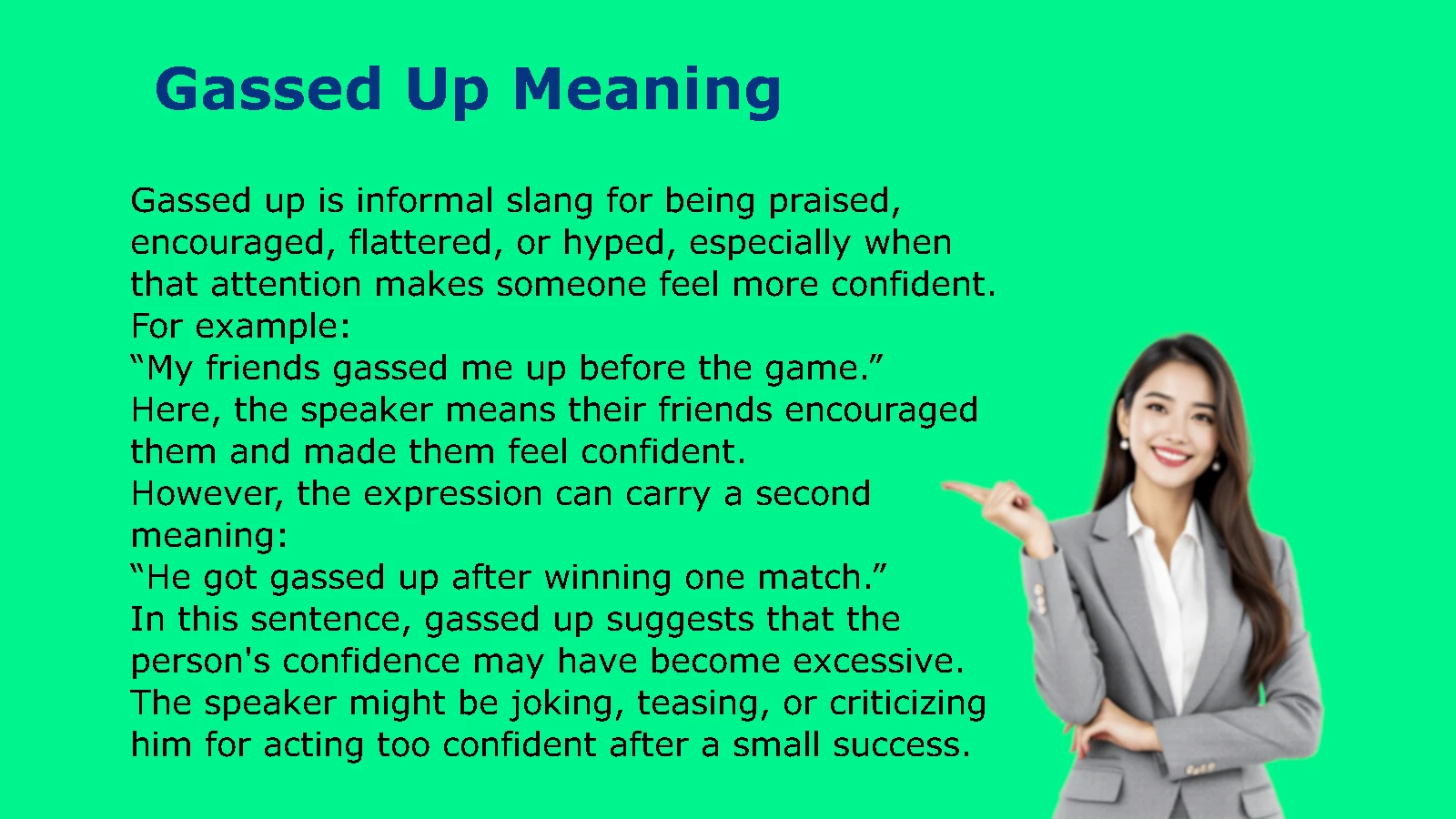
Gassed up is informal slang for being praised, encouraged, flattered, or hyped, especially when that attention makes someone feel more confident.
For example:
“My friends gassed me up before the game.”
Here, the speaker means their friends encouraged them and made them feel confident.
However, the expression can carry a second meaning:
“He got gassed up after winning one match.”
In this sentence, gassed up suggests that the person’s confidence may have become excessive. The speaker might be joking, teasing, or criticizing him for acting too confident after a small success.
Gassed Up Meaning at a Glance
| Expression | Meaning |
| Gassed up | Praised, encouraged, hyped, or made more confident |
| Gas someone up | Praise or encourage someone, often enthusiastically |
| Getting gassed up | Receiving lots of praise or attention |
| Too gassed up | Too confident or full of yourself |
| Don’t get gassed up | Don’t let praise make you overconfident |
The phrase is informal, so you’ll hear it more often in casual conversations, messages, comments, and social situations than in formal writing.
Gassed Up Meaning in Slang
The slang meaning becomes clearer when you focus on the relationship between praise and confidence.
Imagine that you show your friends a drawing you’ve made. They tell you it looks amazing, say you’re incredibly talented, and keep encouraging you to share more of your work. You walk away feeling much more confident.
Your friends gassed you up.
That doesn’t automatically mean they were being dishonest. They may genuinely believe what they said. The expression simply emphasizes how strongly their praise affected your confidence.
On the other hand, suppose someone receives a few compliments and immediately starts acting as though they’re better than everyone else. Someone might say:
“His friends gassed him up too much.”
Now the phrase carries a more critical edge. The issue isn’t the compliment itself. It’s the inflated confidence that followed it.
Positive Use of “Gassed Up”
Sometimes being gassed up is completely positive.
A friend might encourage you before:
- A test
- A sports game
- A performance
- A presentation
- A competition
- A difficult conversation
- A creative project
For example:
“I was nervous about presenting, but my friends gassed me up before class.”
Here, the phrase means they boosted the speaker’s confidence.
Negative Use of “Gassed Up”
The expression can also point toward excessive confidence.
“He got gassed up after one good performance.”
This suggests that the person may now think they’re much better than they actually are.
In this sense, gassed up is close to overconfident, cocky, or full of yourself.
What Does “Gassing Someone Up” Mean?
Gassing someone up means giving that person a lot of praise, encouragement, or hype.
The structure is straightforward:
gas someone up → gassed someone up
For example:
“Her friends were gassing her up before the audition.”
The friends were encouraging her and making her feel confident.
Compare that with:
“She was gassed up by her friends.”
The first sentence focuses on what the friends did. The second focuses on the person receiving the praise.
Common Forms of the Expression
| Form | Example | Meaning |
| Gas someone up | “I always gas my friends up.” | Praise or encourage someone |
| Gassing someone up | “They’re gassing him up.” | They are praising or hyping him |
| Gassed someone up | “We gassed her up before the event.” | We encouraged her |
| Got gassed up | “I got gassed up by my friends.” | My friends boosted my confidence |
| Gassed up | “He’s getting too gassed up.” | He’s becoming too confident |
The expression works especially well in casual conversation because it packs a lot of meaning into just a few words.
Is “Gassed Up” a Compliment or an Insult?
Here’s where context matters.
Gassed up isn’t automatically positive or negative. The surrounding words, situation, and speaker’s tone usually tell you how to interpret it.
| Context | Likely meaning |
| “My teammates gassed me up before the game.” | Encouraged me |
| “My sister always gasses me up.” | Gives me compliments and confidence |
| “Everyone was gassing him up online.” | Praising or hyping him |
| “Don’t get gassed up over one compliment.” | Don’t become overconfident |
| “His friends have him completely gassed up.” | They may have inflated his ego |
A useful rule is:
If the phrase focuses on helping someone feel better, it’s usually positive. If it focuses on someone thinking they’re better than everyone else, it’s usually negative.
A Simple Example
Consider two situations.
Situation one: You have to give a speech and you’re nervous. Your friends tell you that you’ve prepared well and can handle it.
You could say:
“They gassed me up before my speech.”
That’s a positive confidence boost.
Situation two: You win one small contest and then start telling everyone you’re unbeatable.
A friend might joke:
“Okay, don’t get too gassed up.”
Now the phrase gently brings you back down to earth.
Gassed Up Meaning in a Sentence
Seeing the phrase in different contexts makes its meaning much easier to recognize.
Examples of “Gassed Up”
- “My friends gassed me up before the competition.”
They encouraged me and boosted my confidence. - “She got gassed up by all the compliments.”
The compliments made her feel very confident. - “Everyone was gassing him up after his performance.”
Everyone was praising him. - “Don’t get gassed up just because someone complimented you.”
Don’t let the praise make you overly confident. - “His teammates really gassed him up.”
His teammates gave him plenty of encouragement. - “I needed someone to gas me up before I walked onstage.”
I needed someone to make me feel more confident. - “They’re gassing her up in the comments.”
People are praising or hyping her in the comments. - “He got so gassed up that he stopped listening to advice.”
His confidence became excessive.
Gassed Up vs. Hyped Up
Gassed up and hyped up overlap, but they’re not always identical.
Hyped up usually emphasizes excitement, energy, or anticipation.
Gassed up often emphasizes confidence created by praise or encouragement.
Compare these examples:
“I’m hyped up for the concert.”
This means you’re excited about the event.
“My friends gassed me up before the concert.”
This means your friends encouraged you or made you feel confident or excited.
The two expressions can overlap, especially in casual slang. Still, gassed up often has a stronger connection to praise and ego.
Quick Comparison
| Expression | Main idea |
| Gassed up | Confidence boosted by praise or encouragement |
| Hyped up | Excited, energized, or enthusiastic |
| Pumped up | Very energized or excited |
| Boosted | Made more confident or positive |
| Flattered | Pleased because of praise |
That distinction helps explain why you can be hyped up for an event without necessarily being gassed up by another person.
Gassed Up vs. Boosted
These expressions have similar meanings when gassed up refers to increased confidence.
For example:
“My coach boosted my confidence.”
and:
“My coach gassed me up.”
Both sentences suggest that the coach made the speaker feel more confident.
The difference is register.
Boosted my confidence works in almost any setting. Gassed me up sounds much more informal and conversational.
If you’re writing a school essay, professional email, or formal report, encouraged me or boosted my confidence will usually fit better.
If you’re chatting with friends, gassed me up can sound perfectly natural.
Gassed Up vs. Overconfident
These terms aren’t exact synonyms either.
Someone who is overconfident has more confidence than their actual ability or situation justifies.
Someone who is gassed up may simply have received a lot of praise.
For example:
“My friends gassed me up before the presentation.”
There’s no suggestion that the speaker became arrogant.
But:
“He got so gassed up that he thought he couldn’t fail.”
Now gassed up describes confidence that has crossed into overconfidence.
So the phrase can describe the process that produces inflated confidence, while overconfident describes the resulting attitude.
Why Does “Gassed Up” Refer to Praise?
The expression belongs to a broader family of informal uses built around gas and gassing. Modern slang uses gas someone up for the idea of giving someone praise or hype that inflates their confidence.
The exact path of slang expressions can be difficult to pin down. Dictionary and slang references document the expression’s meaning, but that doesn’t mean every popular explanation of its origin is reliable.
Wiktionary records gassed up as an adjective meaning to have an inflated ego or to falsely believe you’re of higher status.
That definition captures an important part of the expression: the idea of confidence being inflated.
It’s also useful to separate this expression from other meanings of gassed. The word has several unrelated slang uses, which can make context especially important.
Other Meanings of “Gassed”
Here’s where English gets a little tricky.
Gassed doesn’t always mean praised or overconfident. The standalone word has several meanings in different varieties of English.
Cambridge Dictionary lists gassed as informal UK English for very excited and US English for extremely tired or having drunk too much alcohol.
Merriam-Webster also records gassed as slang meaning drunk and drained of energy, spent, or exhausted.
That means these sentences can mean very different things:
| Sentence | Likely meaning |
| “My friends gassed me up.” | They praised or encouraged me |
| “I’m gassed about the event.” | I’m very excited |
| “I’m gassed after that workout.” | I’m exhausted |
| “The team looked gassed.” | The team looked tired or spent |
Context does the heavy lifting.
Gassed Up vs. Gassed
Adding up changes the expression.
“I’m gassed.” can have several meanings depending on regional usage.
“They gassed me up.” is much more specifically about praise, encouragement, or hype.
This is one reason you shouldn’t assume that every appearance of gassed has the same meaning.
Gassed Up Meaning on Social Media
On social media, gassed up often appears when people talk about compliments, attention, appearance, achievements, or confidence.
Someone might post a picture and receive dozens of supportive comments. A friend could respond:
“They’re really gassing you up.”
That means people are giving the person plenty of praise.
The phrase can also be playful:
“Y’all are gassing me up too much.”
Here, the speaker may be jokingly acknowledging that they’re receiving a lot of compliments.
Another common pattern involves someone becoming overly confident after receiving praise:
“The comments got him gassed up.”
The meaning is roughly:
The positive attention made him feel extremely confident.
Whether that’s admiration or criticism depends on the surrounding conversation.
Why Context Matters Online
Online communication removes many of the clues you get from face-to-face conversation. You can’t always hear whether someone is joking, teasing, admiring, or criticizing.
That’s why the same phrase can carry different shades of meaning.
For example:
“You’re gassed up 😂”
could be playful teasing.
Meanwhile:
“You’re way too gassed up.”
sounds more openly critical.
The words around gassed up matter.
How to Use “Gassed Up” Correctly
If you want to use the expression naturally, remember that it belongs mainly to informal English.
Common Sentence Patterns
Gas + person + up
“I need to gas my friend up before her performance.”
Get + gassed up
“He got gassed up after everyone complimented him.”
Be + gassed up
“She’s completely gassed up right now.”
Keep + person + gassed up
“His friends keep him gassed up.”
These patterns let you describe both the action and its effect.
When You Should Avoid It
Because gassed up is slang, it isn’t the best choice for every situation.
For example, in a formal academic paper, you might write:
- encouraged
- praised
- motivated
- boosted confidence
- increased self-confidence
Instead of:
“The teacher gassed the student up.”
In a casual conversation, however, the slang version may sound more natural.
Gassed Up Synonyms
There isn’t one perfect synonym because gassed up has several shades of meaning.
Encouraged
- encouraged
- motivated
- supported
- reassured
- inspired
- boosted
Praised
- praised
- complimented
- flattered
- celebrated
- admired
It Means Made More Confident
- boosted
- encouraged
- reassured
- empowered
- built up
When It Means Overconfident
- cocky
- arrogant
- conceited
- self-important
- full of yourself
It Means Excited
- hyped
- pumped
- energized
- fired up
- enthusiastic
The important point is that these aren’t interchangeable in every sentence.
For example, flattered focuses on receiving praise. Hyped focuses on excitement. cocky focuses on excessive confidence. Gassed up can sit somewhere between these ideas.
A Practical Case Study: How the Meaning Changes
Consider this short scenario.
Jordan has a big presentation coming up. Jordan feels nervous, so three friends tell Jordan that the presentation is going to go well. They remind Jordan about the preparation that went into it and point out what Jordan does well.
Jordan says:
“My friends really gassed me up.”
Here, gassed up means encouraged and made more confident.
Now imagine Jordan gives the presentation successfully. Afterward, Jordan starts telling everyone that nobody else could have done as well.
A friend says:
“Okay, you’re getting gassed up now.”
The meaning has shifted slightly. The friend is suggesting that Jordan’s confidence has become excessive.
What Changed?
| Stage | Meaning |
| Before the presentation | Encouragement |
| During preparation | Confidence boost |
| After success | Increased confidence |
| Excessive boasting | Inflated ego |
This example shows why a dictionary-style definition alone doesn’t tell the whole story. The social context determines the shade of meaning.
Common Ways People Use “Gassed Up”
You’ll typically encounter the phrase in a few recurring situations.
Friends Giving Compliments
“My friends gassed me up after I finished the project.”
The friends praised the speaker.
Encouragement Before a Challenge
“She gassed me up before the tryout.”
She encouraged the speaker and helped build confidence.
Praise After an Achievement
“Everyone gassed him up after he won.”
People gave him lots of positive attention.
Teasing Someone About Their Ego
“Don’t get gassed up now.”
The speaker is warning someone not to become too confident.
Online Praise
“The comments are gassing her up.”
People are giving her compliments or enthusiastic support.
Is “Gassed Up” the Same as “Full of Yourself”?
Not exactly.
If someone is full of themselves, they consistently behave as though they’re extremely important, talented, or impressive.
If someone is gassed up, the phrase can suggest that something caused or encouraged that confidence, especially praise from other people.
Compare:
“He’s full of himself.”
This describes a personality or attitude.
“His friends gassed him up.”
This describes what his friends did.
“His friends gassed him up, and now he’s full of himself.”
Now the relationship between the two ideas becomes obvious.
Praise → increased confidence → possible overconfidence.
That’s the basic social meaning behind many uses of the phrase.
Is “Gassed Up” the Same as “Hyped”?
Sometimes, but not always.
If someone says:
“I’m hyped for the weekend.”
They’re saying they’re excited.
If someone says:
“My friends gassed me up for the weekend.”
They’re emphasizing the encouragement or praise they received.
However, informal slang changes quickly, and speakers don’t always use these expressions with strict boundaries. In some contexts, gassed up can simply carry a broader sense of being excited or energized.
Cambridge records gassed as meaning very excited in UK informal usage.
So regional usage matters.
Regional Differences in “Gassed”
One of the easiest mistakes is assuming that slang works identically everywhere.
Gassed can mean different things across varieties of English. Cambridge, for example, distinguishes an excited UK use from tired and intoxicated US uses.
Meanwhile, gassed up in the sense of having one’s ego inflated is a separate expression that appears in slang usage.
This creates an important distinction:
Gassed and gassed up shouldn’t automatically be treated as interchangeable.
If someone says:
“I’m gassed after running.”
they may mean exhausted.
If someone says:
“My friends gassed me up before the race.”
they mean encouraged or praised me.
If someone says:
“I’m gassed about the race.”
in a context where that usage is familiar, they may mean excited.
The surrounding words usually reveal the intended meaning.
Gassed Up Meaning: Common Mistakes
Mistake: Treating It as Always Positive
Gassed up can be positive, but it can also suggest an inflated ego.
Mistake: Treating It as Always Negative
Likewise, it doesn’t always mean arrogance. Friends can genuinely gas someone up to make them feel confident.
Mistake: Assuming “Gassed” and “Gassed Up” Mean the Same Thing
They don’t necessarily.
The phrase gassed up has a more specific slang meaning related to praise, hype, or inflated confidence.
Mistake: Using It in Every Situation
It’s informal slang. A formal setting may call for words such as encouraged, praised, or motivated.
Mistake: Ignoring Regional Usage
The standalone word gassed has different meanings in different varieties of English.
Frequently Asked Questions About Gassed Up Meaning
What does “gassed up” mean?
Gassed up usually means someone has been praised, encouraged, flattered, or hyped, especially when that attention increases their confidence. It can also suggest that someone has become overly confident.
What does “gassing someone up” mean?
Gassing someone up means giving them praise, encouragement, or hype. For example, if your friends repeatedly tell you how well you performed, they may be gassing you up.
Is “gassed up” slang?
Yes. Gassed up is an informal slang expression. It’s more natural in casual speech, texting, online conversations, and friendly interactions than in formal writing.
Is being gassed up a good thing?
It depends on the context. If someone is nervous and friends give them encouragement, being gassed up can be positive. If praise makes someone arrogant, the phrase can have a negative or teasing meaning.
What does “don’t get gassed up” mean?
It usually means don’t let praise or success make you too confident. Depending on the speaker’s tone, it can be serious advice or playful teasing.
What does “gassed up by my friends” mean?
It means your friends praised, encouraged, complimented, or hyped you up. The phrase may also imply that their praise made you feel more confident than before.
What does “he’s gassed up” mean?
It usually means he’s feeling very confident, often because other people have praised or encouraged him. In some contexts, it can suggest that he’s becoming too confident or arrogant.
What does “she gassed me up” mean?
It means she made you feel more confident through praise, encouragement, or compliments.
Is “gassed up” the same as “hyped up”?
Not quite. Hyped up usually focuses on excitement or anticipation. Gassed up often focuses more on praise and the confidence that praise creates. The expressions can overlap in casual speech.
What is another word for “gassed up”?
Depending on the context, alternatives include encouraged, praised, complimented, flattered, boosted, hyped, motivated, or overconfident. No single synonym works in every situation.
Can “gassed up” mean confident?
Yes. In many casual contexts, it describes someone whose confidence has increased because of praise or attention. It can sometimes imply overconfidence rather than ordinary confidence.
Gassed Up Meaning: Quick Reference
| Question | Answer |
| Basic meaning | Praised, encouraged, hyped, or made more confident |
| Slang? | Yes |
| Can it be positive? | Yes |
| Can it be negative? | Yes |
| Can it imply arrogance? | Yes |
| “Gas someone up” meaning | Praise or encourage someone |
| “Got gassed up” meaning | Received lots of praise or encouragement |
| “Don’t get gassed up” meaning | Don’t become overly confident |
| Similar words | Hype, encourage, praise, boost, flatter |
| Best setting | Casual conversation and informal writing |
Final Takeaway on Gassed Up Meaning
The simplest answer to “What does gassed up mean?” is: it means being praised, encouraged, hyped, or given a confidence boost, often by other people.
However, there’s a little more to it. Gassed up can describe healthy encouragement, playful praise, or confidence that has grown into an inflated ego. Context determines which meaning fits.
If someone says, “My friends gassed me up,” they probably mean their friends made them feel confident or good about themselves. If someone says, “Don’t get too gassed up,” they’re probably warning that the confidence is starting to get out of hand.
In short:
Gas someone up → praise or encourage them.
Get gassed up → receive that praise or encouragement.
Be too gassed up → become overly confident or full of yourself.
That’s why the phrase can sound supportive in one conversation and teasing in the next. The words stay the same, but the context changes the meaning.