
Have you ever noticed someone looking closely at something and wondered what “eyeing” really means? While Eyeing Meaning may seem straightforward, this word can describe more than simply looking. Its meaning can change depending on the context, tone, and situation in which it’s used.
Eyeing means looking at someone or something closely, carefully, or with a particular intention. It is often used when a person is paying special attention to something they want, are interested in, or are considering.
Examples:
- She was eyeing the cake on the table.
- He kept eyeing the new car in the showroom.
The confusion is understandable. People often search for what does eyeing mean, eyeing meaning in text, eyeing meaning in chat, or what does it mean when someone is eyeing you because the word can suggest simple observation, interest, desire, suspicion, or even attraction depending on the situation. In other words, a quick glance and a meaningful stare aren’t always the same thing.
In this guide, you’ll learn the complete Eyeing Meaning, its definition, pronunciation, correct usage, and examples in sentences. You’ll also discover the difference between eyeing, looking, staring, and watching, along with common phrases and examples that show how to use eyeing correctly.
What Does Eyeing Mean?
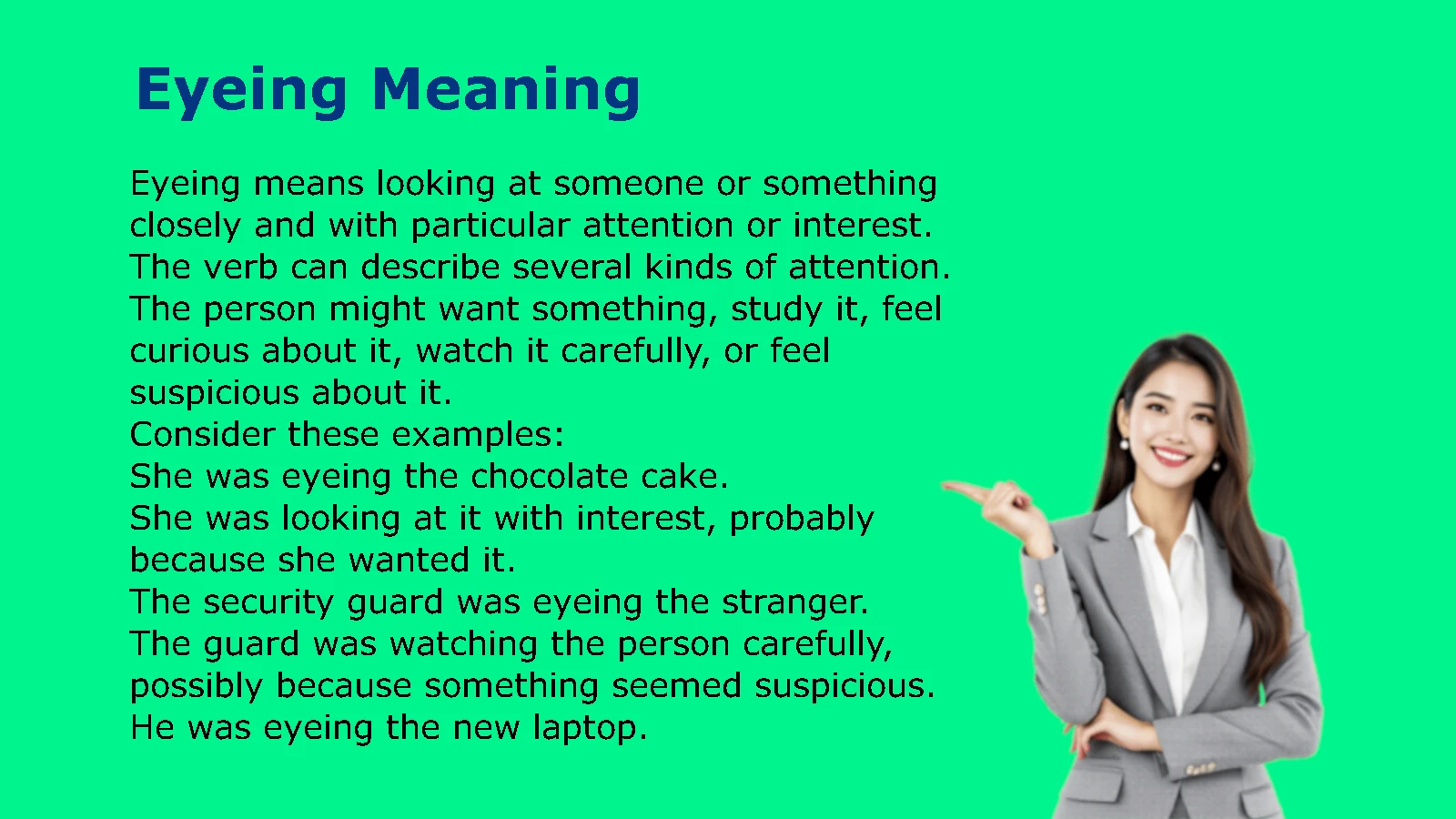
Eyeing means looking at someone or something closely and with particular attention or interest.
The verb can describe several kinds of attention. The person might want something, study it, feel curious about it, watch it carefully, or feel suspicious about it.
Consider these examples:
- She was eyeing the chocolate cake.
She was looking at it with interest, probably because she wanted it. - The security guard was eyeing the stranger.
The guard was watching the person carefully, possibly because something seemed suspicious. - He was eyeing the new laptop.
He was looking at the laptop with interest and may have been considering buying it. - The coach was eyeing several young players.
The coach was watching them closely because they might be useful to the team.
So, the simplest eyeing definition is:
Eyeing means looking closely at someone or something with interest, attention, or a particular purpose.
The context tells you what kind of interest the speaker means.
Eyeing Meaning in Simple Words
In very simple English, eyeing means looking at something carefully because it has caught your attention.
It often carries more meaning than the ordinary verb looking.
Compare:
“She was looking at the shoes.”
This only tells you where she directed her eyes.
Now compare:
“She was eyeing the shoes.”
This suggests that the shoes have caught her attention. She may like them, want them, or be thinking about buying them.
That’s the key difference.
Eyeing Definition and Part of Speech
Eyeing is the present participle of the verb “eye.” The past tense and past participle are eyed. Cambridge lists the present participle as eyeing or eying.
The word eye normally functions as a noun when it refers to the organ used for seeing. However, English also uses eye as a verb.
Eye as a Noun
As a noun, an eye is the organ you use to see.
Example:
Her eyes were bright in the sunlight.
Eye as a Verb
As a verb, eye means to look at someone or something with attention or interest.
Example:
He eyed the unfamiliar package carefully.
Eyeing as a Verb Form
When you add -ing, you get eyeing.
Eye → eyeing
Examples include:
- She is eyeing the dessert.
- He was eyeing the empty chair.
- They are eyeing a new opportunity.
- The dog kept eyeing the food.
- The manager was eyeing several candidates.
The construction usually takes a direct object because eye works as a transitive verb.
She was eyeing the dress.
He was eyeing the stranger.
They were eyeing the prize.
The noun after “eyeing” identifies the person or thing receiving the person’s attention.
What Does Eyeing Someone Mean?
Eyeing someone means looking at that person closely or with noticeable interest.
However, it doesn’t automatically mean romantic or sexual attraction. Context matters.
For example:
The detective was eyeing the suspect.
Here, the detective probably watches the suspect carefully because of suspicion.
Now consider:
She was eyeing him across the room.
This could suggest attraction, curiosity, or simple interest. The sentence alone doesn’t tell you exactly why she is looking at him.
Finally:
The child was eyeing the magician.
This probably means the child was watching the magician with curiosity.
Different Meanings of Eyeing Someone
| Context | What “eyeing” may suggest | Example |
| Attraction | Romantic or physical interest | She was eyeing him from across the room. |
| Suspicion | Careful or doubtful observation | The guard was eyeing the stranger. |
| Curiosity | Interest in finding out more | The child was eyeing the unusual machine. |
| Competition | Watching a rival closely | The player was eyeing his opponent. |
| Evaluation | Judging or assessing someone | The manager was eyeing the applicants. |
This is why it can be misleading to treat eyeing someone as a synonym for flirting. Sometimes it is. Sometimes it isn’t.
What Does Eyeing Something Mean?
Eyeing something means looking at it closely or with particular interest.
The phrase often suggests that the person wants, considers, evaluates, or is attracted to the object.
For example:
He was eyeing the last piece of pizza.
The sentence creates a small story in your head. He isn’t merely noticing the pizza. He probably wants it.
Likewise:
She was eyeing a new apartment.
Here, she may be considering renting or buying it.
The word can also describe strategic interest:
The company is eyeing expansion into a new market.
In that sentence, eyeing doesn’t mean someone is literally looking at a market. It means the company is considering or targeting that opportunity.
Literal and Figurative Eyeing
| Use | Meaning | Example |
| Literal | Looking closely | He was eyeing the strange object. |
| Desire | Looking because you want something | She was eyeing the cake. |
| Evaluation | Assessing something | The buyer was eyeing the used car. |
| Ambition | Considering a goal | The team is eyeing the championship. |
| Strategy | Considering an opportunity | The company is eyeing international expansion. |
This figurative use makes eyeing especially common in news, sports, business, and everyday conversation.
Eyeing Someone With Interest
When someone is eyeing another person with interest, the look usually shows that the person has attracted their attention.
That interest could be romantic, social, professional, or simply curious.
For example:
She noticed a customer eyeing her handmade jewelry.
The customer may be considering a purchase.
Or:
He kept eyeing the new employee.
That could mean he was curious about the person or evaluating them.
The phrase with interest narrows the meaning, but it still doesn’t necessarily mean attraction.
Does Eyeing Someone Mean They Like Them?
Not necessarily.
Someone can eye another person because they:
- find them attractive
- are curious about them
- don’t recognize them
- suspect something
- want to talk to them
- are evaluating them
- are watching their behavior
- are surprised by something they’re doing
Context, facial expressions, body language, and the surrounding words usually provide the missing information.
The verb stays the same. The adverb changes the emotional meaning.
Eyeing Food: A Common Everyday Use
One of the most natural uses of eyeing involves food.
When someone looks at food because they want it, eyeing fits perfectly.
Examples:
- He was eyeing the fresh cookies.
- She kept eyeing the dessert menu.
- The children were eyeing the birthday cake.
- I could tell he was eyeing my fries.
- She was eyeing the last slice of pizza.
The word works particularly well here because the look often reveals desire without saying it directly.
Instead of:
“He looked at the cake because he wanted it.”
You can say:
“He was eyeing the cake.”
One word does a lot of work.
Eyeing an Opportunity
The eyeing meaning becomes more figurative when the object represents an opportunity.
For example:
The company is eyeing a move into the European market.
The company isn’t literally staring at Europe. It is considering or targeting that opportunity.
You might also see:
- eyeing a promotion
- eyeing a new position
- eyeing a championship
- eyeing a career change
- eyeing a new market
- eyeing an investment
- eyeing a record
- eyeing a leadership role
This usage appears frequently in business and sports writing because it expresses ambition in a compact way.
Example in Sports
The team is eyeing its third championship in five years.
Here, eyeing means the team is focused on achieving that goal.
Example in Business
The retailer is eyeing several new locations.
Here, the company is considering or targeting those locations.
Example in Careers
She is eyeing a management position.
This means she is interested in the position and may be hoping to obtain it.
Eyeing vs. Looking
Eyeing and looking overlap, but they aren’t interchangeable in every sentence.
Looking is broad and neutral. Eyeing usually suggests a stronger or more specific reason for looking.
| Word | Main idea | Example |
| Looking | Directing your eyes toward something | She was looking at the shoes. |
| Eyeing | Looking with noticeable interest or attention | She was eyeing the shoes. |
| Watching | Looking at something over a period of time | She was watching the game. |
| Staring | Looking fixedly or intensely | She was staring at the screen. |
| Gazing | Looking steadily, often calmly or admiringly | They were gazing at the stars. |
| Observing | Watching carefully to notice details | The scientist was observing the reaction. |
| Gawking | Looking openly and often rudely | People were gawking at the unusual display. |
A useful way to remember the difference is this:
Looking tells you where someone’s eyes are. Eyeing often hints at why their attention is there.
Eyeing vs. Staring
Staring focuses more on the manner or duration of the look.
Eyeing focuses more on attention, interest, or intention.
Consider:
He was staring at the painting.
This suggests a fixed, prolonged look.
Now:
He was eyeing the painting.
This suggests that he was examining or considering it with particular interest.
Neither word automatically tells you how long the person looked.
When “Staring” Sounds Stronger
“Staring” can sound uncomfortable or rude when someone looks directly at another person for too long.
Stop staring at me.
That sentence clearly communicates discomfort.
“Eyeing” can also sound negative, but it doesn’t inherently carry the same sense of prolonged fixed attention.
Eyeing vs. Gawking
Gawking generally describes looking openly and often rudely because something seems surprising, unusual, or fascinating.
For example:
Tourists were gawking at the enormous statue.
Now compare:
Tourists were eyeing the souvenirs.
The first sentence emphasizes open and possibly rude observation. The second suggests interest or consideration.
A simple distinction:
- Eyeing: paying close attention.
- Staring: looking fixedly.
- Gawking: staring openly, often because something is surprising.
- Gazing: looking steadily in a calm or admiring way.
- Watching: looking at something over time.
These words can overlap, but their emotional shades differ.
Eyeing vs. Gazing
Gazing often has a softer tone than eyeing.
You might say:
They were gazing at the sunset.
That sounds peaceful and reflective.
You could say:
They were eyeing the sunset.
It sounds unusual unless there is some particular reason they are evaluating or watching it.
This illustrates an important point: synonyms aren’t always interchangeable even when their dictionary meanings overlap.
Eyeing often carries a sense of purpose.
Gazing often carries a sense of admiration, wonder, or calm attention.
Eyeing vs. Watching
Watching emphasizes continued attention.
For example:
She was watching the children.
This means she was paying attention to what they were doing.
She was eyeing the children.
This sounds more specific. It suggests she was looking at them closely, perhaps evaluating them, monitoring them, or wondering about them.
If you simply mean that someone is following an event with their eyes, watching usually works better.
If you want to suggest focused interest, eyeing may be more precise.
Is Eyeing Positive, Negative, or Neutral?
The word eyeing has no single emotional tone.
It can sound:
- positive
- neutral
- curious
- suspicious
- ambitious
- desirous
- romantic
- competitive
The surrounding context determines the tone.
Positive Eyeing
She was eyeing the beautiful necklace.
This may suggest admiration or interest.
Neutral Eyeing
The researcher was eyeing the results carefully.
This suggests attention and evaluation.
Suspicious Eyeing
The guard was eyeing the visitor suspiciously.
This clearly suggests doubt.
Ambitious Eyeing
The runner is eyeing the world record.
This suggests a goal or ambition.
Romantic Eyeing
He was eyeing her from across the room.
This can suggest attraction, although the sentence alone doesn’t prove it.
The important lesson is simple: don’t assign an emotional meaning to “eyeing” without considering the rest of the sentence.
Eyeing Up Meaning
The phrase eyeing up has a more specific and informal meaning.
Cambridge defines eye someone up as looking at someone with sexual interest. It defines eye something up as looking closely at something that interests you.
For example:
That guy has been eyeing you up all evening.
Here, the phrase strongly suggests sexual or physical interest.
But:
I saw you eyeing up that chocolate cake.
This simply suggests that you were looking closely at the cake because you wanted it or found it appealing.
Eyeing Up vs. Eyeing
The addition of up can change the nuance.
| Expression | Typical meaning |
| eyeing someone | Looking at someone closely or with interest |
| eyeing someone up | Looking at someone with sexual interest |
| eyeing something | Looking closely because you’re interested |
| eyeing something up | Looking closely at something you are interested in |
This distinction matters because eyeing someone isn’t automatically sexual, while eyeing someone up often carries that implication.
Have Your Eye on Something vs. Eyeing Something
Another useful expression is have your eye on.
Cambridge defines have your eye on someone or something as thinking about getting or intending to get someone or something.
For example:
She has her eye on a new bicycle.
This means she wants the bicycle or intends to get it.
Compare that with:
She is eyeing a new bicycle.
The meanings are close, but the expressions aren’t identical.
Eyeing emphasizes the act of looking or considering.
Having your eye on emphasizes an ongoing intention or desire.
Common Grammar Patterns With Eyeing
Knowing the grammar makes the word much easier to use naturally.
Subject + Be + Eyeing + Object
This is one of the most common structures.
She is eyeing the dress.
They are eyeing a larger house.
He was eyeing the menu.
Subject + Keep + Eyeing + Object
This structure emphasizes repeated looks.
He kept eyeing the door.
She kept eyeing the dessert.
The dog kept eyeing the food bowl.
The word kept makes the repeated attention clearer.
Notice + Someone + Eyeing + Something
This pattern describes seeing another person’s behavior.
I noticed him eyeing the new laptop.
She noticed the children eyeing the cake.
Eyeing + Someone/Something + Adverb
An adverb can clarify the emotion behind the look.
She was eyeing him suspiciously.
He was eyeing the package curiously.
They were eyeing the competition closely.
This is especially useful when the word alone could have several interpretations.
Eyeing Pronunciation
Eyeing is pronounced roughly like:
EYE ing
Cambridge gives the pronunciation /aɪ.ɪŋ/ for the word. The first part sounds like the word eye, followed by the ing sound.
A simple breakdown is:
eye + ing → eyeing
The pronunciation can seem confusing because the spelling contains two vowels together, but the pronunciation is straightforward once you separate the word into its two sound parts.
Eyeing or Eying: Which Spelling Is Correct?
Both eyeing and eying are recognized forms.
Cambridge lists eyeing or eying as the present participle of eye. Its learner’s dictionary specifically notes eying as a US form.
So:
- eyeing is correct.
- eying is also correct.
- eyed is the past tense and past participle.
Spelling Examples
She is eyeing the cake.
She is eying the cake.
Both forms represent the same verb form.
For general US English content, eyeing is often the clearest choice because it visually connects the verb to the noun eye. However, eying should not be treated as a spelling mistake.
Why Does “Eyeing” Have Two Spellings?
The spelling variation comes from the way English handles words ending in e when they take -ing.
Many verbs simply drop the final silent e:
- make → making
- take → taking
- write → writing
But eye creates an awkward-looking result when written as eying. Writers and dictionaries have therefore used both eyeing and eying.
The important practical point is that both forms appear in standard English references.
If clarity matters, especially for readers learning English, eyeing makes the connection with eye immediately visible.
Eyeing Meaning in Different Contexts
The surrounding situation can completely change what the word communicates.
Eyeing a Person
The security officer was eyeing the visitor.
Meaning: The officer was watching the visitor closely.
Eyeing Food
The children were eyeing the birthday cake.
Meaning: The children were looking at the cake with desire or interest.
Eyeing a Product
She was eyeing a new pair of sneakers.
Meaning: She was interested in the sneakers and may have been considering buying them.
Eyeing a Job
He is eyeing a promotion.
Meaning: He wants or is targeting the promotion.
Eyeing a Competitor
The team was eyeing its strongest rival.
Meaning: The team was paying close attention to the rival, possibly in preparation for competition.
Eyeing an Opportunity
Several investors are eyeing the growing company.
Meaning: The investors are interested in the company as a potential investment.
Eyeing a Record
The swimmer is eyeing a new national record.
Meaning: The swimmer is aiming to achieve the record.
This range explains why eyeing appears in both casual conversation and formal news writing.
Eyeing Meaning in Business and Sports
In professional writing, eyeing often means considering, targeting, or aiming for.
For example:
The company is eyeing expansion.
This doesn’t describe literal vision. It describes a business goal.
Sports writers use the word in a similar way:
The team is eyeing another championship.
The striker is eyeing a place in the starting lineup.
The athlete is eyeing a new record.
This usage works because the original idea of looking closely has developed into the broader idea of focusing attention on a desired target.
In other words, the mental progression looks like this:
look closely → focus attention → consider something → target something
That’s why “eyeing” can describe both a cake on a table and a championship several months away.
20 Eyeing Examples in Sentences
Here are practical examples showing the different shades of eyeing meaning:
- She was eyeing the last piece of cake.
- He kept eyeing the clock during the meeting.
- The guard was eyeing the stranger suspiciously.
- I noticed Maya eyeing the new laptop.
- The dog was eyeing the sandwich on the table.
- The company is eyeing several new markets.
- The athlete is eyeing a place in the finals.
- She was eyeing the blue dress in the window.
- The manager was eyeing several candidates for the position.
- He was eyeing the empty seat near the window.
- The children were eyeing the presents under the tree.
- The team is eyeing its second straight championship.
- She kept eyeing him across the room.
- The buyer was eyeing an older model of the car.
- The cat sat quietly, eyeing the bird outside.
- The investor is eyeing the company for a possible acquisition.
- He was eyeing the menu before choosing his meal.
- The coach was eyeing several young players.
- She was eyeing the apartment near the park.
- The runner is eyeing the national record.
Notice how the meaning shifts naturally. Sometimes eyeing means looking. Sometimes it suggests wanting. In other sentences, it means considering or targeting.
A Quick Case Study: How Context Changes Eyeing Meaning
Consider this sentence:
Alex was eyeing Jordan.
At first glance, the meaning remains unclear.
Now add context.
Scenario One: Attraction
Alex was eyeing Jordan from across the party, smiling whenever their eyes met.
The added details make romantic interest a reasonable interpretation.
Scenario Two: Suspicion
Alex was eyeing Jordan carefully because Jordan had been near the missing documents.
Now the meaning clearly involves suspicion.
Scenario Three: Competition
Alex was eyeing Jordan, the team’s strongest competitor, before the final match.
Now the look has a competitive purpose.
The Lesson
The verb eyeing doesn’t carry the entire message by itself.
Context completes the meaning.
That’s one reason writers often add adverbs or descriptive details when they want to remove ambiguity.
Common Mistakes When Using Eyeing
Treating Eyeing as Exactly the Same as Looking
Not every instance of looking should become eyeing.
She was looking out the window.
This is perfectly natural.
She was eyeing out the window.
That doesn’t work in the same way.
Eyeing normally suggests that the person or thing being observed has attracted particular attention.
Assuming Eyeing Always Means Attraction
This is one of the most common misunderstandings.
He was eyeing the waiter.
That sentence doesn’t automatically mean romantic attraction. He might be trying to get the waiter’s attention.
Likewise:
She was eyeing the customer.
She could be suspicious, curious, or simply watching them.
Assuming Eyeing Always Sounds Negative
It doesn’t.
She was eyeing the beautiful necklace.
This can sound perfectly neutral or even admiring.
Context determines the tone.
Confusing Eyeing With Staring
A person can eye something without staring at it for a long time.
Eyeing is about focused interest.
Staring emphasizes the fixed nature of the gaze.
Synonyms for Eyeing
The best synonym depends on what you mean.
| If you mean… | Useful alternative |
| Looking carefully | observing |
| Looking for a period of time | watching |
| Looking closely | examining |
| Looking fixedly | staring |
| Looking calmly or admiringly | gazing |
| Looking openly and rudely | gawking |
| Considering something | considering |
| Showing interest in something | checking out |
| Assessing someone | evaluating |
| Targeting a goal | aiming for |
For example, if the original sentence is:
She was eyeing the job opening.
Possible replacements include:
However, each alternative changes the nuance slightly.
Is Eyeing a Formal or Informal Word?
Eyeing is standard English and works in both everyday and professional contexts.
You can use it in casual conversation:
Why are you eyeing my pizza?
You can also find it in business or sports writing:
The company is eyeing international expansion.
The word itself isn’t slang.
However, certain related expressions are more informal. Eyeing someone up, for example, is marked as informal by Cambridge.
Formality Guide
| Expression | Style |
| eyeing the opportunity | Standard |
| eyeing the position | Standard |
| eyeing the competition | Standard |
| eyeing the dessert | Conversational |
| eyeing someone up | Informal |
Eyeing Meaning: Related Expressions
Several common expressions use eye in ways connected to attention and desire.
Have Your Eye on Something
This means you want something or intend to get it.
She has her eye on a new laptop.
Keep an Eye on Something
This means to watch or look after something.
Please keep an eye on the oven.
This expression is related to attention, but it doesn’t mean the same thing as eyeing.
Keep an Eye Out
This means to watch for someone or something.
Keep an eye out for the delivery driver.
Eye on the Prize
This expression means to remain focused on a desired goal.
Keep your eye on the prize.
These expressions show how English uses the idea of the eye to represent attention, awareness, desire, and focus.
Quick Comparison: Eyeing and Related Expressions
| Expression | Meaning |
| eyeing something | Looking at it with interest |
| have your eye on something | Wanting or intending to get it |
| keep an eye on something | Watching or looking after it |
| keep an eye out | Watching for something |
| eye something up | Looking closely at something that interests you |
| eye someone up | Looking at someone with sexual interest |
The expressions are related, but substituting one for another can change the meaning.
Frequently Asked Questions About Eyeing Meaning
What does eyeing mean in simple words?
Eyeing means looking at someone or something closely with interest or attention.
What does eyeing someone mean?
It means looking at someone closely or with noticeable interest. Depending on context, it can suggest curiosity, suspicion, attraction, evaluation, or another type of focused attention.
Does eyeing someone mean they like them?
No. Eyeing can suggest attraction, but it can also indicate curiosity, suspicion, competition, or simple interest.
Is eyeing the same as staring?
Not exactly. Staring emphasizes a fixed or prolonged look. Eyeing emphasizes focused attention or interest.
Is eyeing the same as looking?
Not quite. Looking is a broad, neutral term. Eyeing usually suggests that something has caught the person’s attention for a particular reason.
Is eyeing positive or negative?
It can be either. The tone depends on context.
She was eyeing the beautiful painting.
This sounds positive or neutral.
The guard was eyeing him suspiciously.
This sounds negative.
Is “eying” a correct spelling?
Yes. Cambridge recognizes eying as a variant of eyeing and identifies it as a US form in its learner’s dictionary.
Is “eyeing” a correct spelling?
Yes. Eyeing is a standard present participle of eye. Cambridge lists both eyeing and eying.
How do you pronounce eyeing?
It is pronounced approximately EYE ing, with the dictionary pronunciation /aɪ.ɪŋ/.
What is the past tense of eye?
The past tense is eyed.
- Present: eye
- Present participle: eyeing / eying
- Past: eyed
- Past participle: eyed
What is another word for eyeing?
Depending on the context, alternatives include watching, observing, examining, studying, staring, gazing, considering, evaluating, and looking at.
The right synonym depends on the exact meaning you want.
What does eyeing up mean?
Eyeing up means looking closely at someone or something with interest. When used with a person, it can specifically suggest sexual interest. Cambridge labels this use informal.
What does “have your eye on” mean?
It means that you want something or are considering getting it. For example, “She has her eye on that new bike” means she wants or intends to get the bike.
Final Takeaway: Eyeing Meaning Explained
The simplest way to understand eyeing is to think of it as looking with a reason.
Someone who is eyeing something has given it more than a passing glance. Their attention has landed there.
That attention can mean different things:
- Interest: “She was eyeing the dress.”
- Desire: “He was eyeing the cake.”
- Suspicion: “The guard was eyeing the stranger.”
- Curiosity: “The child was eyeing the machine.”
- Evaluation: “The manager was eyeing the candidates.”
- Ambition: “The athlete was eyeing the record.”
- Attraction: “She was eyeing him across the room.”
The word also has two accepted spellings: eyeing and eying. The pronunciation is straightforward: EYE ing. Cambridge confirms that eyeing/eying are the present participle forms of eye, while eyed serves as the past tense and past participle.
Ultimately, context does the heavy lifting. If someone is eyeing a person, object, opportunity, or goal, the surrounding words tell you what that focused attention means.