
Have you ever noticed a situation where two people, groups, or things seem unequal and wondered what word best describes the difference? Disparity Meaning refers to a noticeable or significant difference between two or more things, especially when the difference involves level, amount, quality, opportunity, or treatment.
Disparity is a noun that means a clear difference or inequality between people, things, or situations. It is often used when one side has an advantage, greater access, or better conditions than another.
Examples:
- There is a significant disparity in income between the two groups.
- The study revealed a disparity in access to education.
The confusion is understandable. People often search for what does disparity mean, disparity meaning in a sentence, disparity meaning in simple words, or disparity vs difference because the word can describe many types of inequality. And here’s the kicker: not every difference is a disparity. The word usually highlights a noticeable or unfair gap between two things.
In this guide, you’ll learn the complete Disparity Meaning, its definition, pronunciation, synonyms, antonyms, and correct usage. You’ll also discover disparity meaning in simple English, examples of disparity in sentences, common phrases, and the difference between disparity, difference, inequality, and other similar words.
What Does Disparity Mean?
Disparity is a noun that describes a difference, especially a substantial difference between things that you might expect to be more equal or similar.
The word can describe differences in:
- Income
- Wealth
- Pay
- Education
- Health
- Opportunities
- Resources
- Age
- Rank
- Power
- Performance
- Treatment
- Living conditions
Consider this sentence:
There is a significant disparity between the two workers’ salaries.
The sentence doesn’t merely say that the salaries differ. It draws attention to the size or importance of the gap.
That’s one reason disparity sounds stronger than the everyday word difference. You can use difference for almost any variation. Disparity, by contrast, often points toward a meaningful imbalance.
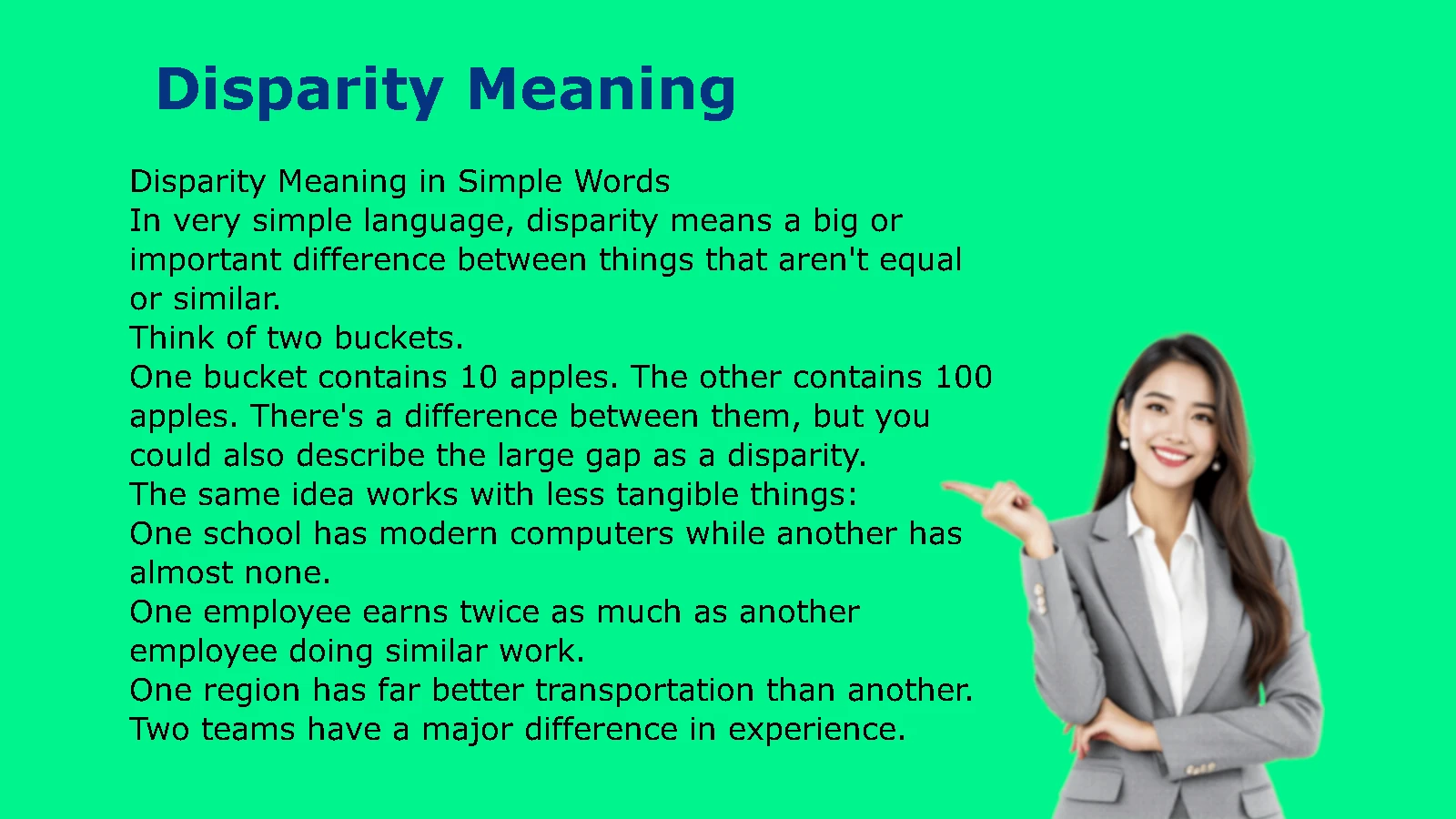
Disparity Meaning in Simple Words
In very simple language, disparity means a big or important difference between things that aren’t equal or similar.
Think of two buckets.
One bucket contains 10 apples. The other contains 100 apples. There’s a difference between them, but you could also describe the large gap as a disparity.
The same idea works with less tangible things:
- One school has modern computers while another has almost none.
- One employee earns twice as much as another employee doing similar work.
- One region has far better transportation than another.
- Two teams have a major difference in experience.
In each case, disparity highlights the gap.
Disparity Definition
Several major dictionaries agree on the central meaning while emphasizing slightly different aspects.
| Source | Core meaning |
| Cambridge Dictionary | A lack of equality or similarity, especially when it seems unfair |
| Merriam Webster | A noticeable and usually significant difference or dissimilarity |
| Oxford Learner’s Dictionaries | A difference, especially one connected with unfair treatment |
| American Heritage Dictionary | A condition of being unequal or different |
Oxford classifies disparity as a formal noun and gives examples involving economic, regional, racial, gender, salary, and resource differences.
These definitions reveal an important point: disparity doesn’t simply mean that two things are different. It usually draws attention to the size, significance, or inequality of that difference.
Is Disparity a Noun?
Yes. Disparity is a noun.
You can use it as either a countable or uncountable noun, depending on the sentence. Oxford and Cambridge both identify these uses.
For example:
There is a disparity in income.
Here, disparity refers generally to an unequal situation.
You can also use the plural:
The report identified several disparities between urban and rural communities.
The plural form is disparities.
Disparity Pronunciation
In American English, disparity is commonly pronounced:
dih-SPAIR-uh-tee
The stress falls on the second syllable.
Cambridge gives the US pronunciation as /dɪˈsper.ə.t̬i/. Oxford gives /dɪˈspærəti/.
Don’t let the spelling intimidate you. Once you hear the word spoken a few times, its pronunciation becomes fairly straightforward.
How to Use Disparity in a Sentence
The most common structures are disparity between, disparity in, and disparity of.
Disparity Between
Use disparity between when you want to identify the two things being compared.
There is a growing disparity between rich and poor households.
The study found a large disparity between urban and rural schools.
There was a noticeable disparity between the teams’ levels of experience.
This structure works especially well when the sentence focuses on a comparison.
Disparity In
Use disparity in when you want to identify the area in which the inequality or difference occurs.
The company discovered a disparity in employee salaries.
Researchers examined disparities in health outcomes.
The report found a disparity in access to educational resources.
This construction appears often in academic, business, government, and news writing.
Disparity Of
You may also encounter disparity of, particularly in formal writing.
The researchers examined the disparity of resources between the two communities.
The disparity of treatment raised concerns.
Although disparity between and disparity in are especially common, disparity of remains a legitimate construction.
Disparity Examples
The easiest way to understand disparity meaning is to see the word working in different contexts.
Income Disparity
The report examined the growing income disparity between high earners and low earners.
Here, income disparity refers to the gap between people’s incomes.
Pay Disparity
The company introduced new policies to reduce pay disparity among employees performing comparable work.
Pay disparity focuses on unequal compensation.
Education
The district is trying to reduce disparities in educational resources between schools.
The word highlights an unequal distribution of resources.
Health
Researchers studied health disparities among different populations.
In health-related writing, disparity often refers to differences in health outcomes, access, treatment, or other health-related measures.
Age
There is a considerable age disparity between the two actors.
Here, the word doesn’t necessarily suggest unfairness. It simply emphasizes a noticeable difference.
Sports
The disparity in experience between the two teams was obvious from the opening minutes.
The word works because the difference in experience creates a meaningful gap between the teams.
Resources
The disparity in resources made it difficult for smaller schools to compete.
This example focuses on unequal access rather than merely stating that the schools have different resources.
Everyday Use
The disparity between the two estimates surprised everyone.
This sentence uses disparity in a less social or economic context. It simply points to a substantial difference.
Common Types of Disparity
The word appears in many fields. Some combinations have become especially common because they describe measurable differences in society and institutions.
| Type | What it describes | Example |
| Income disparity | Differences in earnings | The report examined income disparity across households. |
| Wealth disparity | Differences in accumulated assets and wealth | Wealth disparity can affect access to opportunities. |
| Pay disparity | Differences in compensation | The company reviewed its pay disparity. |
| Economic disparity | Differences in economic conditions | Economic disparity exists between regions. |
| Gender disparity | Differences associated with gender | The organization is studying gender disparities in leadership. |
| Racial disparity | Differences in outcomes or treatment associated with race | The report examined racial disparities in the system. |
| Health disparity | Differences in health outcomes or access | Researchers investigated health disparities. |
| Educational disparity | Differences in educational access or outcomes | Educational disparities can affect long-term opportunities. |
| Regional disparity | Differences between geographic areas | Regional disparities in economic development remain significant. |
| Social disparity | Differences in social conditions or opportunities | The policy aims to reduce social disparities. |
Cambridge specifically documents common expressions such as economic disparity, income disparity, and pay disparity, along with examples involving school spending and unequal resources.
Disparity Synonyms
You have several choices when you want a synonym for disparity, but they don’t all carry exactly the same meaning.
Common synonyms include:
- Difference
- Inequality
- Gap
- Dissimilarity
- Discrepancy
- Imbalance
- Divergence
- Contrast
- Distinctness
- Variation
- Incongruity
- Divergence
Merriam Webster’s thesaurus includes words such as difference, contrast, discrepancy, dissimilarity, imbalance, and inequality among related terms.
Difference
Difference is the broadest choice.
There is a difference between the two cars.
The sentence doesn’t tell you whether the difference is large, small, important, or unfair.
Gap
Gap often works when you want an informal or visual way to describe a measurable separation.
There is a large gap between the two groups.
It can be a good substitute for disparity in everyday writing.
Inequality
Inequality emphasizes a lack of equal status, treatment, resources, rights, or outcomes.
The policy aims to address income inequality.
This word often carries a stronger social or political meaning than difference.
Imbalance
Imbalance suggests that something isn’t evenly distributed or proportioned.
The company noticed an imbalance in its workforce.
It works well when the issue involves distribution, proportion, or equilibrium.
Disparity vs. Difference
Disparity and difference overlap, but they aren’t always interchangeable.
A difference can be completely neutral. A disparity often suggests a noticeable or significant gap.
| Disparity | Difference |
| Usually emphasizes a meaningful gap | Can describe any variation |
| Often involves inequality | Doesn’t imply inequality |
| Frequently appears in formal writing | Extremely common in everyday English |
| Can suggest unfairness depending on context | Usually neutral |
| Often concerns measurable differences | Can concern almost anything |
Consider these examples:
There is a difference in the cars’ colors.
This is ordinary and neutral.
There is a disparity in the cars’ prices.
This suggests a more substantial difference in cost.
The distinction isn’t absolute. In some contexts, disparity can simply mean a significant difference without implying injustice. Merriam Webster, for example, defines the word broadly as a noticeable and usually significant difference or dissimilarity.
Disparity vs. Discrepancy
These two words can look interchangeable at first glance. They aren’t.
Disparity usually describes a significant difference or inequality. Discrepancy usually describes a disagreement or inconsistency between things that should correspond.
For example:
There is a disparity in salaries between the two departments.
The departments have unequal salaries.
Now consider:
There is a discrepancy between the two salary reports.
The reports don’t agree.
That distinction matters.
A discrepancy often signals that something needs checking. Perhaps someone entered the wrong number. Perhaps two records contain conflicting information.
Merriam Webster defines discrepancy as a state or instance of disagreement or being at variance.
Quick Comparison
| Word | Main idea | Example |
| Disparity | Significant difference or inequality | A disparity in income |
| Discrepancy | Inconsistency or disagreement | A discrepancy between two reports |
| Difference | General variation | A difference in size |
| Inequality | Lack of equality | Income inequality |
| Imbalance | Uneven distribution | An imbalance of resources |
A useful rule is simple: use disparity when the gap itself matters; use discrepancy when two pieces of information fail to match.
Disparity vs. Inequality
Disparity and inequality have a large area of overlap.
If two groups have very different levels of income, you might describe the situation as an income disparity or income inequality.
Still, the words can carry different shades of meaning.
Inequality often focuses on the condition of being unequal, particularly in social, economic, legal, or political contexts.
Disparity focuses more directly on the observable gap or difference.
For example:
The study found a disparity in household income.
This emphasizes the measurable difference.
The study examined income inequality.
This can emphasize the broader social or economic condition created by unequal incomes.
Neither word automatically provides an explanation for why the gap exists.
Disparity vs. Disparate
These words look almost identical, but they perform different grammatical jobs.
Disparity is a noun.
The researchers found a disparity between the groups.
Disparate is an adjective.
The researchers compared two disparate groups.
Cambridge defines disparate as meaning different in every way.
The easiest way to remember the difference is:
- Disparity = the difference itself
- Disparate = describes things that are very different
More Examples
The company found a disparity in salaries.
The company compared two disparate departments.
A significant disparity existed between the regions.
The regions had disparate economic conditions.
Don’t use disparity as an adjective.
Incorrect:
The two groups are disparity.
Correct:
There is a disparity between the two groups.
Is Disparity Always Negative?
Not necessarily.
This point often gets lost because the word appears so frequently in discussions of social and economic inequality.
Cambridge emphasizes that disparity often refers to a difference considered unfair. Oxford similarly describes it as a difference that is especially connected with unfair treatment.
However, the word itself doesn’t guarantee that the difference is unjust.
For example:
There is a significant disparity in age between the two athletes.
That difference may have no moral or social judgment attached to it.
Likewise:
The disparity in height between the players was obvious.
Again, the word simply highlights the size of the difference.
Compare that with:
The study found a troubling disparity in access to health care.
Here, disparity clearly carries a more negative implication because the surrounding context concerns unequal access.
The Context Determines the Tone
Words around disparity can strengthen its negative meaning:
- glaring disparity
- unfair disparity
- growing disparity
- wide disparity
- huge disparity
- persistent disparity
- racial disparity
- economic disparity
In other words, disparity can be neutral in theory but strongly negative in many real world contexts.
Common Collocations With Disparity
A collocation is a word combination that English speakers commonly use together. Learning these combinations can make your writing sound more natural.
Common examples include:
- wide disparity
- significant disparity
- large disparity
- considerable disparity
- growing disparity
- increasing disparity
- economic disparity
- income disparity
- wealth disparity
- pay disparity
- health disparity
- racial disparity
- gender disparity
- regional disparity
- social disparity
- disparity between
- disparity in
- disparity of resources
- reduce disparities
- address disparities
- eliminate disparities
Cambridge’s usage material includes combinations such as considerable disparity, disparity of treatment, and disparity of wealth.
Why Collocations Matter
Knowing the definition is only half the battle.
A learner might understand that disparity means a difference but still write an unnatural sentence such as:
There is a disparity among the blue color of these shirts.
A more natural sentence would be:
There is a significant disparity between the prices of these shirts.
The second sentence uses the word in a context where a meaningful gap makes sense.
Common Mistakes When Using Disparity
Even though disparity has a straightforward definition, several mistakes appear regularly.
Treating Disparity as Exactly the Same as Difference
Not every small difference qualifies as a disparity in natural usage.
There is a difference of two inches between the tables.
This sounds ordinary.
There is a disparity of two inches between the tables.
This sounds unnecessarily formal unless the two-inch gap matters for some reason.
Use disparity when the difference deserves attention.
Assuming Disparity Always Means Unfairness
The word often appears in discussions of unfairness, but context matters.
The age disparity between the actors was 20 years.
This describes a difference. It doesn’t automatically accuse anyone of unfair treatment.
Confusing Disparity With Disparate
Remember the grammatical difference:
- Disparity = noun
- Disparate = adjective
Incorrect:
They have a disparate in income.
Correct:
They have a disparity in income.
Using Discrepancy When You Mean Inequality
If two employees earn different amounts, you can discuss a pay disparity.
If two payroll records list different amounts for the same employee, you may have a discrepancy.
That small distinction can dramatically improve precision.
Disparity in Different Contexts
The flexibility of this word explains why it appears in so many types of writing.
Business
Businesses use disparity when discussing salaries, revenue, performance, market access, or resources.
The company investigated a disparity in compensation across departments.
Economics
Economists and journalists often use the word to describe gaps in income, wealth, productivity, or regional development.
The report examined economic disparities between regions.
Education
Schools and researchers may discuss disparities in funding, resources, access, enrollment, or outcomes.
The program was designed to reduce disparities in educational opportunity.
Health
Healthcare research frequently uses health disparities to describe meaningful differences in health outcomes or access to care.
Researchers examined disparities in health outcomes across communities.
Sports
Sports writers can use the word when one team has a substantial advantage.
The financial disparity between the two clubs affected their ability to recruit players.
Everyday Conversation
Although disparity sounds somewhat formal, you can still use it in ordinary conversation when the difference is substantial.
There’s a huge disparity between what the two stores charge for the same product.
If you’re speaking casually, however, big difference or huge gap may sound more natural.
A Practical Case Study: Pay Disparity
Imagine a company with two departments. Both employ workers with similar levels of experience and comparable responsibilities. Yet one department consistently pays higher salaries.
A manager might first describe the situation as a difference in pay.
If the gap becomes large and significant, the manager could describe it as a pay disparity.
The language becomes more precise because disparity signals that the gap deserves attention.
The same pattern applies elsewhere:
Observation → Difference → Significant gap → Disparity
For example:
School A has 20 computers. School B has 21.
That’s simply a difference.
But if School A has 20 computers while School B has 500, calling it a disparity in resources makes much more sense.
The word helps the reader understand that the difference isn’t merely measurable. It’s substantial enough to matter.
How to Choose the Right Word
When deciding whether disparity fits your sentence, ask three questions:
- Are two or more things noticeably different?
- Is the difference significant enough to matter?
- Does the context involve inequality, imbalance, or a meaningful gap?
If the answer to these questions is mostly yes, disparity may be a strong choice.
Word History and Origin of Disparity
The history of disparity helps explain why the modern word centers on inequality.
Merriam Webster traces it through Middle French disparité and Late Latin disparitas, from Latin dispar, meaning unequal or different. The word entered English by the 16th century, with Merriam Webster giving 1571 as its first known use.
Etymonline places an earlier English use in the 1550s, originally referring to the state or quality of being essentially different. By the 1590s, the word had developed a stronger sense of being unequal in rank or condition.
The Latin roots are particularly revealing. Dispar meant unequal or different, while par referred to something equal or well matched.
So the basic idea behind the word has remained remarkably stable: things that don’t match or aren’t equal.
Disparity Facts at a Glance
| Fact | Detail |
| Part of speech | Noun |
| Plural | Disparities |
| US pronunciation | dih-SPAIR-uh-tee |
| UK pronunciation | dih-SPAIR-uh-tee |
| Typical register | Formal |
| Core meaning | A noticeable difference or lack of equality |
| Common structure | disparity between / disparity in |
| Related adjective | disparate |
| Common contexts | Income, wealth, pay, health, education, resources, social conditions |
| Key opposite | Parity or equality |
| First known English use | 1571, according to Merriam Webster |
| Etymological path | Middle French disparité → Late Latin disparitas |
Disparity Antonyms
The best opposite depends on what kind of difference you’re describing.
Common antonyms include:
- Equality
- Parity
- Similarity
- Sameness
- Equivalence
- Uniformity
- Balance
- Correspondence
Parity
Parity is one of the closest opposites because it refers to equality or equivalence.
The two departments now have pay parity.
That means their pay levels are equal or equivalent in the relevant context.
Equality
Equality works particularly well when the issue concerns equal treatment, status, rights, or resources.
The policy aims to promote equality in education.
Similarity
Similarity works when you’re talking about resemblance rather than fairness.
The similarity between the two designs was obvious.
Frequently Asked Questions About Disparity
What does disparity mean in simple terms?
Disparity means a noticeable or significant difference between two or more things, especially when they aren’t equal.
What is an example of disparity?
There is a large disparity between the incomes of the two households.
The sentence highlights a substantial difference in income.
Is disparity a positive or negative word?
It depends on context. The word often appears in discussions of inequality or unfairness, but it can also describe a neutral difference, such as an age disparity or a disparity in size.
What is a synonym for disparity?
Common synonyms include difference, gap, inequality, dissimilarity, discrepancy, imbalance, contrast, and divergence. The best choice depends on the sentence.
What is the opposite of disparity?
Common opposites include equality, parity, similarity, equivalence, and balance.
Is disparity the same as discrepancy?
No. Disparity usually describes a significant difference or inequality. Discrepancy usually describes an inconsistency between things that should agree or match.
What is the plural of disparity?
The plural is disparities.
The study identified several disparities between the regions.
What does “disparity between” mean?
Disparity between introduces the two things that have a noticeable difference.
There is a disparity between the two groups.
What is the difference between disparate and disparity?
Disparity is a noun that names a difference or inequality.
Disparate is an adjective that describes things that are very different.
The study found a disparity between the groups.
The study examined two disparate groups.
Can disparity describe a small difference?
It can, but it usually sounds more natural when the difference is noticeable, significant, or meaningful. For a minor variation, difference is usually the better choice.
Final Takeaway: Disparity Meaning
The simplest way to remember disparity meaning is to think of a meaningful gap.
Disparity is a noun that describes a noticeable difference or lack of equality between two or more things. It often appears when the gap involves income, wealth, pay, health, education, resources, opportunity, or treatment. Dictionaries also recognize broader uses where the word simply describes a significant difference or dissimilarity.
The word becomes especially useful when difference feels too general. Saying that two things are different tells the reader very little. Saying that there is a wide disparity tells the reader that the gap is substantial and worth noticing.
Keep these distinctions in mind:
- Difference = things aren’t the same.
- Disparity = there’s a noticeable or significant gap.
- Inequality = things aren’t equal, often in status, treatment, resources, or outcomes.
- Discrepancy = two things that should match don’t agree.
- Disparate = describes things that are very different.
- Parity = equality or equivalence.
Once you understand that core idea, disparity becomes much easier to use. Whether you’re describing income, salaries, resources, team experience, or two conflicting outcomes, the word gives you a precise way to point to the gap that matters.