
What Is the Confront Meaning?
Confront means to face, challenge, or deal with a difficult person, situation, or problem directly. It can also mean meeting someone face to face to discuss or resolve an issue.
Examples:
- She decided to confront the problem instead of avoiding it.
- He confronted his colleague about the misunderstanding.
The confusion is understandable. Many people look for the meaning of confront, confront definition, how to pronounce confront, or how to use confront in a sentence because the word can describe anything from addressing a conflict to dealing with a personal challenge. But here’s the kicker: understanding its true meaning helps you use it accurately in both speaking and writing.
In this guide, you’ll learn the Confront Meaning, explore the definition of confront, discover its pronunciation, synonyms, antonyms, and example sentences, and understand when to use it in everyday conversations, academic writing, and professional communication.
What Does Confront Mean?
The verb confront means to face someone or something directly, especially when the situation is difficult, uncomfortable, or requires action.
Unlike words that suggest running away or ignoring a problem, confront emphasizes dealing with the issue head-on. The object of confrontation can be a person, an emotion, a challenge, a fact, or an obstacle.
Simple Definition
Confront (verb): To face, address, or deal with someone or something directly.
Simple Examples
- She decided to confront her manager about the misunderstanding.
- We must confront climate challenges together.
- He finally confronted his fear of public speaking.
- The company had to confront rising production costs.
Notice that none of these examples automatically involve an argument. Instead, they involve facing something that cannot be ignored.
Quick Facts About “Confront”
| Feature | Information |
| Word | Confront |
| Part of Speech | Verb |
| Pronunciation (US) | /kənˈfrʌnt/ |
| Meaning | To face or deal with directly |
| Common Contexts | Relationships, business, education, law, psychology, health |
| Tone | Neutral, serious, or determined depending on context |
Where Does the Word Come From?
The English word confront traces its roots to the Latin confrontare, which literally meant “to bring face to face.” It entered English through Old French before becoming part of modern vocabulary.
That original idea still shapes today’s meaning. Whenever you confront someone or something, you bring yourself face-to-face with it instead of avoiding it.
Confront Pronunciation
Correct pronunciation helps you sound more natural in conversations and presentations.
American Pronunciation
Confront
IPA: /kənˈfrʌnt/
Syllable Breakdown
con-front
The stress falls on the second syllable.
✅ con-FRONT
❌ CON-front
Pronunciation Tips
Many English learners place too much emphasis on the first syllable. Instead, keep the first part short and stress front.
Think of it like this:
kuhn-FRUNT
Practice aloud:
- confront the issue
- confront the truth
- confront your fears
- confront reality
Reading these phrases several times helps develop natural rhythm.
Common Pronunciation Mistakes
| Incorrect | Correct |
| CON-front | con-FRONT |
| con-frunt | con-FRONT |
| con-front-uh | con-FRONT |
Confront Definition in Different Contexts
One reason confront appears so often is that it works in many situations. Although the core idea remains the same, the meaning becomes slightly different depending on what follows the verb.
Let’s explore the most common uses.
Confront Someone
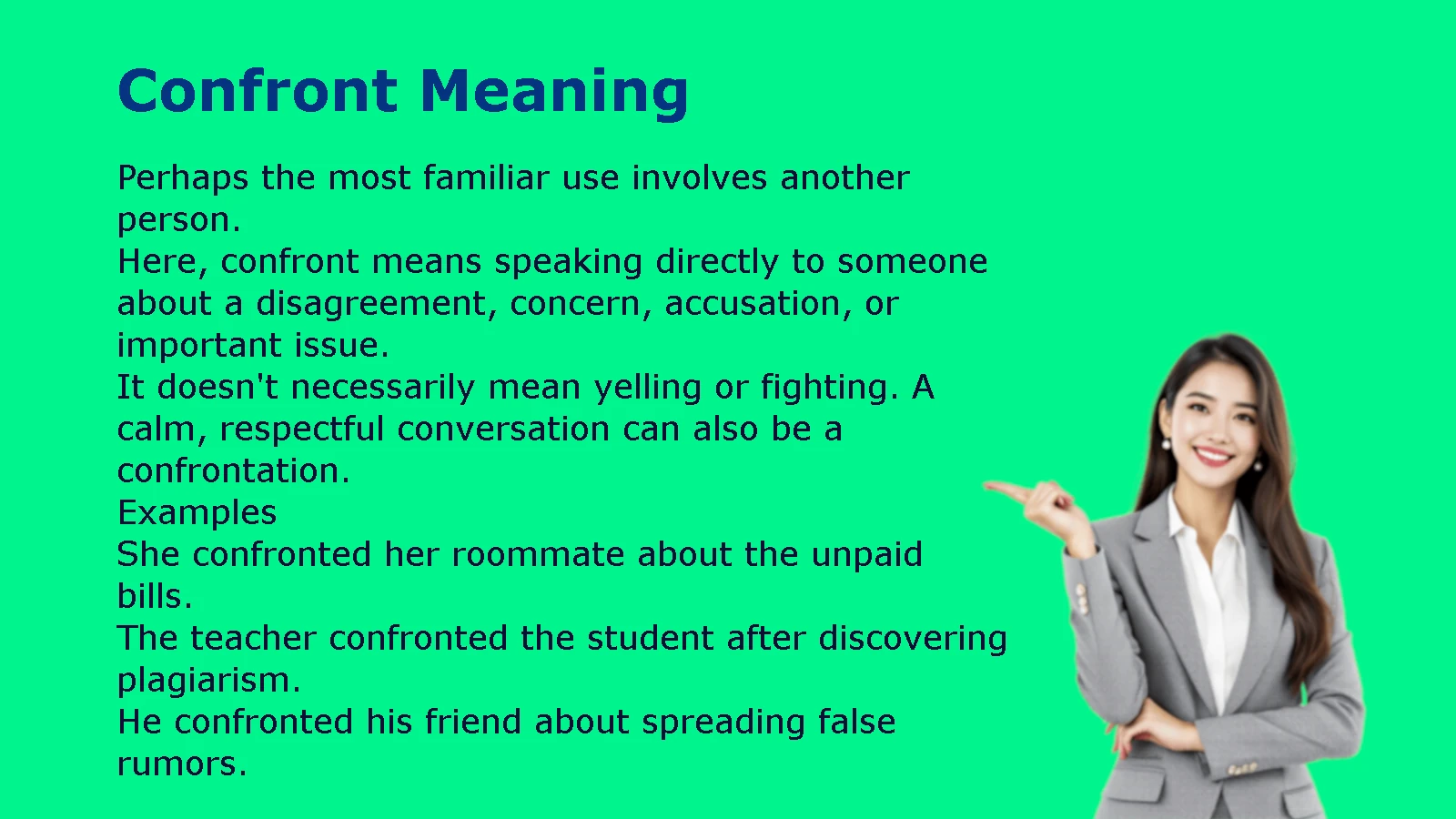
Perhaps the most familiar use involves another person.
Here, confront means speaking directly to someone about a disagreement, concern, accusation, or important issue.
It doesn’t necessarily mean yelling or fighting. A calm, respectful conversation can also be a confrontation.
Examples
- She confronted her roommate about the unpaid bills.
- The teacher confronted the student after discovering plagiarism.
- He confronted his friend about spreading false rumors.
Typical Situations
- Relationship conflicts
- Workplace disagreements
- Family discussions
- School discipline
- Customer complaints
Confront a Problem
Problems rarely disappear on their own. That’s why English speakers frequently use confront with issues, challenges, and obstacles.
In this context, the word means acknowledging the problem and taking steps to solve it.
Examples
- Businesses must confront economic uncertainty.
- The city confronted a severe water shortage.
- Our team confronted unexpected technical issues.
Workplace Example
Imagine a company notices declining sales.
Instead of pretending nothing is wrong, the leadership studies customer feedback, adjusts pricing, improves marketing, and launches better products. They are confronting the problem, not avoiding it.
Confront Fear
Fear affects everyone differently. Some people avoid it while others choose to face it.
When you confront fear, you intentionally face what scares you.
Examples
- She confronted her fear of flying by taking short flights.
- He confronted his anxiety through therapy.
- Athletes often confront pressure before major competitions.
Psychological Perspective
Many evidence-based therapies encourage people to confront fears gradually rather than avoid them. Carefully managed exposure can reduce fear over time because repeated experience helps the brain recognize that the situation is safe.
Confront Reality
This expression appears frequently in books, news articles, and everyday conversations.
To confront reality means accepting facts even when they’re difficult or disappointing.
Examples
- The company had to confront financial reality.
- Eventually, he confronted the truth about the failed project.
- They confronted the reality that change was unavoidable.
Example Scenario
A student hopes to pass an exam without studying.
After receiving poor grades, the student confronts reality and creates a better study schedule.
The confrontation isn’t with another person. It’s with the facts.
Confront Challenges
Challenges test your skills, patience, and determination.
To confront challenges means facing them confidently and working toward a solution.
Examples
- Entrepreneurs confront risk every day.
- Healthcare workers confront difficult decisions.
- Scientists confront complex research questions.
This usage often carries a positive tone because it highlights resilience rather than conflict.
How to Use “Confront” in a Sentence
Knowing the definition is helpful. Using the word naturally matters even more.
The verb confront usually follows this pattern:
Subject + confront + object
Examples:
- I confronted the issue.
- She confronted her fears.
- They confronted the challenge.
- We confronted the customer politely.
Notice that confront normally takes a direct object. English speakers generally say confront someone or confront something, not confront to someone.
Confront in Everyday Conversation
In daily speech, people often use confront when discussing relationships, responsibilities, or personal growth.
Examples
- I finally confronted my neighbor about the loud music.
- You should confront the issue before it becomes worse.
- We confronted the misunderstanding calmly.
- She confronted the mistake immediately.
Mini Dialogue
Emma: “Did you ever talk to your boss?”
Lucas: “Yes. I confronted him respectfully and explained my concerns.”
Emma: “How did it go?”
Lucas: “Much better than I expected.”
This exchange shows that confrontation doesn’t have to be aggressive.
Confront in Professional Writing
Business communication often uses confront when discussing risks, obstacles, or strategic decisions.
Examples
- Organizations must confront cybersecurity threats.
- Leaders should confront challenges with transparency.
- The committee confronted budget limitations before approving the proposal.
- Executives confronted declining customer satisfaction through operational improvements.
Business Example
Instead of writing:
The company ignored declining revenue.
A stronger sentence is:
The company confronted declining revenue by expanding into new markets and improving customer retention.
The second sentence highlights action rather than avoidance.
Confront in Academic Writing
Researchers, educators, and students frequently use confront to describe intellectual challenges or social issues.
Examples
- The study confronts long-standing assumptions.
- Researchers confront ethical questions throughout the project.
- Historians confront conflicting historical evidence.
- Students confront increasingly complex concepts as courses advance.
Academic writing usually treats confront as a neutral verb that signals careful examination rather than emotional conflict.
Confront in News Reports
Journalists often use confront because it communicates urgency without exaggeration.
Examples
- Emergency crews confronted dangerous weather conditions.
- Officials confronted growing public concern.
- Hospitals confronted increased patient demand.
- Residents confronted severe flooding after heavy rainfall.
News writers choose the word because it suggests direct engagement with a situation instead of passive observation.
Confront in Formal Communication
Formal letters, reports, and official statements also rely on confront when discussing responsibilities and solutions.
Examples
- The organization remains committed to confronting discrimination.
- Governments must confront environmental challenges through long-term planning.
- Community leaders confronted safety concerns during the public meeting.
- The board confronted legal risks before approving the merger.
Using confront in formal writing adds precision because it clearly communicates that someone addressed an issue rather than ignored it.
“The first step toward solving a problem is to confront it.”
This idea appears in leadership, psychology, education, and business because meaningful progress usually begins when people stop avoiding difficult situations and choose to face them directly.
Real-World Example Sentences Using “Confront”
One of the fastest ways to master a new word is to see it used naturally. The examples below cover everyday conversations, business, education, health, sports, technology, and more.
Everyday Life
- She finally confronted her brother about borrowing her car without asking.
- We need to confront this issue before it grows into a bigger problem.
- Instead of avoiding the conversation, he chose to confront the misunderstanding calmly.
- They had to confront the consequences of their decision.
Workplace
- The manager confronted the employee about repeated late arrivals.
- Our team confronted unexpected delays during the project.
- The company confronted rising operating costs by improving efficiency.
- Good leaders confront problems instead of ignoring them.
School and Education
- The teacher confronted bullying immediately.
- Students often confront difficult subjects during their first year of college.
- She confronted her fear of public speaking by joining the debate club.
- Researchers confronted conflicting evidence before reaching a conclusion.
Health and Personal Growth
- He confronted his anxiety with professional support.
- Many people confront self-doubt before making major life decisions.
- The patient confronted a long recovery with determination.
- She confronted unhealthy habits one step at a time.
Business and Finance
- Small businesses confront changing market conditions every year.
- Investors confronted economic uncertainty with cautious planning.
- The startup confronted strong competition by offering better customer service.
Technology
- Cybersecurity experts confront new online threats daily.
- Developers confronted software bugs before launching the update.
- Companies confront privacy concerns by strengthening security measures.
Sports
- The team confronted its toughest opponent of the season.
- Athletes confront pressure before championship games.
Government and Society
- Community leaders confronted housing shortages through new development plans.
- Lawmakers confronted public concerns during the hearing.
These examples show that confront applies to much more than arguments. In many cases, it simply means facing something difficult with intention and action.
Confront vs. Similar Words
English offers several words that overlap with confront, but they aren’t interchangeable in every situation. Choosing the right one makes your writing more precise.
Confront vs. Face
These words are closely related, but face is broader and often less intense.
Confront usually suggests taking direct action.
Face simply means experiencing or dealing with something.
Examples
- We must face reality.
- We must confront reality by changing our strategy.
In the second sentence, the speaker doesn’t just acknowledge reality. They actively respond to it.
Confront vs. Challenge
These verbs serve different purposes.
Confront means facing a difficulty.
Challenge often means questioning, competing with, or inviting someone to prove themselves.
Examples
- She confronted her fear.
- She challenged the decision.
One deals with fear. The other questions authority or an idea.
Confront vs. Oppose
To oppose means resisting or disagreeing with something.
To confront means facing it directly.
You can confront a problem without opposing anyone.
Examples
- Citizens opposed the new law.
- Officials confronted the problems created by the new law.
Confront vs. Deal With
Both involve handling situations, but deal with sounds less direct.
Examples
- I dealt with customer complaints.
- I confronted the customer about abusive behavior.
The second sentence carries more urgency and directness.
Confront vs. Encounter
People often confuse these verbs.
Encounter means meeting something unexpectedly.
Confront means intentionally facing it.
Examples
- We encountered heavy traffic.
- We confronted the transportation problem by changing our delivery routes.
Comparison Table
| Word | Primary Meaning | Implies Direct Action? | Common Context | Example |
| Confront | Face directly | Yes | Conflict, problems, fears | Confront a challenge |
| Face | Experience or deal with | Sometimes | General situations | Face reality |
| Challenge | Question or compete | Yes | Competition, ideas | Challenge a decision |
| Oppose | Resist | Yes | Politics, opinions | Oppose a proposal |
| Deal with | Handle | Usually | Everyday situations | Deal with complaints |
| Encounter | Meet unexpectedly | No | Experiences | Encounter difficulties |
Confront Synonyms
No single synonym replaces confront in every sentence. The best choice depends on what you’re talking about.
Common Synonyms
- Face
- Address
- Tackle
- Handle
- Deal with
- Meet
- Approach
- Oppose
- Stand up to
- Challenge
- Combat
- Resist
Synonyms by Context
For Problems
- Address
- Solve
- Tackle
- Handle
- Resolve
For Conflict
- Oppose
- Stand up to
- Challenge
- Resist
For Fear
- Face
- Overcome
- Meet
- Accept
For Difficult Situations
- Navigate
- Manage
- Handle
- Address
Synonym Comparison Table
| Synonym | Best Used For | Example |
| Face | General situations | Face reality |
| Address | Formal writing | Address the issue |
| Tackle | Solving problems | Tackle inflation |
| Handle | Everyday speech | Handle complaints |
| Stand up to | Personal courage | Stand up to bullies |
| Oppose | Disagreement | Oppose the proposal |
| Combat | Serious threats | Combat disease |
Confront Antonyms
Antonyms express the opposite idea. Instead of facing a situation, these words describe avoiding it.
Common Antonyms
- Avoid
- Ignore
- Evade
- Escape
- Dodge
- Retreat
- Withdraw
- Bypass
- Shirk
- Neglect
Antonym Comparison Table
| Antonym | Meaning | Example |
| Avoid | Stay away from | Avoid responsibility |
| Ignore | Pay no attention | Ignore criticism |
| Evade | Escape indirectly | Evade the question |
| Retreat | Move backward | Retreat from conflict |
| Withdraw | Remove yourself | Withdraw from negotiations |
| Dodge | Avoid cleverly | Dodge accountability |
Is “Confront” Always Negative?
Many learners think confront always involves anger or conflict. That’s a common misconception.
In modern English, the word often carries a neutral or even positive meaning.
For example:
- Confronting your fears shows courage.
- Confronting financial problems shows responsibility.
- Confronting mistakes demonstrates honesty.
- Confronting injustice reflects integrity.
The emotional tone depends on the situation, not the word itself.
Consider these examples.
Negative
The suspect confronted the police aggressively.
Neutral
Engineers confronted several technical problems during testing.
Positive
She confronted years of self-doubt and started her own business.
Notice how the verb stays the same while the context changes completely.
Common Collocations with “Confront”
A collocation is a natural combination of words that native speakers frequently use together.
Learning collocations helps your English sound more fluent.
Most Common Collocations
- confront reality
- confront the truth
- confront a problem
- confront a challenge
- confront an issue
- confront an obstacle
- confront an enemy
- confront injustice
- confront discrimination
- confront criticism
- confront your fears
- confront difficult decisions
- confront uncertainty
- confront consequences
- confront accusations
Collocation Table
| Phrase | Meaning | Example |
| Confront reality | Accept facts | It’s time to confront reality. |
| Confront the truth | Accept what is true | She confronted the truth. |
| Confront a challenge | Face difficulty | The company confronted global competition. |
| Confront criticism | Respond to criticism | The CEO confronted public criticism. |
| Confront injustice | Take action against unfairness | Citizens confronted injustice peacefully. |
| Confront consequences | Accept results | He confronted the consequences of his actions. |
Common Idioms and Expressions Related to Confrontation
English also uses colorful expressions that convey the idea of confronting problems or difficult situations.
Face the Music
Meaning: Accept punishment or criticism.
Example
After breaking company policy, he had to face the music.
Stand Your Ground
Meaning: Refuse to give in.
Example
She stood her ground during the negotiations.
Meet Head-On
Meaning: Deal with something directly.
Example
The organization met the crisis head-on.
Call Someone Out
Meaning: Publicly challenge or criticize someone’s behavior.
Example
The journalist called out misleading claims.
Bite the Bullet
Meaning: Do something difficult but necessary.
Example
He bit the bullet and apologized.
Take the Bull by the Horns
Meaning: Deal with a difficult situation immediately.
Example
Instead of waiting, the new manager took the bull by the horns.
Quick Reference Table
| Idiom | Meaning |
| Face the music | Accept consequences |
| Stand your ground | Remain firm |
| Meet head-on | Face directly |
| Call someone out | Challenge publicly |
| Bite the bullet | Do something difficult |
| Take the bull by the horns | Act decisively |
Grammar Rules for “Confront”
Because confront is a regular verb, its forms follow standard English grammar.
Verb Forms
| Verb Form | Example |
| Base Form | confront |
| Third Person Singular | confronts |
| Present Participle | confronting |
| Past Tense | confronted |
| Past Participle | confronted |
Examples
Present
- They confront challenges every day.
Past
- We confronted the issue yesterday.
Present Continuous
- She is confronting the problem now.
Present Perfect
- They have confronted similar situations before.
Future
- We will confront the challenge together.
Sentence Pattern
The most common structure is:
Subject + confront + object
Examples:
- She confronted the manager.
- They confronted the problem.
- We confronted our fears.
- Scientists confronted new evidence.
Common Preposition Mistakes
Many English learners accidentally add unnecessary prepositions.
| Incorrect | Correct |
| confront to someone | confront someone |
| confront with someone | confront someone |
| confront against someone | confront someone |
Correct:
- She confronted her supervisor.
Not:
- She confronted to her supervisor.
Common Mistakes When Using “Confront”
Even advanced English learners make mistakes with this word.
Mistake: Thinking It Always Means Arguing
Not every confrontation is hostile.
✔ Correct
We confronted the issue professionally.
Mistake: Using the Wrong Preposition
Incorrect
He confronted to the teacher.
Correct
He confronted the teacher.
Mistake: Using It Without an Object
Because confront is usually transitive, it normally needs an object.
Incorrect
She confronted.
Correct
She confronted the accusation.
Mistake: Choosing It When “Encounter” Fits Better
Incorrect
We confronted heavy rain while driving.
Better
We encountered heavy rain while driving.
If you unexpectedly come across something, encounter is usually the better choice.
Phrasal and Related Expressions
Several words share the same root as confront.
| Word | Part of Speech | Meaning |
| Confront | Verb | Face directly |
| Confrontation | Noun | A direct meeting, dispute, or conflict |
| Confrontational | Adjective | Inclined toward confrontation |
| Confrontationally | Adverb | In a confrontational manner |
| Self-confrontation | Noun | Honest reflection about yourself |
| Nonconfrontational | Adjective | Avoiding unnecessary conflict |
Word Family
Understanding related words expands your vocabulary and helps you recognize different forms in reading and conversation.
| Word | Part of Speech | Meaning | Example |
| Confront | Verb | Face directly | We confronted the issue. |
| Confrontation | Noun | A direct conflict or meeting | The confrontation lasted only a few minutes. |
| Confrontational | Adjective | Aggressive or inclined toward conflict | His confrontational tone escalated the discussion. |
| Confrontationally | Adverb | In an aggressive or challenging way | She spoke confrontationally during the debate. |
| Nonconfrontational | Adjective | Calm and not inclined toward conflict | He preferred a nonconfrontational approach. |
Confront in Literature, Media, and Everyday Speech
The word confront appears across many forms of communication because it clearly expresses the act of facing something difficult. Whether you’re reading a novel, watching the news, or listening to a motivational speaker, you’ll likely encounter this versatile verb.
Although the situations differ, the core meaning stays the same: someone chooses to deal with a person, problem, or truth directly instead of avoiding it.
Confront in Literature
Authors often use confront to create tension, reveal character growth, or move the plot forward. A confrontation can be physical, emotional, or psychological.
For example, a novel might describe a character who finally confronts their past after years of denial. Another story may feature two rivals confronting each other before a decisive moment.
Example
After years of silence, she confronted her childhood memories and began rebuilding her life.
In literature, confrontation often represents a turning point where a character changes, learns, or accepts an important truth.
Confront in News Reporting
Journalists use confront to describe governments, organizations, communities, and individuals responding to serious issues.
Common examples include:
- Governments confront inflation.
- Cities confront housing shortages.
- Hospitals confront staffing challenges.
- Emergency responders confront natural disasters.
- Schools confront declining attendance.
- Businesses confront changing consumer demand.
This usage is factual and neutral. It simply means that someone is actively dealing with a situation.
Confront in Movies and Television
Movies frequently build toward a final confrontation between characters. However, confrontation doesn’t always involve action scenes.
A courtroom drama may show a lawyer confronting false testimony.
A family drama might center on siblings confronting long-hidden secrets.
A sports film often portrays athletes confronting self-doubt before an important competition.
These moments usually represent emotional growth as much as conflict.
Confront in Business Communication
Professional writers often choose confront because it emphasizes action and responsibility.
Examples
- The leadership team confronted declining sales through market research.
- Executives confronted supply chain disruptions by diversifying suppliers.
- The organization confronted customer complaints with improved support services.
Notice that these examples focus on solving problems rather than assigning blame.
Confront in Psychology and Self-Development
Psychologists frequently use confront when discussing emotional health and personal growth.
Examples include:
- Confront negative thinking.
- Confront unhealthy habits.
- Confront limiting beliefs.
- Confront difficult emotions.
- Confront unresolved conflict.
Many therapeutic approaches encourage people to acknowledge difficult feelings instead of suppressing them. While the methods differ, the goal remains the same: facing reality often creates opportunities for lasting improvement.
When You Should Use “Confront”
Knowing when to use a word is just as important as knowing its definition.
Use confront whenever someone faces a difficult situation directly.
In Personal Relationships
Healthy relationships sometimes require honest conversations.
Examples include:
- Confronting a misunderstanding.
- Confronting repeated dishonesty.
- Confronting hurtful behavior.
- Confronting communication problems.
A respectful confrontation often strengthens trust because it encourages openness instead of avoidance.
In the Workplace
Managers and employees regularly confront challenges.
Examples include:
- Missed deadlines.
- Budget limitations.
- Workplace conflict.
- Customer complaints.
- Performance concerns.
Professional confrontation focuses on solving problems rather than criticizing people.
In Education
Teachers, students, and researchers confront new challenges every day.
Examples include:
- Difficult assignments.
- Academic pressure.
- Research questions.
- Ethical concerns.
- Classroom conflicts.
Learning often begins when students confront ideas that challenge their assumptions.
In Legal Contexts
Legal professionals frequently use confront in discussions about evidence, testimony, and legal rights.
Examples include:
- Confront conflicting evidence.
- Confront accusations.
- Confront witnesses during questioning.
- Confront legal challenges.
The word describes direct engagement with legal issues rather than emotional disagreement.
In Healthcare
Healthcare professionals confront difficult decisions every day.
Examples include:
- Medical emergencies.
- Disease outbreaks.
- Staffing shortages.
- Complex diagnoses.
- Ethical dilemmas.
Patients also confront health challenges throughout treatment and recovery.
In Conflict Resolution
Effective conflict resolution doesn’t avoid disagreement. Instead, it encourages respectful communication.
Successful confrontation usually includes:
- Listening carefully.
- Remaining calm.
- Sticking to facts.
- Respecting different viewpoints.
- Working toward a solution.
Confrontation becomes productive when the goal is understanding rather than winning an argument.
Mini Case Studies
Real-world examples show how the word confront works in different settings.
Case Study: Workplace Communication
Situation
A project manager notices that deadlines are repeatedly missed.
Action
Instead of blaming the team, the manager confronts the scheduling problem during a meeting. Together, the team identifies unrealistic timelines and redistributes the workload.
Outcome
Productivity improves because the root cause receives attention instead of being ignored.
Lesson: Confronting a problem early often prevents larger issues later.
Case Study: Personal Growth
Situation
A college student avoids public speaking because of anxiety.
Action
The student joins a speaking club and gradually confronts the fear through regular practice.
Outcome
Confidence grows with experience, making classroom presentations less stressful.
Lesson: Confronting fear doesn’t eliminate discomfort overnight, but consistent practice can reduce it over time.
Case Study: Business Strategy
Situation
A small retailer experiences declining sales after new competitors enter the market.
Action
The owner confronts the challenge by analyzing customer feedback, improving product selection, and enhancing online services.
Outcome
Customer satisfaction increases and sales begin to recover.
Lesson: Businesses that confront change quickly often adapt more successfully than those that ignore it.
Common Phrases with “Confront”
Native speakers regularly combine confront with certain nouns.
| Phrase | Meaning | Example |
| Confront reality | Accept the facts | It’s time to confront reality. |
| Confront the truth | Accept what is true | She confronted the truth about the situation. |
| Confront your fears | Face what scares you | He confronted his fear of heights. |
| Confront the issue | Address the problem | Let’s confront the issue today. |
| Confront a challenge | Deal with difficulty | The team confronted unexpected obstacles. |
| Confront criticism | Respond to criticism | The CEO confronted public criticism directly. |
| Confront injustice | Oppose unfair treatment | Citizens confronted injustice peacefully. |
| Confront consequences | Accept the results | He confronted the consequences of his decision. |
Quick Summary Table
| Topic | Key Point |
| Meaning | To face someone or something directly |
| Part of Speech | Verb |
| Pronunciation | /kənˈfrʌnt/ |
| Tone | Neutral, positive, or negative depending on context |
| Common Uses | Problems, fears, people, challenges, reality |
| Common Synonyms | Face, address, tackle, handle |
| Common Antonyms | Avoid, ignore, evade |
| Grammar Pattern | Confront + object |
Frequently Asked Questions
What does confront mean?
Confront means to face or deal with someone or something directly, especially when the situation is difficult, uncomfortable, or requires action.
Example:
She confronted the problem instead of ignoring it.
Does confront always mean arguing?
No.
Although confrontation can involve disagreement, the word often describes calmly addressing a problem, accepting reality, or facing a difficult situation.
For example:
The company confronted rising costs by improving efficiency.
No argument takes place in this example.
Can you confront a problem?
Yes.
In fact, confront a problem is one of the most common collocations in English.
Examples include:
- Confront financial problems.
- Confront environmental challenges.
- Confront technical issues.
- Confront customer complaints.
Is confront formal or informal?
Confront works well in both formal and informal English.
Informal
I confronted my roommate about the noise.
Formal
Government agencies confronted significant regulatory challenges.
Because the word is widely understood, it fits conversations, academic writing, business reports, and news articles.
What is the difference between confront and face?
Both verbs involve dealing with something difficult, but confront usually implies taking direct action.
Face often means simply experiencing or acknowledging a situation.
| Face | Confront |
| More general | More direct |
| Often passive | Usually active |
| Face reality | Confront reality by taking action |
What is the noun form of confront?
The noun is confrontation.
Example:
Their confrontation lasted only a few minutes before they reached an agreement.
What are the best synonyms for confront?
The best synonym depends on the context.
Common choices include:
- Face
- Address
- Tackle
- Handle
- Deal with
- Stand up to
- Oppose
- Challenge
Choose the word that best matches the tone and situation.
Is confrontation always negative?
No.
Many confrontations produce positive outcomes.
Examples include:
- Confronting unhealthy habits.
- Confronting workplace problems.
- Confronting unfair treatment.
- Confronting personal fears.
When handled respectfully, confrontation often leads to better communication, stronger relationships, and effective problem-solving.
Key Takeaways
The confront meaning centers on facing someone or something directly rather than avoiding it. Whether you’re confronting a person, a difficult decision, a personal fear, or an unexpected challenge, the word highlights action, honesty, and responsibility.
Here are the most important points to remember:
- Confront is a verb that means to face or deal with someone or something directly.
- The word doesn’t always suggest conflict. It often describes constructive action.
- Common collocations include confront reality, confront the truth, confront a problem, confront your fears, and confront a challenge.
- The most common grammar pattern is confront + object.
- Strong synonyms include face, address, tackle, and handle, while common antonyms include avoid, ignore, and evade.
- The related noun is confrontation, and the adjective is confrontational.
- In everyday conversation, professional writing, education, healthcare, and business, confront describes taking responsibility instead of looking the other way.
Understanding how native speakers use confront will help you communicate with greater precision and confidence. The next time you encounter this word, you’ll recognize that it often represents courage, accountability, and the willingness to deal with challenges head-on rather than letting them grow unchecked.