
Have you ever seen the word “trayed” and paused to wonder what it actually means? The Trayed Definition can be confusing because this is not a word you hear often in everyday English. Its meaning becomes clearer when you look at how it relates to the word tray and the context where it appears.
Trayed is generally the past tense or past participle form of “tray,” a verb that can mean to place something on a tray or arrange something on a tray. In some contexts, however, trayed may appear as a less common or specialized form, so understanding the sentence is important.
Examples:
- She trayed the dishes before taking them to the dining room.
- She trayed the cups and carried them to the guests.
The confusion is understandable. People often search for what does trayed mean, trayed meaning, trayed definition, or trayed meaning in a sentence because the word is uncommon in everyday English. You may also wonder whether trayed is a correct word or how it differs from related words such as tray and trays.
In this guide, you’ll learn the complete trayed definition, its meaning, pronunciation, part of speech, correct usage, and examples in sentences. You’ll also discover whether trayed is a valid English word, how it is used in different contexts, and the difference between trayed, tray, and other related terms.
What Does “Trayed” Mean?
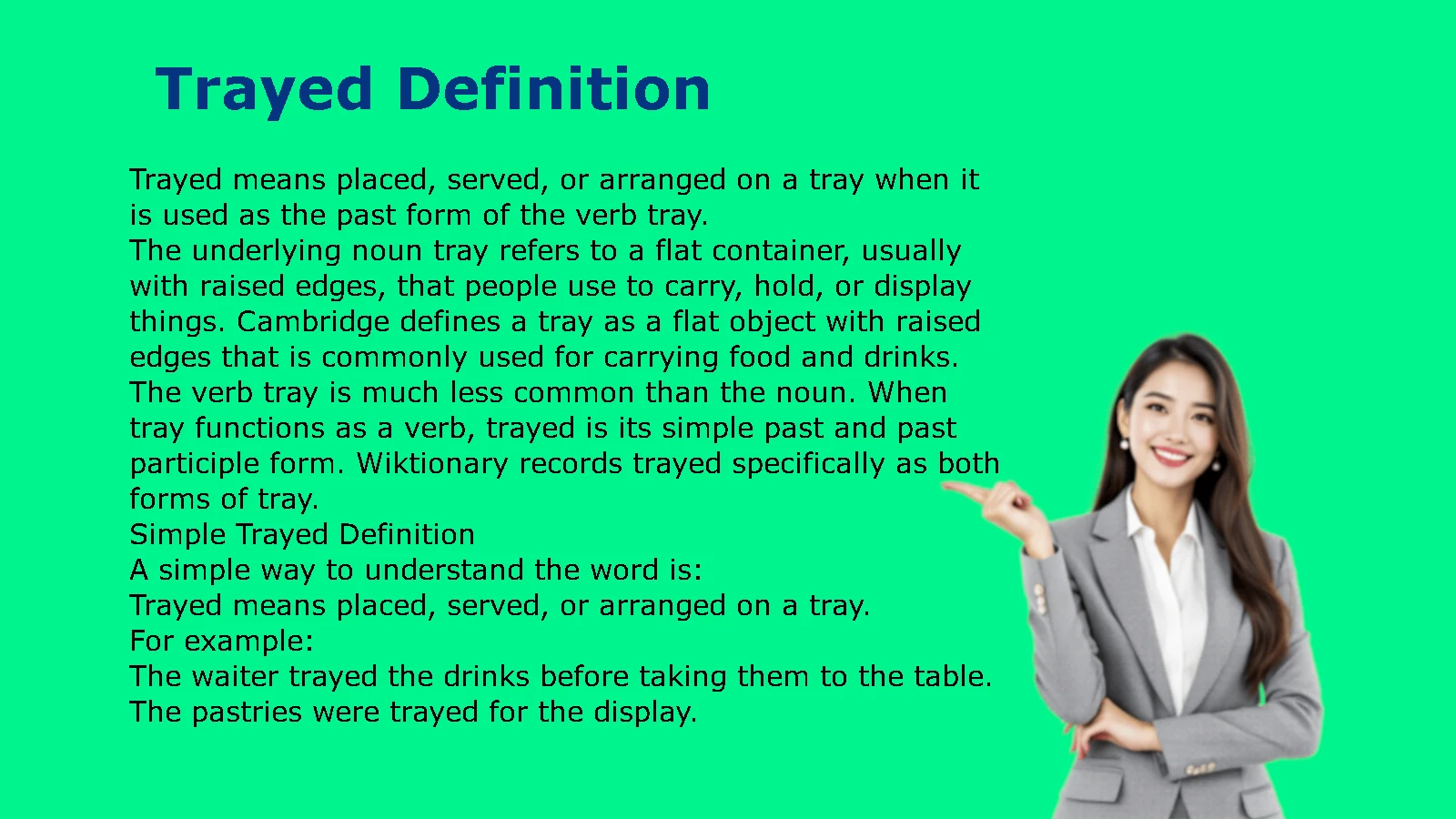
The underlying noun tray refers to a flat container, usually with raised edges, that people use to carry, hold, or display things.
The verb tray is much less common than the noun. When tray functions as a verb, trayed is its simple past and past participle form. Wiktionary records trayed specifically as both forms of tray.
Simple Trayed Definition
A simple way to understand the word is:
Trayed means placed, served, or arranged on a tray.
For example:
- The waiter trayed the drinks before taking them to the table.
That said, these sentences use a relatively uncommon verb. In ordinary conversation, a speaker would more naturally say:
- The waiter placed the drinks on a tray.
So, knowing the definition isn’t quite enough. Usage matters.
Is “Trayed” a Word?
Yes. Trayed is a recorded word form, specifically the simple past and past participle of tray. Wiktionary and YourDictionary both identify it this way.
However, calling a word “real” doesn’t mean people use it frequently.
English contains thousands of words that are grammatically possible but relatively uncommon. Trayed falls into that category. You may understand it perfectly in context while still rarely hearing someone use it in casual speech.
This distinction matters because readers often ask two different questions:
- Does “trayed” sound natural in everyday English?
The answer to the first question is yes.
The answer to the second is usually not as natural as a clearer phrase such as “placed on a tray.”
Why Does “Trayed” Sound Unusual?
The noun tray is extremely familiar. Dictionaries such as Cambridge, Oxford, Merriam-Webster, and Collins all describe the common noun and its uses.
The unusual part is turning that noun into a verb.
English does this frequently. For example:
| Noun | Verb | Past form |
| emailed | ||
| bottle | bottle | bottled |
| chair | chair | chaired |
| tray | tray | trayed |
But not every possible noun-to-verb conversion becomes common in everyday speech.
That explains why trayed can be grammatically understandable while still sounding unusual.
Trayed Pronunciation
Trayed is pronounced:
/treɪd/
It sounds exactly like “trade.” Wiktionary lists trayed as a homophone of trade.
How to Say “Trayed”
Break it into one simple sound:
trayed → /treɪd/
Think of:
- trade
- made
- paid
- played
All have a similar ending sound.
The word tray itself is pronounced /treɪ/. Cambridge and Oxford both give this pronunciation.
Adding the regular past-tense -ed creates the /d/ sound:
tray → trayed
So you don’t pronounce it as two syllables such as tray-ed. It has one syllable.
“Trayed” as the Past Tense of “Tray”
The clearest grammatical explanation of trayed is that it represents the past form of tray.
The basic pattern is:
| Verb form | Word |
| Base form | tray |
| Simple past | trayed |
| Past participle | trayed |
| Present participle | traying |
Because trayed is a regular -ed formation, the spelling follows the normal pattern for many English verbs.
Present Tense
The base form is tray.
Example:
The staff tray the meals before serving them.
This sentence treats tray as an action.
Simple Past
The past form is trayed.
Example:
The staff trayed the meals before serving them.
The action happened in the past.
Past Participle
The past participle is also trayed.
For example:
The meals had been trayed before the guests arrived.
The form remains trayed, although the construction itself sounds formal and uncommon.
Present Participle
The -ing form is traying.
Example:
The workers were traying the products for delivery.
Again, this is grammatically understandable, but a more natural sentence would usually describe the action directly:
The workers were putting the products on trays for delivery.
That small change makes the sentence sound much more familiar.
How to Use “Trayed” in a Sentence
You can understand the word best by seeing how it functions in context.
Examples With Food
The server trayed the drinks before bringing them to the table.
Here, trayed means the server put or arranged the drinks on a tray.
A more natural version would be:
The server placed the drinks on a tray before bringing them to the table.
Another example:
The desserts were trayed and ready for service.
This sentence treats trayed as a past participle.
However, most readers would probably find this clearer:
The desserts were arranged on trays and ready for service.
Examples With Plants
The word can also make sense when people arrange plants or seedlings in trays.
The seedlings were trayed before they were transported.
The intended meaning is that the seedlings were placed into trays.
A clearer version would be:
The seedlings were placed in trays before they were transported.
This distinction becomes especially useful in technical or agricultural writing. A specialized audience may understand trayed immediately, while a general audience may pause and wonder whether the word is a typo.
Examples With Objects
The samples were trayed before inspection.
This suggests that the samples were organized on trays.
For general readers, however:
The samples were arranged on trays before inspection.
is more direct.
The second sentence leaves less room for interpretation. Good writing often works that way: the clearest phrase wins.
“Trayed” as an Adjective
There is another recorded use of trayed. In this case, it functions as an adjective rather than as the past form of a verb.
Reverso lists trayed as a rare adjective meaning “arranged in trays.” Its examples include trayed seedlings, pastries, and plants.
For example:
The trayed seedlings were ready for planting.
Here, trayed describes the seedlings.
It doesn’t describe an action happening at that exact moment. Instead, it tells you about the condition or arrangement of the seedlings.
What Does “Trayed” Mean as an Adjective?
As an adjective, trayed means:
Arranged or placed in trays.
Examples include:
- trayed seedlings
- trayed pastries
- trayed plants
- trayed samples
This use is uncommon, so you should consider your audience before using it.
For a technical document intended for specialists, it may be perfectly understandable. For a general article, arranged in trays is usually clearer.
Trayed vs. Tray vs. Traying
These three forms come from the same verb.
| Word | Grammatical role | Basic meaning | Example |
| tray | Base verb | Put or arrange on a tray | They tray the meals. |
| trayed | Past/past participle | Put or arranged on a tray | They trayed the meals. |
| traying | Present participle | Putting or arranging on a tray | They are traying the meals. |
The noun tray is much more common than the verb.
Oxford describes a tray as a flat piece of wood, metal, or plastic with raised edges that is used to carry or hold things, especially food. It also notes specialized types such as seed trays, litter trays, and ice trays.
That gives you an important clue about usage. Tray is an everyday noun. Trayed is a much less familiar verb form.
Trayed vs. Betrayed
One of the easiest mistakes is confusing trayed with betrayed.
They look similar, but their meanings have nothing to do with each other.
Trayed
Trayed relates to tray.
It refers to placing, serving, or arranging something on a tray.
The waiter trayed the glasses.
Betrayed
Betrayed comes from betray.
It means to be disloyal to someone, deceive someone, or reveal something that should have remained secret.
She felt betrayed by her closest friend.
The difference is substantial:
| Word | Root word | Meaning |
| trayed | tray | Placed or arranged on a tray |
| betrayed | betray | Deceived, disloyal, or exposed a secret |
The words only look related because they share some letters.
They aren’t semantic cousins.
Trayed vs. Portrayed
Another common-looking word is portrayed.
Again, the meanings are completely different.
Trayed
Trayed relates to a tray.
The food was trayed before the event.
Portrayed
Portrayed comes from portray and means represented, depicted, or described.
The actor portrayed a detective in the film.
You can compare them like this:
| Word | Meaning | Example |
| trayed | Placed or arranged on a tray | The dishes were trayed. |
| portrayed | Represented or depicted | The character was portrayed as brave. |
| betrayed | Deceived or treated disloyally | He felt betrayed by his friend. |
The endings can make these words look confusing at first glance. Once you identify the root word, the meaning becomes much easier to understand.
Common Confusion About “Trayed”
Because trayed is uncommon, people tend to make a few predictable assumptions about it.
Assuming “Trayed” Means “Betrayed”
This is incorrect.
The prefix be- changes the root and meaning of betrayed. It has no connection with putting something on a tray.
Assuming “Trayed” Means “Portrayed”
It doesn’t.
Portrayed comes from portray, while trayed relates to tray.
Assuming “Trayed” Is a Common Everyday Verb
Trayed is recorded as the past and past participle form of tray.
Still, that doesn’t make it the most natural choice for ordinary conversation.
A speaker is far more likely to say:
- put it on a tray
- placed it on a tray
- served it on a tray
- arranged it on a tray
Using “Trayed” When a Clearer Phrase Works Better
Consider this sentence:
The nurse trayed the instruments.
A reader can work out what it means. But this version is immediately clear:
The nurse placed the instruments on a tray.
The second version uses more words, but it communicates the action without making the reader stop.
Examples of “Trayed” in Context
The following examples show how the word can function in different settings.
Food and Serving
The waiter trayed the glasses before entering the dining room.
Meaning: The waiter placed or arranged the glasses on a tray.
Meaning: The pastries were arranged on trays.
The caterer trayed the appetizers for the reception.
Meaning: The caterer arranged the appetizers on trays.
Plants and Agriculture
The seedlings were trayed before being moved to the greenhouse.
The seedlings were placed into trays.
The trayed plants were ready for transport.
The plants were arranged in trays.
Workers moved the trayed seedlings into the growing area.
This adjective use is specialized and less common than simply saying seedlings in trays.
Samples and Materials
The samples were trayed before inspection.
Meaning: The samples were arranged on trays.
The technician moved the trayed samples to the testing area.
Again, a clearer general-audience version would be:
The technician moved the samples on trays to the testing area.
Is “Trayed” Common in Everyday English?
No. It is uncommon.
That’s probably the most useful practical fact about the word.
The noun tray is completely ordinary. Major dictionaries define it as a common object used to carry, hold, or display items.
The verb tray, however, is much less familiar. As a result, the past form trayed can sound unusual even when the reader can infer its meaning.
Think of it like this:
“Tray” is familiar. “Trayed” is possible but uncommon.
That difference is important for writers.
If you’re writing for a broad audience, clarity should usually come first. If you’re writing for a specialized audience that already uses the terminology, the shorter form may be acceptable.
Why Writers Often Prefer “Placed on a Tray”
Compare these sentences:
The chef trayed the desserts.
and:
The chef placed the desserts on trays.
The first is compact. The second is instantly clear.
The choice depends on your purpose.
| Situation | Better choice |
| Casual conversation | put on a tray |
| General writing | placed on a tray |
| Food service | served on a tray |
| Organization | arranged on a tray |
| Technical context | trayed may be appropriate |
| Specialized agricultural context | trayed may be understandable |
There is no prize for making a sentence shorter if the reader has to decode it.
Better Alternatives to “Trayed”
In most general writing, one of these phrases will sound more natural.
| Alternative | Best use | Example |
| placed on a tray | Neutral and clear | The cups were placed on a tray. |
| served on a tray | Food and drinks | The meals were served on a tray. |
| arranged on a tray | Organized objects | The samples were arranged on a tray. |
| put on a tray | Informal speech | She put the dishes on a tray. |
| carried on a tray | Transportation | The drinks were carried on a tray. |
| set on a tray | Everyday descriptions | He set the glasses on a tray. |
| placed in trays | Plants or containers | The seedlings were placed in trays. |
“Placed on a Tray” vs. “Placed in a Tray”
The preposition matters.
Use on a tray when the item rests on the surface of the tray.
The waiter placed the glasses on a tray.
Use in a tray when the tray functions more like a container.
The seedlings were placed in a tray.
With specialized containers, the natural preposition can depend on the physical design.
For example, you might put ice cubes in an ice tray, while you place plates on a serving tray.
Oxford specifically lists compounds such as seed tray, cat’s litter tray, and ice tray, showing how broadly the word tray can apply to different shallow containers.
A Practical Case Study: Choosing the Right Word
Imagine you’re writing instructions for a restaurant employee.
Version A
Trayed the drinks and take them to table six.
The meaning can be guessed, but the sentence has two problems. It uses an uncommon verb, and it lacks a clear subject.
Version B
Place the drinks on a tray and take them to table six.
This version is much more direct.
Now imagine you’re writing a technical report about an agricultural process.
Version A
The seedlings were placed in trays before transportation.
Version B
The seedlings were trayed before transportation.
Both communicate the basic idea. The first is easier for a general audience. The second is more compact and may work in a specialized context where the terminology is already understood.
The lesson: Don’t choose a word merely because it exists. Choose it because it serves the reader.
What Is the Origin of “Trayed”?
The form trayed comes from the noun and verb tray.
The history of tray itself is much older than its modern everyday use. Merriam-Webster gives its first known use as before the 12th century and traces it through Middle English to Old English forms.
Oxford likewise traces tray to late Old English, connecting its origin to a Germanic base associated with tree and suggesting that its earliest sense may have involved a wooden container.
That history is worth noting because today’s tray can be made from plastic, metal, wood, or other materials. The modern object has evolved, but the basic idea of a shallow container for holding or carrying things has remained remarkably stable.
Facts About “Trayed”
Here are the key facts at a glance:
- Word: trayed
- Root: tray
- Primary grammatical role: simple past and past participle of tray
- Pronunciation: /treɪd/
- Syllables: one
- Homophone: trade
- Basic meaning: placed, served, or arranged on a tray
- Usage frequency: uncommon
- Adjective use: rare, meaning arranged in trays
- Common alternatives: placed on a tray, served on a tray, arranged on a tray
- Potentially confusing words: betrayed, portrayed
The verb form is recorded by Wiktionary and YourDictionary, while Reverso separately records the rare adjective sense.
Frequently Asked Questions About “Trayed”
What is the definition of trayed?
Trayed is the simple past and past participle of the verb tray. It means placed, served, or arranged on a tray.
Is trayed a real word?
Yes. Trayed is a recorded English word form, specifically the past tense and past participle of tray. However, it is uncommon in everyday English.
What is the past tense of tray?
The past tense is trayed.
Present: They tray the meals.
Past: They trayed the meals.
What is the past participle of tray?
The past participle is also trayed.
The meals had been trayed before the event.
How do you pronounce trayed?
Trayed is pronounced /treɪd/. It sounds the same as trade.
Is trayed the same as betrayed?
No.
Trayed relates to tray, while betrayed comes from betray and refers to deception, disloyalty, or revealing something that should have remained secret.
Is trayed the same as portrayed?
No.
Portrayed means represented, depicted, or described. It comes from portray.
What does trayed mean as an adjective?
As a rare adjective, trayed means arranged in trays. Reverso lists this adjective sense as rare.
For example:
The trayed seedlings were ready for planting.
What is a simpler word for trayed?
The best alternative depends on the sentence.
Use:
- placed on a tray
- served on a tray
- arranged on a tray
- put on a tray
- placed in trays
These phrases are generally easier for a broad audience to understand.
Is “trayed” common in American English?
It is not a common everyday word in American English. The noun tray is very familiar, but the verb form trayed is much less common.
If you’re writing for a general American audience, placed on a tray or served on a tray will usually sound more natural.
Does trayed rhyme with trade?
Yes.
Trayed and trade have the same pronunciation: /treɪd/.
Can you use trayed in formal writing?
You can use it when the intended meaning is clear and the context supports the verb. However, because the word is uncommon, formal writing doesn’t automatically make it the best choice.
In many cases, placed on a tray is clearer.
What is the difference between tray and trayed?
Tray is the base form, while trayed is its past and past participle form when tray is used as a verb.
They tray the food.
They trayed the food.
The noun tray, meanwhile, refers to the physical container itself.
Final Takeaway on the Trayed Definition
The simplest trayed definition is “placed, served, or arranged on a tray.” Grammatically, trayed is recorded as the simple past and past participle of the verb tray.
The word is legitimate, but it isn’t common everyday English. That’s the key distinction. If you encounter trayed in a specialized context, the intended meaning is usually easy to understand from the surrounding sentence.
As a writer, though, you have a clearer option in most situations. Instead of saying:
The dishes were trayed.
you can write:
The dishes were placed on a tray.
Instead of:
The drinks were trayed.
you can write:
The drinks were served on a tray.
And instead of:
The seedlings were trayed.
you can write:
The seedlings were placed in trays.
So, remember the essential distinction:
Trayed = the past form of tray, meaning placed or arranged on a tray.
Betrayed = deceived or treated disloyally.
Portrayed = represented or depicted.
Those three words may look like close relatives, but their meanings live in completely different neighborhoods. Once you identify the root word, the confusion disappears.