
Have you ever heard someone say they’re “amped” and wondered exactly what they meant? While Amped Meaning may seem simple, this informal word can describe different feelings depending on the context, tone, and situation in which it’s used.
Amped is an informal adjective that usually means very excited, enthusiastic, or full of energy. It is commonly used in casual conversations, texts, social media, and everyday speech when someone feels highly excited about something.
Examples:
- I’m so amped for the concert tonight.
- She was amped about getting the new job.
The confusion is understandable. People often search for what does amped mean, amped meaning in text, amped meaning in slang, or what does it mean when someone says they are amped because the word can also describe someone who is energized, stimulated, or highly alert. In some contexts, it can even suggest that someone is unusually energetic or worked up.
In this guide, you’ll learn the complete Amped Meaning, its definition, pronunciation, origin, correct usage, and examples in sentences. You’ll also discover amped meaning in texting, how to use it naturally, related slang terms, and the difference between amped, excited, hyped, and pumped.
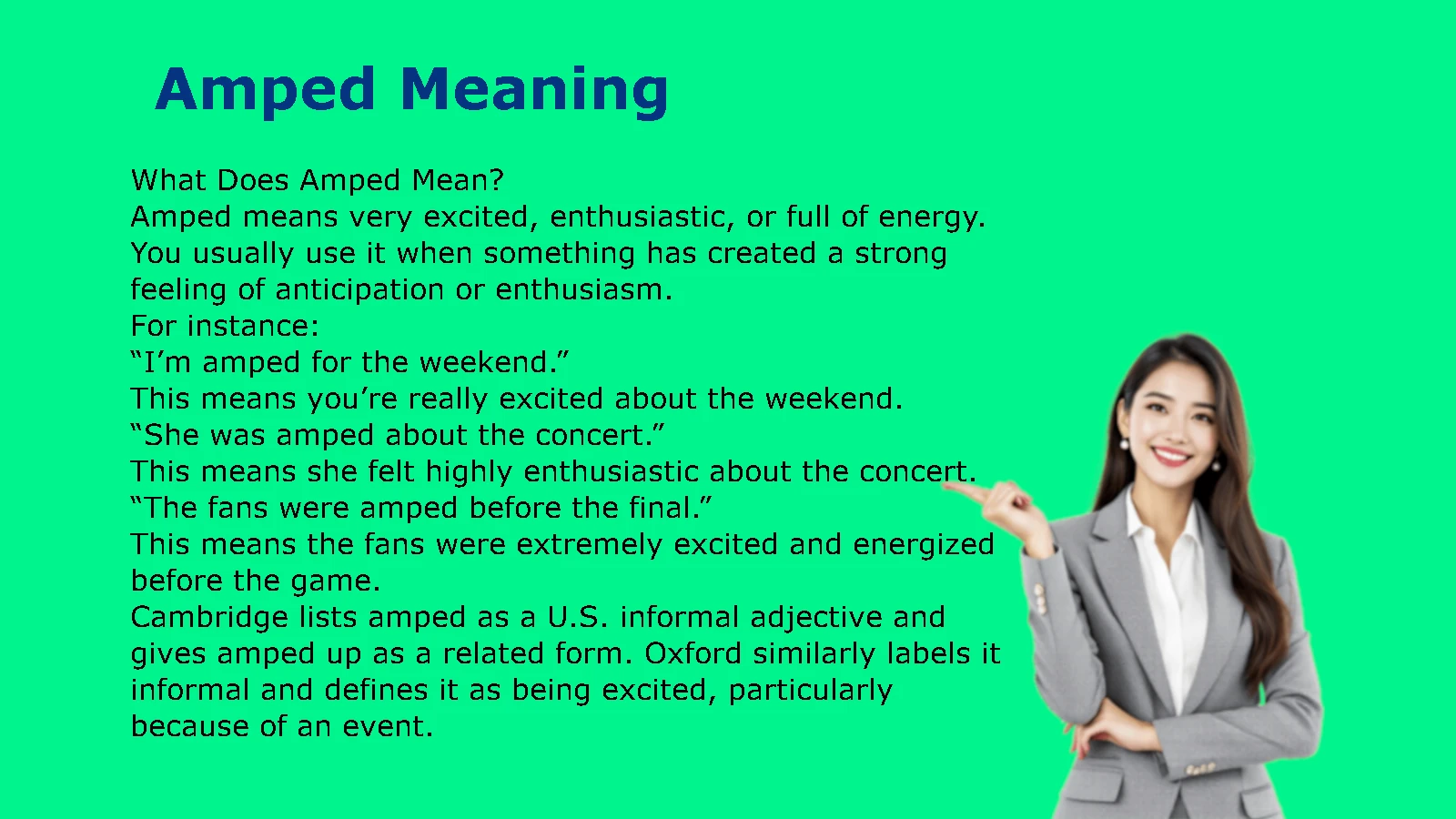
What Does Amped Mean?
Amped means very excited, enthusiastic, or full of energy. You usually use it when something has created a strong feeling of anticipation or enthusiasm.
For instance:
- “I’m amped for the weekend.”
This means you’re really excited about the weekend. - “She was amped about the concert.”
This means she felt highly enthusiastic about the concert. - “The fans were amped before the final.”
This means the fans were extremely excited and energized before the game.
Cambridge lists amped as a U.S. informal adjective and gives amped up as a related form. Oxford similarly labels it informal and defines it as being excited, particularly because of an event.
Amped Meaning at a Glance
| Word or phrase | Meaning | Tone |
| Amped | Very excited or energized | Informal |
| Amped up | Highly excited, energized, or worked up | Informal |
| Excited | Happy or enthusiastic about something | Neutral |
| Hyped | Extremely enthusiastic or full of anticipation | Informal |
| Pumped | Excited and energized | Informal |
| Stoked | Very excited or pleased | Informal |
The key difference is intensity and tone. Excited works almost anywhere. Amped sounds more energetic and casual.
What Does Amped Mean in Slang?
In slang, amped means really excited, energized, or fired up.
It often appears when someone feels a strong rush of anticipation. A person might be amped before a championship game, a concert, a vacation, a competition, a party, or the release of a highly anticipated video game.
Consider these two sentences:
- “I’m excited for the game.”
- “I’m amped for the game.”
Both sentences express positive anticipation. However, amped makes the emotion sound more energetic and informal.
It’s similar to turning up the volume on a speaker. The basic emotion remains excitement, but the expression makes that excitement feel stronger.
Amped Meaning in Texting and Social Media
Texting gives amped plenty of room to shine because casual digital conversations often favor short, expressive language.
You might see messages such as:
- “I’m so amped!”
- “Amped for tonight!”
- “We’re all amped for the trip.”
- “I’m seriously amped about this.”
- “So amped to see everyone.”
- “The whole group is amped.”
The word can also appear with exclamation marks or emojis when the speaker wants to emphasize enthusiasm:
“I’m so amped for Saturday! 🔥”
The meaning stays the same. The extra punctuation simply adds emotional emphasis.
What Does Amped Up Mean?
Amped up means very excited, energized, or worked up.
In many situations, amped and amped up are interchangeable:
- “I’m amped for the concert.”
- “I’m amped up for the concert.”
Both communicate strong excitement.
However, amped up can sometimes describe a person’s heightened emotional state more broadly. Depending on context, it may refer to excitement, intense energy, or being worked up.
Oxford gives examples involving people who become amped up before competing and people who are both amped up and happy at an event.
Amped vs. Amped Up
| Expression | Common sense | Example |
| Amped | Very excited or energized | “I’m amped for the concert.” |
| Amped up | Highly excited, energized, or worked up | “The crowd was amped up.” |
A useful rule is simple: amped often focuses on the person’s feeling, while amped up can emphasize a heightened state of energy or excitement.
How to Use Amped in a Sentence
The word amped usually works as an adjective after a form of be.
Common patterns include:
- be + amped
- be + amped for + noun
- be + amped about + noun
- be + amped to + verb
- be + amped up
Amped for an Event
Use amped for when you’re excited about something that’s coming.
Examples:
- “I’m amped for the concert.”
- “We’re amped for the championship.”
- “She’s amped for her birthday party.”
- “Everyone is amped for the festival.”
This construction strongly emphasizes anticipation.
Amped About Something
You can also use amped about when the focus falls on the thing causing the excitement.
Examples:
- “He’s amped about his new project.”
- “She’s amped about the announcement.”
- “They’re amped about the opportunity.”
- “I’m really amped about this trip.”
Amped to Do Something
Use amped to before a verb when you want to explain what you’re excited to do.
Examples:
- “I’m amped to see the band.”
- “She’s amped to compete.”
- “We’re amped to start the tournament.”
- “They’re amped to meet the team.”
This structure is especially natural in casual conversation.
Amped After Good News
Someone can also become amped because of news or an unexpected development.
For example:
- “Everyone got amped when the announcement came.”
- “The team was amped after hearing the results.”
- “She got amped when she found out she had won.”
Here, the word describes a sudden increase in enthusiasm.
Amped Examples in Everyday Conversations
The easiest way to understand amped meaning is to see how people use it in real situations.
Friends Making Plans
Alex: “Are you coming to the beach Saturday?”
Jordan: “Absolutely. I’m already amped for it.”
Here, amped means Jordan is really excited and looking forward to the trip.
Sports
“The players were amped before the championship game.”
The players aren’t merely happy. They feel energized and ready to compete.
Gaming
“I’m so amped for the new game release.”
The speaker has strong anticipation for the release.
Music
“The crowd was amped when the band came onstage.”
The audience was full of excitement and energy.
School
“She’s amped for graduation.”
She feels highly excited about the upcoming event.
Work
“I’m pretty amped about the new project.”
This sounds casual. It communicates enthusiasm but wouldn’t necessarily suit a formal business report.
Group Chats
“Who else is amped for tonight?”
This is a natural way to ask friends whether they’re excited about an upcoming event.
Amped vs. Excited
Amped and excited overlap heavily, but they aren’t identical in tone.
Excited is the standard, neutral choice. You can use it in casual conversation, professional communication, academic writing, and many other settings.
Amped sounds more informal and energetic.
| Feature | Excited | Amped |
| Basic meaning | Feeling enthusiasm or anticipation | Feeling very excited or energized |
| Formality | Neutral | Informal |
| Energy level | Broad range | Often stronger |
| Professional writing | Usually appropriate | Usually too casual |
| Texting | Natural | Very natural |
| Sports | Natural | Especially common |
| Social media | Natural | Common |
Compare:
Neutral:
“I’m excited about the conference.”
Casual and energetic:
“I’m amped for the conference!”
The second sentence sounds more animated. It has more personality.
Amped vs. Hyped
Amped and hyped are close synonyms, especially in casual speech.
Both can describe strong enthusiasm about an upcoming event, product, game, performance, or experience.
However, hyped often emphasizes anticipation or excitement created by publicity, discussion, or expectation. Amped often puts more emphasis on a person’s energy and emotional excitement.
For example:
- “Everyone is hyped for the new game.”
- “Everyone is amped for the new game.”
Both work naturally.
The distinction isn’t absolute. In everyday slang, speakers frequently use these words in similar situations.
Amped vs. Pumped
Pumped is another close alternative.
You can say:
- “I’m pumped for the game.”
- “I’m amped for the game.”
Both sound natural in casual American English.
Still, pumped often has a strong connection with physical energy, exercise, sports, or motivation. Amped can carry a similar energetic feeling but also works broadly for concerts, entertainment, trips, parties, and other events.
Examples
Sports:
“I’m pumped for the final.”
Concert:
“I’m amped for the concert.”
Workout:
“I’m pumped and ready to train.”
These aren’t strict rules. Native speakers can use the words in overlapping ways.
Synonyms for Amped
Several words can replace amped, but each one brings a slightly different shade of meaning.
Excited
The safest general synonym.
“I’m excited for the trip.”
Unlike amped, excited isn’t strongly informal.
Enthusiastic
A more polished alternative.
“She’s enthusiastic about the project.”
This works well in professional or academic contexts.
Energized
Focuses on having energy rather than simply anticipating something.
“The team felt energized after the win.”
Psyched
A highly informal synonym for excited.
“I’m psyched for the concert.”
Pumped
Suggests strong energy and enthusiasm.
“We’re pumped for the tournament.”
Hyped
Common in casual speech and online conversations.
“Everyone is hyped for the release.”
Stoked
Means very excited or pleased.
“I’m stoked about the trip.”
Thrilled
Stronger than ordinary excited and more suitable for many formal situations.
“She was thrilled with the results.”
Fired up
Emphasizes strong energy, motivation, or passion.
“The team was fired up before the game.”
Eager
Focuses on wanting something to happen.
“I’m eager to get started.”
These words aren’t perfect substitutes in every sentence. Context matters.
Is Amped Positive or Negative?
Most commonly, amped has a positive meaning. It usually describes excitement, enthusiasm, anticipation, or high energy.
For example:
“I’m amped for my vacation.”
That clearly expresses positive anticipation.
However, amped up can sometimes describe someone who has become highly worked up or emotionally intense. Merriam Webster’s definition of the verb amp includes both making someone more excited or energetic and making something more intense.
Consider:
“He got amped up during the argument.”
Here, the phrase may suggest that the person’s emotions became more intense. The sentence doesn’t necessarily mean he felt happy.
The Context Changes the Meaning
| Sentence | Likely meaning |
| “I’m amped for the concert.” | Very excited |
| “The fans were amped.” | Energetic and enthusiastic |
| “He got amped up before the race.” | Highly energized |
| “He got amped up during the argument.” | Became worked up or emotionally intense |
So, amped isn’t automatically positive in every possible context. The surrounding words tell you how to interpret it.
Where Does the Word Amped Come From?
The modern amped connects to the verb amp, which dictionaries define as meaning to excite or energize someone. Merriam Webster traces this verb to a shortening of amplify and records its first known use in this verb sense in 1985.
The connection becomes easier to understand when you think about an amplifier.
An amplifier makes a signal stronger. In everyday slang, amp developed a figurative sense related to increasing energy or excitement.
So:
amplify → amp → amp up → amped
The American Heritage Dictionary similarly defines the informal verb amp as meaning to amplify and, figuratively, to stimulate or excite.
A Note About the Origin
Some slang references have proposed additional theories for the origin of the excitement sense, including possible connections to amphetamine. However, the reliable dictionary evidence is more cautious. Merriam Webster specifically gives short for amplify as the etymology of the verb while noting that the excitement sense may also have been influenced by amphetamine.
Therefore, it is better to describe the connection to amplify as the documented etymological explanation rather than state an uncertain slang theory as fact.
Is Amped Formal or Informal?
Amped is informal.
Cambridge labels it US informal, while Oxford labels it North American English, informal.
That distinction matters because a word can be perfectly understandable and grammatically normal while still sounding too casual for a particular situation.
Where Amped Works Well
Use amped naturally in:
- Text messages
- Group chats
- Social media
- Conversations with friends
- Sports discussions
- Gaming communities
- Casual blogs
- Informal interviews
- Entertainment discussions
Where Another Word May Work Better
Consider a more neutral alternative in:
- Formal business reports
- Academic papers
- Official announcements
- Formal emails
- Legal documents
- Professional proposals
For example:
Casual:
“I’m really amped about the event.”
Professional:
“I’m very excited about the event.”
More formal:
“I’m enthusiastic about the opportunity.”
The meaning stays close, but the tone changes.
Can You Use Amped in Professional Communication?
You can, but that doesn’t mean you always should.
Imagine sending this to a close coworker:
“I’m so amped about the launch!”
If your workplace has a relaxed culture, that sentence may sound completely natural.
Now imagine putting the same sentence in a formal proposal:
“Our company is amped about the proposed partnership.”
That wording feels noticeably casual.
A better choice would be:
“Our company is excited about the proposed partnership.”
Or:
“Our company is enthusiastic about the proposed partnership.”
The goal isn’t to avoid informal language at all costs. Instead, match the word to the audience and situation.
Common Phrases With Amped
Several constructions appear naturally with amped.
Amped for
Used for excitement about an upcoming event.
“I’m amped for the concert.”
Amped about
Used when focusing on the thing creating excitement.
“She’s amped about her new job.”
Amped to
Used before a verb.
“We’re amped to get started.”
Amped up
Used for a heightened state of excitement, energy, or agitation.
“The crowd was amped up.”
Get amped
A casual command or encouragement meaning get excited or energized.
“Get amped! The game starts in ten minutes.”
Feel amped
Focuses directly on the speaker’s emotional or physical energy.
“I feel amped after that workout.”
Common Mistakes When Using Amped
The word is simple, but a few usage mistakes can make a sentence sound unnatural.
Using Amped in Highly Formal Writing
The biggest issue is tone, not grammar.
Instead of:
“The committee was amped about the proposal.”
Use:
“The committee was enthusiastic about the proposal.”
Assuming Amped Always Means Happy
Amped usually signals positive excitement, but amped up can also mean worked up or intensely agitated.
Always look at the surrounding context.
Confusing Amped With Ampere
The word amp has several unrelated meanings.
An amp can mean an ampere, a unit of electric current. It can also mean an amplifier, especially in music. Merriam Webster lists both noun meanings separately from the informal verb amp.
So:
“The guitar is plugged into an amp.”
Here, amp means amplifier.
But:
“The crowd was amped.”
Here, amped means highly excited or energized.
Treating Amped and Amped Up as Completely Different
They often express essentially the same idea.
“I’m amped for the game.”
“I’m amped up for the game.”
Both communicate strong excitement.
The exact nuance can shift with context, but you don’t need to treat them as unrelated expressions.
Ignoring Tone
If you use amped in a formal report, the problem isn’t that readers won’t understand it. The problem is that it may sound too casual.
Good vocabulary isn’t only about meaning. It’s also about fit.
Amped Meaning in Different Contexts
The same basic word can carry slightly different shades depending on where you use it.
| Context | Example | What amped conveys |
| Sports | “The players are amped for the final.” | Competitive energy |
| Gaming | “I’m amped for the new release.” | Strong anticipation |
| Music | “The crowd was amped.” | Excitement and energy |
| Travel | “We’re amped for the road trip.” | Enthusiasm |
| School | “She’s amped for graduation.” | Excitement about an event |
| Work | “I’m amped about the project.” | Casual enthusiasm |
| Parties | “Everyone was amped for the party.” | High anticipation |
| Competition | “He gets amped before every race.” | Energy and readiness |
| Arguments | “He got amped up.” | Heightened emotion |
The word works particularly well when the situation involves anticipation, movement, competition, entertainment, or strong emotion.
Case Study: Understanding Amped Through One Situation
Imagine a basketball team preparing for a championship game.
Two hours before tipoff, a player says:
“I’m excited about tonight.”
The statement is clear and neutral.
Later, after hearing the crowd outside the arena, seeing teammates warm up, and realizing the game is about to begin, the same player says:
“I’m amped for tonight!”
The second sentence communicates something more energetic. The player isn’t merely looking forward to the game. The player feels charged up and ready.
Now imagine the coach says:
“The whole team is amped up.”
That sentence shifts the focus from one person’s anticipation to the team’s overall emotional energy.
This example shows why amped works so well in sports and entertainment. The word carries a sense of momentum.
How to Reply When Someone Says “I’m Amped”
If someone says “I’m amped!”, they’re telling you they’re excited.
Your response depends on the relationship and situation.
Friendly Responses
- “Same here!”
- “Me too!”
- “I can’t wait!”
- “It’s going to be awesome.”
- “I’m excited too.”
Supportive Responses
- “You should be. It’s going to be great!”
- “That’s exciting!”
- “You’ve got every reason to be excited.”
- “I can tell!”
Casual Text Responses
- “Same! 🔥”
- “Let’s go!”
- “Me too!”
- “Absolutely!”
- “This is going to be wild!”
A short response often works best because amped itself belongs to casual, energetic communication.
Amped Meaning: Amped vs. Other Similar Words
It’s useful to compare the word with related expressions because no synonym carries exactly the same tone.
| Word | Main idea | Formality | Energy |
| Amped | Very excited and energized | Informal | High |
| Excited | Happy or enthusiastic | Neutral | Medium to high |
| Hyped | Highly enthusiastic or anticipating something | Informal | High |
| Pumped | Energized and excited | Informal | High |
| Stoked | Very excited or pleased | Informal | High |
| Psyched | Very excited | Informal | High |
| Eager | Strongly wanting something to happen | Neutral | Medium |
| Thrilled | Extremely pleased or excited | Neutral | High |
| Enthusiastic | Showing strong interest or excitement | Neutral/formal | Medium to high |
| Energized | Filled with energy | Neutral | High |
The best replacement depends on what you want to emphasize.
Is Amped a Slang Word or a Real Word?
Amped is a real English word, and major dictionaries recognize it as an adjective.
Cambridge lists amped as an informal adjective meaning excited. Oxford also includes it as an informal North American English adjective.
Calling it slang isn’t completely unreasonable in everyday conversation because the word has a strongly informal flavor. However, informal is the more precise label used by major learner dictionaries.
That distinction is useful.
A slang term may be highly restricted to a particular social group or subculture. An informal word can have much broader use while still sounding casual.
Amped fits comfortably into modern informal American English.
Is “Amped” the Same as “Excited”?
Not exactly, although the meanings overlap.
Excited is broader and more neutral.
Amped usually adds a stronger sense of energy or intensity.
For example:
“I’m excited about the trip.”
This sounds perfectly ordinary.
“I’m amped about the trip.”
This sounds more animated and casual.
Neither sentence is wrong. The second simply has a different personality.
What Does “I’m So Amped” Mean?
“I’m so amped” means “I’m very excited or energized.”
The word so increases the intensity.
For example:
“I’m so amped for the concert!”
This means:
“I’m extremely excited about the concert.”
It’s especially natural in texting and casual conversation.
What Does “Get Amped” Mean?
Get amped means get excited, energized, or ready for something.
For example:
“Get amped! The final starts in five minutes.”
A coach, friend, commentator, or fan might use this phrase to build excitement.
It has a motivational quality. The speaker isn’t simply describing excitement. They’re encouraging someone to feel it.
What Does “Amped Out” Mean?
Amped out can appear in informal usage to describe someone who has become excessively excited, overstimulated, or full of energy.
However, it is less common than amped and amped up in ordinary modern usage.
For most everyday situations, amped or amped up is the more natural choice.
Quick Facts About the Word Amped
- Part of speech: Adjective when used as in “I’m amped.”
- Pronunciation: /æmpt/
- Register: Informal
- Regional labeling: U.S. or North American English in major dictionaries
- Core meaning: Very excited or energized
- Related expression: amped up
- Related verb: amp
- Common contexts: Sports, entertainment, gaming, social media, texting, and casual conversation
- Formal alternative: excited, enthusiastic, or eager, depending on context
- Technical meanings of amp: An ampere or an amplifier
Frequently Asked Questions About Amped Meaning
What does amped mean in slang?
Amped means very excited, energized, or enthusiastic. It is an informal expression commonly used when someone feels strong anticipation about something.
What does “I’m so amped” mean?
“I’m so amped” means “I’m extremely excited or energized.” The expression often refers to an upcoming event or experience.
What does amped up mean?
Amped up means highly excited, energized, or worked up. It often overlaps with amped and can describe a heightened emotional state.
Is amped a formal word?
No. Amped is informal. Cambridge and Oxford both label it as an informal expression associated with U.S. or North American English.
Is amped the same as excited?
They have very similar meanings, but amped sounds more casual and energetic. Excited works in a much wider range of situations.
Is amped positive?
Usually, yes. Amped generally expresses positive excitement or enthusiasm. However, amped up can sometimes describe someone who has become worked up or emotionally intense.
What are the synonyms for amped?
Common alternatives include excited, hyped, pumped, psyched, stoked, energized, enthusiastic, thrilled, fired up, and eager. The best choice depends on the tone and context.
Is amped a real word?
Yes. Amped is recognized by major English dictionaries as the past participle of amp and as an informal adjective meaning excited or energized.
Is “amped” American slang?
It is strongly associated with informal North American English. Oxford labels the word North American English and informal, while Cambridge labels it U.S. informal.
What does “amped for” mean?
Amped for means very excited about something that is going to happen.
“I’m amped for the weekend.”
This means the speaker is really looking forward to the weekend.
What does “amped about” mean?
Amped about means very excited or enthusiastic about something.
“She’s amped about her new role.”
What does “amped to” mean?
Amped to means very excited to do something.
“I’m amped to see the band.”
Final Takeaway: Amped Meaning Explained
The amped meaning is straightforward: very excited, energized, or enthusiastic.
It’s an informal word that works especially well when someone feels a strong rush of anticipation. You might be amped for a concert, amped about a vacation, amped to compete, or simply amped for the weekend.
The closely related expression amped up carries much the same meaning. Depending on the context, however, it can also describe someone who has become highly worked up or emotionally intense.
The word comes from amp, a verb associated with amplifying or increasing energy. Merriam Webster traces the verb to a shortening of amplify and records its modern excitement related verb sense as informal.
So, when someone texts:
“I’m amped for tonight!”
they’re essentially saying:
“I’m really excited, energized, and looking forward to tonight!”
It’s casual. It’s expressive. And when the moment calls for a little extra energy, amped says it with more punch than plain old excited.