
Irony is a literary device and figure of speech in which the actual outcome or intended meaning is different from what is expected or expressed. It is commonly found in literature, conversations, and everyday situations through verbal, situational, and dramatic irony. Irony meaning refers to this contrast between expectation and reality or between literal words and their intended meaning.
The confusion is understandable. Many people know the word irony, but they’re unsure about its actual meaning, definition, or how to use irony in a sentence. But here’s the kicker: using the term incorrectly can completely change the point you’re trying to make.
In this guide, you’ll learn the Irony Meaning, explore the definition of irony, discover the different types of irony, understand how to use irony correctly, and see plenty of examples of irony in sentences. You’ll also learn the difference between irony vs coincidence, verbal irony, situational irony, and dramatic irony, so you’ll know exactly when the word applies.
By the end, you’ll confidently recognize irony in everyday conversations, books, movies, and real-life situations—and you’ll never misuse the term again.
What Does Irony Mean?
Irony is a literary and rhetorical device in which the intended meaning differs from what appears on the surface. Most often, irony involves a contrast between expectation and reality.
Simply put, irony happens when things are not what they seem.
Sometimes a person says the opposite of what they truly mean. Other times, events unfold in a way nobody expects. In stories, readers may even know something that the characters don’t, creating tension and suspense.
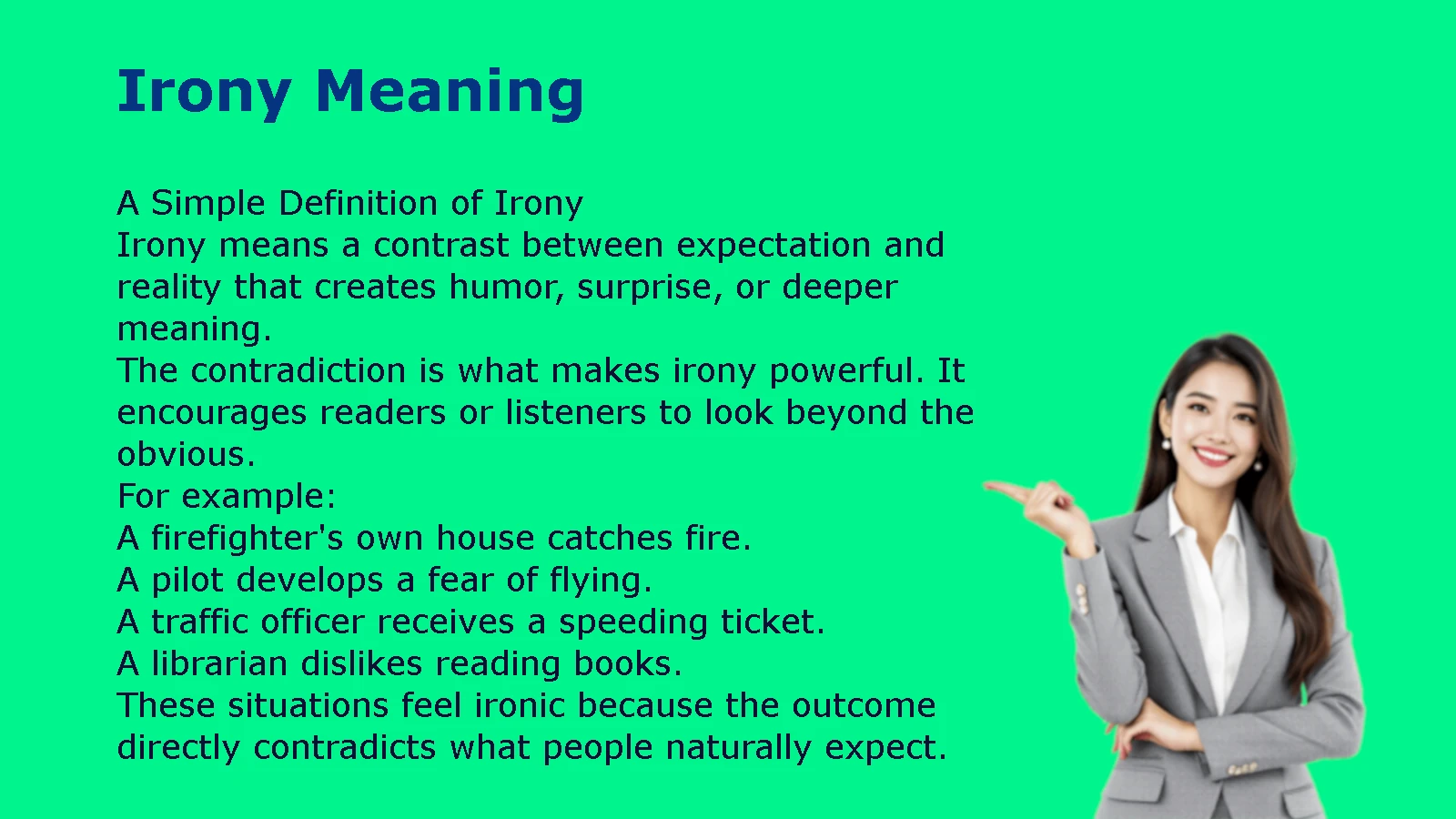
A Simple Definition of Irony
Irony means a contrast between expectation and reality that creates humor, surprise, or deeper meaning.
The contradiction is what makes irony powerful. It encourages readers or listeners to look beyond the obvious.
For example:
- A firefighter’s own house catches fire.
- A pilot develops a fear of flying.
- A traffic officer receives a speeding ticket.
- A librarian dislikes reading books.
These situations feel ironic because the outcome directly contradicts what people naturally expect.
The Origin of the Word “Irony”
The word irony comes from the ancient Greek word eirōneía, meaning dissimulation, feigned ignorance, or deliberate understatement.
Greek philosopher Socrates famously used this technique by pretending not to know something. Instead of giving answers directly, he asked questions that encouraged others to discover weaknesses in their own reasoning.
This approach later became known as Socratic irony, one of the oldest recognized forms of irony.
Over time, the meaning expanded beyond conversation and became an important literary device used in poetry, novels, plays, films, speeches, journalism, and even advertising.
How Irony Works
Irony depends on contrast.
Readers first develop an expectation. Then reality challenges that expectation.
This unexpected shift creates an emotional reaction such as:
- amusement
- surprise
- sadness
- tension
- curiosity
- reflection
Think of irony as two paths.
The audience expects the story to follow one path.
Instead, it suddenly takes another.
That unexpected turn gives irony its impact.
Why Context Matters
The exact same sentence can be ironic in one situation and completely literal in another.
Imagine someone says:
“Beautiful weather today.”
If the sun is shining, the speaker probably means exactly what they say.
If a hurricane is blowing trees across the road, they’re almost certainly being ironic.
Without context, it’s impossible to know.
That’s why understanding irony always requires paying attention to the surrounding situation.
Key Characteristics of Irony
Most examples of irony share several important features.
| Characteristic | Explanation |
| Contrast | Reality differs from expectations. |
| Hidden meaning | Surface meaning differs from intended meaning. |
| Context dependent | The surrounding situation determines whether something is ironic. |
| Emotional effect | Creates humor, suspense, tragedy, or reflection. |
| Reader engagement | Encourages audiences to think more deeply. |
Why Is Irony Used?
Irony isn’t just a clever writing trick.
It serves several important purposes in communication and storytelling.
Whether you’re reading a novel, watching a movie, or listening to a speech, irony often makes the message stronger and more memorable.
Here are the main reasons people use irony.
It Makes Writing More Interesting
Straightforward writing explains events.
Irony transforms them.
Instead of telling readers exactly what to think, irony lets them discover meaning on their own.
That process keeps readers engaged because they become active participants rather than passive observers.
It Creates Humor
Many jokes rely on irony.
Comedy often comes from watching expectations collapse in unexpected ways.
Imagine someone spending twenty minutes searching for their glasses only to realize they’re already wearing them.
The contradiction makes the situation funny.
It Builds Suspense
Writers frequently use irony to increase tension.
Readers may know danger is coming while the characters remain completely unaware.
That difference in knowledge keeps audiences turning pages.
It Reveals Character
A person’s ironic words or actions often expose personality traits that direct descriptions never could.
For example:
- arrogance
- insecurity
- overconfidence
- intelligence
- kindness
- hypocrisy
Irony allows readers to discover these qualities naturally.
It Highlights Social Problems
Satire depends heavily on irony.
Authors often exaggerate contradictions to criticize governments, traditions, or human behavior.
Rather than preaching, irony encourages readers to recognize problems themselves.
It Makes Messages Memorable
People tend to remember surprising ideas.
Because irony breaks expectations, it sticks in memory longer than ordinary statements.
That’s one reason advertisers, comedians, teachers, and public speakers use it so often.
Benefits of Using Irony
| Benefit | Why It Matters |
| Adds humor | Makes communication entertaining. |
| Creates suspense | Keeps audiences engaged. |
| Encourages thinking | Invites deeper interpretation. |
| Reveals character | Shows personality through actions or speech. |
| Strengthens storytelling | Makes narratives richer and more dynamic. |
| Improves memorability | Unexpected outcomes stay with readers longer. |
The Three Main Types of Irony
Although irony appears in many forms, nearly every example belongs to one of three major categories.
Understanding these types makes it much easier to recognize irony in books, movies, conversations, and everyday life.
Verbal Irony Meaning
Verbal irony occurs when someone intentionally says the opposite of what they actually mean.
The speaker expects listeners to recognize the hidden meaning from tone, context, or situation.
Unlike lying, verbal irony doesn’t aim to deceive.
Instead, it communicates an idea indirectly.
Examples of Verbal Irony
Imagine these situations.
A student walks into class after forgetting every homework assignment.
The teacher smiles and says:
“Excellent preparation.”
The teacher clearly doesn’t mean the student prepared well.
Instead, the opposite message is being communicated.
Other examples include:
- Saying “Fantastic!” after spilling coffee everywhere.
- Saying “Perfect timing.” when someone arrives an hour late.
- Saying “What a peaceful neighborhood.” while construction equipment shakes the entire building.
Verbal Irony vs. Sarcasm
Many people think these terms mean exactly the same thing.
They don’t.
Sarcasm is usually intended to mock, criticize, or insult.
Verbal irony may simply create humor without hurting anyone.
For example:
“Wonderful weather.”
If someone says this while standing in heavy rain, they’re using verbal irony.
If they say it to mock someone who planned an outdoor wedding, it becomes sarcasm.
Every sarcastic remark is verbally ironic.
Not every example of verbal irony is sarcastic.
When Writers Use Verbal Irony
Authors use verbal irony to:
- create humor
- reveal personality
- expose hypocrisy
- soften criticism
- surprise readers
- add emotional depth
It appears frequently in novels, television shows, sitcoms, and everyday conversations.
Situational Irony Meaning
Situational irony happens when the actual outcome differs dramatically from what people reasonably expect.
The contradiction isn’t random.
It carries meaningful significance.
Unexpected events alone don’t create irony.
There must be a logical expectation that reality overturns.
Examples of Situational Irony
Consider these examples.
A fire station burns down.
A swimming instructor is afraid of water.
A locksmith gets locked out of their own house.
A diet coach wins a pie eating contest.
Each outcome directly contradicts what people naturally expect.
That’s what makes these situations ironic.
Everyday Situational Irony
Here are several familiar examples.
| Expectation | Reality | Why It’s Ironic |
| A weather app predicts sunshine | It rains all day | Expected forecast fails. |
| A technology company suffers a major computer crash | Experts face the problem they solve | Reality contradicts expertise. |
| A police officer forgets traffic rules | The rule enforcer breaks rules | Role reversal creates irony. |
| A chef burns dinner | Cooking expert fails to cook | Unexpected contradiction. |
Why Situational Irony Is Powerful
Situational irony reminds people that life rarely follows predictable patterns.
It creates:
- surprise
- humor
- emotional impact
- memorable storytelling
Many of history’s most famous stories rely on unexpected outcomes.
Dramatic Irony Meaning
Dramatic irony occurs when the audience knows important information that one or more characters do not.
Readers understand what’s really happening.
The characters remain unaware.
That difference creates suspense, excitement, or emotional tension.
How Dramatic Irony Works
Imagine watching a horror movie.
The audience sees the villain hiding behind a door.
The main character doesn’t.
As the character slowly approaches the room, viewers become increasingly anxious because they already know the danger waiting inside.
That knowledge gap creates dramatic irony.
Everyday Example
Imagine your friend spends weeks planning a surprise birthday party.
Meanwhile, you accidentally discover the invitation online.
Your friend still believes everything remains secret.
Now every conversation becomes dramatically ironic because you know something they don’t.
Why Writers Love Dramatic Irony
Dramatic irony allows authors to:
- increase suspense
- create emotional investment
- build anticipation
- deepen character development
- encourage audience participation
Readers enjoy watching characters gradually discover truths they already know.
Comparing the Three Main Types of Irony
| Type | Definition | Who Knows the Truth? | Example |
| Verbal Irony | Words mean the opposite of their literal meaning. | Speaker | Saying “Great job” after a mistake. |
| Situational Irony | Reality differs from expectations. | Everyone discovers the surprise together. | Fire station catches fire. |
| Dramatic Irony | Audience knows more than the characters. | Audience | Viewers know the villain is hiding nearby. |
Other Forms of Irony You May Encounter
Although verbal, situational, and dramatic irony are the most common categories, several specialized forms also appear in literature, philosophy, and history.
Understanding them gives you a more complete picture of how irony works.
Cosmic Irony Meaning
Cosmic irony happens when fate, destiny, or a higher power seems to manipulate events in unexpected ways.
Characters often believe they control their future.
Instead, circumstances prove otherwise.
This type of irony appears frequently in tragedies.
Example
A king spends years trying to avoid a prophecy.
Every decision he makes brings the prophecy closer to becoming reality.
The universe appears to be working against him.
Socratic Irony Meaning
Socratic irony involves pretending not to know something in order to encourage another person to think more deeply.
Instead of giving answers, the speaker asks thoughtful questions.
This teaching method remains widely used in classrooms, law schools, and philosophy discussions today.
Example
A professor asks:
“Why do you think that’s true?”
Rather than correcting the student immediately, the professor guides them toward discovering the answer independently.
Historical Irony Meaning
Historical irony occurs when events produce outcomes that completely contradict the intentions of historical figures or societies.
Examples
- A policy designed to strengthen a government eventually causes its collapse.
- An invention created for peace later becomes a military tool.
- Economic reforms intended to reduce inequality produce the opposite effect.
History contains many examples where unintended consequences reshape the world.
Tragic Irony Meaning
Tragic irony combines dramatic irony with heartbreaking consequences.
The audience often recognizes the coming disaster long before the main character does.
As readers watch events unfold, the emotional impact becomes even stronger because the ending feels unavoidable.
Classic tragedies frequently rely on this form of irony to create unforgettable stories.
Irony vs. Sarcasm
Many people use irony and sarcasm as if they mean the same thing. They don’t. While the two often overlap, they serve different purposes.
The easiest way to remember the difference is this:
- Irony highlights a contrast between expectation and reality.
- Sarcasm uses sharp or mocking language to criticize, tease, or express contempt.
In other words, sarcasm is a type of verbal irony, but not every example of verbal irony is sarcastic.
What Is Sarcasm?
Sarcasm is a way of speaking where someone says the opposite of what they mean to make a point, often with a mocking or humorous tone.
Tone of voice usually reveals sarcasm.
For example:
A coworker spills coffee all over important documents.
Someone says:
“Well, that couldn’t have gone any better.”
The speaker doesn’t mean the situation went well. They’re highlighting the mistake with humor or criticism.
How Irony and Sarcasm Differ
| Feature | Irony | Sarcasm |
| Main purpose | Creates contrast | Criticizes or mocks |
| Tone | Neutral, humorous, tragic, or thoughtful | Usually sharp or humorous |
| Requires ridicule | No | Usually yes |
| Common in literature | Very common | Less common |
| Can be kind | Yes | Rarely |
Examples of Irony vs. Sarcasm
| Situation | Irony | Sarcasm |
| It starts raining during a picnic | “Our picnic picked the perfect weather.” | “Brilliant planning, everyone.” |
| Someone forgets their wallet | “Looks like shopping will be interesting.” | “Great job remembering the one thing you needed.” |
| Elevator stops working | The building’s newest elevator breaks first. | “Top quality engineering.” |
Notice that sarcasm usually carries a sharper emotional edge.
Irony simply points out the contradiction.
When to Use Irony Instead of Sarcasm
Irony works better when you want to:
- Add humor without insulting anyone.
- Tell a story with an unexpected twist.
- Encourage readers to think.
- Create suspense.
- Express subtle humor.
Sarcasm fits casual conversations between people who understand each other’s sense of humor. However, it can sound rude in professional settings, emails, or formal writing.
Irony vs. Coincidence
This is one of the biggest sources of confusion.
People often describe unlikely events as ironic when they’re actually coincidences.
A coincidence happens when two events occur together without creating a meaningful contradiction.
Irony requires contradiction.
Coincidence does not.
What Is a Coincidence?
A coincidence is an unexpected event that happens by chance.
For example:
- Two strangers discover they share the same birthday.
- You meet an old friend while traveling overseas.
- Twins buy each other the same birthday gift without planning it.
These events are surprising.
They aren’t ironic because nothing contradicts expectations.
Examples of True Irony
Now compare those with these examples.
- A lifeguard needs rescuing.
- A police station gets robbed.
- A professional gardener forgets to water their own plants.
- A locksmith locks their keys inside the house.
Each situation contains an obvious contradiction.
Irony vs. Coincidence Comparison Table
| Question | Irony | Coincidence |
| Unexpected? | Yes | Yes |
| Contradiction exists? | Yes | No |
| Depends on expectation? | Yes | No |
| Happens by chance? | Sometimes | Usually |
| Creates deeper meaning? | Often | Rarely |
Quick Test
Ask yourself this question:
Did reality directly contradict what people would reasonably expect?
If the answer is yes, it’s probably irony.
If the answer is no, it’s likely just coincidence.
Irony vs. Paradox
Irony and paradox both involve contradictions.
However, they operate in completely different ways.
A paradox is a statement that appears impossible or self-contradictory but reveals a deeper truth.
Irony focuses on events, actions, or intentions.
Examples of Paradox
- Less is more.
- The only constant is change.
- Silence speaks louder than words.
- The beginning of the end.
These statements seem contradictory at first.
After thinking about them, they make sense.
Examples of Irony
- A marriage counselor files for divorce.
- A snowplow gets stuck in the snow.
- A professional photographer forgets their camera.
These involve unexpected outcomes rather than contradictory statements.
Irony vs. Paradox Table
| Irony | Paradox |
| Usually involves events | Usually involves statements |
| Depends on expectation | Depends on logic |
| Creates surprise | Creates reflection |
| Common in stories | Common in philosophy and literature |
Irony vs. Oxymoron
An oxymoron combines two opposite words into a single expression.
Unlike irony, an oxymoron doesn’t require a surprising situation.
Instead, the contradiction exists within the phrase itself.
Common Oxymorons
- Deafening silence
- Seriously funny
- Open secret
- Living dead
- Pretty ugly
- Awfully good
- Bittersweet
Each phrase combines opposing ideas.
That’s what makes it an oxymoron.
Irony vs. Oxymoron at a Glance
| Irony | Oxymoron |
| Happens through events or context | Happens inside a phrase |
| Often requires a story | Exists in only two or three words |
| Creates unexpected meaning | Creates descriptive contrast |
How to Identify Irony
Spotting irony becomes much easier once you know what clues to watch for.
Instead of asking whether something is surprising, ask whether it contradicts reasonable expectations.
Here are the signs.
Look for a Contrast
Irony almost always begins with expectation.
Ask yourself:
- What did everyone expect?
- What actually happened?
If those answers conflict, irony may be present.
Consider the Speaker’s Intent
People don’t always mean exactly what they say.
Pay attention to:
- facial expressions
- tone of voice
- context
- body language
These clues reveal whether someone is speaking ironically.
Ask Whether the Outcome Fits the Situation
Some events are simply unlucky.
Others are ironic.
For example:
A chef burns toast.
That feels ironic because cooking is the chef’s profession.
A teenager burns toast.
That’s ordinary.
Watch for Audience Knowledge
If readers know information hidden from the characters, dramatic irony is probably at work.
Movies often use this technique to increase suspense.
Think About the Bigger Picture
Irony usually serves a purpose.
Ask:
- Does it reveal character?
- Does it create humor?
- Does it criticize society?
- Does it build suspense?
Meaningful irony almost always contributes something important.
Quick Irony Checklist
Before calling something ironic, see whether it checks these boxes.
- ✅ Expectations exist.
- ✅ Reality contradicts those expectations.
- ✅ The contradiction matters.
- ✅ Context supports the hidden meaning.
- ✅ The result creates humor, tension, or insight.
If most answers are yes, you’ve probably found irony.
How to Use Irony Correctly in Writing
Irony can make writing more memorable.
Used well, it adds depth without explaining everything directly.
The key is subtlety.
Readers enjoy discovering irony on their own.
In Fiction
Novelists use irony to:
- build suspense
- surprise readers
- reveal personalities
- create emotional endings
Many mystery novels depend on dramatic irony.
Readers often know clues that characters haven’t discovered yet.
In Essays
Irony can strengthen persuasive writing.
For example:
Instead of saying pollution is increasing, a writer might describe a city winning an environmental award while its river remains contaminated.
The contradiction makes the point more powerful.
In Speeches
Public speakers often use irony to emphasize ideas.
Example:
“We’re connected to thousands of people online, yet many of us have never felt lonelier.”
The contrast makes listeners stop and think.
In Marketing
Advertisers sometimes use irony to attract attention.
Imagine a cleaning product advertisement showing an unbelievably messy room before revealing the solution.
The contrast keeps viewers engaged.
In Everyday Conversations
Irony adds humor to ordinary life.
Examples include:
- “Perfect timing.”
- “Exactly what I needed today.”
- “Well, that’s convenient.”
The meaning depends entirely on context.
Tips for Using Irony Naturally
- Don’t explain the irony immediately.
- Let readers notice the contradiction.
- Match the tone to your audience.
- Avoid overusing ironic statements.
- Make sure the contrast is meaningful.
Good irony feels effortless.
Forced irony feels confusing.
Examples of Irony in Everyday Life
Irony isn’t limited to novels or movies.
You’ll find it almost everywhere once you begin looking.
Here are common examples from everyday situations.
Irony at School
Example 1
A spelling champion misspells the word “spelling.”
Example 2
The student who reminds everyone about deadlines forgets their own assignment.
Example 3
The school librarian loses a borrowed book.
These situations contradict what people naturally expect.
Irony at Work
Example 1
A cybersecurity company gets hacked.
Example 2
A time management coach arrives late to every meeting.
Example 3
An accountant forgets to file taxes on time.
Professional expertise makes these outcomes ironic.
Irony at Home
Example 1
Someone spends an hour cleaning windows before birds immediately leave them covered in droppings.
Example 2
A parent buys an expensive organizer and then can’t remember where they put it.
Example 3
A person installs a smart home system and gets locked outside because the battery dies.
Small contradictions like these often create everyday humor.
Irony in Technology
Technology produces ironic moments surprisingly often.
Examples include:
- Your password manager forgets your password.
- Your GPS gets lost because of outdated maps.
- Your backup drive crashes before the main computer.
- A smartphone dies while showing battery-saving tips.
Technology promises convenience.
When it causes the opposite, irony appears.
Irony in Weather
Weather creates many naturally ironic situations.
Examples include:
- A drought begins immediately after someone installs a new irrigation system.
- A snowstorm cancels a conference about climate preparedness.
- The weather forecast predicts sunshine during an all-day rainstorm.
Again, the contradiction matters more than the surprise.
Case Study: Why “The Fire Station Burned Down” Is Truly Ironic
Consider one of the most famous examples.
A fire station catches fire.
At first glance, it simply sounds unfortunate.
Look closer.
People expect firefighters to prevent fires.
The very place dedicated to fighting fires becomes the victim of one.
That direct contradiction transforms an ordinary event into genuine situational irony.
This example appears in countless writing and literature classes because it perfectly demonstrates the gap between expectation and reality.
Irony in Literature: Famous Examples That Shaped Storytelling
Irony has been one of literature’s most effective storytelling tools for thousands of years. It allows writers to surprise readers, build suspense, reveal character flaws, and explore complex themes without explaining every detail.
Many of the world’s greatest novels, plays, and short stories use irony to leave a lasting impression.
Let’s look at some well-known examples.
Dramatic Irony in Romeo and Juliet
One of the most famous examples of dramatic irony appears in William Shakespeare’s Romeo and Juliet.
Toward the end of the play, Juliet takes a potion that makes her appear dead. The audience knows she’s alive, but Romeo does not. Believing she has died, he takes his own life. Juliet later wakes, finds Romeo dead, and ends her own life.
This heartbreaking sequence creates enormous emotional tension because readers understand the truth long before the characters.
Why It Works
- Readers know more than the characters.
- Every decision increases suspense.
- The ending becomes even more tragic because it could have been avoided.
Situational Irony in The Gift of the Magi
In O. Henry’s classic short story The Gift of the Magi, a poor married couple each sacrifices their most valuable possession to buy a Christmas gift for the other.
- The wife sells her long hair to buy a chain for her husband’s watch.
- The husband sells his watch to buy combs for her hair.
Their gifts become unusable, yet their love shines brighter than the presents themselves.
This unexpected outcome perfectly illustrates situational irony.
Verbal Irony in Pride and Prejudice
Jane Austen frequently uses verbal irony through dialogue and narration.
Characters often say one thing while meaning another, revealing pride, prejudice, or social hypocrisy.
Instead of openly criticizing society, Austen lets irony expose its contradictions.
Irony in Modern Fiction
Modern authors continue to rely on irony because it reflects the unpredictability of real life.
Common examples include:
- A detective unknowingly trusts the criminal.
- A hero creates the problem they’re trying to solve.
- A politician loses an election because of an honesty campaign.
- A billionaire discovers money cannot solve their greatest challenge.
These twists keep readers emotionally invested.
Irony in Movies and Television
Movies often use irony because visual storytelling makes contrasts even more dramatic.
Whether the goal is laughter, suspense, or heartbreak, irony keeps audiences engaged.
Dramatic Irony on Screen
Horror films frequently rely on dramatic irony.
The audience sees danger approaching while the main character remains unaware.
Examples include:
- A villain hiding behind a door.
- A poisoned drink waiting on the table.
- A trap hidden beneath the floor.
Viewers want to warn the character, which creates tension.
Situational Irony in Comedy
Comedy often depends on unexpected outcomes.
Imagine a motivational speaker forgetting their own speech.
Or a driving instructor getting pulled over for speeding.
The contradiction itself becomes the joke.
Verbal Irony in Sitcoms
Television comedies regularly feature characters who use verbal irony.
Examples include comments such as:
- “This day just keeps getting better.”
- “Exactly what I wanted.”
- “Fantastic news.”
The audience understands the opposite meaning through context and tone.
Why Filmmakers Love Irony
Irony helps directors:
- Build suspense.
- Deliver memorable plot twists.
- Create humor naturally.
- Develop believable characters.
- Keep viewers emotionally engaged.
A well-executed ironic moment often becomes the scene audiences remember most.
Common Misuses of the Word “Irony”
The word irony is one of the most commonly misused terms in English.
People frequently apply it to situations that are merely surprising, unfortunate, or coincidental.
Learning these common mistakes helps you use the word accurately.
Calling Every Surprise “Ironic”
Not every unexpected event is ironic.
Incorrect
You buy a lottery ticket and win.
That’s surprising.
It isn’t ironic.
Correct
A mathematician who teaches probability never wins a raffle but accidentally wins three unrelated contests in one week.
The contradiction between expectations and reality makes the situation ironic.
Confusing Bad Luck with Irony
Bad luck alone doesn’t create irony.
Example
Your phone slips into a lake.
That’s unfortunate.
However, if the phone falls into the water while you’re recording a video about waterproof technology, the contradiction creates irony.
Mistaking Coincidence for Irony
Meeting someone from your hometown while traveling abroad is a coincidence.
Meeting your former geography teacher because both of you got lost in the same unfamiliar city is much closer to irony.
The contradiction matters.
Assuming Sarcasm Always Means Irony
Sarcasm usually includes verbal irony, but the speaker’s goal is often criticism.
Irony doesn’t always criticize anyone.
Sometimes it simply points out an amusing contradiction.
Forgetting the Role of Context
The same sentence may be ironic in one conversation and completely sincere in another.
Context determines meaning.
Without context, identifying irony becomes almost impossible.
Common Expressions That Use Irony
English speakers naturally use irony in everyday conversation.
Here are some of the most common expressions.
| Expression | When People Use It |
| The irony is… | To introduce an unexpected contradiction. |
| Ironically enough… | To describe an outcome opposite of expectations. |
| How ironic! | To react to an unexpected contradiction. |
| That’s rich. | To point out hypocrisy. |
| Perfect timing. | Usually after poor timing. |
| Just my luck. | Often after something frustrating happens. |
These expressions depend heavily on tone and context.
Is Irony Always Negative?
Not at all.
Many people associate irony with unfortunate events because tragic stories often use it.
In reality, irony can be positive, humorous, bittersweet, or simply thought provoking.
Positive Irony
Sometimes unexpected outcomes benefit everyone involved.
Example
Someone reluctantly volunteers at a community event.
There they meet lifelong friends and eventually their future spouse.
The unexpected outcome creates positive irony.
Humorous Irony
Comedy thrives on irony.
Examples include:
- A barber desperately needs a haircut.
- A baker burns cookies.
- A photographer forgets their camera.
These situations make people laugh because expectations flip upside down.
Tragic Irony
Tragic irony creates emotional impact.
Readers understand the truth before the characters do.
Many Shakespearean plays rely on this technique.
Neutral Irony
Some ironic situations simply make us pause.
Imagine spending weeks organizing your office only to lose the organizer itself.
No one gets hurt.
The contradiction simply feels amusing.
Quick Comparison Table
| Term | Meaning | Key Feature | Example |
| Irony | Contrast between expectation and reality | Unexpected contradiction | A fire station catches fire. |
| Sarcasm | Mocking statement that means the opposite | Criticism | “Great job,” after a mistake. |
| Coincidence | Two unrelated events happen together | Chance | Friends buy identical gifts. |
| Paradox | Statement that seems impossible but contains truth | Logical contradiction | Less is more. |
| Oxymoron | Two opposite words combined | Word level contrast | Deafening silence. |
How to Recognize Irony Quickly
If you’re ever unsure whether something is ironic, ask these five questions.
- Was there a reasonable expectation?
- Did reality produce the opposite result?
- Does the contradiction matter?
- Would most people recognize the contrast?
- Does it create humor, suspense, or deeper meaning?
If the answer is yes to most of these questions, you’ve probably found genuine irony.
Frequently Asked Questions About Irony Meaning
What is the simplest definition of irony?
Irony is a contrast between what people expect and what actually happens or between what someone says and what they truly mean.
What are the three main types of irony?
The three primary forms are:
- Verbal irony
- Situational irony
- Dramatic irony
These categories cover most examples found in literature, films, and everyday conversations.
Is sarcasm a form of irony?
Yes. Sarcasm is generally considered a type of verbal irony because the speaker says the opposite of what they mean. However, sarcasm usually includes criticism or mockery, while verbal irony doesn’t have to.
Is every coincidence ironic?
No.
A coincidence involves chance.
Irony requires a meaningful contradiction between expectation and reality.
Why do writers use irony?
Writers use irony to:
- Build suspense.
- Add humor.
- Reveal character.
- Develop themes.
- Surprise readers.
- Encourage deeper thinking.
It makes stories more engaging and memorable.
Can irony be positive?
Absolutely.
Many ironic situations lead to happy endings, unexpected success, or humorous discoveries.
Irony isn’t limited to tragedy.
What is the difference between irony and paradox?
Irony usually involves events or actions that contradict expectations.
A paradox is a statement that appears contradictory but reveals a deeper truth.
How can you recognize irony quickly?
Look for a meaningful gap between expectation and reality.
If that contrast adds humor, suspense, or insight, you’re likely seeing irony.
Final Thoughts on Irony Meaning
Understanding irony meaning goes far beyond recognizing a clever joke or an unexpected twist. At its core, irony reveals the fascinating gap between appearance and reality, reminding us that life doesn’t always unfold the way we expect.
Whether it’s verbal irony hidden in everyday conversations, situational irony that turns expectations upside down, or dramatic irony that keeps audiences on the edge of their seats, each form adds depth and emotion to communication. Writers use irony to make stories unforgettable. Speakers use it to emphasize ideas. Even ordinary conversations become more engaging when irony appears naturally.
The next time someone calls a surprising event “ironic,” take a moment to look closer. Ask yourself whether the outcome simply happened by chance or whether it truly contradicts what people reasonably expected. That small distinction separates genuine irony from coincidence.
Once you begin recognizing irony, you’ll notice it almost everywhere—in books, movies, news stories, classrooms, workplaces, and daily life. More importantly, you’ll understand why it works. Irony isn’t just about surprise. It’s about meaningful contrast that makes people laugh, think, question assumptions, and sometimes even see the world from a completely different perspective.
“Irony reminds us that reality often has a better plot twist than fiction.”