
Have you ever received a message that simply says “Hi” and wondered if there was more meaning behind it? While HI Meaning may seem obvious, this short greeting can have different meanings depending on the conversation, tone, and context in which it’s used.
HI is a common informal greeting used to say hello or to start a conversation. It is one of the most widely used greetings in English and is appropriate in texts, social media, emails, and face-to-face conversations.
Examples:
- Hi, how are you today?
- Hi! It’s nice to meet you.
The confusion is understandable. People often search for what does HI mean, HI meaning in text, HI meaning in chat, or even how to respond to HI because the greeting can be friendly, professional, casual, or simply a way to start a conversation. And here’s the kicker: the same two-letter word can create very different first impressions.
In this guide, you’ll learn the complete HI Meaning, its definition, pronunciation, correct usage, and examples in sentences. You’ll also discover HI meaning in texting, HI meaning on social media, when it’s appropriate to use, and the difference between Hi, Hello, and other common greetings.
What Does HI Mean?
The HI meaning is a friendly greeting used when meeting or speaking to someone. It serves the same purpose as hello, although it generally sounds a little more casual.
Unlike slang or abbreviations that change over time, hi has remained one of the most common greetings in English for generations.
Simple Definition
Hi (interjection): A casual word used to greet another person or attract someone’s attention.
You can use hi when:
- Meeting someone in person
- Starting a conversation
- Beginning a text message
- Opening an email
- Answering a phone call
- Greeting people online
Example Sentences
- Hi, Sarah! It’s great to see you.
- Hi everyone. Thanks for joining today’s meeting.
- Hi! How have you been?
- I sent him a quick “Hi” before asking my question.
Even though the word contains only two letters, it communicates friendliness, openness, and politeness.
HI Meaning at a Glance
| Feature | Details |
| Word | Hi |
| Meaning | A friendly greeting |
| Part of Speech | Interjection |
| Pronunciation | /haɪ/ |
| Formality | Informal to semi-formal |
| Common Uses | Conversations, emails, texts, social media |
| Opposite Situation | Formal letters or legal documents |
| Related Words | Hello, Hey, Greetings |
Quick Fact
English speakers use greeting words thousands of times throughout their lives. Among those greetings, hi ranks as one of the most recognizable across English-speaking countries.
Origin and History of HI
Every common word has a story. Although hi feels modern, its roots stretch back more than a century.
Where Did “Hi” Come From?
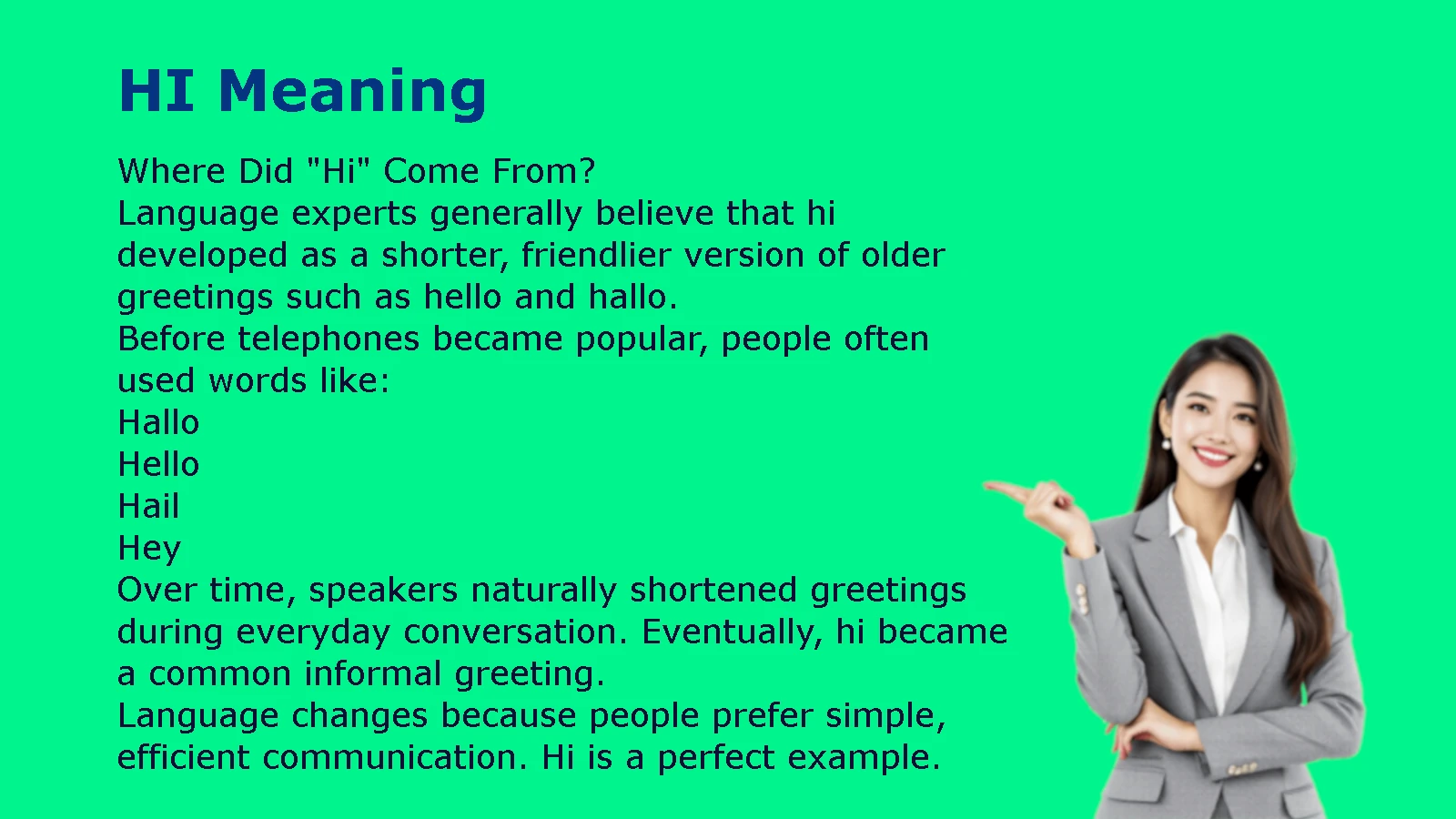
Language experts generally believe that hi developed as a shorter, friendlier version of older greetings such as hello and hallo.
Before telephones became popular, people often used words like:
- Hallo
- Hello
- Hail
- Hey
Over time, speakers naturally shortened greetings during everyday conversation. Eventually, hi became a common informal greeting.
Language changes because people prefer simple, efficient communication. Hi is a perfect example.
First Recorded Uses
Historical dictionaries trace hi as a greeting to the late 1800s.
Before that, people sometimes used hi simply to attract attention, much like saying:
- Hey!
- Look!
- Listen!
Later, the word gradually shifted toward becoming a greeting.
By the early twentieth century, English speakers widely accepted hi as a friendly way to say hello.
How the Greeting Became Popular
Several factors helped hi spread around the world.
Everyday Conversation
People naturally prefer shorter words when speaking quickly.
Instead of saying:
“Hello there.”
Many simply say:
“Hi.”
Telephone Conversations
As telephone use expanded during the twentieth century, brief greetings became more practical.
Examples include:
- Hi!
- Hello!
- Good morning!
The shorter greeting felt more natural during quick conversations.
Television and Movies
Movies, television shows, and later the internet introduced hi to audiences worldwide.
Characters often greeted friends with simple expressions like:
- Hi!
- Hi there!
- Hi, everyone!
These repeated examples helped make hi one of the most familiar English greetings.
The Internet Era
Today, billions of online conversations begin with hi.
You’ll see it in:
- Text messages
- Video calls
- Online gaming
- Workplace chats
- Social media
- Customer support
Its simplicity makes it ideal for fast communication.
When to Use HI
Knowing the HI meaning is only part of the story. Understanding when to use it matters just as much.
In most everyday situations, hi sounds polite without feeling overly formal.
Greeting Friends
This is the most common use.
Examples:
- Hi, Emma!
- Hi, Jake!
- Hi! Want to grab lunch?
Among friends, hi creates an easygoing atmosphere.
Greeting Family Members
Families use hi constantly.
Examples include:
- Hi, Mom!
- Hi, Dad!
- Hi, Grandma!
Because family relationships are naturally relaxed, hi feels warm and comfortable.
Greeting Coworkers
Many modern workplaces encourage friendly communication.
Examples:
- Hi, Chris.
- Hi, everyone.
- Hi, team.
In casual office environments, hi often works perfectly.
However, highly formal organizations may prefer hello or good morning, especially when speaking with senior executives or clients.
Starting Emails
One reason people search for HI meaning is to know whether it’s appropriate in emails.
The answer depends on your audience.
Suitable examples:
- Hi Maria,
- Hi John,
- Hi Team,
Less suitable:
- Formal government letters
- Academic applications
- Legal correspondence
In professional settings, matching your greeting to your audience always works best.
Text Messages
Texting favors short, natural greetings.
Common examples include:
- Hi!
- Hi 😊
- Hi, what are you doing?
- Hi, are you free later?
Notice how hi sounds friendlier than beginning immediately with a question.
Instead of writing:
Can you help me?
Many people prefer:
Hi! Can you help me with something?
That tiny greeting softens the request.
Phone Calls
Many phone conversations begin with hi.
Example:
Person A: Hi!
Person B: Hi! How are you?
This greeting quickly establishes a friendly tone before the conversation continues.
Social Media Conversations
Social media encourages informal communication.
You’ll often see:
- Hi everyone!
- Hi friends!
- Hi there!
- Hi all!
Whether someone is posting on Facebook, messaging on Instagram, or chatting on LinkedIn, hi remains one of the safest greetings.
When You Shouldn’t Use HI
Although hi works in many situations, it isn’t always the best choice.
Choosing the right greeting shows awareness of your audience.
Formal Business Letters
Instead of:
Hi Sir,
Write:
Dear Mr. Johnson,
or
Dear Hiring Manager,
These greetings better match formal business communication.
Legal Documents
Legal writing follows strict conventions.
Greetings like hi rarely appear because documents require professional language.
Academic Writing
Research papers, essays, and dissertations generally avoid conversational greetings altogether.
Academic writing focuses on information rather than personal conversation.
Official Government Communication
Applications, formal requests, and government correspondence often begin with:
- Dear Sir or Madam
- Dear Officer
- Dear Committee Members
Using hi may sound too casual.
Speaking to Someone for the First Time
Context matters.
Imagine meeting:
- A judge
- A university dean
- A company CEO
- A government official
While many people still say hi, choosing hello or good morning may create a stronger first impression.
Examples of HI in Sentences
Seeing words in context makes them easier to understand.
Here are practical examples.
Everyday Conversation
- Hi! How was your weekend?
- Hi, it’s nice to finally meet you.
- Hi there! Come on in.
- Hi! Thanks for stopping by.
School
- Hi, Professor Smith.
- Hi, everyone. Ready for class?
- Hi, can I borrow your notes?
Workplace
- Hi, Alex. Do you have a minute?
- Hi team. Let’s begin today’s meeting.
- Hi, thank you for your email.
Customer Service
- Hi! How may I help you today?
- Hi, thanks for contacting support.
- Hi there. What seems to be the issue?
Online Messaging
- Hi! Are you available?
- Hi 😊
- Hi, I just wanted to check in.
Email Introductions
Instead of jumping straight into your message, start politely.
Example:
Hi Jessica,
Thanks for reaching out. I appreciate your email.
A simple greeting makes communication feel more personal.
HI in Texting and Social Media
Digital communication has made hi even more popular. Every day, millions of conversations begin with this short greeting across messaging apps, forums, and social platforms.
However, context still matters. The same word can feel friendly, professional, playful, or even awkward depending on how it’s used.
What Does HI Mean in Text Messages?
In texting, hi usually means exactly what it does in face-to-face conversation: a simple way to start talking to someone.
People often use it to:
- Start a conversation
- Check if someone is available
- Reconnect after a long time
- Introduce a question
- Get someone’s attention
For example:
Person A: Hi!
Person B: Hey! What’s up?
The greeting creates a natural opening before the real conversation begins.
HI vs. Hello vs. Hey
Although these greetings share a similar purpose, they don’t always create the same impression.
| Greeting | Tone | Formality | Best Use |
| Hi | Friendly | Informal to semi-formal | Everyday conversations, emails, texts |
| Hello | Polite and neutral | Neutral to formal | Professional settings, introductions |
| Hey | Relaxed and casual | Informal | Friends, family, close coworkers |
Which Greeting Should You Choose?
- Use Hi when you want to sound friendly without being too casual.
- Choose Hello when professionalism matters.
- Say Hey when you’re talking with friends or people you know well.
“The right greeting isn’t about following strict rules. It’s about matching your words to the situation and the person you’re speaking with.”
Different Ways to Reply to HI
Someone says “Hi.” What should you say next?
There isn’t one correct answer. Your response depends on who you’re talking to, where the conversation is happening, and how formal you want to sound.
A quick reply keeps the conversation flowing and shows you’re engaged.
Casual Replies
These responses work well with friends, classmates, neighbors, and family members.
- Hi!
- Hey!
- Hello!
- Hi there!
- Hey! How’s it going?
- Hi! Good to see you.
- Hi! What’s up?
- Hey! Long time no see.
Example:
Emma: Hi!
James: Hi! How have you been?
Professional Replies
In a workplace, your greeting should remain friendly while maintaining professionalism.
Good responses include:
- Hi, thanks for reaching out.
- Hello! How can I help you today?
- Hi, it’s great to hear from you.
- Hi, I hope you’re doing well.
- Good morning! Thanks for your email.
Example:
Client: Hi, I’d like more information about your services.
Representative: Hi! I’d be happy to help. What would you like to know?
Friendly Email Responses
When replying to an email that begins with Hi, it’s perfectly acceptable to mirror the sender’s greeting.
For example:
Hi Sarah,
Thanks for your message. I reviewed the documents and attached my feedback below.
Matching the other person’s tone often creates a natural and comfortable conversation.
Common Variations of HI
The word hi has inspired many variations over the years. Some sound playful. Others fit group conversations or online chats.
Each variation creates a slightly different impression.
Hi There
This greeting feels welcoming and conversational.
Examples
- Hi there! Welcome to our website.
- Hi there! Thanks for stopping by.
Hi Everyone
A great choice when addressing a group.
Examples
- Hi everyone!
- Hi everyone. Let’s get started.
Hi All
You’ll often see this greeting in workplace emails.
Example
Hi All,
Please review the attached report before Friday.
It’s concise, professional, and widely accepted.
Hiya
Hiya is especially common in British English and some other English-speaking regions.
It sounds cheerful and relaxed.
Example
- Hiya! How’s your day going?
Hiiii
Adding extra letters changes the emotional tone rather than the meaning.
People often write:
- Hii
- Hiii
- Hiiii
This version usually expresses excitement, affection, or enthusiasm.
Example
Hiiii! I haven’t seen you in forever!
Hi Again
Useful when you’ve already spoken with someone earlier.
Example
- Hi again! I forgot to ask one more question.
Hi Buddy
This greeting works well between close friends.
Example
- Hi buddy! Ready for the game?
Hi Folks
A warm greeting for groups.
Common in:
- Team meetings
- Community events
- Online discussions
Example
- Hi folks! Thanks for joining today’s webinar.
Synonyms of HI
English offers many alternatives to hi. Choosing the right one depends on your audience and the situation.
| Greeting | Tone | Common Use |
| Hello | Neutral | Everyday and professional |
| Hey | Casual | Friends |
| Greetings | Formal | Letters and announcements |
| Good morning | Professional | Morning meetings |
| Good afternoon | Professional | Afternoon conversations |
| Good evening | Formal | Evening events |
| Welcome | Friendly | Receiving guests |
| Nice to see you | Warm | Meeting someone again |
When to Use Each Greeting
Hello
A safe choice almost everywhere.
Example
Hello, Ms. Carter.
Hey
Best for people you know well.
Example
Hey! Ready to leave?
Greetings
Less common in speech but useful in formal writing.
Example
Greetings to everyone attending today’s conference.
Good Morning
Ideal for professional environments.
Example
Good morning, everyone.
Quick Comparison
| Situation | Best Greeting |
| Texting a friend | Hi or Hey |
| Job interview | Hello or Good morning |
| Office email | Hi or Hello |
| Business presentation | Good morning |
| Meeting new clients | Hello |
Common Mistakes When Using HI
Although hi is simple, people sometimes use it in ways that don’t fit the situation.
Avoiding these mistakes helps your communication sound polished and thoughtful.
Using HI in Highly Formal Documents
A greeting such as Hi doesn’t belong in documents like:
- Legal agreements
- Court correspondence
- Academic research papers
- Official government applications
Choose a formal greeting instead.
Assuming HI Fits Every Situation
Many people think hi is universal.
It isn’t.
For example, introducing yourself to a judge with “Hi!” may sound too casual.
Instead, use:
- Good morning.
- Hello.
- It’s a pleasure to meet you.
Forgetting the Person’s Name
Compare these openings.
Less Personal
Hi,
Better
Hi Jennifer,
Using someone’s name makes your greeting warmer and more engaging.
Starting Every Email the Same Way
Repeating Hi in every email isn’t wrong, though varying your greetings keeps your writing fresh.
Consider alternatives like:
- Good morning
- Hello
- Welcome
- Thanks for reaching out
The variation feels more natural without changing the message.
Sending Only “Hi”
Many people receive a message that simply says:
Hi
Then nothing happens.
This forces the other person to wait for your real question.
Instead, combine your greeting with your purpose.
Instead of
Hi
Write:
Hi! Do you have a few minutes to discuss tomorrow’s meeting?
This approach respects the other person’s time.
Is HI Appropriate in Professional Emails?
Yes. In most modern workplaces, Hi is completely acceptable.
However, context still matters.
When HI Works Well
Use Hi when emailing:
- Coworkers
- Existing clients
- Team members
- Supervisors you’ve worked with
- Business partners you know
Example
Hi Daniel,
Thanks for sending the updated proposal. I reviewed everything and have a few comments below.
When Hello May Be Better
Choose Hello if you’re:
- Contacting someone for the first time
- Writing to a senior executive
- Reaching out to an important client
- Sending a formal inquiry
Example
Hello Ms. Williams,
Thank you for considering my application.
When to Use Dear Instead
Some situations still call for traditional greetings.
Examples include:
- Cover letters
- Legal correspondence
- Government documents
- Official complaints
- Academic applications
A greeting such as Dear Hiring Manager remains the preferred option.
HI Meaning in Different Contexts
One reason hi has remained popular is its flexibility. The word changes very little, yet it fits many different settings.
Let’s explore how it works across everyday life.
HI Meaning in Everyday English
In daily conversation, hi simply signals friendliness.
Examples include:
- Greeting neighbors
- Meeting classmates
- Entering a store
- Seeing family members
It creates an easy and welcoming atmosphere.
HI Meaning in Business Communication
Modern workplaces have become less formal than they were decades ago.
Many professionals now begin emails with:
- Hi John,
- Hi Lisa,
- Hi Team,
This greeting feels approachable while remaining professional.
However, businesses that value formal communication may still prefer Hello or Good morning.
HI Meaning in Online Chat
Online conversations move quickly.
Because hi is short, it’s one of the most common opening messages on platforms like:
- Slack
- Microsoft Teams
- Discord
- Messenger
- Telegram
Sometimes people even send Hi! followed immediately by their question.
HI Meaning in Gaming
Gamers often greet teammates before a match begins.
Examples:
- Hi team!
- Hi everyone.
- Hi! Ready?
The greeting helps establish friendly communication before gameplay starts.
HI Meaning on Social Media
You’ll regularly find hi in:
- Instagram comments
- Facebook groups
- LinkedIn messages
- TikTok conversations
- Reddit discussions
Examples include:
- Hi everyone!
- Hi there!
- Hi! Thanks for following.
Although the platforms differ, the greeting serves the same purpose.
HI Meaning in Customer Support
Businesses often use hi because it sounds warm and welcoming.
Examples:
- Hi! How can we help today?
- Hi there! Thanks for contacting support.
- Hi! We’d be happy to assist you.
The greeting helps reduce tension, especially when customers are experiencing problems.
Case Study: Why One Simple Greeting Improved Customer Engagement
A software company wanted to make its customer support emails feel more approachable.
Originally, every message started with:
Dear Customer,
While polite, the greeting felt distant.
The support team tested a friendlier opening:
Hi Alex,
They also addressed customers by name and used conversational language throughout the email.
The Result
Customers reported that the replies felt:
- More personal
- Easier to understand
- Less robotic
- More welcoming
The company didn’t change its policies or solutions. It simply adjusted the tone.
Lesson: A small greeting like hi can influence how people perceive an entire conversation.
Key Facts About the HI Meaning
- Hi is an interjection used as a greeting.
- It usually sounds informal to semi-formal.
- The word became widely popular during the late nineteenth and early twentieth centuries.
- It’s appropriate in most conversations, text messages, and many workplace emails.
- Context determines whether hi, hello, or dear is the best choice.
- Adding a person’s name often makes the greeting feel more thoughtful.
- Sending only “Hi” without context may delay communication.
“Good communication doesn’t begin with complicated words. It often begins with a simple greeting that makes someone feel acknowledged.”
Frequently Asked Questions About the HI Meaning
What does HI mean?
The HI meaning is a friendly greeting used to acknowledge someone or begin a conversation. It is an interjection, meaning it expresses a feeling or reaction rather than describing an action or object.
People use hi in everyday situations, including:
- Meeting someone in person
- Starting a phone call
- Sending a text message
- Opening an email
- Greeting coworkers
- Beginning an online chat
Although hi is informal, it remains one of the most widely accepted greetings in modern English.
Is HI formal or informal?
Hi is generally considered informal to semi-formal.
It works well in everyday conversations and most workplace settings. However, highly formal situations often require a different greeting.
Here’s a quick guide:
| Situation | Is “Hi” Appropriate? |
| Talking with friends | ✅ Yes |
| Text messages | ✅ Yes |
| Workplace emails | ✅ Yes |
| Meeting coworkers | ✅ Yes |
| Speaking with customers | ✅ Usually |
| Job interviews | ⚠️ Sometimes |
| Legal documents | ❌ No |
| Government letters | ❌ No |
| Academic papers | ❌ No |
The key isn’t the word itself. It’s the context.
Can I use HI in a professional email?
Yes. In today’s workplace, Hi is one of the most common email greetings.
For example:
Hi Michael,
Thank you for your email. I’ve reviewed the proposal and attached my comments below.
This greeting sounds professional without feeling overly formal.
If you’re writing to someone for the first time or contacting a senior executive, Hello or Dear may be a better choice.
Is HI the same as Hello?
Not exactly.
Both words serve the same basic purpose, but they create slightly different impressions.
| Greeting | Tone | Typical Use |
| Hi | Friendly | Everyday conversations |
| Hello | Neutral | Professional and general communication |
Think of hello as slightly more polished, while hi feels more relaxed.
What’s the difference between HI and Hey?
Many English learners confuse these greetings because they appear in similar situations.
Here’s the difference:
- Hi sounds friendly and neutral.
- Hey sounds more casual and familiar.
For example:
Appropriate
Hi, Professor Davis.
Less natural
Hey, Professor Davis.
With close friends, however, hey often feels completely natural.
Is HI considered slang?
No.
Although hi is informal, it is not slang.
Unlike slang words that may disappear over time, hi has remained a standard English greeting for well over a century.
You’ll find it in:
- Dictionaries
- Schools
- Newspapers
- Business communication
- Books
- Professional emails
Its widespread acceptance makes it part of standard English vocabulary.
How do you respond to HI?
There are many natural responses.
Simple replies include:
- Hi!
- Hello!
- Hey!
- Hi there!
- Good morning!
- Nice to hear from you.
- Hi! How are you?
If someone asks a question after saying hi, respond to both the greeting and the question whenever possible.
Is it rude to say only HI?
Not necessarily.
However, sending a message that contains only:
Hi
may leave the other person wondering why you contacted them.
A better approach is to include your reason immediately.
Instead of:
Hi
Write:
Hi! Do you have a few minutes to discuss tomorrow’s presentation?
This small change saves time and makes communication more efficient.
Why do people spell HI as “Hii” or “Hiii”?
Adding extra letters doesn’t change the dictionary meaning.
Instead, it changes the emotional tone.
For example:
- Hi = Neutral
- Hii = Warm
- Hiii = Excited
- Hiiii! = Very enthusiastic
These spellings appear mostly in text messages and social media conversations.
Can HI be used in customer service?
Absolutely.
Many companies intentionally use hi because it creates a friendly first impression.
Examples include:
- Hi! How can I help today?
- Hi there! Thanks for contacting us.
- Hi! We’re happy to assist you.
A welcoming greeting often makes conversations feel more personal.
Common Myths About the HI Meaning
Several misconceptions surround this simple greeting. Let’s separate fact from fiction.
| Myth | Reality |
| “Hi” is unprofessional. | False. Many businesses use it every day. |
| “Hello” is always better. | Not always. It depends on the audience. |
| “Hi” is slang. | False. It’s standard English. |
| “Hi” only belongs in speech. | False. It’s widely used in emails, texts, and online chats. |
| Young people invented “Hi.” | False. The greeting has existed since the late nineteenth century. |
Best Practices for Using HI
Although hi is easy to use, following a few simple habits can make your communication even stronger.
Match the Greeting to the Situation
Ask yourself:
- Who am I talking to?
- How formal is this conversation?
- Have we spoken before?
Choosing the right greeting helps establish the right tone from the start.
Add the Person’s Name
A name makes your greeting feel more thoughtful.
Instead of:
Hi,
Try:
Hi Emily,
or
Hi Mr. Johnson,
Don’t Forget the Rest of the Message
Avoid sending only a greeting if you already know why you’re reaching out.
For example:
Less Effective
Hi
More Effective
Hi Alex! Could you review the attached report before tomorrow afternoon?
This approach respects the recipient’s time and keeps the conversation moving.
Stay Consistent With the Tone
If someone begins with:
Hello,
You can safely reply with:
Hello,
If they start with:
Hi,
Replying with:
Hi,
often feels more natural.
Matching the tone creates smoother communication.
Quick Reference Guide
| Question | Answer |
| What does HI mean? | A friendly greeting |
| Is it formal? | Informal to semi-formal |
| Is it slang? | No |
| Can it be used in emails? | Yes |
| Is it suitable for texting? | Yes |
| Is it appropriate for business? | Usually |
| Should it be used in legal documents? | No |
| Is it accepted worldwide? | Yes, among English speakers |
Key Takeaways
Before finishing, here’s a quick recap of the most important points.
- Hi is a standard English greeting.
- It expresses friendliness and acknowledges another person.
- It works well in conversations, emails, texts, and online chats.
- The greeting sounds informal but is acceptable in many professional settings.
- Context determines whether hi, hello, or dear is the best choice.
- Adding someone’s name makes the greeting more personal.
- Sending only “Hi” without context may slow communication.
- Simple greetings often create stronger first impressions than complicated language.
Final Thoughts on the HI Meaning
The HI meaning may seem simple at first glance, but its impact goes far beyond two letters. It’s one of the first words people learn in English and one of the last words they’ll ever stop using. From classrooms and offices to coffee shops and video calls, hi opens millions of conversations every day.
Its strength lies in its simplicity. The greeting feels welcoming, approachable, and easy to understand across cultures and generations. While more formal alternatives like hello or dear have their place, hi remains the go-to choice for most everyday interactions because it strikes the right balance between warmth and professionalism.
The next time you greet someone, remember that communication starts before the main conversation begins. A thoughtful “Hi” can make a positive first impression, set a friendly tone, and encourage a more comfortable exchange. Sometimes, the smallest words leave the biggest impact.
Quote to Remember
“Every meaningful conversation starts with a simple greeting. A sincere ‘Hi’ is often the first step toward building a connection.”