
Have you ever come across the word “inherent” and wondered what it really means? While Inherent Meaning may seem a little tricky at first, the word describes something that is naturally part of a person, thing, or situation and does not need to be added from the outside.
Inherent is an adjective that means existing naturally or as a permanent part of something. It often describes a quality, feature, or characteristic that is naturally present and closely connected to something.
Examples:
- Every job has inherent risks.
- She has an inherent ability to understand complex ideas.
The confusion is understandable. People often search for what does inherent mean, inherent meaning in English, inherent meaning in a sentence, inherent meaning in text, or inherent meaning and examples because the word can sound formal or abstract. And here’s the kicker: inherent does not simply mean “common” or “usual.” It refers to something that is naturally built into or connected with something else.
In this guide, you’ll learn the complete Inherent Meaning, its definition, pronunciation, synonyms, correct usage, and examples in sentences. You’ll also discover the difference between inherent, intrinsic, and inborn, along with simple ways to understand and remember the word.
What Does Inherent Mean?
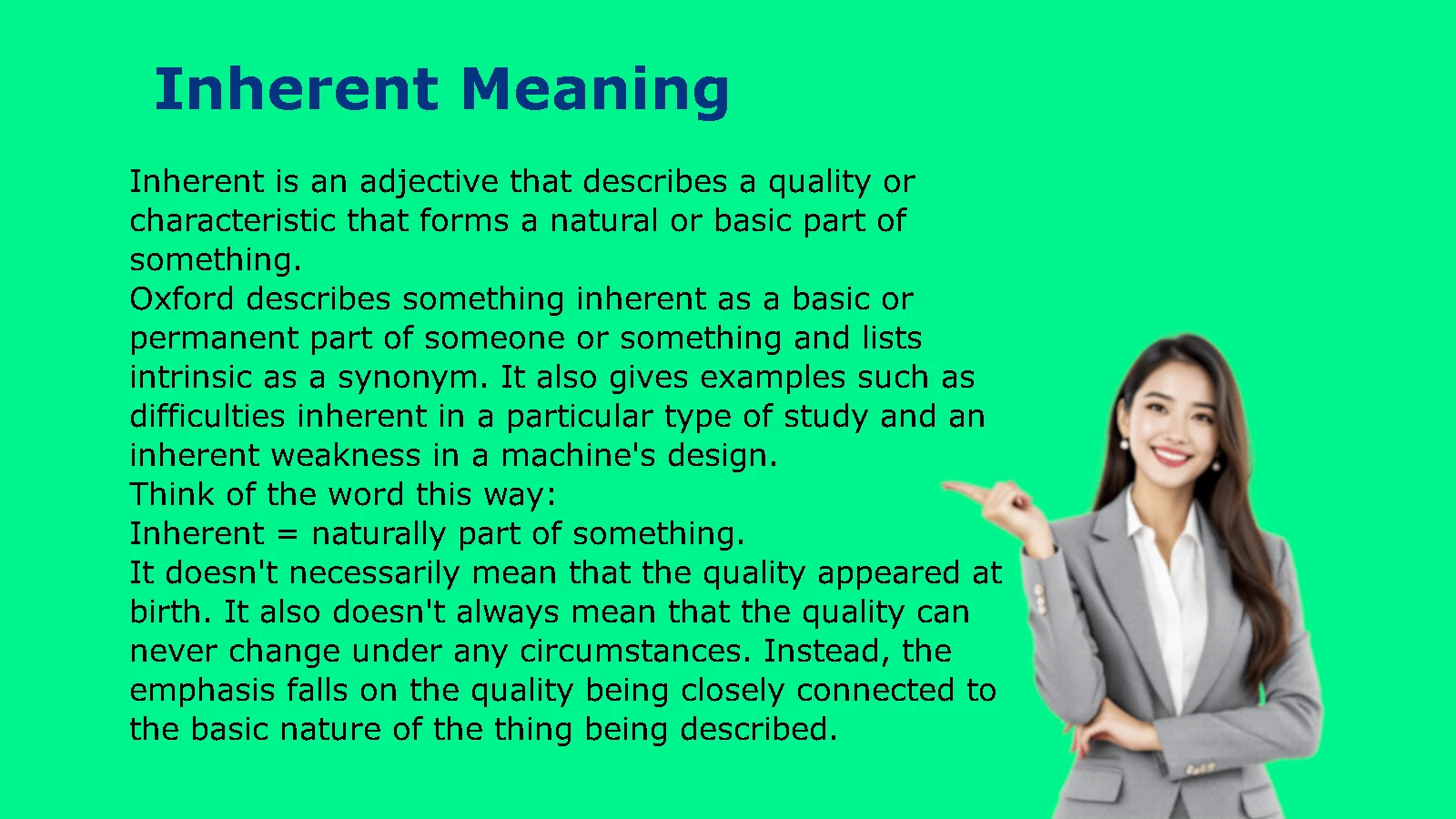
Inherent is an adjective that describes a quality or characteristic that forms a natural or basic part of something.
Oxford describes something inherent as a basic or permanent part of someone or something and lists intrinsic as a synonym. It also gives examples such as difficulties inherent in a particular type of study and an inherent weakness in a machine’s design.
Think of the word this way:
Inherent = naturally part of something.
It doesn’t necessarily mean that the quality appeared at birth. It also doesn’t always mean that the quality can never change under any circumstances. Instead, the emphasis falls on the quality being closely connected to the basic nature of the thing being described.
Simple Definition of Inherent
Here are several easy ways to understand inherent:
- Naturally part of something
- Built into something’s nature
- A basic quality of something
- Closely connected to what something is
- Existing as an essential characteristic
For example:
- A weakness can be inherent in a design.
- A risk can be inherent in an activity.
- A quality can be inherent in a person.
- A limitation can be inherent in a system.
- A characteristic can be inherent in a material.
The key idea is belonging naturally.
What Is the Meaning of Inherent in One Sentence?
Inherent means naturally belonging to the basic nature or structure of someone or something.
That short definition covers most everyday uses of the word.
What Does Inherent Meaning Mean?
The phrase inherent meaning refers to meaning that is understood as naturally belonging to something itself.
However, there’s an important wrinkle.
Not every object, word, action, or symbol has one universally agreed upon inherent meaning. Meaning can depend on context, culture, history, language, intention, and interpretation.
For example, consider a wedding ring.
A ring is a physical object. Its material shape doesn’t automatically force one universal interpretation. Yet within many social and cultural contexts, a wedding ring carries associations with marriage, commitment, and partnership.
So when someone talks about the inherent meaning of a symbol, they may be asking what significance belongs naturally or essentially to that symbol rather than what meaning an individual happened to assign to it.
This distinction becomes especially important in philosophy, literature, art, religion, law, and cultural studies.
Inherent Meaning vs. Assigned Meaning
The difference becomes clearer with a simple comparison.
| Type of meaning | What it means | Example |
| Inherent meaning | Meaning understood as belonging naturally to something | A feature of an object that follows from its nature |
| Assigned meaning | Meaning deliberately given to something | A company choosing a symbol for its logo |
| Contextual meaning | Meaning created or changed by circumstances | A phrase that means different things in different situations |
| Cultural meaning | Meaning developed within a particular culture | A gesture that carries a specific social message |
These categories can overlap.
A symbol may gain a cultural meaning over centuries. That meaning can become so strongly associated with the symbol that people begin to treat it as an essential part of what the symbol represents.
Inherent Meaning in Simple Terms
If the word inherent feels abstract, imagine a bicycle.
A bicycle has two wheels, a frame, handlebars, and other components that allow it to function as a bicycle. Those characteristics aren’t random decorations. They relate directly to what the object is.
Now imagine someone painting the bicycle red.
The red color may matter to the owner. It may even have personal significance. However, the bicycle doesn’t need to be red to remain a bicycle.
That distinction helps explain inherent.
An inherent characteristic is much closer to the thing’s basic identity than a feature that someone simply adds.
Consider these examples:
- An inherent limitation is a limitation that comes from the nature or structure of something.
- An inherent risk is a risk that naturally comes with an activity or situation.
- An inherent strength is a strength that forms part of something’s basic character.
- An inherent weakness is a weakness built into a design, system, or approach.
- Inherent value refers to value considered to belong to something in itself.
The phrase doesn’t simply mean important. It means naturally connected to the thing being described.
Examples of Inherent in Sentences
Seeing the word in real sentences makes its meaning much easier to grasp.
Everyday Examples of Inherent
- Every outdoor activity has some inherent risks.
- The material has an inherent strength that makes it useful for construction.
- The job comes with inherent challenges.
- Some decisions contain inherent uncertainty.
- The design has an inherent weakness that engineers need to address.
Notice the pattern. The adjective describes something that belongs naturally to the subject.
Academic Examples of Inherent
Academic writing frequently uses inherent when discussing limitations, characteristics, problems, or contradictions.
- The study has inherent limitations because of its small sample size.
- The theory contains an inherent contradiction.
- Researchers must account for the inherent uncertainty of the measurements.
- The method has inherent weaknesses that can affect the results.
This usage works well because academic writers often need to distinguish between a temporary problem and a problem connected to the structure of a method or system.
Workplace Examples of Inherent
The word also appears naturally in business and professional writing.
- The position carries inherent responsibilities.
- The project has inherent risks that require careful planning.
- The process contains an inherent delay between approval and implementation.
- The business model has inherent limitations.
- Negotiation involves inherent uncertainty.
These sentences sound formal because inherent is more precise than simply saying “natural” or “normal.”
Formal Writing Examples
In formal writing, you may see constructions such as:
- The difficulties inherent in the process must be considered.
- The system has an inherent weakness.
- The risks inherent in the activity cannot be ignored.
- The design contains several inherent limitations.
Oxford specifically uses constructions such as “the difficulties inherent in a study of this type” and “an inherent weakness in the design of the machine.”
How to Use Inherent Correctly
The word inherent usually works in two common grammatical patterns.
Inherent + Noun
The simplest pattern places inherent directly before a noun.
Pattern:
inherent + noun
Common combinations include:
- inherent risk
- inherent value
- inherent quality
- inherent weakness
- inherent problem
- inherent danger
- inherent ability
- inherent bias
- inherent complexity
- inherent limitation
- inherent contradiction
- inherent uncertainty
- inherent strength
For example:
The software has an inherent limitation.
Here, the limitation is presented as something connected to the software’s basic design rather than an accidental problem.
Noun + Inherent in + Something
Another common construction uses inherent in.
Pattern:
noun + inherent in + something
Examples include:
- the risks inherent in the activity
- the difficulties inherent in the process
- the problems inherent in the system
- the uncertainty inherent in the measurement
- the challenges inherent in the role
Cambridge gives the example “There are risks inherent in almost every sport.”
This construction is especially common in formal, academic, legal, and professional writing.
Inherent vs. Intrinsic
Inherent and intrinsic are close in meaning. In many sentences, you can use either word without dramatically changing the meaning.
Oxford explicitly lists intrinsic as a synonym for inherent.
Still, the two words have slightly different flavors.
Inherent often emphasizes something that naturally belongs to or comes with a person, thing, activity, or system.
Intrinsic often emphasizes something that belongs to the essential nature or value of something.
Cambridge defines intrinsic as an important and basic characteristic of a person or thing. It gives examples such as intrinsic value, intrinsic interest, and intrinsic part.
| Word | Main idea | Example |
| Inherent | Naturally part of something | The activity has inherent risks. |
| Intrinsic | Belonging to the essential nature or value of something | The work has intrinsic value. |
Compare these sentences:
The design has an inherent weakness.
The weakness forms part of the design itself.
The artwork has intrinsic value.
The value is considered to belong to the artwork itself rather than coming only from an outside reward or price.
The distinction isn’t absolute. The words overlap substantially.
Inherent vs. Innate
Innate is another word that often causes confusion.
The main difference is that innate usually refers to something present from birth or naturally possessed by an organism.
Cambridge defines an innate quality or ability as one that a person is born with rather than one they learned.
Oxford similarly defines innate as a quality or feeling that someone has when they are born.
Compare:
She has an innate ability to recognize musical patterns.
This suggests the ability was present naturally rather than learned.
Now consider:
The system has inherent limitations.
The limitations aren’t “born” with the system in a biological sense. They belong to the system’s basic structure.
Quick Comparison
| Word | Core idea | Example |
| Inherent | Naturally part of something | The system has inherent limitations. |
| Innate | Present from birth | She has an innate talent for music. |
| Intrinsic | Essential to the nature or value of something | The activity has intrinsic value. |
| Inborn | Present from birth | The behavior may be inborn. |
A useful shortcut is:
Innate → born with it.
Inherent → naturally part of it.
Intrinsic → essential to its nature or value.
Inherent vs. Ingrained
Ingrained describes something that has become deeply established, especially a habit, attitude, belief, or behavior.
For example:
The company has an ingrained culture of long working hours.
This suggests the culture developed deeply over time.
Compare that with:
The system has inherent limitations.
The limitations belong to the system’s structure.
The difference is subtle but useful:
- Inherent focuses on natural connection.
- Ingrained focuses on deep establishment.
- Innate focuses on something present from birth.
Using the right word can change the entire meaning of a sentence.
Synonyms for Inherent
Several words can replace inherent, but context matters. A synonym isn’t automatically interchangeable in every sentence.
Closest Synonyms
- Intrinsic
- Essential
- Fundamental
- Integral
- Built-in
- Natural
Cambridge lists inbuilt as a synonym and notes that US English generally uses built-in instead.
Related Words That Need More Care
- innate
- inborn
- ingrained
- internal
- essential
- fundamental
- intrinsic
- integral
For example, fundamental means basic or essential, but it doesn’t always carry the same sense of naturally belonging to something.
Likewise, internal simply describes something located within. It doesn’t necessarily mean that the quality is an essential part of the thing’s nature.
Common Collocations With Inherent
Certain combinations appear much more naturally than others.
Inherent Risk
Inherent risk refers to risk that exists naturally within an activity, situation, process, or system.
For example:
Driving involves inherent risks.
That doesn’t mean every driving situation will cause harm. It means that risk is part of the activity itself.
Inherent Value
Inherent value refers to value considered to exist in something itself rather than value supplied entirely by an outside reward.
The phrase often appears in discussions about ethics, art, philosophy, education, and economics.
Inherent Weakness
An inherent weakness is a weakness connected to the basic design or nature of something.
The old system has an inherent weakness that makes accurate reporting difficult.
Inherent Bias
An inherent bias is a bias believed to arise from the structure, design, assumptions, or nature of a system or process.
Because bias can also develop through outside influences, context matters. Calling a bias “inherent” makes a stronger claim about where it comes from.
Inherent Limitation
An inherent limitation is a limitation that follows from the nature or structure of a method, system, tool, or situation.
This phrase is especially common in academic and technical writing.
Other Common Combinations
| Collocation | Meaning |
| inherent danger | Danger naturally associated with something |
| inherent ability | Ability considered naturally present |
| inherent complexity | Complexity built into the nature of something |
| inherent uncertainty | Uncertainty that cannot easily be separated from the situation |
| inherent contradiction | A contradiction within the basic structure of an idea |
| inherent strength | A naturally strong characteristic |
| inherent right | A right regarded as belonging naturally to someone |
| inherent problem | A problem connected to the basic nature of something |
What Does Inherently Mean?
Inherently is the adverb form of inherent.
It means in a way that exists naturally or as a basic part of something. Cambridge uses examples such as “There’s nothing inherently wrong with his ideas” and describes something as inherently unfair when the unfairness is understood as part of its basic nature.
Examples:
- The technology isn’t inherently dangerous.
- The system is inherently complex.
- Competition isn’t inherently bad.
- The method is inherently limited.
- The process isn’t inherently unfair.
Oxford gives “an inherently unworkable system” as an example and defines inherently in terms of the basic nature of something.
Inherent vs. Inherently
The difference is grammatical.
Inherent is an adjective:
The system has an inherent weakness.
Inherently is an adverb:
The system is inherently weak.
The first describes the noun weakness.
The second modifies the adjective weak.
Is Inherent Meaning the Same as True Meaning?
No. Inherent meaning and true meaning can overlap, but they aren’t identical.
True meaning often asks what something actually means or what interpretation is correct.
Inherent meaning focuses on meaning believed to belong naturally to something itself.
For example, imagine a phrase that has one meaning in everyday conversation and another meaning in a specialized field. Its meaning changes according to context.
That doesn’t automatically mean one interpretation is “inherent” while the other is false.
Language is flexible. Words gain meanings through usage, communities, history, and context.
This is why it’s better to avoid treating inherent meaning as a magic phrase that produces one unquestionable interpretation.
Can Something Have More Than One Inherent Meaning?
Yes, depending on what exactly you mean by inherent meaning.
A word, symbol, object, or practice can carry several closely connected meanings. Different communities may also attach different meanings to the same thing.
Consider a national flag.
Its physical properties include its colors, shape, and design. Its social meaning, however, comes from history, political institutions, shared experiences, and cultural interpretation.
A person might therefore describe certain meanings as deeply associated with the flag. Another person might argue that those meanings are culturally constructed rather than inherent in the physical object.
That distinction matters.
A Useful Three-Layer Model
When analyzing meaning, separate these three layers:
The object itself → the established association → the interpretation
For example:
Object: a dove
Association: peace
Interpretation: a symbol of reconciliation or hope
This model prevents a common mistake: assuming that every widely recognized association must be an inherent property.
What Is the Opposite of Inherent?
The best opposite depends on context.
Possible opposites include:
- External
- Extrinsic
- Acquired
- Learned
- Imposed
- Added
- Artificial
Inherent vs. Extrinsic
The clearest conceptual contrast often appears between inherent and extrinsic.
Inherent points toward something naturally belonging to the thing itself.
Extrinsic points toward something that comes from outside.
For example:
Intrinsic or inherent value = value considered to belong to something itself.
Extrinsic value = value that depends on an outside factor.
The contrast is particularly useful when discussing motivation.
A person might study because they genuinely enjoy learning. That motivation is intrinsic.
Another person might study primarily to earn a reward. That motivation is extrinsic.
Common Mistakes With Inherent
The word looks straightforward, but a few mistakes appear regularly.
Using Inherent to Mean Common
Something can be common without being inherent.
For example:
Stress is common among students.
That doesn’t automatically mean:
Stress is inherent in being a student.
The second sentence makes a much stronger claim. It suggests that stress belongs naturally to the experience itself.
Using Inherent to Mean Permanent
Inherent can suggest a quality that is deeply rooted or difficult to separate from something. Oxford includes “basic or permanent” in its definition.
Still, avoid treating inherent as a synonym for absolutely unchangeable in every context.
A system may have an inherent limitation under its current design. Changing the design could change that limitation.
Confusing Inherent With Innate
Remember:
Innate = present from birth.
Inherent = naturally part of something.
A machine can have inherent limitations. It can’t have an innate personality in the ordinary biological sense.
Assuming Inherent Means Good
Inherent is neutral.
Something can have:
- an inherent strength
- an inherent weakness
- an inherent benefit
- an inherent danger
- an inherent limitation
- an inherent advantage
The word doesn’t tell you whether the characteristic is positive or negative.
Pronunciation and Word Forms
The American pronunciation of inherent is commonly represented as:
/ɪnˈhɪr.ənt/
The main stress falls on the second syllable:
in-HEER-ent
The word is an adjective.
Its main related form is:
- inherent — adjective
- inherently — adverb
Examples:
The method has an inherent limitation.
The method is inherently limited.
The spelling also deserves attention because inherent can look similar to inherit, but the words have completely different meanings.
Inherit means to receive something from a previous owner, relative, or predecessor.
Inherent means naturally belonging to something.
Where Does the Word Inherent Come From?
The history of inherent provides a surprisingly useful memory trick.
Oxford traces the word to the Latin inhaerent-, meaning “sticking to,” from inhaerere.
That original idea fits the modern meaning remarkably well.
Imagine a quality that sticks to something because it belongs to its nature.
That’s essentially the concept behind inherent.
You don’t need to memorize the Latin root to use the word correctly. However, the connection can make the definition easier to remember:
Inherent = a quality that naturally “sticks” to something.
Inherent Meaning in Different Contexts
The word becomes even clearer when you see how different fields use it.
| Context | What inherent means | Example |
| Everyday English | Naturally associated with something | The activity has inherent risks. |
| Business | A built-in characteristic or risk | The model has inherent limitations. |
| Science | A property connected to the nature of a system or material | The measurement has inherent uncertainty. |
| Law | A power, right, or quality regarded as naturally belonging to an authority or person | The court may possess inherent authority. |
| Philosophy | A quality, value, or meaning considered to exist in something itself | The discussion concerns inherent value. |
| Academic writing | A basic limitation, feature, or problem | The method has inherent weaknesses. |
| Technology | A limitation or property connected to design | The system has inherent security constraints. |
| Literature | Meaning or significance considered part of a work itself | The critic examines the poem’s inherent meaning. |
The exact meaning always depends on the noun that follows inherent and the context surrounding it.
Case Study: Understanding an Inherent Limitation
Consider a simple example from research.
Suppose a researcher wants to understand people’s opinions by surveying 100 volunteers.
The survey may have several limitations. Some could come from poor execution. Others could arise from the method itself.
If the researcher asks only volunteers from one small group, the results may not represent the broader population. That limitation relates directly to the sampling method.
A researcher might therefore describe limited generalizability as an inherent limitation of the particular research design.
The important point isn’t that the study is useless.
Instead, the researcher recognizes that every method has boundaries. A good study doesn’t hide those boundaries. It identifies them.
That’s one reason inherent limitation appears so often in academic writing.
Case Study: Understanding Inherent Risk
Consider rock climbing.
A climber can reduce danger through training, equipment, planning, and good judgment. Yet the activity still involves some risk.
That risk isn’t necessarily caused by poor planning. Falling, changing weather, equipment failure, and difficult terrain can remain possible.
This is where inherent risk becomes useful.
Some risk is inherent in rock climbing.
The sentence doesn’t say that accidents are inevitable.
It says that risk is part of the activity itself.
This distinction matters in everyday conversation, professional risk analysis, and legal discussions because inherent risk doesn’t mean guaranteed harm.
Case Study: Inherent Value vs. Market Value
Imagine an original painting.
Its market value might depend on the artist’s reputation, rarity, demand, condition, provenance, and current interest among collectors.
Its inherent value, by contrast, refers to the idea that the artwork possesses value in itself rather than merely because people are willing to pay for it.
Those are different concepts.
A painting could have enormous market value because collectors compete for it. Another could have deep artistic or cultural significance despite having a modest selling price.
The word inherent helps separate qualities considered internal to something from value supplied by external circumstances.
Why Inherent Meaning Can Be Tricky
The phrase sounds simple until you ask a deeper question:
Where does meaning actually come from?
With physical properties, the idea can be relatively straightforward.
A triangle has three sides. That characteristic follows from what the word triangle means.
With symbols, language, art, and culture, things get messier.
Meaning can emerge from:
- physical properties
- intended purpose
- social conventions
- historical development
- cultural traditions
- personal interpretation
- surrounding context
- repeated usage
As a result, saying that something has an inherent meaning can sometimes express a philosophical position rather than a simple dictionary fact.
That distinction is worth remembering when writing about literature, art, religion, politics, or cultural symbols.
Frequently Asked Questions About Inherent Meaning
What is the simplest meaning of inherent?
Inherent means naturally belonging to something or forming a basic part of its nature.
For example, risk can be inherent in certain activities.
What does inherent meaning mean?
Inherent meaning refers to meaning understood as naturally belonging to something itself. The exact interpretation can depend on context.
Is inherent the same as intrinsic?
They are very close. Intrinsic often emphasizes an essential quality or value, while inherent commonly emphasizes a quality naturally belonging to something. Dictionaries treat them as closely related and sometimes synonymous.
Is inherent the same as innate?
No.
Innate usually means present from birth or naturally possessed by an organism. Inherent has a broader meaning and describes something naturally belonging to a person, thing, system, activity, or situation.
What is an example of inherent?
“The job has inherent challenges.”
This means the challenges naturally come with the nature of the job.
What is the opposite of inherent?
Depending on context, useful opposites include external, extrinsic, acquired, learned, imposed, and added.
How do you use inherent in a sentence?
Use inherent before a noun or in the construction inherent in.
Examples:
- The design has an inherent weakness.
- The risks inherent in the activity require careful planning.
What does inherently mean?
Inherently means according to or because of the basic nature of something.
Example:
The process is inherently complex.
Can inherent mean natural?
Yes, in many contexts. Inherent describes something that exists naturally as part of something’s basic nature. However, natural has a broader range of meanings and isn’t always a perfect substitute.
What does “inherent in” mean?
Inherent in means naturally belonging to or forming part of something.
For example:
There are risks inherent in almost every sport.
The risks are presented as part of the nature of participating in those sports.
Final Takeaway: What Does Inherent Meaning Really Mean?
The simplest way to remember inherent meaning is this:
Inherent means naturally belonging to the basic nature of something.
So, inherent meaning refers to meaning that is understood as belonging to something itself rather than being merely added from outside.
The word appears in many useful expressions:
- inherent risk
- inherent value
- inherent weakness
- inherent strength
- inherent limitation
- inherent bias
- inherent danger
- inherent complexity
The closest comparison is usually intrinsic, while innate has a narrower sense connected to qualities present from birth. Inherently is simply the adverb form.
Most importantly, don’t treat inherent as a fancy replacement for “natural” in every sentence. Its real strength comes from the idea of belonging to something’s basic nature. Once you understand that central idea, the word becomes much easier to recognize, explain, and use accurately.