
Have you ever come across a declaration and wondered exactly what it means? While Declaration Meaning may seem straightforward, the word can have different meanings depending on the context, purpose, and situation in which it is used.
Declaration is a noun that means a clear and formal statement about something. It can be used when someone openly announces an intention, belief, decision, fact, or position.
Examples:
- The president made a declaration about the new policy.
- She signed a declaration confirming the information was correct.
The confusion is understandable. People often search for what does declaration mean, declaration meaning in English, declaration meaning in text, or declaration meaning in a sentence because the word appears in many settings, including everyday conversations, legal documents, government announcements, and formal writing. And here’s the kicker: a declaration can be as simple as a personal statement or as serious as an official legal document.
In this guide, you’ll learn the complete Declaration Meaning, its definition, pronunciation, correct usage, and examples in sentences. You’ll also discover common synonyms for declaration, different meanings of the word in various contexts, and the difference between declaration, statement, announcement, and other related words.
What Does Declaration Mean?
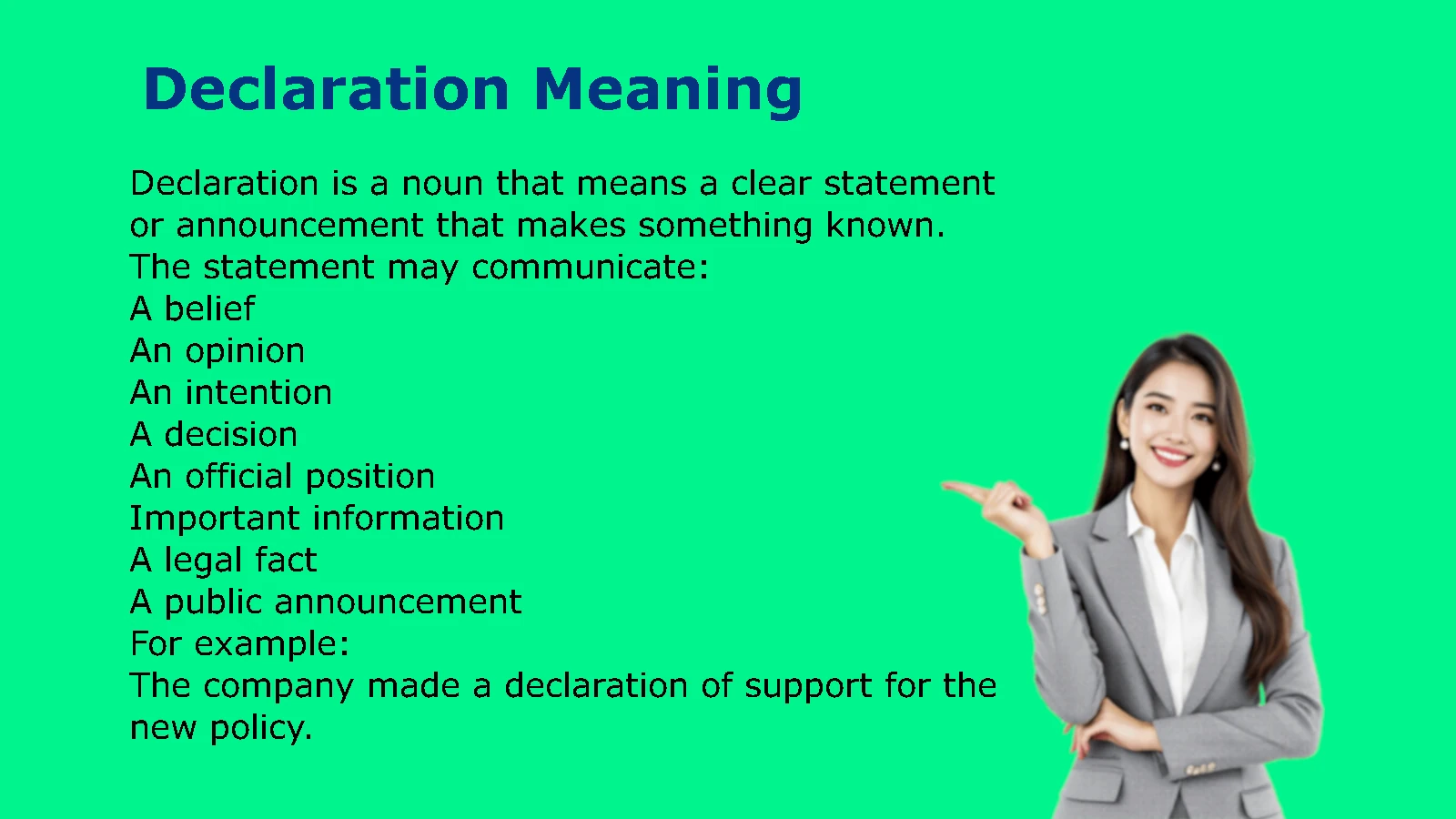
Declaration is a noun that means a clear statement or announcement that makes something known.
The statement may communicate:
- A belief
- An opinion
- An intention
- A decision
- An official position
- Important information
- A legal fact
- A public announcement
For example:
The company made a declaration of support for the new policy.
Here, the company publicly stated its position.
Another example is:
She made a declaration that she would finish the project.
In this sentence, the declaration communicates a firm intention.
The word often suggests more weight than the ordinary word statement. A statement can be almost any piece of information. A declaration usually draws attention to the fact that someone has formally, clearly, or emphatically made something known.
Cambridge’s Business English definition describes a declaration as an official or public statement about something, or the act of making such a statement.
Declaration Meaning in One Sentence
A declaration is a clear statement or announcement that makes an idea, intention, decision, fact, or position known, often in a formal or official way.
That definition covers most common uses of the word.
Declaration Meaning in Simple English
In simple English, declaration means saying something clearly and openly so that other people know it.
Think of it as putting your position on the table.
For example, imagine that a company has been quiet about whether it supports a new environmental policy. The company then publishes a formal statement saying it supports the policy.
That statement can be called a declaration of support.
The same basic idea appears in very different situations:
| Context | Meaning of declaration | Example |
| Everyday English | A strong or important statement | She made a declaration of love. |
| Business | An official statement or position | The board issued a declaration of support. |
| Law | A formal statement with legal relevance | He signed a legal declaration. |
| Government | An official announcement or position | The government issued a declaration. |
| Travel | Information formally given to customs | She completed a customs declaration. |
| History | A formal public statement of political principles or status | The Declaration of Independence |
| Cricket | A captain’s decision to end their team’s innings | The captain made a declaration. |
The common thread is making something known clearly.
Declaration Definition and Word Class
Declaration is a countable noun in its most common uses.
You can say:
- a declaration
- the declaration
- several declarations
- an official declaration
- a written declaration
Its pronunciation is:
declaration: /ˌdek.ləˈreɪ.ʃən/
The word comes from the verb declare.
The Related Verb: Declare
To declare means to announce or state something clearly, firmly, publicly, or officially. Cambridge gives examples such as declaring support for a proposal and declaring something to be true.
The relationship is straightforward:
declare → declaration
For example:
- She declared her support.
- She made a declaration of support.
The first sentence uses the verb. The second uses the noun.
Other related forms include:
- declare — verb
- declared — past tense and past participle
- declaring — present participle
- declaration — noun
- declarative — adjective
What Is a Declaration?
A declaration is more than a random comment. It usually has a clear purpose.
When you make a declaration, you’re making something known. Depending on the situation, you may be:
- Announcing a decision
- Expressing a belief
- Stating an intention
- Confirming information
- Taking an official position
- Creating a formal record
- Publicly recognizing a fact or status
For example:
The organization issued a declaration of principles.
The organization isn’t simply chatting about its principles. It is formally putting those principles into words.
That’s why declaration often sounds more serious than remark, comment, or chat.
Declaration Examples in Everyday English
Although declaration can sound formal, people also use it in personal and ordinary situations.
Consider these examples:
- His declaration of love caught her completely by surprise.
- She made a declaration that she would never quit.
- His public declaration of support helped the campaign.
- The student’s declaration of innocence sounded sincere.
- They issued a joint declaration about their plans.
- Her declaration made her position perfectly clear.
- The couple made a public declaration of their commitment.
- He made a bold declaration about his future goals.
Notice the pattern. In each case, the person is making an important idea known.
The word can therefore add emphasis. Compare:
She said she supported him.
with:
She made a declaration of support.
The second sentence sounds more formal and deliberate.
Declaration Meaning in Different Contexts
The word becomes much easier to understand once you see how its meaning changes slightly from one field to another.
Declaration in General Conversation
In everyday English, a declaration can mean a strong or emphatic statement.
For example:
“I’ll never give up,” he said in a firm declaration.
Here, nobody necessarily needs a legal document. The speaker simply makes his intention very clear.
You might also hear:
Her declaration of love surprised everyone.
In this context, declaration means a strong and open expression of a feeling.
However, declaration can sound formal in casual conversation. In ordinary speech, people often use words such as statement, announcement, or simply saying.
Declaration in Law
Legal English gives declaration a more specific meaning.
A legal declaration can be an official statement or proclamation. Cornell Law School’s Legal Information Institute notes that a declaration can be an official statement and gives an affidavit as an example. It also explains that someone who knowingly lies in a declaration can face serious legal consequences, depending on the circumstances and applicable law.
Legal declarations can appear in situations involving:
- Court proceedings
- Legal transactions
- Rights
- Property
- Financial matters
- Official facts
- Statements made under particular legal requirements
A declaration isn’t automatically the same thing as an affidavit. An affidavit is a particular type of sworn written statement. Legal terminology varies by jurisdiction, so the exact effect of a declaration depends on the applicable law and document.
Declaration in Government and Politics
Governments and public authorities often issue declarations to make an official position known.
Examples include:
- A declaration of emergency
- A declaration of war
- A declaration of independence
- A declaration of principles
The word matters because a government declaration can carry official significance.
For instance, declare war means to formally announce a state of war. Merriam Webster lists “declaration of war” among established legal uses of the noun.
Declaration in Business
Businesses use declarations when they need to communicate an official position, provide required information, or formally confirm something.
Common examples include:
- Declaration of interest
- Declaration of ownership
- Declaration of compliance
- Declaration of conformity
- Declaration of support
For example:
The director signed a declaration of interest before the meeting.
The declaration helps make a relevant interest known.
In another case:
The manufacturer provided a declaration of conformity for the product.
Here, the declaration serves a formal compliance purpose.
The important point is that a business declaration can be more than a press release. It may be part of a formal process or record.
Declaration in Travel and Customs
A customs declaration is a particularly practical use of the word.
When travelers or businesses cross an international border, customs procedures may require them to provide information about goods or other items they are bringing into or taking out of a country.
For example:
You must complete a customs declaration for the goods you are importing.
Here, declaration means formally providing required information to a government customs authority.
The meaning isn’t simply “tell someone what you have.” The information can have regulatory, tax, security, and enforcement implications.
Declaration in Cricket
Cricket gives declaration a specialized meaning that surprises many English learners.
In cricket, a captain can declare an innings closed before all available wickets have fallen. Cambridge specifically lists this as a separate cricket meaning of declaration.
For example:
The captain made a declaration after his team built a large lead.
The captain is choosing to stop batting because the team believes it has enough runs and wants to give itself more time to bowl at the opposing team.
This is a good example of why context matters. In ordinary English, declaration means a statement or announcement. In cricket, it describes a tactical decision to end an innings.
Declaration vs. Statement
Declaration and statement overlap, but they aren’t always interchangeable.
A statement is the broader word. Almost anything someone says or writes can be a statement.
A declaration usually carries an additional sense of formality, importance, publicity, or firmness.
| Word | Typical meaning | Formality |
| Statement | Something said or written that communicates information or an opinion | Low to high |
| Declaration | A clear, often formal or emphatic statement | Usually medium to high |
| Announcement | Information made known to others | Medium |
| Proclamation | A formal public announcement, often by an authority | High |
| Remark | A comment or observation | Usually low to medium |
Consider these examples:
The manager made a statement about the schedule.
This sounds neutral.
The manager made a declaration about the company’s future.
This sounds more formal and significant.
A declaration often tells the audience, “This is our position, intention, or official information.”
Declaration vs. Announcement
An announcement focuses on making information known.
A declaration can do that too, but it often emphasizes the statement itself and its importance or formality.
For example:
The school announced that classes would begin at 9 a.m.
This is ordinary information.
The organization issued a declaration of its principles.
This expresses an official position.
The two words can overlap. However, announcement tends to focus on the act of informing people, while declaration often focuses on the formal statement being made.
Declaration vs. Proclamation
A proclamation is generally a formal public announcement, especially one made by an authority.
A declaration has a wider range of uses.
For example:
- A president or government may issue a proclamation.
- A company can issue a declaration.
- A traveler can make a customs declaration.
- A person can make a declaration of love.
So, proclamation tends to have a more official and public flavor, while declaration works across more situations.
Common Types of Declarations
The word appears in many established expressions. Understanding these phrases can dramatically improve your vocabulary.
Declaration of Independence
A declaration of independence is a formal statement asserting that a territory or people are independent.
The best-known example in American history is the United States Declaration of Independence, adopted by the Continental Congress on July 4, 1776. Cambridge uses the American Declaration of Independence as a standard example of the word’s meaning.
The phrase demonstrates the power of declaration: the document didn’t merely describe an opinion. It publicly stated a political position of enormous historical consequence.
Declaration of War
A declaration of war is a formal announcement that a state considers itself at war with another state.
The phrase is commonly used in legal, political, and historical writing.
Example:
The government issued a declaration of war after diplomatic negotiations failed.
Modern conflicts don’t always begin through a traditional formal declaration, which makes the legal and historical context important.
Declaration of Intent
A declaration of intent states what a person or organization intends to do.
Example:
The company issued a declaration of intent to expand its operations.
It tells readers about a planned course of action.
Declaration of Support
A declaration of support openly expresses backing for a person, idea, organization, or policy.
Example:
The association released a declaration of support for the proposed reforms.
This phrase is common in public, political, organizational, and professional contexts.
Declaration of Rights
A declaration of rights formally states rights or principles that a particular document or institution recognizes.
The exact legal meaning depends on the document and jurisdiction.
Customs Declaration
A customs declaration provides customs authorities with required information about goods or other matters covered by customs rules.
Example:
The importer submitted a customs declaration before the shipment arrived.
This is a practical example of declaration functioning as part of an official administrative process.
Statutory Declaration
A statutory declaration is a formal statement made according to the requirements of a particular law.
Its rules vary by jurisdiction. It shouldn’t automatically be treated as identical to an affidavit because the two documents can have different legal requirements and effects.
Declaration of Interest
A declaration of interest is a formal disclosure of an interest that could be relevant to a decision or activity.
For example:
The committee member made a declaration of interest before the vote.
The goal is transparency.
Declaration of Conformity
A declaration of conformity is a formal document used in certain regulatory systems to state that a product meets specified requirements.
The exact requirements depend on the relevant jurisdiction, product category, and regulatory framework.
What Does “Make a Declaration” Mean?
Make a declaration means to state or announce something clearly and openly, often formally.
Examples include:
- The minister made a declaration about the new policy.
- She made a declaration of support.
- The company made a public declaration.
- He made a declaration of intent.
The phrase sounds formal because declaration itself usually carries some weight.
In casual conversation, you might simply say:
She said she supported the plan.
In a formal report, you could write:
She made a declaration of support for the plan.
Neither sentence is wrong. The second simply frames the act as more formal or significant.
What Does “Declaration of” Mean?
The structure declaration of + noun tells you what the declaration concerns.
For example:
- Declaration of independence → a statement about independence
- Declaration of support → a statement expressing support
- Declaration of intent → a statement of intention
- Declaration of war → a formal announcement of war
- Declaration of rights → a statement setting out rights
- Declaration of interest → a disclosure of an interest
- Declaration of ownership → a formal statement concerning ownership
This construction is extremely useful because the word after of gives the declaration its specific meaning.
Compare:
The organization issued a declaration.
We don’t know what it declared.
The organization issued a declaration of support.
Now the purpose is clear.
How to Use “Declaration” in a Sentence
The noun works naturally in several grammatical patterns.
Declaration + of + Noun
This is one of the most common structures.
The board issued a declaration of support.
He signed a declaration of ownership.
The group published a declaration of principles.
Declaration + That Clause
You can also use declaration that + clause.
Her declaration that she would resign surprised the committee.
This structure emphasizes the content of the declaration.
Make a Declaration
The organization made a formal declaration.
This focuses on the act of declaring.
Issue a Declaration
The government issued a declaration.
This sounds particularly natural for governments, organizations, and institutions.
Sign a Declaration
The employee signed a declaration confirming the information provided.
This emphasizes the document.
Public Declaration
The athlete made a public declaration of support.
This emphasizes that the statement was made openly.
Is “Declaration” Formal or Informal?
Declaration is generally more formal than statement.
You can use it in ordinary conversation, but it often sounds deliberate or emphatic.
Compare these three sentences:
I want to tell you something.
Casual and natural.
I want to make a statement.
More deliberate.
I want to make a declaration.
Formal, emphatic, and potentially dramatic.
That doesn’t make declaration wrong in casual speech. It simply gives the sentence a different tone.
For professional writing, the word can be useful when the subject genuinely involves a formal statement or clear position.
Declaration Synonyms
Several words can overlap with declaration, but context matters. A synonym isn’t a replacement button you can press without changing the meaning.
Statement
A general term for something expressed verbally or in writing.
The company released a statement.
Announcement
Information communicated to a group of people.
The school made an announcement about the new schedule.
Proclamation
A formal public announcement, often from an authority.
The mayor issued a proclamation.
Pronouncement
A formal or authoritative statement.
The judge’s pronouncement ended the dispute.
Assertion
A confident statement that something is true.
His assertion was difficult to verify.
Communication
A broad term for information conveyed from one party to another.
The official communication explained the new policy.
Formal Statement
A plain but accurate alternative when you want to emphasize formality without using the word declaration.
The best synonym depends on what you’re trying to say.
Declaration Antonyms
There isn’t one perfect opposite of declaration because the word has several meanings.
Depending on context, contrasting ideas may include:
- Silence
- Secrecy
- Concealment
- Suppression
- Retraction
- Denial
For example, if a declaration means openly revealing information, concealment may contrast with it.
If a declaration means making a firm statement, retraction may represent taking that statement back.
These aren’t strict dictionary antonyms in every situation.
Common Collocations With Declaration
Learning common word combinations helps you use declaration naturally.
| Collocation | Meaning | Example |
| make a declaration | formally state something | She made a declaration of support. |
| issue a declaration | officially publish or announce something | The agency issued a declaration. |
| sign a declaration | formally sign a statement or document | He signed the declaration. |
| formal declaration | an official or serious statement | The court received a formal declaration. |
| official declaration | a statement made with official authority | The government released an official declaration. |
| public declaration | a statement made openly | She made a public declaration. |
| written declaration | a declaration in written form | The witness submitted a written declaration. |
| declaration of intent | statement of intended action | The group issued a declaration of intent. |
| declaration of support | formal expression of support | They released a declaration of support. |
| declaration of war | formal announcement of war | Congress discussed the declaration of war. |
| customs declaration | information provided to customs | The traveler completed a customs declaration. |
| declaration of interest | disclosure of a relevant interest | The member made a declaration of interest. |
These combinations are more useful than memorizing declaration in isolation.
Case Study: The Declaration of Independence
The Declaration of Independence provides one of the clearest examples of the word’s power.
On July 4, 1776, the Continental Congress adopted the document that announced the American colonies’ decision to separate from Great Britain. The document didn’t function as an everyday announcement. It presented a formal political position and explained the principles used to justify that position.
That’s why declaration fits so well.
It was a statement intended to make a political status and argument publicly known.
The example also shows why context matters. The word declaration doesn’t inherently mean “historical document.” It simply describes a formal or significant statement. The historical importance comes from what was being declared.
Case Study: Declaration in Law
Imagine that a person submits a formal written statement in a legal proceeding.
The document identifies the person, explains relevant facts, and contains a statement that the person believes the information is truthful.
Calling it a declaration tells the reader that this isn’t merely an informal note. It belongs to a legal setting and may have consequences under applicable law.
Cornell’s Legal Information Institute explains that a declaration can be an official statement and notes that false statements in certain declarations can expose the declarant to legal consequences.
The lesson is simple:
In legal contexts, never assume that declaration is just a fancy word for “comment.”
Its effect depends on the law governing the document.
Case Study: Declaration in Cricket
Cricket demonstrates a completely different use.
Suppose a team has scored a large number of runs and still has wickets available. Its captain may decide that continuing to bat isn’t worth the lost time. The captain can declare the innings closed.
Why would a team do that?
Because cricket involves a balance between scoring runs and creating enough time to dismiss the opposition. A captain may sacrifice the opportunity to score additional runs in order to give the bowling side more time to take wickets.
So:
The captain declared the innings.
Here, declaration doesn’t mean a written statement at all.
Cambridge specifically identifies this cricket sense as a separate meaning of the noun.
It’s a useful reminder that vocabulary lives inside context.
Declaration vs. Declare
The difference is grammatical but important.
Declare is a verb.
Declaration is a noun.
Compare:
| Verb | Noun |
| They declared their support. | They made a declaration of support. |
| The government declared an emergency. | The government issued a declaration. |
| She declared her intention to leave. | She made a declaration of intent. |
| He declared the information. | He submitted a declaration. |
A simple rule helps:
You declare something. You make, issue, sign, or submit a declaration.
The exact verb depends on the context.
Common Mistakes With “Declaration”
Using It for Every Simple Statement
Not every sentence someone says deserves the label declaration.
If your friend says:
“I had coffee this morning.”
Calling that a declaration would sound unnecessarily dramatic.
In most situations, statement or comment would work better.
Treating Declaration and Proclamation as Identical
They overlap, but they aren’t identical.
A proclamation usually has a strong public or official flavor. Declaration has a broader range of uses.
Assuming Every Declaration Is Legally Binding
A declaration can have legal significance, but the word itself doesn’t automatically make something legally binding.
A personal declaration of love isn’t a contract.
A formal legal declaration can have legal consequences.
Context and governing law determine the effect.
Confusing a Declaration With an Affidavit
An affidavit is a specific type of sworn statement. A declaration may or may not be sworn, depending on the document and jurisdiction.
Legal terminology matters.
Facts About the Word “Declaration”
A few language facts help put the word into perspective:
- Declaration is a noun.
- Its related verb is declare.
- The word dates back to Middle English. Merriam Webster records its first known use in the 14th century.
- Declare ultimately traces through Anglo French to Latin declarare, connected with the idea of making something clear.
- Declaration commonly refers to a formal, public, or official statement.
- The word also has a specialized meaning in cricket.
- In legal contexts, a declaration can have consequences that an ordinary statement does not.
- The phrase declaration of is especially common in formal English.
The history is fitting. At its core, the word is connected with the idea of making something clear.
Frequently Asked Questions About Declaration Meaning
What is the meaning of declaration?
Declaration means a clear statement or announcement that makes something known. It often refers to a formal, official, public, or emphatic statement.
What is a simple example of a declaration?
The company made a declaration of support for the proposal.
The company is clearly and publicly expressing its position.
What is another word for declaration?
Depending on context, alternatives include statement, announcement, proclamation, pronouncement, assertion, and formal statement.
However, these words aren’t interchangeable in every sentence.
Is a declaration the same as a statement?
Not exactly.
Statement is the broader word. Declaration usually suggests a more formal, deliberate, public, or emphatic statement.
What does “make a declaration” mean?
It means to state or announce something clearly and openly, often in a formal or deliberate way.
What does “declaration of intent” mean?
A declaration of intent is a statement that clearly communicates what a person or organization intends to do.
What does “declaration of support” mean?
It means a formal or public statement showing that someone supports a person, idea, organization, policy, or cause.
What does declaration mean in law?
In law, a declaration can refer to a formal or official statement. Its precise meaning and legal effect depend on the legal context and jurisdiction.
What is the verb form of declaration?
The verb is declare.
For example:
The organization declared its support.
Is declaration a noun?
Yes. Declaration is a noun.
Example:
The declaration was published yesterday.
What does declaration mean in cricket?
In cricket, a declaration occurs when a team ends its innings voluntarily before all its available wickets have been lost. This is usually a strategic decision.
Key Takeaway: Declaration Meaning
The simplest way to remember declaration meaning is this:
A declaration is a clear statement that makes something known, often formally, publicly, or officially.
The word can describe a personal statement, a business position, a legal document, a government announcement, a customs form, or a cricketing decision.
Its meaning becomes clearer when you look at what is being declared and why.
In other words, the word always circles back to one central idea:
Make something clear. Make it known. Put it into words.