
Have you ever heard someone say they are “stoked” and wondered what they really mean? While Stoked Meaning may seem confusing at first, this informal word is usually used to express excitement, happiness, or enthusiasm about something.
Stoked is an informal adjective that means very excited, happy, or enthusiastic about something. It is commonly used in casual conversations, texts, social media, and everyday English.
Examples:
- I’m stoked about the concert tonight.
- She was stoked to hear the good news.
The confusion is understandable. People often search for what does stoked mean, stoked meaning in text, stoked meaning in chat, or what does it mean when someone says stoked because the word can describe strong excitement, anticipation, or enthusiasm depending on the context. And here’s the kicker: although stoked sounds unusual, it is a common and natural word in casual American English.
In this guide, you’ll learn the complete Stoked Meaning, its definition, pronunciation, origin, correct usage, and examples in sentences. You’ll also discover stoked meaning in texting, how to use it naturally, synonyms for stoked, and the difference between stoked, excited, and other similar words.
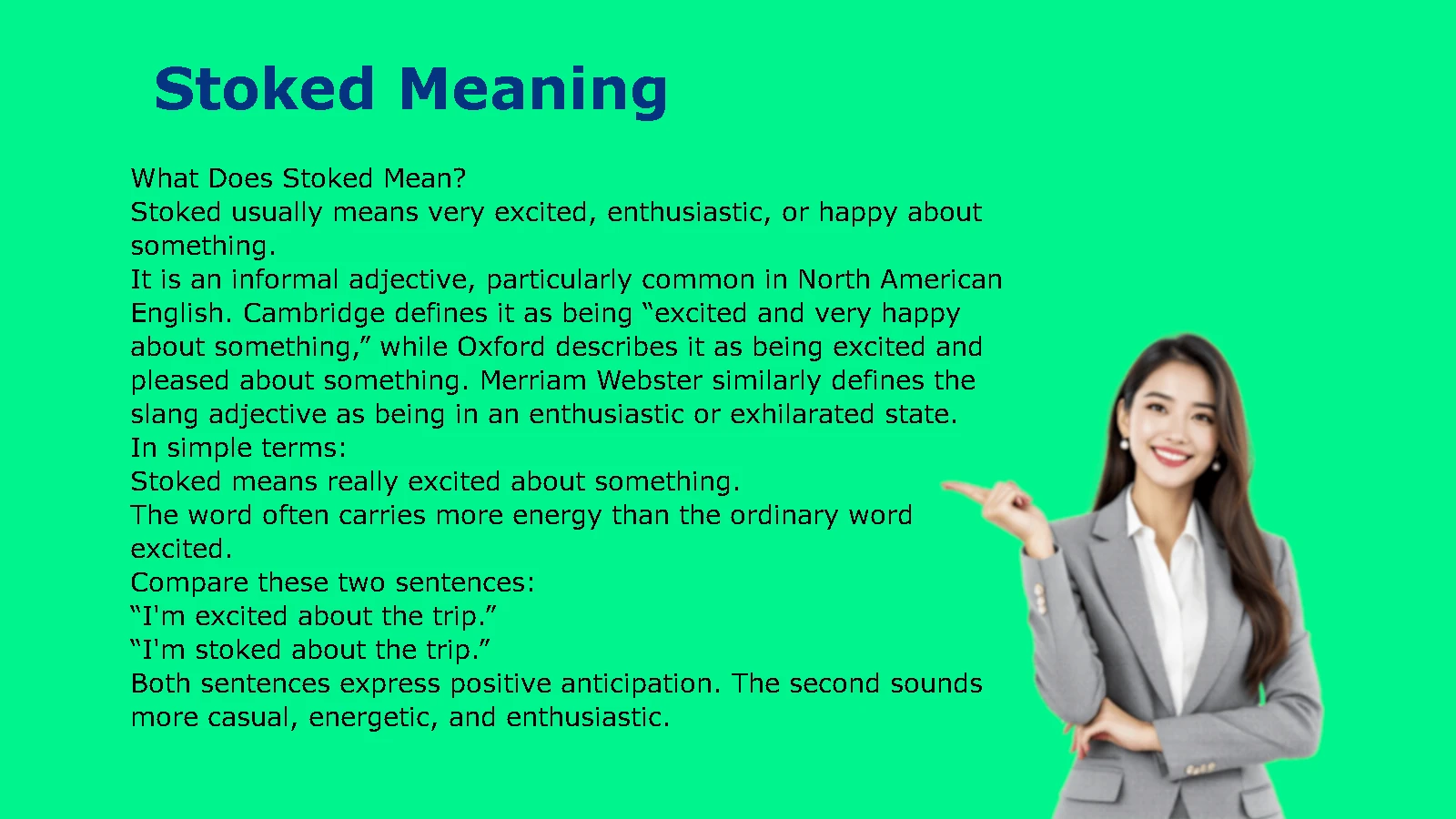
What Does Stoked Mean?
Stoked usually means very excited, enthusiastic, or happy about something.
It is an informal adjective, particularly common in North American English. Cambridge defines it as being “excited and very happy about something,” while Oxford describes it as being excited and pleased about something. Merriam Webster similarly defines the slang adjective as being in an enthusiastic or exhilarated state.
In simple terms:
Stoked means really excited about something.
The word often carries more energy than the ordinary word excited.
Compare these two sentences:
- “I’m excited about the trip.”
- “I’m stoked about the trip.”
Both sentences express positive anticipation. The second sounds more casual, energetic, and enthusiastic.
You might use stoked when a friend tells you about concert tickets, when your team reaches the playoffs, or when you finally book the vacation you’ve been planning for months.
Stoked Meaning in Simple Words
If you want the shortest possible explanation, remember this:
Stoked = very excited, enthusiastic, or happy about something.
Here are a few quick examples:
- “I’m stoked for the game.” → I’m really excited for the game.
- “She’s stoked about her new job.” → She’s very happy and excited about her new job.
- “We’re stoked to be here.” → We’re really excited to be here.
- “He was stoked when he heard the news.” → He was extremely pleased and excited.
The exact strength depends on context, but the feeling is usually strongly positive.
Stoked Meaning in Slang
The slang meaning of stoked is extremely excited or enthusiastic.
Dictionaries identify this sense as informal or slang. Merriam Webster lists excited, enthusiastic, and exhilarated among its related meanings and synonyms.
In everyday speech, someone who is stoked isn’t merely interested. They have a noticeable sense of excitement.
For example:
“We’re stoked about the new album.”
This means:
“We’re really excited about the new album.”
The slang use often appears in situations where people feel anticipation, energy, or strong enthusiasm.
Common Situations Where People Say “Stoked”
You might hear stoked when someone is talking about:
- A concert
- A vacation
- A sporting event
- A new job
- A promotion
- A new car
- A trip
- A competition
- A new project
- A celebration
- An achievement
- An outdoor adventure
- Meeting someone they admire
- An upcoming event
For instance:
“I’m stoked to finally visit California.”
The speaker isn’t simply saying the visit will be pleasant. They’re emphasizing their enthusiasm about it.
Stoked Meaning in Texting
In texting, stoked usually means really excited.
Because text messages tend to be casual, the word fits naturally into conversations between friends, family members, teammates, and coworkers who have an informal relationship.
Consider this exchange:
Alex: We got tickets for Saturday!
Jordan: No way! I’m stoked!
Here, I’m stoked means:
“I’m extremely excited about this!”
Another example:
Mia: Your favorite band is playing here next month.
Sam: Seriously? I’m so stoked!
The word gives the response more energy than simply saying “I’m happy.”
Common Texting Phrases With Stoked
You may see phrases such as:
- I’m stoked.
- So stoked!
- Super stoked!
- Really stoked.
- I’m stoked about it.
- I’m stoked for you.
- I’m stoked to go.
- We’re all stoked.
- I’m so stoked for this.
These expressions are generally friendly and enthusiastic.
What Does “I’m Stoked” Mean?
“I’m stoked” means “I’m very excited” or “I’m really enthusiastic about something.”
The phrase doesn’t always state exactly what caused the excitement. The surrounding conversation usually provides that information.
For example:
“We leave for Hawaii tomorrow.”
“I’m stoked!”
The second speaker means they’re extremely excited about the trip.
Similarly:
“I finally got the job.”
“I’m stoked for you!”
Here, the speaker expresses excitement on someone else’s behalf.
“I’m Stoked” vs. “I’m Excited”
These sentences have almost the same basic meaning:
- “I’m excited.”
- “I’m stoked.”
The difference lies mostly in tone.
I’m excited is neutral and works in almost any setting.
I’m stoked is casual and more energetic.
For example, a person might write this in a professional email:
“I’m excited to join the team.”
That sounds natural.
This version:
“I’m stoked to join the team.”
sounds much more informal. It might work with a close colleague, but it isn’t the safest choice for a formal business message.
What Does “Stoked for You” Mean?
“Stoked for you” means “I’m really happy or excited for you because something good happened to you.”
It expresses positive enthusiasm on another person’s behalf.
For example:
“I got accepted into my first choice of college!”
“That’s awesome. I’m stoked for you!”
The speaker isn’t saying that they personally received the good news. Instead, they’re sharing the other person’s excitement.
Other examples include:
- “I’m stoked for you and your new job.”
- “We’re all stoked for you!”
- “I’m so stoked that things worked out.”
- “I’m genuinely stoked for you.”
This phrase often sounds warm, friendly, and supportive.
Stoked Meaning in Social Media
On social media, stoked commonly appears in captions, comments, announcements, and casual posts.
For example:
“Stoked to finally make it to the mountains!”
Or:
“So stoked to be part of this team.”
Or:
“Stoked for what’s coming next!”
The word works especially well in social posts because it communicates excitement without sounding overly formal.
It also fits posts about activities where enthusiasm is central, such as travel, sports, music, surfing, skating, hiking, and outdoor adventures.
A caption that says:
“Excited for this weekend.”
is perfectly normal.
A caption that says:
“Stoked for this weekend!”
sounds more energetic and informal.
Stoked Meaning in English
The word stoked has more than one grammatical and semantic role.
As an informal adjective, it commonly means very excited or enthusiastic.
As the past tense or past participle of stoke, it can mean fueled, stirred, or increased.
This distinction matters.
| Use | Meaning | Example |
| Informal adjective | Very excited | “I’m stoked about the trip.” |
| Verb, past tense | Added fuel to a fire | “He stoked the fire.” |
| Verb, figurative | Increased or intensified something | “The announcement stoked interest.” |
So, don’t assume every use of stoked means excited.
The sentence itself tells you which meaning applies.
Stoked vs. Stoke
The relationship between stoked and stoke explains much of the word’s history.
Stoke is the base verb. In its literal sense, it means to tend a fire by adding fuel or stirring it so that it burns more strongly.
For example:
“She stoked the fire before going to bed.”
Here, stoked is simply the past tense of stoke.
But English speakers also use stoke figuratively to mean increase or intensify something.
For example:
“The announcement stoked public interest.”
This means the announcement increased public interest.
You can also stoke negative emotions:
“The rumor stoked anger among the fans.”
Here, stoked does not mean excited in the positive slang sense. It means intensified or increased.
That distinction is one of the most important things to understand about the word.
Why Does Stoked Mean Excited?
The slang sense of stoked connects naturally to the original image of a fire.
When you stoke a fire, you add fuel or tend the flames so they burn more strongly.
The same idea works as a metaphor for enthusiasm.
Think of excitement as a fire:
- A small amount of interest creates a small flame.
- More enthusiasm adds fuel.
- Strong excitement makes the flame burn hotter.
- Someone who is stoked feels that enthusiasm at a high level.
Dictionary sources trace stoked to stoke + -ed. Merriam Webster gives the first known use of stoke in the fire related sense as 1683 and traces the word to Dutch stoken, meaning to feed or tend a fire.
The slang adjective is a later development of that basic idea.
So when someone says:
“I’m stoked!”
the word carries the sense of enthusiasm being fired up.
How to Pronounce Stoked
Stoked is pronounced:
/stoʊkt/
It has one syllable and rhymes approximately with smoked.
Break it down like this:
stoked → STOHKT
The pronunciation stays the same whether you’re using stoked as an adjective or as the past tense of stoke.
Stoked Examples in Sentences
Seeing the word in different situations makes its meaning much easier to understand.
Everyday Examples
“I’m stoked about our weekend plans.”
Meaning: I’m very excited about our weekend plans.
“She’s stoked about her new apartment.”
Meaning: She’s really happy and excited about her new apartment.
“We’re stoked to be part of the event.”
Meaning: We’re very enthusiastic about participating.
“He was stoked when he heard the news.”
Meaning: He was extremely pleased and excited.
“The kids were stoked about the surprise.”
Meaning: The children were very excited about the surprise.
Work and School Examples
“I’m stoked to start my new job.”
“She was stoked when she earned the scholarship.”
“The students were stoked about the field trip.”
“Our team is stoked to launch the project.”
These examples show that stoked doesn’t belong to just one subject area. It can describe excitement about almost anything.
Sports Examples
Sports provide a particularly natural setting for the word.
“The players were stoked after the win.”
“I’m stoked for Sunday’s game.”
“The fans were absolutely stoked.”
Here, stoked communicates strong enthusiasm and energy.
How to Use Stoked in a Sentence
The word appears in several common sentence patterns.
Stoked About + Noun
Use stoked about when you want to identify the thing causing your excitement.
“I’m stoked about the concert.”
“She’s stoked about her promotion.”
“They’re stoked about the new restaurant.”
This pattern focuses on what you’re excited about.
Stoked For + Noun
Use stoked for when talking about something you eagerly anticipate.
“I’m stoked for the weekend.”
“We’re stoked for the tournament.”
“She’s stoked for the trip.”
It can also appear when you’re excited on someone else’s behalf:
“I’m stoked for you!”
Stoked To + Verb
Use stoked to before an action.
“I’m stoked to meet everyone.”
“We’re stoked to be here.”
“She’s stoked to start her new role.”
This construction is extremely common in casual conversation.
Stoked That + Clause
Use stoked that when the reason for your excitement is expressed as a complete clause.
“I’m stoked that you can come.”
“He’s stoked that the plan worked.”
“We’re stoked that everyone enjoyed the event.”
These structures make stoked easy to use in everyday English.
Stoked Synonyms
Several words can replace stoked, but the best choice depends on the situation.
Common Synonyms for Stoked
- Excited
- Thrilled
- Enthusiastic
- Pumped
- Psyched
- Eager
- Elated
- Exhilarated
- Jazzed
- Fired up
- Enthused
- Happy
However, these words aren’t identical.
Excited is the broadest and most neutral choice.
Thrilled often suggests a particularly strong feeling of happiness.
Pumped emphasizes energetic excitement.
Psyched is also informal and commonly expresses strong anticipation.
Enthusiastic sounds more neutral or formal.
Eager emphasizes a strong desire to do or experience something.
Stoked vs. Excited
The difference between stoked and excited mainly involves tone.
| Feature | Stoked | Excited |
| Tone | Informal | Neutral |
| Energy | Strong and energetic | Can range from mild to strong |
| Formal writing | Usually inappropriate | Appropriate |
| Casual conversation | Very natural | Very natural |
| Texting | Common | Common |
| Social media | Common | Common |
Consider these examples:
“I’m excited to meet you.”
This works in a professional email.
“I’m stoked to meet you.”
This sounds much more casual and enthusiastic.
Neither sentence is grammatically wrong. The difference is register.
If you’re writing a formal report, excited or pleased is usually safer. If you’re talking to a friend, stoked can sound more natural.
Stoked vs. Psyched
Stoked and psyched overlap heavily.
Both can mean very excited or enthusiastic.
For example:
“I’m stoked for the concert.”
and
“I’m psyched for the concert.”
communicate essentially the same idea.
Both are informal. The choice often comes down to personal style and regional usage.
Stoked can have a particularly strong association with excitement about activities, experiences, sports, and outdoor pursuits.
Psyched often emphasizes anticipation or eagerness.
Still, the distinction isn’t absolute. In many casual conversations, you can substitute one for the other without changing the basic meaning.
Stoked vs. Pumped
Pumped is another close synonym.
Compare:
“I’m stoked for the game.”
“I’m pumped for the game.”
Both mean the speaker is highly excited about the game.
There can be a slight difference in emphasis.
Pumped often suggests energetic readiness. It can sound like someone is fired up and ready to act.
Stoked often emphasizes strong enthusiasm or happiness about something.
For example:
“I’m pumped to compete.”
sounds especially energetic and action oriented.
“I’m stoked about the trip.”
sounds strongly enthusiastic about the upcoming experience.
The distinction is subtle rather than strict.
Is Stoked a Positive or Negative Word?
In its common slang sense, stoked is positive.
If someone says:
“I’m stoked!”
they normally mean they’re very excited or happy.
However, the related verb stoke can have a negative object.
For example:
“The comment stoked anger.”
Here, stoked means increased or intensified anger.
That isn’t the same as saying someone was “stoked” in the slang sense.
This distinction becomes clear when you look at the grammar:
- I am stoked about the concert. → excited
- The article stoked public anger. → intensified anger
The same spelling appears in both sentences, but the grammatical role and meaning differ.
Is Stoked Formal or Informal?
When stoked means very excited, it is informal.
Cambridge identifies this use as mainly US informal. Oxford also labels it especially North American and informal.
That means it’s a natural choice for:
- Casual conversations
- Text messages
- Social media
- Friendly emails
- Informal interviews
- Conversations with teammates
- Conversations with friends
It isn’t usually the best choice for:
- Academic papers
- Legal documents
- Formal reports
- Official announcements
- Highly formal business correspondence
Instead of writing:
“We are stoked about the results.”
in a formal report, consider:
“We are very pleased with the results.”
Or:
“We are enthusiastic about the results.”
The right word depends on the audience.
Stoked Meaning for Work and Professional Communication
Although stoked is informal, it isn’t automatically inappropriate at work.
The relationship between the speakers matters.
If a close team regularly uses casual language, someone might say:
“I’m stoked about what we accomplished this quarter.”
That can sound friendly and genuine.
But if you’re sending a formal message to a client, this would usually be better:
“I’m excited about the opportunity to work together.”
The key isn’t whether stoked is a “bad” word. It isn’t. The issue is register.
Good communication matches the tone to the audience.
Stoked Meaning in Different Contexts
The word becomes easier to understand when you see how context changes its flavor.
| Context | Example | Meaning |
| Travel | “I’m stoked for the trip.” | Very excited |
| Music | “We’re stoked about the concert.” | Very enthusiastic |
| Sports | “The team was stoked after the win.” | Extremely excited |
| Work | “She’s stoked about her promotion.” | Very pleased |
| School | “He’s stoked about getting accepted.” | Very happy and excited |
| Friendship | “I’m stoked for you!” | Very happy for someone |
| Social media | “Stoked to be here!” | Excited and enthusiastic |
The underlying feeling remains similar: strong positive excitement.
Stoked Up Meaning
Stoked up can mean something different from the slang adjective stoked.
In its literal sense, stoke up means to add fuel to a fire or increase its heat.
For example:
“He stoked up the fire before the temperature dropped.”
The phrase can also have a figurative meaning:
“The story stoked up public anger.”
Here, stoked up means increased or intensified anger.
Another example:
“The announcement stoked up interest in the product.”
This means the announcement increased interest.
So don’t automatically interpret stoked up as “very excited.”
Compare:
“I’m stoked about the concert.”
Meaning: I’m very excited about the concert.
“The campaign stoked up interest in the product.”
Meaning: The campaign increased interest in the product.
Context does the heavy lifting.
The Literal Meaning of Stoke
The verb stoke originally relates to tending a fire.
If you stoke a fire, you add fuel or tend the flames so the fire continues burning strongly.
For example:
“He stoked the fireplace with another log.”
Over time, English speakers extended the idea beyond physical fires.
You can stoke:
- Interest
- Excitement
- Fear
- Anger
- Demand
- Concern
- Tension
- Enthusiasm
For example:
“The advertisement stoked demand for the product.”
Here, stoked means increased.
Similarly:
“The rumor stoked fears about the economy.”
The rumor made those fears stronger.
This figurative use is important because it shows why stoke can be associated with both positive and negative emotions.
A Simple Way to Remember the Stoked Meaning
Think of a fire.
When you stoke a fire, you give it fuel. The flames grow stronger.
Now apply that image to excitement.
When someone is stoked, their enthusiasm is burning strongly.
That mental picture makes the slang meaning easy to remember:
Stoke a fire → make it burn stronger → stoked → highly energized or excited.
It’s a simple metaphor, but it captures the relationship between the literal verb and the modern slang adjective.
Common Mistakes With Stoked
Confusing Stoked With Stoke
Stoke is the base verb.
Stoked is its past tense and past participle. It also functions as an informal adjective meaning excited.
Correct:
“I’m stoked about the trip.”
Correct:
“She stoked the fire.”
Incorrect in standard usage:
“I’m stoke about the trip.”
Using Stoked in Every Formal Situation
The slang meaning is informal.
A phrase like:
“We are stoked to announce the quarterly results.”
may sound too casual for a highly formal corporate announcement.
A better choice might be:
“We are pleased to announce the quarterly results.”
Assuming Every Use Means Excited
Not every use of stoked means excited.
“The news stoked concern.”
Here, stoked means increased.
Always look at what follows the word and how the sentence is structured.
Treating Stoked and Excited as Completely Identical
They overlap in meaning, but their tones differ.
Stoked is more casual and energetic.
Excited is more neutral and versatile.
Stoked Meaning in American English
In American English, the slang adjective stoked commonly means very excited or enthusiastic.
Cambridge labels the adjective mainly US informal. Oxford likewise identifies the excitement sense as especially North American and informal.
The word also appears outside the United States, particularly in other English speaking communities where American informal vocabulary has influenced everyday speech.
Still, its strongest associations are with casual speech and energetic expressions of enthusiasm.
Stoked and Outdoor Culture
The word has a strong association with activities where enthusiasm and adrenaline play a major role, including surfing, skating, snowboarding, and other outdoor pursuits.
That doesn’t mean stoked belongs exclusively to those communities. Modern speakers use it far more broadly.
Someone can be stoked about:
- A movie
- A job
- A meal
- A vacation
- A birthday
- A wedding
- A sports game
- A new project
- A concert
- A personal achievement
The outdoor association helps explain the word’s energetic feel, but it doesn’t limit its modern meaning.
Is “Stoked” the Same as “Happy”?
Not exactly.
Happy is a broad emotional word. It can describe general contentment or pleasure.
Stoked usually describes strong excitement or enthusiasm about something specific.
Compare:
“I’m happy with my new job.”
This suggests satisfaction.
“I’m stoked about my new job.”
This suggests strong excitement and enthusiasm.
You can be happy without being stoked.
For example, someone might quietly feel happy about a small positive event. Being stoked usually suggests a much more energetic reaction.
Is “Stoked” the Same as “Thrilled”?
They’re close, but their tones differ.
Thrilled can work in both formal and informal English.
Stoked is much more casual.
Compare:
“We were thrilled to receive the award.”
This sounds appropriate in a formal announcement.
“We were stoked to receive the award.”
This sounds relaxed and conversational.
Both express strong positive emotion. The difference is mainly style and register.
Related Words and Expressions
Several informal expressions share part of the meaning of stoked.
Pumped
Means highly excited or energized.
“I’m pumped for the game.”
Psyched
Means very excited or enthusiastic.
“She’s psyched about the trip.”
Amped
Means highly excited, energized, or worked up.
“Everyone was amped before the show.”
Jazzed
Means excited or enthusiastic.
“I’m really jazzed about the project.”
Fired Up
Means highly energized, enthusiastic, or emotionally charged.
“The team was fired up before the match.”
These words overlap with stoked, but each has its own tone and usage patterns.
Stoked Meaning: Quick Reference
| Question | Answer |
| What does stoked mean? | Very excited, enthusiastic, or happy about something |
| Is stoked slang? | The “very excited” sense is informal slang |
| Is stoked positive? | Usually, yes |
| Is stoked formal? | No, the excitement sense is informal |
| What does “I’m stoked” mean? | I’m very excited |
| What does “stoked for you” mean? | I’m very happy or excited for you |
| What does “stoked about” mean? | Very excited about something |
| What does “stoked to” mean? | Very excited to do something |
| What is a synonym for stoked? | Excited, thrilled, pumped, psyched |
| What is the base verb? | Stoke |
| What does stoke mean literally? | To tend or add fuel to a fire |
| Can stoked mean increased? | Yes, when it functions as the past tense of the verb stoke |
Frequently Asked Questions About Stoked Meaning
What does stoked mean in slang?
In slang, stoked usually means very excited, enthusiastic, or exhilarated. It is an informal expression that commonly appears in casual conversations, texts, and social media.
What does “I’m stoked” mean?
“I’m stoked” means “I’m really excited.” The phrase often expresses strong enthusiasm about an upcoming event, opportunity, activity, or piece of good news.
For example:
“I’m stoked for the concert.”
means:
“I’m really excited about the concert.”
What does stoked mean in texting?
In texting, stoked normally means very excited or happy about something.
For example:
“Got the tickets!”
“I’m stoked!”
The second message expresses strong excitement.
Is stoked a positive word?
Yes. When used as informal slang to describe a person’s feelings, stoked is normally positive.
It means the person feels excited, enthusiastic, or very pleased.
However, the past tense of stoke can appear in negative contexts:
“The rumor stoked fear.”
Here, it means increased fear, not “felt excited.”
Is stoked the same as excited?
The meanings overlap, but the tone differs.
Excited is neutral and works in formal or informal English.
Stoked is more informal, energetic, and conversational.
What is another word for stoked?
Depending on the context, useful alternatives include:
- Excited
- Thrilled
- Enthusiastic
- Pumped
- Psyched
- Eager
- Exhilarated
- Jazzed
- Fired up
The best synonym depends on the sentence and desired tone.
Can you call someone stoked?
Yes.
You can say:
“She is stoked about the opportunity.”
or:
“They were stoked when they heard the news.”
These sentences describe someone’s strong excitement.
What does “stoked for you” mean?
“Stoked for you” means “I’m really happy and excited for you.”
It’s often used when someone shares good news.
“I got the promotion!”
“That’s amazing! I’m stoked for you!”
Is stoked American slang?
Stoked is commonly identified as an informal, especially North American expression. Cambridge labels the excitement sense mainly US informal, while Oxford describes it as especially North American and informal.
It is also used in other varieties of English.
Can stoked mean high?
Some dictionaries record a separate slang sense in which stoked can mean intoxicated or high. However, that is not the ordinary meaning in most everyday sentences about excitement.
For example:
“I’m stoked about the concert.”
clearly means:
“I’m very excited about the concert.”
The surrounding context determines which sense applies.
What is the opposite of stoked?
If stoked means very excited, possible opposites include:
- Uninterested
- Unenthusiastic
- Indifferent
- Apathetic
- Bored
- Unexcited
The best opposite depends on what kind of excitement you’re contrasting.
Final Takeaway: Stoked Meaning
The most common stoked meaning is simple: very excited, enthusiastic, or happy about something.
It is an informal word that adds energy to a sentence. When someone says “I’m stoked,” they’re saying they’re really excited. When someone says “I’m stoked for you,” they’re expressing strong happiness or enthusiasm about another person’s good news.
The word also has a literal connection to stoke, which means to tend or add fuel to a fire. From there, stoke developed figurative uses involving the increase of emotions, interest, demand, fear, and other forces.
That gives stoked two important uses:
- “I’m stoked about the trip.” → I’m very excited about it.
- “The announcement stoked interest.” → The announcement increased interest.
When you see stoked in texting, social media, or casual conversation, the excitement meaning will usually be the one intended.
So, if a friend tells you, “I’m stoked about this weekend,” they’re not just mildly interested.
They’re really looking forward to it.