
Ever come across the word Lest and wondered what it actually means? You’re not alone. Lest Meaning is a common search because this old-fashioned yet important word still appears in books, legal documents, formal writing, speeches, and even everyday expressions.
Lest is a conjunction that means “for fear that,” “so that something bad does not happen,” or “to avoid the possibility of something.” It is used to introduce a clause expressing a warning, precaution, or undesirable outcome.
Examples:
- She whispered lest she wake the baby.
- Wear a coat lest you catch a cold.
- They left early lest they miss the train.
The confusion is understandable. Many people search for lest meaning, lest definition, how to use lest, and lest in a sentence because the word isn’t used as often in casual conversation. And here’s the kicker: misunderstanding lest can completely change the meaning of a sentence.
In this guide, you’ll discover the Lest Meaning, learn the definition of lest, understand how to use lest correctly, explore lest examples, and see lest in a sentence with easy-to-follow explanations. You’ll also learn the pronunciation of lest, common mistakes to avoid, and similar words that can help you use it with confidence.
What Does Lest Mean?
Definition of Lest
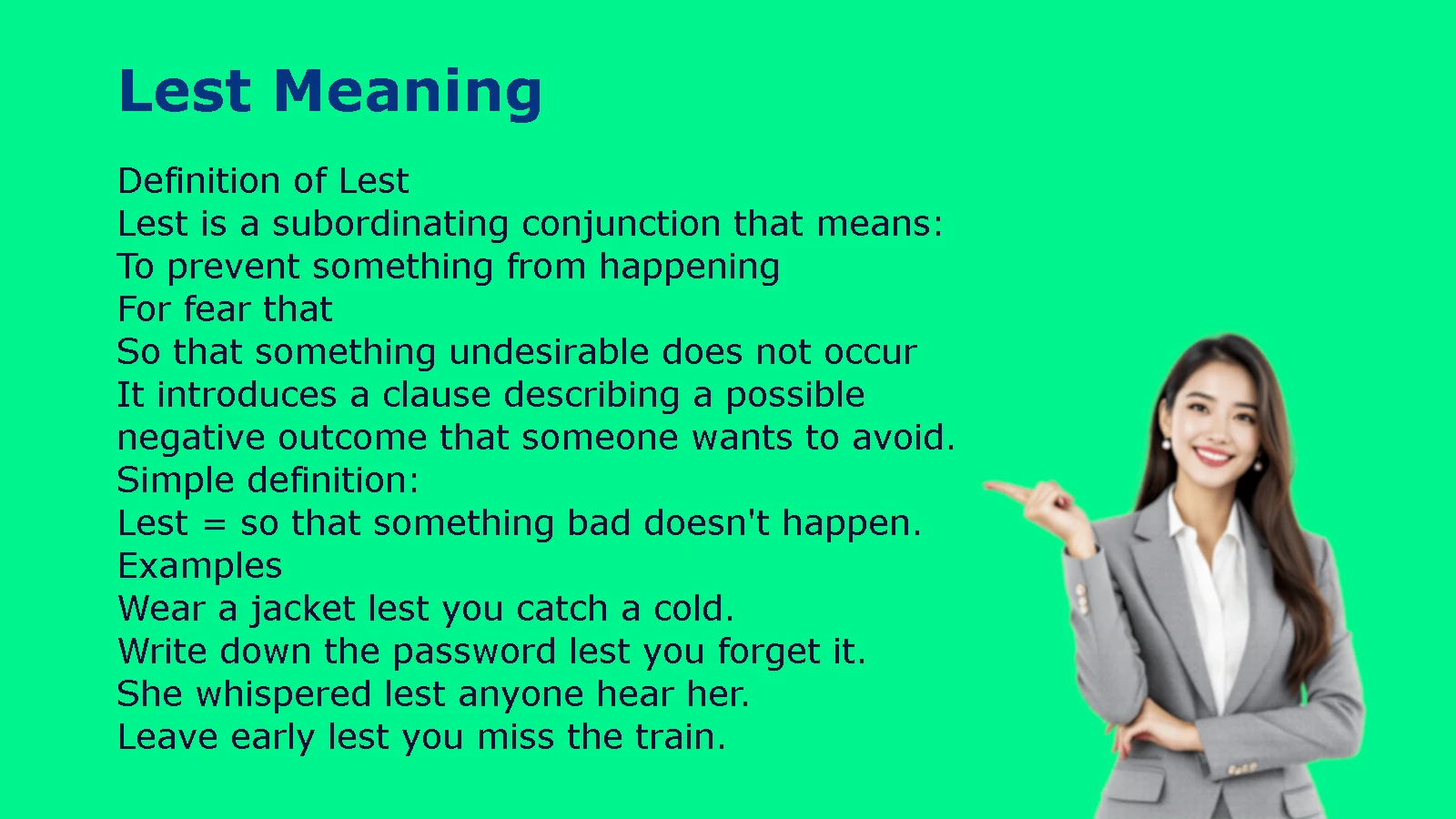
Lest is a subordinating conjunction that means:
- To prevent something from happening
- For fear that
- So that something undesirable does not occur
It introduces a clause describing a possible negative outcome that someone wants to avoid.
Simple definition:
Lest = so that something bad doesn’t happen.
Examples
- Wear a jacket lest you catch a cold.
- Write down the password lest you forget it.
- She whispered lest anyone hear her.
- Leave early lest you miss the train.
Each sentence describes an action taken to avoid an unwanted result.
Pronunciation
The word lest is pronounced:
/lest/
It rhymes with:
- best
- test
- chest
- guest
Because it contains only one syllable, pronunciation is usually straightforward.
Part of Speech
Lest functions as a subordinating conjunction.
A subordinating conjunction connects a dependent clause to the main clause and explains the relationship between the two ideas.
For example:
Bring your passport lest immigration refuse entry.
Here:
- Main clause: Bring your passport
- Dependent clause: lest immigration refuse entry
The second clause explains what the first action is trying to prevent.
Origin and Etymology
The history of lest stretches back hundreds of years.
| Period | Development |
| Old English | Derived from þȳ lǣs þe, meaning “by less that” or “in order that not.” |
| Middle English | Gradually shortened to lest. |
| Early Modern English | Became common in religious texts, legal documents, and literature. |
| Modern English | Used mainly in formal, literary, academic, legal, and ceremonial contexts. |
Historically, lest appeared frequently in translations of the Bible, works by Shakespeare, political speeches, and legal writing. Although everyday speech now favors alternatives like so that or in case, lest remains grammatically correct and widely understood.
Is Lest Still Used Today?
Yes. Although it isn’t common in casual conversation, lest hasn’t disappeared.
You’ll still see it in:
- Legal contracts
- Government publications
- Academic writing
- News headlines
- Literature
- Historical writing
- Religious texts
- Military ceremonies
- Formal speeches
One of the best-known examples is:
“Lest We Forget.”
This phrase appears during remembrance ceremonies in several English-speaking countries to honor soldiers who died in war.
So while lest may sound traditional, it remains an active part of modern English.
Quick Answer: Lest Meaning
If you’re looking for a quick explanation, here’s the simplest answer.
| Word | Meaning |
| Lest | So that something bad doesn’t happen |
| Lest | To avoid the possibility of something |
| Lest | For fear that |
Easy example
Carry extra water lest you become dehydrated.
Meaning:
Carry extra water so that you don’t become dehydrated.
Another example:
Save your work frequently lest you lose your progress.
Meaning:
Save your work often to avoid losing it.
How to Use Lest in a Sentence
Understanding the grammar behind lest makes it much easier to use correctly.
Basic Sentence Structure
The standard pattern looks like this:
Main clause + lest + possible unwanted outcome
Examples:
- Lock the door lest someone enter.
- Study carefully lest you fail the exam.
- Speak softly lest you wake the baby.
- Leave now lest traffic delay you.
Notice that the action always comes first. The lest clause explains the consequence the speaker wants to prevent.
Why Lest Expresses Prevention
Unlike words such as because or since, lest doesn’t explain why something happened.
Instead, it explains why someone takes a precaution.
Compare the sentences below.
| Sentence | Meaning |
| Wear boots because it’s raining. | Explains the reason. |
| Wear boots lest your feet get wet. | Explains what you’re trying to prevent. |
The difference is subtle but important.
The Hidden Idea Behind Lest
Every sentence with lest carries an implied warning.
Consider these examples:
- Bring cash lest the card machine fail.
- Charge your phone lest the battery die.
- Double-check your email lest you send the wrong attachment.
Each sentence suggests a possible problem and recommends taking action before it happens.
Common Sentence Patterns
Action + Lest + Base Verb
- Hurry lest we miss the flight.
- Be careful lest you slip.
Action + Lest + Someone + Verb
- Whisper lest anyone overhear us.
- Stay inside lest neighbors become concerned.
Action + Lest + Something Happen
- Save the document lest the computer crash.
- Take notes lest you forget the details.
Examples of Lest in Sentences
Examples help you understand how native speakers use the word in different situations.
Everyday Examples
Although lest sounds formal, these examples show how naturally it fits into ordinary situations.
- Pack sunscreen lest you get sunburned.
- Leave early lest traffic slows you down.
- Charge your laptop lest it shuts down during the meeting.
- Set an alarm lest you oversleep.
- Keep your receipt lest you need a refund.
- Drink enough water lest you become dehydrated.
- Lock your bicycle lest someone steal it.
- Bring a map lest your phone loses signal.
Formal Writing Examples
Formal English often prefers lest because it sounds concise.
Examples:
- The committee delayed the announcement lest inaccurate information spread.
- The company withheld the report lest confidential data become public.
- Researchers repeated the experiment lest errors affect the results.
- Officials issued warnings lest residents underestimate the storm.
Academic Examples
You’ll often encounter lest in research papers and scholarly writing.
Examples include:
- The variables were controlled lest external factors influence the findings.
- Additional evidence was collected lest conclusions rely on incomplete data.
- Participants remained anonymous lest personal information compromise privacy.
Legal Examples
Legal English values precision, which explains why lest still appears in contracts and court documents.
Examples:
- The information shall remain confidential lest unauthorized disclosure occur.
- Protective measures were implemented lest evidence be destroyed.
- Access was restricted lest sensitive records become available to the public.
Literary Examples
Classic literature uses lest to create a serious or dramatic tone.
Examples:
- She lowered her eyes lest sorrow betray her.
- He concealed the letter lest anyone discover the truth.
- The villagers remained silent lest fear spread among the children.
Business Communication Examples
Although modern businesses usually prefer simpler language, lest occasionally appears in formal reports or executive communication.
Examples:
- Verify every figure lest inaccuracies reach investors.
- Complete the backup lest important files disappear.
- Review the proposal carefully lest costly mistakes remain unnoticed.
Common Phrases Using Lest
Some expressions with lest have become part of standard English.
Learning these phrases helps you recognize the word immediately.
Lest We Forget
This is by far the most famous expression containing lest.
Meaning:
May we never forget those who sacrificed their lives.
The phrase serves as both a reminder and a tribute. It encourages people to remember military personnel who died in service, particularly during remembrance ceremonies and memorial events.
You’ll often see it engraved on monuments, displayed on memorial wreaths, or included in speeches honoring veterans.
Lest Anyone Think…
This phrase introduces clarification before readers reach the wrong conclusion.
Examples:
- Lest anyone think the project failed, it actually exceeded expectations.
- Lest anyone misunderstand, attendance is optional.
Lest Someone Should…
This construction appears mainly in British English and formal writing.
Examples:
- She remained quiet lest someone should notice her.
- The witness left early lest anyone should question him.
In American English, writers often omit should:
- She remained quiet lest someone notice her.
Both forms are grammatically acceptable, although the version without should sounds more natural in contemporary American English.
Lest There Be Any Confusion
This phrase introduces clarification before misunderstanding occurs.
Examples:
- Lest there be any confusion, tomorrow’s meeting starts at 9:00 a.m.
- Lest there be any doubt, all participants must register in advance.
Lest You Wonder
Writers use this expression to answer a question before readers ask it.
Examples:
- Lest you wonder why the process takes longer, every application undergoes manual review.
- Lest you wonder about the delay, the shipment is awaiting customs clearance.
Lest It Happen Again
This phrase emphasizes learning from previous mistakes.
Examples:
- The company improved its cybersecurity lest it happen again.
- New safety rules were introduced lest the accident happen again.
Other Established Expressions
You’ll also encounter phrases such as:
- Lest we repeat history
- Lest they forget
- Lest anyone object
- Lest misunderstandings arise
- Lest panic spread
- Lest confusion result
- Lest problems escalate
These expressions appear most often in editorials, speeches, government communications, and formal publications.
“Lest We Forget” Meaning
Among all phrases containing lest, none is more recognizable than “Lest We Forget.”
The expression means:
We must never forget the sacrifices made by those who served and died, especially in times of war.
The phrase encourages remembrance rather than celebration. It reminds communities that freedom often comes at a tremendous human cost.
Historical Background
The expression became widely known after the publication of Rudyard Kipling’s 1897 poem “Recessional.” In the poem, the repeated words “Lest we forget” serve as a warning against pride and complacency. Over time, the phrase took on a broader meaning and became closely associated with honoring military sacrifice.
Today, it appears during remembrance events, memorial services, and commemorations in countries such as the United Kingdom, Canada, Australia, and New Zealand. While its modern use centers on honoring fallen service members, its literary origin reflects a broader call to remember important lessons from history.
“Lest we forget.” — Rudyard Kipling, “Recessional” (1897)
The phrase remains one of the most enduring examples of lest in modern English.
Lest vs. So That
At first glance, lest and so that may seem interchangeable because both connect two ideas. However, they don’t always carry the same meaning.
Lest specifically introduces something you want to prevent. So that simply explains the purpose of an action and can describe either a positive or negative outcome.
Compare the examples below.
| Expression | Primary Meaning | Example |
| Lest | To prevent an unwanted result | Leave now lest you miss the flight. |
| So that | To explain purpose | Leave now so that you arrive on time. |
Notice the subtle difference.
- Lest focuses on avoiding a problem.
- So that focuses on achieving a goal.
Both sentences may describe the same situation, yet the emphasis changes.
More Examples
- Save your work lest you lose it.
- Save your work so that you can continue later.
The first sentence warns against a negative possibility. The second explains the benefit.
Lest vs. In Case
Many English learners confuse lest with in case because both involve preparation.
The difference lies in the speaker’s intent.
| Lest | In Case |
| Expresses prevention | Expresses preparation |
| Usually more formal | Common in everyday English |
| Often found in writing | Common in speech and writing |
Examples:
- Bring an umbrella lest you get soaked.
- Bring an umbrella in case it rains.
Both are correct, but they don’t sound identical.
The lest sentence emphasizes avoiding getting wet.
The in case sentence emphasizes preparing for rain.
Lest vs. For Fear That
For fear that carries nearly the same meaning as lest, although it sounds even more literary.
Examples:
- He hid the evidence lest someone discover it.
- He hid the evidence for fear that someone would discover it.
Both communicate the same basic idea.
Modern writers generally prefer lest because it’s shorter and cleaner.
Lest with “Should”
One grammar point surprises many learners.
You’ll often see should after lest, especially in British English and older writing.
Examples:
- Lock the gate lest anyone should enter.
- She remained silent lest someone should overhear.
This construction isn’t incorrect. It simply sounds more traditional.
In modern American English, writers usually omit should.
Compare the two versions.
| Traditional Style | Modern Style |
| Lest anyone should notice | Lest anyone notice |
| Lest he should forget | Lest he forget |
| Lest they should arrive | Lest they arrive |
The shorter version appears much more often today.
Can Lest Be Used Without “Should”?
Absolutely.
In fact, omitting should is now the standard style in most American publications.
Examples:
- Drive carefully lest you damage the car.
- Speak quietly lest the children wake up.
- Check your spelling lest readers become confused.
Adding should isn’t wrong, but it may sound old-fashioned unless you’re writing in a formal or literary style.
Is Lest Followed by the Base Verb?
Yes.
After lest, English usually uses the base form of the verb or a clause that naturally expresses the possible outcome.
Examples:
✔ Lest anyone know
✔ Lest she forget
✔ Lest they arrive
You’ll also see complete clauses.
Examples:
- Lest the meeting run late.
- Lest confusion arise.
- Lest mistakes occur.
- Lest valuable time be lost.
Does Lest Always Introduce a Negative Outcome?
Almost always.
The clause following lest describes something undesirable that someone hopes to avoid.
Examples:
- Wear gloves lest your hands freeze.
- Stay hydrated lest you become exhausted.
- Verify the address lest the package go to the wrong location.
Without that idea of prevention, lest usually doesn’t fit.
Can a Sentence Begin with Lest?
Yes, although it happens less often.
Beginning a sentence with lest creates emphasis and often sounds literary or formal.
Examples:
- Lest anyone misunderstand, the policy applies to every employee.
- Lest there be any doubt, all submissions require approval.
- Lest history repeat itself, governments study previous mistakes.
This structure appears frequently in speeches, editorials, and legal documents.
Is Lest Old-Fashioned?
One of the most common questions about lest meaning is whether the word still belongs in modern English.
The short answer is yes, but context matters.
Most native speakers understand lest, yet they rarely use it during casual conversation.
You probably wouldn’t hear someone say:
“I’m taking my charger lest my phone die.”
Instead, they’re more likely to say:
“I’m taking my charger in case my phone dies.”
Both sentences communicate the same idea. The second simply sounds more natural in everyday speech.
Where Is Lest Common Today?
Although conversational English favors simpler alternatives, lest remains common in several fields.
You’ll regularly encounter it in:
- Academic journals
- Court opinions
- Legal contracts
- Government publications
- Historical writing
- Newspaper editorials
- Religious texts
- Formal speeches
- Literary fiction
These contexts value precision and concise wording, which helps explain why lest has survived for centuries.
American English vs. British English
Both varieties of English recognize lest, although usage differs slightly.
| American English | British English |
| Less frequent in speech | Slightly more common |
| Usually omits should | More likely to include should |
| Mostly formal writing | Formal and literary writing |
Example:
American style:
Review the report lest errors remain.
British style:
Review the report lest errors should remain.
Neither version is incorrect.
Formal vs. Informal Writing
Choosing between lest and a simpler alternative depends on your audience.
Formal Writing
- Lest confusion arise…
- Lest sensitive information become public…
- Lest misunderstandings occur…
Informal Writing
- So nobody gets confused…
- In case something goes wrong…
- To avoid mistakes…
Professional writers match the word to the situation rather than using it everywhere.
How Often Is Lest Used Today?
Compared with everyday conjunctions like because, if, or since, lest appears relatively infrequently.
However, its low frequency doesn’t mean it’s obsolete.
Instead, it fills a specific grammatical role that shorter alternatives sometimes can’t match.
For example:
“Please verify all figures lest inaccuracies appear in the final report.”
The sentence sounds precise, formal, and efficient.
Synonyms of Lest
Several expressions can replace lest, depending on the sentence.
Each carries a slightly different tone.
| Alternative | Best Used In | Example |
| So that…not | General writing | Hurry so that you don’t miss the bus. |
| In case | Everyday conversation | Bring cash in case the card reader fails. |
| To avoid | Professional writing | Save regularly to avoid losing data. |
| For fear that | Literary writing | He whispered for fear that someone might hear. |
| Otherwise | Instructions | Lock the gate. Otherwise, animals may escape. |
| To prevent | Technical writing | Wear goggles to prevent eye injuries. |
When Should You Replace Lest?
Replacing lest often improves readability.
For example:
Instead of:
Employees should verify receipts lest accounting reject reimbursement.
You could write:
Employees should verify receipts so that accounting doesn’t reject reimbursement.
Or:
Employees should verify receipts to avoid reimbursement delays.
The best choice depends on your audience.
Antonyms and Opposite Expressions
Because lest expresses prevention, its opposite isn’t a single word.
Instead, several expressions communicate the opposite idea.
Examples include:
- Without worrying about
- Regardless of
- Even if
- Despite
- Whether or not
Compare the meanings.
| With Lest | Opposite Idea |
| Leave early lest traffic delay you. | Leave whenever you want regardless of traffic. |
| Save often lest data disappear. | Continue working even if data isn’t saved. |
| Wear sunscreen lest you burn. | Go outside whether or not you wear sunscreen. |
Words Commonly Confused With Lest
Because lest isn’t an everyday word, many learners confuse it with similar-looking terms.
Fortunately, the differences are easy to understand.
Least
Least refers to the smallest amount.
Examples:
- That’s the least expensive option.
- She showed the least interest.
Least is usually an adjective or adverb.
It has nothing to do with prevention.
Less
Less compares quantities.
Examples:
- Spend less money.
- Drink less coffee.
Again, the meaning differs completely from lest.
Unless
Unless means except if.
Examples:
- Don’t leave unless I call.
- The event will continue unless it rains.
Unlike lest, unless introduces a condition rather than a precaution.
Until
Until refers to time.
Examples:
- Stay here until noon.
- Wait until everyone arrives.
It doesn’t express prevention.
Otherwise
Otherwise often appears in warnings.
Example:
- Fasten your seat belt. Otherwise, you could be injured.
Although similar in meaning, otherwise begins a separate sentence or clause instead of introducing one.
Lest vs. Least
This is the spelling mistake learners make most often.
Although the words differ by only one letter, their meanings aren’t related.
| Feature | Lest | Least |
| Part of speech | Conjunction | Adjective, pronoun, or adverb |
| Meaning | To prevent something | Smallest amount |
| Function | Introduces precaution | Compares quantity |
Examples
Correct:
- Leave now lest you miss the train.
Correct:
- This is the least expensive hotel.
Incorrect:
- Leave now least you miss the train.
Memory Trick
Think of the letter T in lest as standing for threat.
Whenever a sentence warns about a possible problem, lest is probably the correct choice.
Lest vs. Unless
Although these conjunctions sometimes appear in similar contexts, they perform different grammatical jobs.
| Lest | Unless |
| Means to prevent | Means except if |
| Expresses precaution | Expresses condition |
| Often formal | Common in everyday speech |
Compare the sentences.
Lest
Bring extra fuel lest the generator stop.
Meaning:
Bring fuel to prevent the generator from stopping.
Unless
The generator won’t run unless you add fuel.
Meaning:
Adding fuel is the required condition.
Can They Replace Each Other?
Usually, no.
Incorrect substitution:
Lock the door unless someone enters.
Correct:
Lock the door lest someone enter.
Or:
Lock the door in case someone tries to enter.
Understanding this distinction helps you avoid one of the most common grammar mistakes involving lest.
Common Mistakes When Using Lest
Even experienced writers occasionally misuse lest. Most errors come from applying everyday grammar patterns to a word that follows slightly different rules.
Here are the mistakes to watch for.
Using a Double Negative
Incorrect:
Wear a helmet lest you don’t get hurt.
Correct:
Wear a helmet lest you get hurt.
The negative idea already exists within lest, so adding another negative creates confusion.
Using the Wrong Verb Form
Incorrect:
Leave now lest you will miss the train.
Correct:
Leave now lest you miss the train.
After lest, use the base verb or a natural clause rather than a future tense.
Overusing “Should”
While should remains grammatically acceptable after lest, adding it to every sentence can make your writing sound dated.
Instead of:
Save your files lest they should disappear.
Modern American English usually prefers:
Save your files lest they disappear.
Using Lest in Casual Conversation
Technically correct doesn’t always mean natural.
Imagine someone saying:
“I’m taking a snack lest I become hungry.”
Most native speakers would probably say:
“I’m taking a snack in case I get hungry.”
Choose lest when the tone calls for it.
Confusing Lest with Similar Words
Many spelling mistakes involve:
- least
- less
- unless
Reading the sentence aloud often makes the error obvious.
How to Remember the Meaning of Lest
Fortunately, lest is one of the easiest formal conjunctions to memorize once you connect it with a simple idea.
Think of this formula:
Action → Prevent Problem
Examples:
- Carry water → prevent dehydration.
- Lock the door → prevent theft.
- Review your work → prevent mistakes.
Whenever you notice that pattern, lest may fit naturally.
A Simple Memory Trick
Picture a bright yellow warning sign.
Every time you see lest, imagine that sign flashing.
It reminds you:
“Do this now so something bad doesn’t happen later.”
That single image helps many learners remember the word long after they’ve finished studying it.
Real-Life Examples of Lest
Learning grammar rules is helpful. Seeing lest in authentic writing makes the meaning stick.
Although lest appears less often than words like because or if, it still shows up in journalism, legal writing, literature, and public speeches. In nearly every case, it introduces an action taken to avoid an undesirable outcome.
Lest in News Headlines
Journalists occasionally use lest in opinion pieces, editorials, and feature stories because it communicates a warning in a concise way.
Examples include:
- Officials strengthen flood defenses lest another disaster strike.
- Experts urge stronger passwords lest cybercriminals exploit weak accounts.
- Authorities expand vaccination programs lest preventable diseases spread.
- Conservation groups protect nesting areas lest endangered species decline further.
These headlines share one theme: they describe preventive action.
Lest in Government Publications
Government agencies often choose precise language. As a result, lest sometimes appears in official documents.
Examples:
- Safety barriers were installed lest unauthorized visitors enter restricted areas.
- Emergency supplies were distributed lest severe weather isolate communities.
- Additional inspections were ordered lest structural defects remain undetected.
The wording sounds formal, yet it remains clear and direct.
Lest in Legal Documents
Legal writing values precision above almost everything else.
Examples include:
- The court sealed portions of the record lest confidential information become public.
- The agreement includes additional safeguards lest either party breach the contract.
- Evidence remained under secure storage lest it be altered.
Because legal documents often describe actions intended to prevent future problems, lest fits naturally.
Lest in Academic Writing
Researchers frequently discuss precautions.
Examples:
- Data were verified repeatedly lest calculation errors influence the conclusions.
- Scientists calibrated the instruments lest measurement inaccuracies affect the experiment.
- Additional peer review was requested lest overlooked mistakes remain in publication.
Although many journals now prefer simpler wording, lest still appears occasionally.
Lest in Everyday Writing
Even if you don’t use lest while chatting with friends, you may see it in emails, workplace documents, or school assignments.
Examples:
- Back up your files lest you lose months of work.
- Keep your receipts lest you need to return the item.
- Double-check your reservation lest booking errors delay your trip.
- Write the deadline on your calendar lest you forget.
Each sentence follows the same pattern:
Action → Possible problem → Prevention
Lest in Literature
Writers have used lest for centuries because it creates a serious, elegant tone.
You’ll encounter the word in poetry, novels, historical writing, and classic speeches.
Unlike conversational English, literature often favors rhythm and precision over simplicity.
Why Classic Authors Preferred Lest
Earlier forms of English relied heavily on conjunctions such as:
- lest
- whereby
- therein
- henceforth
- whereupon
Today, many of these words sound old-fashioned.
Lest, however, has survived because no modern substitute captures its meaning quite as neatly.
Instead of writing:
“…so that something bad would not happen…”
an author can simply write:
“…lest it happen.”
The sentence becomes shorter without losing meaning.
Rudyard Kipling’s “Recessional”
Perhaps the best-known literary use appears in Rudyard Kipling’s 1897 poem “Recessional.”
The repeated phrase:
“Lest we forget.”
serves as a warning against arrogance and the danger of forgetting important lessons from history.
Although the poem originally reflected concerns about national pride, the expression gradually became associated with military remembrance around the world.
Today, millions recognize the phrase even if they rarely use lest elsewhere.
Biblical Usage
Many English Bible translations include lest, particularly older translations.
Examples include passages that warn readers against:
- forgetting God’s commandments
- becoming proud
- following false teachings
- making poor decisions
Modern Bible translations often replace lest with simpler phrases such as:
- so that you don’t…
- otherwise…
- be careful not to…
This change improves readability while preserving the original meaning.
Modern Literature
Contemporary novelists still use lest, although less frequently than earlier generations.
Modern authors usually choose it when they want to:
- create historical authenticity
- establish a formal narrator
- imitate older speech
- add dramatic emphasis
Used sparingly, the word can give a sentence extra weight without sounding unnatural.
Case Study: Why “Lest” Works Better Than Longer Alternatives
Imagine an editor reviewing two versions of the same sentence.
Version A
Please review the proposal carefully so that no important errors remain before submission.
Version B
Please review the proposal carefully lest important errors remain.
Both sentences communicate the same idea.
However, Version B:
- uses fewer words
- sounds more formal
- avoids repetition
- flows smoothly
This example illustrates why professional writers occasionally choose lest instead of longer alternatives.
The key is moderation. Using lest once or twice in formal writing adds precision. Using it repeatedly can make the text feel dated.
Common Contexts Where You’ll See Lest
The table below summarizes where lest appears most often today.
| Context | Common? | Example |
| Everyday conversation | Rare | “Take an umbrella in case it rains.” |
| Academic writing | Moderate | “Variables were controlled lest bias affect the results.” |
| Legal documents | Common | “Access remained restricted lest confidential records be disclosed.” |
| Government publications | Moderate | “Inspections increased lest safety standards decline.” |
| Literature | Common | “She hid the letter lest anyone discover it.” |
| Religious writing | Common | “Remember these teachings lest you forget their importance.” |
| Journalism | Occasional | “Officials acted swiftly lest shortages worsen.” |
| Speeches | Moderate | “We must remain vigilant lest history repeat itself.” |
Quick Reference Table: Lest Meaning at a Glance
| Feature | Explanation |
| Word | Lest |
| Pronunciation | /lest/ |
| Part of Speech | Subordinating conjunction |
| Primary Meaning | To prevent something undesirable from happening |
| Modern Equivalent | In case, so that…not, to avoid |
| Tone | Formal, literary, academic |
| Common Phrase | Lest We Forget |
| Usually Followed By | Base verb or a clause describing the unwanted outcome |
| Still Used Today? | Yes, mainly in formal contexts |
Frequently Asked Questions About Lest Meaning
What does lest mean in simple words?
Lest means to prevent something bad from happening or so that something undesirable doesn’t occur.
Example:
Bring a flashlight lest you get stuck in the dark.
Is lest the same as unless?
No.
Lest expresses prevention.
Unless expresses condition.
Compare:
- Leave now lest you miss the train.
- You won’t catch the train unless you leave now.
The ideas are related but not identical.
Does lest mean “in case”?
Sometimes.
In many situations, in case communicates a similar idea.
However, lest sounds more formal and places greater emphasis on preventing an unwanted result.
Is lest formal or informal?
It is generally considered formal.
You’ll see it far more often in writing than in casual conversation.
Can you use “should” after lest?
Yes.
Both forms are correct.
Examples:
- Lest anyone notice.
- Lest anyone should notice.
Modern American English usually omits should.
Is lest still used today?
Yes.
Although less common than it once was, lest remains an accepted part of modern English.
It appears regularly in:
- legal writing
- literature
- historical works
- government publications
- formal speeches
- academic papers
What is the difference between lest and least?
These words have completely different meanings.
- Lest means to avoid something.
- Least means the smallest amount.
Examples:
- Hurry lest you miss the flight.
- This is the least expensive option.
Is lest a conjunction?
Yes.
It is a subordinating conjunction because it connects a dependent clause to the main clause while expressing prevention.
Can a sentence begin with lest?
Yes.
Examples:
- Lest anyone misunderstand, attendance is optional.
- Lest history repeat itself, we must learn from past mistakes.
This construction sounds formal but remains grammatically correct.
How can I remember the meaning of lest?
Remember this simple formula:
Do something now → prevent a problem later.
If that pattern fits the sentence, lest is often the right word.
Key Takeaways
If you remember only a few points about lest meaning, make them these:
- Lest means to prevent something undesirable from happening.
- It functions as a subordinating conjunction.
- It usually appears in formal, literary, legal, academic, and historical writing.
- Modern alternatives include in case, to avoid, and so that…not.
- The clause following lest normally uses the base form of the verb or describes the unwanted outcome.
- The famous phrase “Lest We Forget” remains one of the best-known examples in English.
- Don’t confuse lest with least, less, or unless.
- Use lest sparingly. It adds precision in formal writing but can sound unnatural in everyday conversation.
Final Thoughts on Lest Meaning
Although lest isn’t a word you’ll hear every day, it continues to play an important role in English. Its ability to express prevention in a single, compact word explains why writers, lawyers, scholars, journalists, and public speakers still rely on it.
Once you understand that lest introduces an unwanted possibility someone hopes to avoid, the word becomes much easier to recognize and use. Whether you’re reading classic literature, interpreting legal documents, or refining your own writing, knowing the lest meaning helps you understand subtle shades of English more accurately.
The next time you encounter a sentence like “Leave early lest you miss the train,” you’ll immediately recognize what it conveys: take action now so a problem doesn’t happen later. That’s the enduring value of lest—a small word that expresses a powerful idea with remarkable efficiency.