
Have you ever come across the word ” solve “ and wondered what it really means? You’re not alone. Many English learners and writers search for the solve meaning, solve definition, or how to use solve because the word appears in everything from math problems to everyday conversations.
The confusion often comes from its different uses. Here’s the good news: once you understand the meaning and context, you’ll know exactly when to use solve correctly and naturally.
In this guide, you’ll discover the solve meaning, learn the solve definition, understand how to use solve, explore the past tense of solve, see solve pronunciation, and find solve examples and solve in a sentence to improve your vocabulary and writing skills.
What Is the Solve Meaning?
Solve means to find the answer to a problem, puzzle, question, or difficult situation. It can also mean to discover a solution, resolve an issue, or work out an answer through reasoning or investigation.
Examples:
- She solved the math problem in just a few minutes.
- Detectives worked hard to solve the mystery.
- We need to solve this issue before the meeting.
Simple Definition of Solve
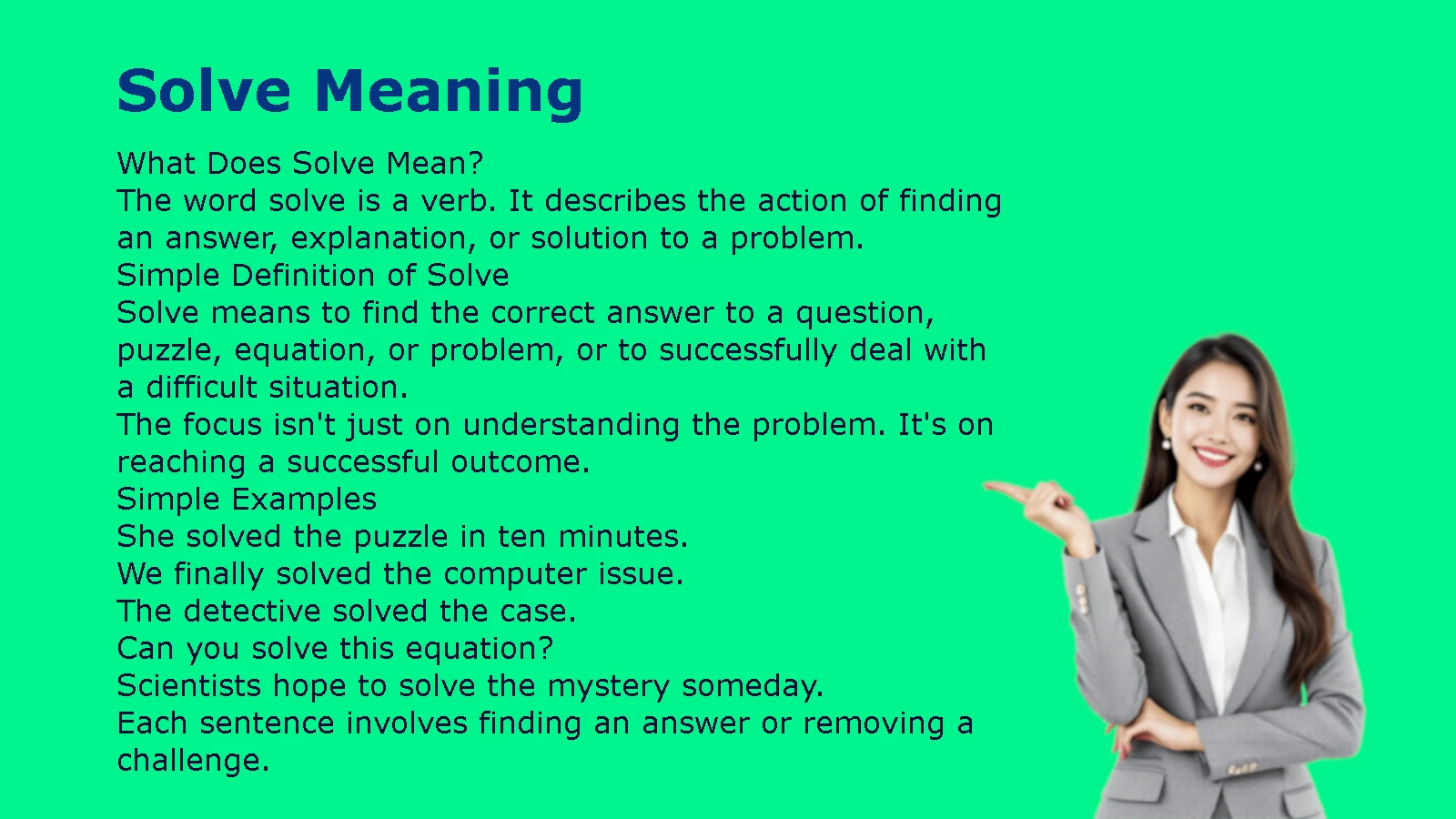
Solve means to find the correct answer to a question, puzzle, equation, or problem, or to successfully deal with a difficult situation.
The focus isn’t just on understanding the problem. It’s on reaching a successful outcome.
Simple Examples
- She solved the puzzle in ten minutes.
- We finally solved the computer issue.
- The detective solved the case.
- Can you solve this equation?
- Scientists hope to solve the mystery someday.
Each sentence involves finding an answer or removing a challenge.
Pronunciation
Solve
IPA (US): /sɑːlv/
It rhymes closely with resolve without the first syllable.
Part of Speech
| Form | Word |
| Verb | Solve |
| Third-person singular | Solves |
| Present participle | Solving |
| Past tense | Solved |
| Past participle | Solved |
Quick Facts About the Word “Solve”
| Feature | Information |
| Part of speech | Verb |
| Meaning | Find an answer or solution |
| Common contexts | Math, technology, science, business, daily life |
| Opposite idea | Complicate or create a problem |
| Related noun | Solution |
| Related adjective | Solvable |
Solve Meaning in Different Contexts
The meaning of solve stays consistent, but the type of problem changes depending on the situation.
Let’s look at the most common uses.
Solve Meaning in Everyday Life
Most people use solve when talking about everyday problems.
These problems don’t have to be complicated. They simply require a workable answer.
Examples
- We solved the parking problem by arriving earlier.
- She solved the scheduling conflict quickly.
- They solved their disagreement through honest conversation.
- He solved the issue before it became serious.
In daily life, solve often means finding a practical solution instead of a perfect one.
Common Everyday Problems You Can Solve
- Budget issues
- Relationship conflicts
- Time management
- Household repairs
- Transportation problems
- Planning events
- Communication misunderstandings
Solve Meaning in Mathematics
Math is one of the first places people encounter the word solve.
Here, solve means finding the correct value or answer using mathematical rules.
Examples
- Solve for x.
- Solve the equation.
- Solve the fraction.
- Solve the algebra problem.
- Solve the geometry question.
Example
Equation:
2x + 8 = 18
Subtract 8 from both sides.
2x = 10
Divide by 2.
x = 5
You have successfully solved the equation.
Common Math Problems You Solve
| Type | Example |
| Algebra | Solve for x |
| Geometry | Find missing angles |
| Calculus | Solve derivatives |
| Statistics | Solve probability questions |
| Arithmetic | Solve multiplication problems |
Solve Meaning in Science
Scientists solve questions by collecting evidence and testing ideas.
Unlike math, scientific problems don’t always have one clear answer. New discoveries often improve earlier solutions.
Examples
- Researchers solved the chemical reaction.
- Scientists solved part of the climate puzzle.
- The team hopes to solve the energy storage challenge.
Scientific solving usually involves:
- Observation
- Experimentation
- Analysis
- Testing
- Verification
Solve Meaning in Technology
Technology introduces new problems every day.
Software developers, engineers, and IT professionals spend much of their time solving issues.
Common Examples
- Solve a software bug.
- Solve a login error.
- Solve a network issue.
- Solve a server problem.
- Solve a security vulnerability.
Example
A website suddenly becomes slow.
Instead of restarting everything randomly, the developer checks the database, identifies inefficient queries, and optimizes them.
The performance problem is solved because the root cause was found and fixed.
Solve Meaning in Business
Businesses solve problems to improve efficiency, reduce costs, and satisfy customers.
Managers often use the word during meetings.
Examples
- We need to solve the supply chain issue.
- The company solved customer complaints faster.
- Our new strategy solved the inventory problem.
Business problems may involve:
- Customer service
- Sales
- Marketing
- Finance
- Human resources
- Production
Solve Meaning in Criminal Investigations
Police officers and detectives solve crimes by collecting evidence.
Here, solving means identifying exactly what happened and who was responsible.
Examples
- Detectives solved the robbery.
- Officers solved the cold case.
- Investigators solved the cybercrime.
Common expressions include:
- Solve a murder
- Solve a crime
- Solve a mystery
- Solve a case
Solve Meaning in Education
Teachers encourage students to solve problems instead of memorizing answers.
This approach builds critical thinking.
Students commonly solve:
- Homework questions
- Logic puzzles
- Science experiments
- Word problems
- Reading comprehension tasks
Solve Meaning in Personal Development
Many self-help books discuss solving personal challenges.
Examples include:
- Solving bad habits
- Solving communication problems
- Solving financial stress
- Solving career obstacles
The emphasis is on taking action rather than simply recognizing the issue.
Examples of “Solve” in Sentences
Seeing a word in context makes it easier to remember.
Everyday Examples
- I finally solved the problem with my phone.
- She solved the misunderstanding by explaining everything.
- We solved the issue together.
- They solved the traffic problem by leaving earlier.
- You solved it much faster than I expected.
Academic Examples
- The students solved every question correctly.
- She solved the algebra equation in five minutes.
- The teacher explained how to solve complex fractions.
- He solved the chemistry problem without help.
- Our class solved the puzzle as a team.
Business Examples
- Our team solved the customer’s issue immediately.
- The manager solved the scheduling conflict.
- We solved the production delay.
- They solved the budgeting problem before launch.
- The company solved several operational challenges this year.
Technology Examples
- The update solved the software bug.
- Engineers solved the server outage overnight.
- The technician solved the internet connection problem.
- Developers solved the security flaw.
- Restarting the router solved the issue.
Law Enforcement Examples
- The detective solved the mystery.
- Police solved the robbery after reviewing surveillance footage.
- Investigators solved the case using DNA evidence.
- The task force solved several crimes this month.
- The officer solved the fraud investigation.
Conversation Examples
Person A: How did the meeting go?
Person B: We solved the biggest issue and agreed on a plan.
When to Use “Solve”
Use solve when you successfully find an answer or overcome a challenge.
The word works best when the focus is on reaching a solution.
Use “Solve” With These Nouns
| Correct Combination | Example |
| Solve a problem | We solved the problem quickly. |
| Solve an equation | She solved the equation easily. |
| Solve a mystery | Detectives solved the mystery. |
| Solve a puzzle | The child solved the puzzle. |
| Solve a conflict | They solved the conflict peacefully. |
| Solve an issue | Our support team solved the issue. |
| Solve a case | Police solved the case. |
| Solve an error | Engineers solved the error. |
| Solve a challenge | We solved the challenge together. |
| Solve a dispute | Lawyers solved the dispute through mediation. |
Situations Where “Solve” Sounds Natural
You can naturally use solve when discussing:
- Math
- Science
- Engineering
- Technology
- Crime investigations
- Workplace challenges
- Family disagreements
- Financial problems
- Research
- Logical reasoning
Helpful Tip
Ask yourself one question:
“Am I finding an answer or removing a problem?”
If the answer is yes, solve is probably the right word.
When Not to Use “Solve”
Although solve is versatile, it doesn’t fit every situation.
Sometimes another verb sounds more natural.
Don’t Use “Solve” When You Mean “Answer”
Incorrect:
❌ I solved your question.
Correct:
✅ I answered your question.
Questions receive answers.
Problems receive solutions.
Don’t Use “Solve” for Repairs
Incorrect:
❌ I solved my broken bicycle.
Correct:
✅ I fixed my bicycle.
Physical objects usually need to be fixed, repaired, or replaced.
Don’t Use “Solve” for Completing Tasks
Incorrect:
❌ I solved my homework.
Correct:
✅ I finished my homework.
However, you can say:
✅ I solved the math problems in my homework.
Don’t Use “Solve” When Giving Information
Incorrect:
❌ She solved my email.
Correct:
✅ She replied to my email.
Common Mistakes
| Incorrect | Correct |
| Solve a question | Answer a question |
| Solve a phone | Fix a phone |
| Solve homework | Finish homework |
| Solve an email | Reply to an email |
| Solve a person | Help a person |
Solve vs. Fix
These words seem similar, but they aren’t interchangeable.
| Feature | Solve | Fix |
| Main meaning | Find a solution | Repair something |
| Common use | Problems, equations, mysteries | Broken objects, machines, software |
| Focus | Thinking and resolving | Repairing or correcting |
| Can involve physical repair | Sometimes | Usually |
Examples
✅ We solved the scheduling problem.
✅ I fixed the broken chair.
Notice that the same situation may involve both words.
For example, a software update fixes the broken code and solves the user’s problem.
Quick Comparison
Imagine your car won’t start.
- The mechanic fixes the engine.
- The repair solves your transportation problem.
One action repairs the object. The other removes the overall difficulty.
Solve vs. Resolve
These verbs are closely related, yet they differ in tone.
| Feature | Solve | Resolve |
| Tone | Everyday | More formal |
| Common use | Problems, math, puzzles | Disputes, conflicts, legal matters |
| Frequency | Very common | Common in professional writing |
Examples
Solve:
- We solved the issue yesterday.
- She solved the equation.
Resolve:
- The companies resolved their dispute.
- Both sides resolved the conflict peacefully.
Which One Should You Choose?
Choose solve for everyday conversations.
Choose resolve when discussing:
- Legal matters
- Business negotiations
- Customer complaints
- Formal reports
- Workplace conflicts
Both words suggest a successful outcome, but resolve often emphasizes reaching an agreement rather than simply finding an answer.
Solve vs. Answer
People often confuse these verbs.
Here’s an easy way to remember the difference.
| Solve | Answer |
| Used for problems | Used for questions |
| Used for puzzles | Used for emails |
| Used for mysteries | Used for phone calls |
| Used for equations | Used for interviews |
Examples
✅ She answered the interview question.
✅ She solved the math problem.
❌ He solved the phone.
A good memory trick is this:
Questions are answered. Problems are solved.
Solve vs. Figure Out
These expressions have similar meanings, but they sound different.
| Solve | Figure Out |
| More direct | More conversational |
| Common in writing | Common in speech |
| Often used in education | Often used in daily conversation |
Examples
Solve:
- We solved the problem.
Figure out:
- We finally figured out what caused the problem.
Sometimes both work.
- We solved the mystery.
- We figured out the mystery.
However, figure out usually emphasizes the thinking process, while solve highlights the successful result.
For example:
- After hours of testing, the engineers figured out why the system kept crashing.
- Once they updated the faulty code, they solved the problem.
Synonyms of Solve
The word solve has many synonyms, but they don’t all mean exactly the same thing. The best choice depends on the situation. For example, you can solve a puzzle, resolve a dispute, fix a broken chair, or decipher a coded message.
Using the right synonym makes your writing clearer and more natural.
Common Synonyms of Solve
| Synonym | Meaning | Best Used For | Example |
| Resolve | Settle successfully | Conflicts, disputes | We resolved the disagreement peacefully. |
| Fix | Repair something | Machines, software, devices | The technician fixed my laptop. |
| Figure out | Discover the answer | Everyday conversations | I finally figured out the problem. |
| Work out | Find a solution | Plans, calculations | We worked out a better schedule. |
| Answer | Respond correctly | Questions, quizzes | She answered every question correctly. |
| Decipher | Interpret hidden meaning | Codes, handwriting | They deciphered the ancient inscription. |
| Crack | Solve something difficult | Mysteries, puzzles | Detectives cracked the case. |
| Unravel | Discover the truth | Mysteries, investigations | Reporters unraveled the fraud. |
| Determine | Find through research | Science, analysis | Scientists determined the cause. |
| Explain | Make something clear | Concepts, ideas | The teacher explained the formula. |
Formal Synonyms
Formal writing often uses more precise alternatives.
- Resolve
- Determine
- Clarify
- Identify
- Establish
- Analyze
- Verify
- Eliminate
- Rectify (for correcting errors)
- Diagnose (especially in medicine and technology)
Example
Informal:
We solved the issue.
Formal:
The engineering team identified the root cause and resolved the issue.
Informal Synonyms
Everyday conversations usually favor these expressions.
- Figure out
- Work out
- Crack
- Sort out
- Get to the bottom of
- Piece together
Examples
- I finally figured it out.
- We’ll sort it out tomorrow.
- She cracked the puzzle in minutes.
Context-Based Synonyms
Choosing the right synonym depends on what you’re talking about.
| Context | Better Word |
| Mathematics | Solve |
| Computer repair | Fix |
| Legal dispute | Resolve |
| Mystery | Crack |
| Secret code | Decipher |
| Scientific research | Determine |
| Customer complaint | Resolve |
| Puzzle | Solve |
| Technical troubleshooting | Diagnose |
| Investigation | Unravel |
Antonyms of Solve
An antonym expresses the opposite idea.
Since solve means finding an answer or solution, its opposites involve creating, worsening, or failing to resolve a problem.
| Antonym | Meaning | Example |
| Complicate | Make more difficult | The new rules complicated the process. |
| Confuse | Make unclear | His explanation confused everyone. |
| Worsen | Become more serious | The delay worsened the problem. |
| Ignore | Refuse to deal with | They ignored the warning signs. |
| Create | Bring into existence | Poor planning created more issues. |
| Misunderstand | Interpret incorrectly | She misunderstood the instructions. |
| Obscure | Hide or make unclear | Missing data obscured the facts. |
Common Collocations with “Solve”
A collocation is a natural combination of words that native speakers frequently use together.
Learning collocations helps you sound fluent because these word pairs appear in books, news articles, workplaces, and everyday conversations.
| Collocation | Example Sentence |
| Solve a problem | We solved the problem before lunch. |
| Solve an equation | She solved the equation correctly. |
| Solve a puzzle | My brother solved the crossword. |
| Solve a mystery | Detectives solved the mystery quickly. |
| Solve a crime | Police solved the robbery. |
| Solve a case | The investigators solved the case. |
| Solve an issue | Customer support solved my issue. |
| Solve a conflict | The manager solved the conflict professionally. |
| Solve a dispute | Both companies solved the dispute peacefully. |
| Solve an error | Engineers solved the coding error. |
| Solve a challenge | The team solved every challenge. |
| Solve a dilemma | We solved the hiring dilemma together. |
| Solve a shortage | The company solved the supply shortage. |
| Solve a crisis | Strong leadership solved the crisis. |
| Solve a bottleneck | Automation solved the production bottleneck. |
Most Common Verbs That Appear with “Solve”
You’ll often see these patterns in English.
- Try to solve
- Help solve
- Learn to solve
- Successfully solve
- Quickly solve
- Completely solve
- Finally solve
- Easily solve
Examples
- We finally solved the mystery.
- The software helps solve scheduling problems.
- Students learn to solve equations in algebra.
Phrasal and Related Expressions
Although solve itself isn’t a phrasal verb, it appears in several common expressions and related terms.
Solve for
This phrase appears almost exclusively in mathematics.
Example
Solve for x.
Here, you’re finding the value of an unknown variable.
Problem-Solving
Problem-solving is a noun that describes the process of finding solutions.
Examples
- Problem-solving skills are valuable in every career.
- Good leaders encourage creative problem-solving.
Solver
A solver is someone or something that solves problems.
Examples include:
- Puzzle solver
- Problem solver
- Equation solver
- Sudoku solver
Computer software can also be called a solver if it automatically finds answers.
Solvable
Solvable is an adjective.
It means a problem has a solution.
Examples
- The issue is solvable.
- Every equation in the test was solvable.
Unsolved
This adjective describes something that hasn’t been solved.
Examples
- An unsolved mystery
- An unsolved crime
- An unsolved mathematical problem
Solved
Solved can function as both a verb and an adjective.
Examples
Verb:
- We solved the problem yesterday.
Adjective:
- The case is solved.
Solving
This form describes the ongoing action.
Examples
- Solving puzzles improves logical thinking.
- She enjoys solving difficult riddles.
Idioms and Expressions Related to Solving Problems
English contains many colorful expressions that relate to solving challenges.
Although these idioms don’t always include the word solve, they express the same general idea.
| Idiom | Meaning | Example |
| Crack the code | Discover the answer | Scientists finally cracked the code. |
| Get to the bottom of it | Find the real cause | We’ll get to the bottom of the issue. |
| Piece it together | Understand gradually | Detectives pieced together the evidence. |
| Connect the dots | Recognize relationships | Investors connected the dots quickly. |
| Think outside the box | Find creative solutions | We solved it by thinking outside the box. |
| Break the deadlock | End a disagreement | The mediator broke the deadlock. |
| Turn things around | Improve a difficult situation | The new manager turned things around. |
Real-Life Example
Imagine your internet keeps disconnecting.
You could say:
- I figured out the cause.
- I got to the bottom of the issue.
- The technician fixed the router.
- That solved the problem.
Each expression highlights a different stage of reaching the solution.
Common Mistakes with “Solve”
Many English learners make the same mistakes when using solve.
Knowing these errors helps you avoid awkward sentences.
Using “Solve” Instead of “Answer”
❌ She solved my question.
✅ She answered my question.
Remember:
- Questions are answered.
- Problems are solved.
Using “Solve” with Physical Objects
❌ I solved my computer.
✅ I fixed my computer.
You solve the problem, not the object itself.
Using “Solve” for Homework
❌ I solved my homework.
✅ I finished my homework.
However:
✅ I solved every math problem in my homework.
Confusing “Solve” and “Resolve”
Both words can fit many situations.
However, resolve sounds more formal.
Compare these examples.
Casual:
We solved the issue.
Formal:
We resolved the contractual dispute.
Incorrect Verb Forms
Incorrect:
❌ He solve the equation.
Correct:
✅ He solves the equation.
Incorrect:
❌ She has solve the problem.
Correct:
✅ She has solved the problem.
Wrong Prepositions
Incorrect:
❌ Solve about the issue.
Correct:
✅ Solve the issue.
Incorrect:
❌ Solve on the problem.
Correct:
✅ Solve the problem.
The verb solve usually takes a direct object without a preposition.
Grammar Guide for “Solve”
Understanding the grammar behind solve makes it easier to use confidently in speech and writing.
Is “Solve” a Regular or Irregular Verb?
Solve is an irregular verb.
Unlike regular verbs that simply add -ed to form the past tense, solve changes spelling slightly before adding the ending.
| Base Form | Past Tense | Past Participle |
| Solve | Solved | Solved |
Although the forms appear regular today, solve is traditionally classified as an irregular verb because of its historical development from Latin through Old French into English.
Verb Forms
| Tense | Example |
| Base | Solve the problem. |
| Present | She solves problems quickly. |
| Past | We solved it yesterday. |
| Present Continuous | They are solving the issue. |
| Present Perfect | I have solved the equation. |
| Past Perfect | She had solved it before class. |
| Future | We will solve the challenge tomorrow. |
Third-Person Singular
The third-person singular form is:
Solves
Examples:
- She solves puzzles every weekend.
- He solves customer complaints professionally.
- The software solves common security issues.
Present Participle
The present participle is:
Solving
Examples:
- Solving problems builds confidence.
- She enjoys solving logic puzzles.
Past Tense
The past tense is:
Solved
Examples:
- They solved the mystery yesterday.
- We solved the issue before lunch.
Past Participle
The past participle is also:
Solved
Examples:
- The problem has been solved.
- Every question was solved correctly.
Word Family of “Solve”
Words in the same family share a common root but serve different grammatical purposes.
| Word | Part of Speech | Meaning |
| Solve | Verb | Find an answer or solution |
| Solution | Noun | The answer to a problem |
| Solver | Noun | A person or tool that solves |
| Solving | Gerund/Participle | The act of finding solutions |
| Solvable | Adjective | Able to be solved |
| Solved | Adjective | Already resolved |
| Unsolved | Adjective | Not yet resolved |
| Insoluble | Adjective | Impossible or extremely difficult to solve |
Examples
- Every difficult problem has a solution.
- She’s an excellent problem solver.
- This puzzle is solvable.
- The mystery remains unsolved.
- The debate reached an insoluble deadlock.
Etymology of “Solve”
The history of a word often explains why it carries its current meaning.
The English verb solve comes from the Latin word solvere, which meant to loosen, release, untie, or set free.
Over time, the meaning shifted from physically loosening something to mentally “untangling” a problem or difficulty. By the late Middle Ages, English speakers commonly used solve to describe finding answers to mathematical questions, logical puzzles, and complex situations.
Today, that core idea remains the same. When you solve a problem, you “untie the knot” and remove the obstacle that stood in your way.
This origin also explains related English words such as:
- Solution
- Dissolve
- Absolute (through the same Latin root family)
- Resolution (a related concept through Latin resolvere)
Frequently Asked Questions About Solve Meaning
What does solve mean in simple words?
Solve means to find the correct answer to a problem or discover a successful way to deal with a difficult situation. You can solve a math equation, a puzzle, a mystery, or a real-life challenge.
Example
- We solved the problem by working together.
- She solved the crossword in fifteen minutes.
Is solve only used in mathematics?
No. Although solve is common in math, people use it in many other situations.
For example, you can solve:
- Business problems
- Computer errors
- Scientific questions
- Criminal investigations
- Family disagreements
- Technical issues
- Logic puzzles
- Financial challenges
The word always suggests reaching a successful solution.
What is the difference between solve and resolve?
Both words involve finding a solution, but they aren’t always interchangeable.
- Solve is more common in everyday English.
- Resolve sounds more formal and often refers to disputes, conflicts, or official matters.
Examples
Solve
- We solved the software problem.
- She solved the equation.
Resolve
- The company resolved the customer complaint.
- Both countries resolved the trade dispute.
What is the difference between solve and fix?
The difference is simple.
- Solve means finding a solution to a problem.
- Fix means repairing something that’s broken.
Examples
- The mechanic fixed the engine.
- That repair solved our transportation problem.
Sometimes both words describe the same situation from different perspectives.
What is the noun form of solve?
The noun form is solution.
Examples
- We finally found the solution.
- Her solution saved the company time and money.
Other related nouns include:
- Solver
- Problem-solving
What is the adjective form of solve?
Several adjectives come from solve.
| Adjective | Meaning |
| Solved | Already resolved |
| Solvable | Able to be solved |
| Unsolved | Not yet solved |
| Insoluble | Impossible or extremely difficult to solve |
Examples
- The case remains unsolved.
- Every solvable problem deserves careful attention.
- The issue has already been solved.
What is the opposite of solve?
There isn’t one exact opposite, but several words express the opposite idea depending on the context.
Common antonyms include:
- Complicate
- Confuse
- Ignore
- Worsen
- Create (a problem)
- Misunderstand
Example
Instead of solving the issue, the new policy complicated it.
How do you use solve in a sentence?
Here are a few natural examples.
Everyday Life
- We solved the scheduling conflict quickly.
- She solved the internet problem herself.
School
- Every student solved the equation correctly.
- I solved the science worksheet before lunch.
Business
- Our team solved the customer’s complaint within an hour.
- The new software solved several workflow issues.
Technology
- Updating the driver solved the error.
- Engineers solved the performance problem through optimization.
Can you use solve with people?
Usually, no.
You solve problems, not people.
Incorrect
❌ I solved my friend.
Correct
✅ I helped my friend solve the problem.
The focus stays on the issue rather than the person.
What types of problems can you solve?
You can solve almost any challenge that has a clear answer or workable solution.
Examples include:
- Math equations
- Crossword puzzles
- Computer bugs
- Customer complaints
- Business challenges
- Engineering problems
- Scientific questions
- Financial issues
- Communication problems
- Criminal investigations
Is solve a regular or irregular verb?
The verb forms are straightforward:
- Base form: Solve
- Third-person singular: Solves
- Present participle: Solving
- Past tense: Solved
- Past participle: Solved
Examples
- She solves difficult puzzles every weekend.
- We solved the issue yesterday.
- They have solved every challenge so far.
Key Takeaways
The word solve is one of the most useful verbs in English because it applies to countless situations. From classrooms and workplaces to scientific research and everyday conversations, it describes the process of finding answers and overcoming challenges.
Here are the main points to remember:
- Solve means to find the answer to a problem or discover a successful solution.
- It is a verb commonly used in mathematics, technology, science, business, law enforcement, and daily life.
- The most common verb forms are solve, solves, solving, and solved.
- Questions are answered, while problems are solved.
- Fix usually refers to repairing something physical, while solve focuses on removing the underlying problem.
- Resolve is a more formal alternative often used in legal, business, and professional settings.
- Common collocations include solve a problem, solve an equation, solve a mystery, solve a dispute, and solve an issue.
- Related words include solution, solver, solvable, solved, and unsolved.
- The word traces back to the Latin solvere, meaning to loosen or untie, which explains why solving a problem is often described as “untangling” a difficult situation.
Conclusion
Understanding the solve meaning goes beyond memorizing a dictionary definition. The word represents one of the most important actions in communication: finding answers, overcoming obstacles, and turning challenges into opportunities.
You can solve a difficult equation, solve a software bug, solve a mystery, or solve a disagreement. In every case, the goal remains the same—identify the problem, understand its cause, and reach a successful outcome.
As your English vocabulary grows, learning when to use solve, resolve, fix, answer, and figure out will make your writing and conversations more precise. Instead of relying on one verb for every situation, you’ll choose the word that best matches the context.
The next time you encounter the word solve, you’ll recognize that it isn’t limited to mathematics. It’s a versatile verb that plays a central role in everyday communication, professional writing, education, science, technology, and countless real-world situations. Mastering its meaning and usage will help you express ideas with greater confidence and accuracy.