
Have you ever read something several times but still struggled to understand what it really means? That’s where the Comprehend Meaning comes in. While comprehend may sound like a formal word, it simply describes the ability to understand something clearly, especially an idea, message, or piece of information.
Comprehend is a verb that means to understand something fully or clearly. It is often used when talking about understanding information, ideas, situations, or concepts that may be difficult to grasp.
Examples:
- I couldn’t comprehend how quickly everything changed.
- She comprehended the lesson after the teacher explained it again.
The confusion is understandable. People often search for what does comprehend mean, comprehend meaning in English, comprehend meaning in text, or how to use comprehend in a sentence because the word can sound more complicated than it really is. And here’s the kicker: comprehend usually suggests more than simply hearing or reading something. It means actually understanding it.
In this guide, you’ll learn the complete Comprehend Meaning, including its definition, pronunciation, part of speech, correct usage, and examples in sentences. You’ll also discover common synonyms for comprehend, how to use it in everyday and formal writing, and the difference between comprehend, understand, and other similar words.
What Does Comprehend Mean?
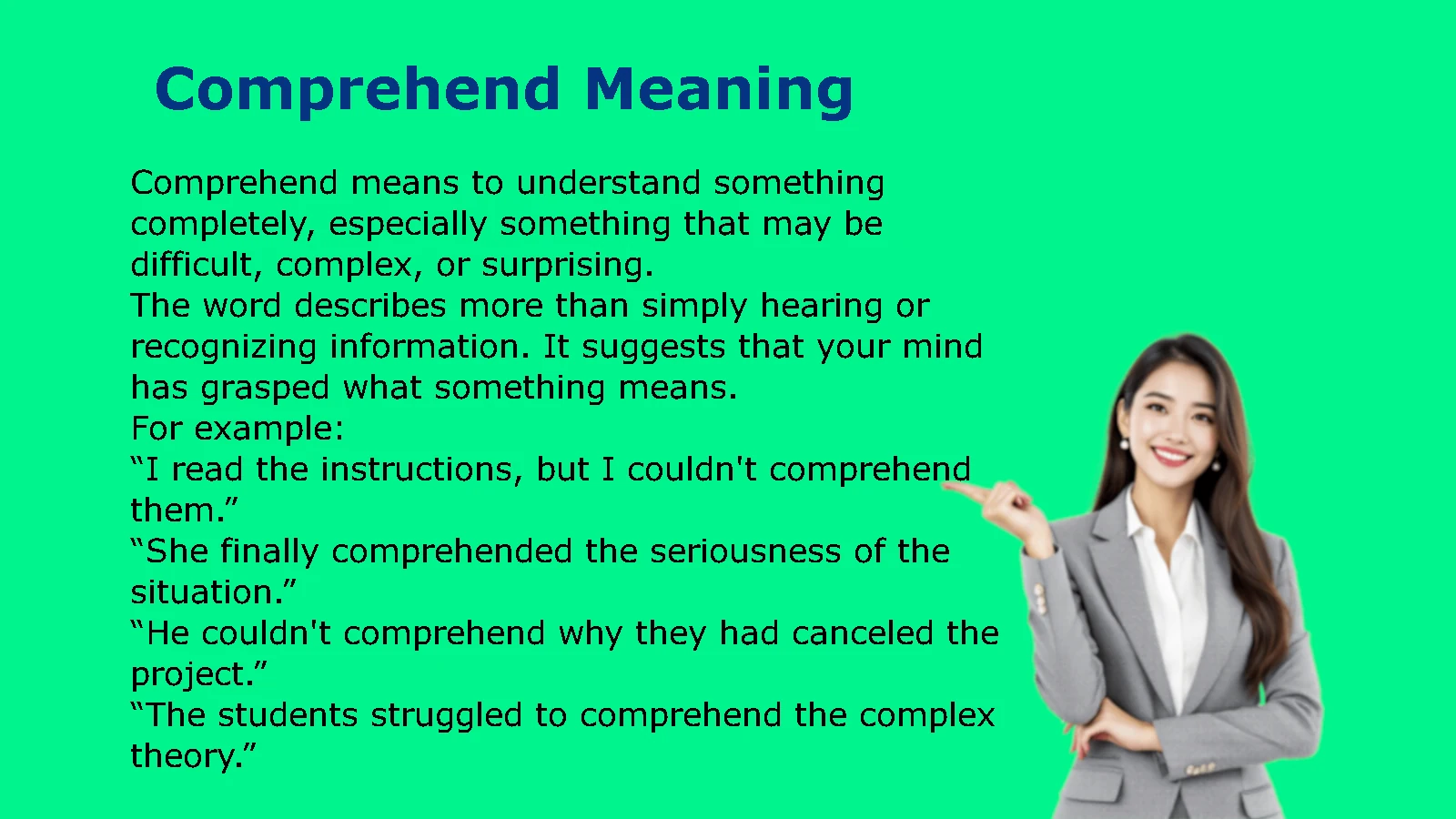
Comprehend means to understand something completely, especially something that may be difficult, complex, or surprising.
The word describes more than simply hearing or recognizing information. It suggests that your mind has grasped what something means.
For example:
- “I read the instructions, but I couldn’t comprehend them.”
- “She finally comprehended the seriousness of the situation.”
- “He couldn’t comprehend why they had canceled the project.”
- “The students struggled to comprehend the complex theory.”
In each example, the person needs to mentally grasp information, an idea, a reason, or a situation.
Cambridge gives examples such as someone failing to comprehend another person’s attitude or failing to comprehend the scale of a problem. It also shows that comprehend can be followed by question words such as why and clauses beginning with that.
Simple Definition of Comprehend
In very simple English:
Comprehend = understand fully.
You can think of it this way:
Hear something → process it → understand what it means → comprehend it fully
For example, imagine someone explains a complicated math problem. You hear every word, but the explanation still doesn’t make sense. You haven’t fully comprehended the problem.
Once the pieces click into place, you can say:
“Now I comprehend it.”
In everyday conversation, however, most people would simply say:
“Now I understand it.”
What Does Comprehend Mean in Simple English?
The easiest way to explain comprehend meaning is to use the idea of grasping an idea.
If you comprehend something, you understand what it means, how it works, or why it matters.
Consider these examples:
- I comprehend the instructions.
I understand the instructions. - She couldn’t comprehend the news.
She couldn’t fully understand or take in the news. - He comprehended the danger.
He understood how serious the danger was. - They comprehended the main idea.
They understood the central point.
So, when someone says, “I can’t comprehend this,” they usually mean that something is too difficult, confusing, unexpected, or significant for them to fully understand.
Comprehend Pronunciation
In US English, comprehend is pronounced:
/ˌkɑːm.prəˈhend/
An easier pronunciation guide is:
kom-pruh-HEND
The main stress falls on HEND.
How to Pronounce Comprehend
Break the word into three parts:
- com
- pre
- hend
Say it naturally as:
kom-pruh-HEND
The final syllable receives the strongest emphasis.
Cambridge lists the US pronunciation as /ˌkɑːm.prəˈhend/.
Is Comprehend a Verb?
Yes. Comprehend is a verb.
A verb describes an action, state, or process. In this case, comprehend describes the mental process of understanding something.
Here are the main forms:
| Form | Example |
| Comprehend | I comprehend the problem. |
| Comprehends | She comprehends the risks. |
| Comprehended | He comprehended the situation. |
| Comprehending | They are capable of comprehending the idea. |
The past tense and past participle are both comprehended.
Examples of Comprehend as a Verb
- “Do you comprehend the instructions?”
- “She comprehends the basic concept.”
- “He comprehended the consequences too late.”
- “The child was too young to comprehend what was happening.”
Notice that comprehend normally connects directly to the thing being understood.
You would say:
“I comprehend the problem.”
Not:
“I comprehend about the problem.”
That distinction matters because comprehend already means understand. It doesn’t need about before its object.
How to Use Comprehend in a Sentence
Comprehend works best when you want to describe full or meaningful understanding. It commonly appears before a noun, a question clause, or a that clause.
Comprehend Something
This is one of the simplest patterns:
comprehend + noun
Examples:
- “I couldn’t comprehend the instructions.”
- “She comprehended the importance of the meeting.”
- “They struggled to comprehend the new system.”
- “He couldn’t comprehend the scale of the disaster.”
This structure works especially well when the object represents an idea, problem, situation, instruction, or fact.
Comprehend What Something Means
You can use comprehend before a clause beginning with what.
Examples:
- “I couldn’t comprehend what he was saying.”
- “She finally comprehended what the message meant.”
- “They couldn’t comprehend what had happened.”
- “He struggled to comprehend what the results showed.”
This structure lets you describe a more specific piece of information.
Comprehend Why Something Happened
Another natural pattern uses why.
Examples:
- “I can’t comprehend why she left.”
- “He couldn’t comprehend why the plan failed.”
- “They struggled to comprehend why the results changed.”
- “She couldn’t comprehend why anyone would make that decision.”
This construction often appears when an event seems confusing, unreasonable, or surprising.
Comprehend How Something Works
You can also use how to talk about understanding a process or mechanism.
Examples:
- “I couldn’t comprehend how the machine worked.”
- “The students eventually comprehended how the system operated.”
- “She couldn’t comprehend how the mistake had happened.”
Comprehend That Something Is True
Another useful structure is:
comprehend + that clause
Examples:
- “He couldn’t comprehend that the project was over.”
- “She finally comprehended that her decision had consequences.”
- “They struggled to comprehend that the opportunity was gone.”
This pattern often emphasizes the difficulty of accepting or mentally grasping a fact.
Comprehend Examples
Seeing the word in different situations makes its meaning much easier to understand.
| Sentence | What comprehend means here |
| I couldn’t comprehend the instructions. | I couldn’t fully understand them. |
| She comprehended the seriousness of the situation. | She understood how serious it was. |
| He couldn’t comprehend what had happened. | He couldn’t make full sense of the event. |
| We finally comprehended the main idea. | We finally understood the central point. |
| They struggled to comprehend the theory. | They found the theory difficult to understand. |
| I can’t comprehend why he reacted that way. | I can’t understand his reason for reacting that way. |
| She couldn’t comprehend the scale of the problem. | She couldn’t fully grasp how large or serious it was. |
| The child was too young to comprehend the situation. | The child was not mature enough to understand it fully. |
| He comprehended the risks before investing. | He understood the risks before making the decision. |
| The reader should be able to comprehend the explanation. | The reader should be able to understand it. |
Comprehend Examples in School
In education, comprehend often relates to reading, instructions, concepts, and information.
For example:
“Students must comprehend the main idea before answering the questions.”
Another example:
“The teacher explained the concept again because several students couldn’t comprehend it.”
This connects to reading comprehension, which refers to the ability to understand written material. Cambridge defines comprehension as the ability to understand something completely and also uses the term for tests that measure how well students understand written or spoken language.
Comprehend Examples at Work
The word can also fit professional situations:
- “The team needs to comprehend the financial impact before making a decision.”
- “She couldn’t comprehend the reason for the sudden change.”
- “Managers must comprehend the risks involved.”
- “The report helps readers comprehend the company’s strategy.”
However, in a casual workplace conversation, understand will often sound more natural:
“Do you understand the new process?”
rather than:
“Do you comprehend the new process?”
The second sentence isn’t necessarily wrong. It simply sounds more formal.
Comprehend Synonyms
The best synonym for comprehend is usually understand.
Other related words include:
- Understand
- Grasp
- Appreciate
- Recognize
- Realize
- Perceive
- Follow
- Decipher
- Take in
- Make sense of
These words overlap, but they aren’t perfect substitutes in every sentence.
Cambridge’s thesaurus groups understand, comprehend, follow, grasp, and digest among words used for understanding.
Comprehend vs Grasp
Grasp often suggests mentally getting hold of an idea.
Compare:
“I comprehended the concept.”
and:
“I grasped the concept.”
Both sentences mean that you understood the idea. Grasp can sound a little more natural when talking about an abstract idea or a difficult concept.
For example:
“It took me several minutes to grasp the basic principle.”
You could also say:
“It took me several minutes to comprehend the basic principle.”
Both work, although grasp often feels more conversational.
Comprehend vs Appreciate
Appreciate can mean understanding the importance, value, or seriousness of something.
For example:
“She appreciated the difficulty of the situation.”
This doesn’t simply mean that she understood the words. It suggests that she recognized the situation’s significance.
By contrast:
“She comprehended the explanation.”
focuses more directly on understanding.
Comprehend vs Realize
Realize usually means becoming aware of a fact or recognizing something.
For example:
“I realized that I had made a mistake.”
This describes a moment of awareness.
Comprehend emphasizes understanding:
“I couldn’t comprehend how I had made such a serious mistake.”
The two can overlap, but they focus on different parts of the mental process.
Comprehend vs Understand
The difference between comprehend and understand is mostly about usage, tone, and emphasis.
Both words can describe knowing the meaning of something. Cambridge defines understand in several ways, including knowing the meaning of something someone says and knowing why or how something happens.
| Comprehend | Understand |
| More formal | More common in everyday speech |
| Often emphasizes full understanding | Has a very broad range of meanings |
| Common with difficult or complex ideas | Works in casual and formal situations |
| Can sound serious or emphatic | Usually sounds natural and neutral |
| “I can’t comprehend the scale of it.” | “I can’t understand how big it is.” |
Are Comprehend and Understand the Same?
Often, yes.
In many sentences, you can replace one with the other without changing the basic meaning.
For example:
“I don’t comprehend the instructions.”
and:
“I don’t understand the instructions.”
Both tell the reader that the instructions aren’t clear to the speaker.
The difference is mainly one of tone and emphasis.
Understand is the everyday workhorse. It fits almost anywhere.
Comprehend is more formal and can emphasize the idea of fully grasping something.
Think of the difference like this:
Understand is the everyday tool you reach for first.
Comprehend is the heavier tool you might choose when the idea is complicated, surprising, or difficult to grasp.
Is Comprehend a Formal Word?
Yes. Comprehend is generally considered a formal word.
Cambridge explicitly labels it formal.
That doesn’t mean you should avoid it. It simply means that understand will usually sound more natural in casual speech.
Formal Example
“The committee could not comprehend the full implications of the decision.”
More Natural Everyday Version
“The committee couldn’t understand the full impact of the decision.”
Both are grammatically correct. The first sounds more formal and deliberate.
Where Comprehend Works Well
You may see comprehend in:
- Academic writing
- Formal reports
- Serious discussions
- Educational materials
- Explanations of complex ideas
- News and analytical writing
- Discussions involving large-scale or difficult situations
Where Understand Usually Works Better
Use understand when talking casually with friends, family, coworkers, or classmates.
For example:
“Do you understand what I’m saying?”
sounds much more natural than:
“Do you comprehend what I’m saying?”
The second version can sound unusually formal or even dramatic.
Common Phrases With Comprehend
Certain sentence patterns occur naturally with this verb.
Comprehend Something
“She couldn’t comprehend the problem.”
This is the most basic pattern.
Comprehend What…
“I can’t comprehend what he means.”
This pattern focuses on a specific message or situation.
Comprehend Why…
“They couldn’t comprehend why the decision had been made.”
This often appears when the reason behind an event seems difficult to understand.
Comprehend How…
“He couldn’t comprehend how the system had failed.”
This works well when discussing processes or causes.
Comprehend That…
“She couldn’t comprehend that everything had changed.”
This structure emphasizes understanding a fact or reality.
Fail to Comprehend
Fail to comprehend is common in formal writing.
It means not to understand something fully.
For example:
“The report failed to explain the issue clearly, so many readers failed to comprehend its significance.”
Struggle to Comprehend
This phrase describes difficulty rather than complete failure.
“Students may struggle to comprehend complex scientific concepts without examples.”
Difficult to Comprehend
You can use the phrase to describe something that is hard to understand.
“The instructions were difficult to comprehend.”
Comprehend Antonyms
An antonym is a word with an opposite or contrasting meaning.
The clearest everyday antonym of comprehend is:
misunderstand
Other related opposites include:
- Misinterpret
- Miss
- Overlook
- Fail to understand
- Misread
- Confuse
Consider the difference:
“I comprehended the instructions.”
versus:
“I misunderstood the instructions.”
The first means you understood them. The second means you interpreted them incorrectly.
Comprehend vs Misunderstand
These two words create a particularly useful contrast.
| Word | Meaning | Example |
| Comprehend | Understand fully | I comprehended the instructions. |
| Misunderstand | Understand incorrectly | I misunderstood the instructions. |
| Misinterpret | Give something the wrong meaning | She misinterpreted his comment. |
| Overlook | Fail to notice something | He overlooked an important detail. |
Not every opposite works in every context. For example, overlook usually means failing to notice something rather than failing to understand it.
Comprehend Word Forms
Learning the related forms can make the word much easier to use correctly.
| Word | Part of Speech | Meaning |
| Comprehend | Verb | Understand fully |
| Comprehends | Verb | Understands fully |
| Comprehended | Verb | Understood fully |
| Comprehending | Verb form | Understanding |
| Comprehension | Noun | The ability or process of understanding |
| Comprehensible | Adjective | Able to be understood |
| Incomprehensible | Adjective | Impossible or extremely difficult to understand |
| Comprehensively | Adverb | In a complete or thorough way |
What Does Comprehension Mean?
Comprehension is the noun related to comprehend.
It means the ability to understand something.
For example:
“Her reading comprehension is excellent.”
It can also refer to a test designed to measure understanding:
“The students completed a reading comprehension exercise.”
Cambridge lists both meanings: general ability to understand and a test of how well students understand written or spoken language.
What Does Comprehensible Mean?
Comprehensible is an adjective meaning able to be understood.
For example:
“The teacher gave a clear and comprehensible explanation.”
Cambridge defines comprehensible as “able to be understood.”
The opposite is incomprehensible:
“The technical explanation was almost incomprehensible to beginners.”
Comprehend vs Comprehensive
These words look similar, but their meanings differ.
Comprehend means understand.
Comprehensive means covering many or all parts of something; complete or broad in scope.
Compare:
“I can’t comprehend the problem.”
Here, comprehend means understand.
“We need a comprehensive report.”
Here, comprehensive describes a report that covers the subject thoroughly.
Don’t treat these words as interchangeable.
Comprehend Meaning in Different Contexts
The word becomes easier to understand when you see how it behaves in different settings.
Comprehend in Education
Education provides one of the clearest examples.
Teachers often need students to comprehend information rather than simply memorize it.
For example:
“Students should comprehend the main argument before discussing the article.”
This distinction matters. A student might remember a definition without actually understanding the concept behind it.
Memorizing tells you what something says.
Comprehending means you understand what it means.
That is why the related noun comprehension appears frequently in reading and language education.
Comprehend in Everyday Conversation
You can use comprehend in ordinary conversation, but it can sound more formal than understand.
Imagine a friend says:
“I can’t comprehend why he would do that.”
This sounds perfectly understandable. It also conveys strong confusion or disbelief.
Still, a more casual version would be:
“I can’t understand why he would do that.”
The difference isn’t correctness. It’s tone.
Comprehend in Formal Writing
Formal writing often favors comprehend when discussing complex information.
For example:
“Readers must comprehend the relationship between the two variables before evaluating the results.”
The word works well because the subject involves an intellectual process.
You might also see it in serious discussions:
“It is difficult to comprehend the full scale of the economic impact.”
Here, comprehend adds weight to the sentence. The writer isn’t merely saying the subject is unfamiliar. The writer is emphasizing how difficult it is to fully grasp.
The Less Common Meaning of Comprehend
There is another meaning of comprehend, although it is much less common in modern everyday English.
In older or specialized usage, comprehend can mean to include, contain, or encompass something within a whole. Cambridge’s main modern definition focuses on understanding, while historical and specialized dictionary usage records the broader sense.
This meaning can be confusing because modern readers usually interpret comprehend as understand.
For everyday English, it’s safest to remember:
Comprehend = understand fully.
If you encounter the less common sense in older literature or specialized writing, the surrounding context will usually make the intended meaning clear.
Common Mistakes With Comprehend
A few simple mistakes can make sentences with comprehend sound unnatural.
Using Comprehend When Understand Sounds Better
The sentence may be grammatically correct but still feel overly formal.
For example:
“Do you comprehend what I’m telling you?”
This can sound stern or theatrical.
A more natural alternative is:
“Do you understand what I’m telling you?”
However, if you’re discussing a difficult subject, comprehend may fit perfectly:
“It took several hours to comprehend the full implications of the report.”
Adding “About” After Comprehend
Because comprehend already means understand, don’t normally add about before the object.
Incorrect or unnatural:
“I couldn’t comprehend about the problem.”
Better:
“I couldn’t comprehend the problem.”
Or:
“I couldn’t understand the problem.”
Confusing Comprehend With Comprehension
Remember the parts of speech:
- Comprehend = verb
- Comprehension = noun
Correct:
“Students need to comprehend the passage.”
Correct:
“Students need strong reading comprehension.”
Incorrect:
“Students need to comprehension the passage.”
Confusing Comprehend With Comprehensive
This is another common word family mix-up.
- Comprehend: understand
- Comprehension: understanding
- Comprehensible: able to be understood
- Incomprehensible: difficult or impossible to understand
- Comprehensive: broad and complete
Once you separate these meanings, the word family becomes much easier to remember.
Comprehend in the Past Tense
The past tense of comprehend is comprehended.
Examples:
- “She comprehended the problem immediately.”
- “He finally comprehended what the instructions meant.”
- “They comprehended the seriousness of the situation.”
- “I didn’t comprehend how difficult the task would be.”
The same form, comprehended, also works as the past participle.
For example:
“The full meaning had been comprehended by the research team.”
That sentence uses passive voice. In most cases, active voice sounds clearer:
“The research team had comprehended the full meaning.”
The active version puts the people doing the understanding at the center of the sentence.
A Practical Case Study: Comprehend vs Understand
Consider a student reading a difficult science article.
At first, the student reads every sentence but can’t explain the central argument. The student has read the article, but that doesn’t necessarily mean they have comprehended it.
After reviewing the key terms and examples, the student can explain:
- what the main idea is
- how the process works
- why the result occurred
- how the evidence supports the conclusion
At that point, the student has moved from simply encountering information to comprehending it.
In everyday speech, though, the student would probably say:
“Now I understand it.”
A teacher might say:
“You need to demonstrate comprehension of the passage.”
Both expressions point to the same basic mental ability. The second simply uses a more formal vocabulary choice.
Another Case Study: Understanding a Surprising Event
Imagine a company announces that a major project will end earlier than expected.
An employee might say:
“I understand that the project is ending.”
That sentence simply states awareness.
But consider:
“I can’t comprehend how the project could end so quickly.”
Now the speaker emphasizes difficulty in mentally grasping the situation.
This illustrates an important point about comprehend meaning: the word often carries a sense of full or complete understanding, especially when the subject seems complicated, surprising, or enormous.
Quick Comparison of Related Words
| Word | Core meaning | Example |
| Comprehend | Understand fully | I can’t comprehend the situation. |
| Understand | Know the meaning or reason | I understand the situation. |
| Grasp | Understand an idea | She grasped the main point. |
| Realize | Become aware of something | He realized his mistake. |
| Appreciate | Understand the value or significance | She appreciated the seriousness of the issue. |
| Interpret | Explain or assign meaning | He interpreted the message differently. |
| Decipher | Work out the meaning of something difficult to read or understand | She deciphered the handwritten note. |
These words overlap, but choosing the right one makes your writing more precise.
Frequently Asked Questions About Comprehend
What does comprehend mean?
Comprehend means to understand something completely or fully grasp its meaning. It is usually used as a verb and often appears in formal contexts.
What is a simple synonym for comprehend?
The simplest synonym is understand.
Depending on the context, you can also use grasp, appreciate, realize, follow, or take in.
Is comprehend the same as understand?
They often mean the same thing, but comprehend is generally more formal and can emphasize complete understanding.
For example:
“I understand the problem.”
is neutral and conversational.
“I comprehend the problem.”
sounds more formal.
Is comprehend a formal word?
Yes. Major dictionaries such as Cambridge label comprehend as formal.
It works well in academic, professional, and serious writing. In casual conversation, understand usually sounds more natural.
What is the opposite of comprehend?
The clearest everyday opposite is misunderstand.
Other contrasting words include misinterpret, overlook, and fail to understand, depending on the context.
What is the noun form of comprehend?
The main noun is comprehension.
For example:
“The test measures reading comprehension.”
What is the adjective form of comprehend?
The closely related adjective comprehensible means able to be understood.
Its opposite is incomprehensible, meaning extremely difficult or impossible to understand.
Can comprehend mean include?
Yes, but this is a less common meaning. In modern everyday English, comprehend overwhelmingly refers to understanding something.
If you encounter the “include” meaning, context will usually signal it.
Can you say “comprehend about”?
Usually, no.
Use:
“I comprehend the problem.”
not:
“I comprehend about the problem.”
If you want to use about, choose a different structure:
“I understand something about the problem.”
Is “I comprehend” natural English?
It is grammatically possible, but it can sound formal depending on the situation.
In everyday conversation, people usually say:
“I understand.”
In a formal discussion about a complicated subject, comprehend can sound perfectly appropriate.
Final Takeaway: Comprehend Meaning
The simplest way to remember the comprehend meaning is:
Comprehend means to understand something fully or grasp its meaning.
It is a verb and is generally more formal than understand. You can use it with nouns, what, why, how, and that clauses:
- “I couldn’t comprehend the instructions.”
- “She couldn’t comprehend what happened.”
- “He couldn’t comprehend why they left.”
- “They struggled to comprehend how the system worked.”
- “She finally comprehended that the situation had changed.”
The most useful synonym is understand, while grasp, realize, appreciate, and decipher can work in specific contexts.
The key distinction is simple: understand is the everyday choice. Comprehend often highlights deeper, fuller, or more difficult understanding.
Once you know that difference, the word becomes much easier to use naturally.