
Have you ever heard someone use the word “concede” and wondered exactly what they meant? While CONCEDE Meaning may seem a little formal, this word can have different meanings depending on the sentence, tone, and context in which it’s used.
Concede is a verb that means to admit that something is true, accept that you have lost, or give something to someone after first resisting it. It is often used when someone acknowledges a point, accepts defeat, or agrees to something reluctantly.
Examples:
- She conceded that he had a good point.
- The team conceded defeat after the final goal.
The confusion is understandable. People often search for what does concede mean, concede meaning in English, concede meaning in a sentence, or how to use concede correctly because the word can describe both admitting something and giving something up. And here’s the kicker: concede doesn’t always mean that you completely agree. Sometimes, it simply means you accept that someone else has a valid point.
In this guide, you’ll learn the complete CONCEDE Meaning, its definition, pronunciation, word forms, correct usage, and examples in sentences. You’ll also discover the difference between concede, admit, accept, and surrender, along with common phrases and practical examples to help you use concede correctly.
Concede Meaning
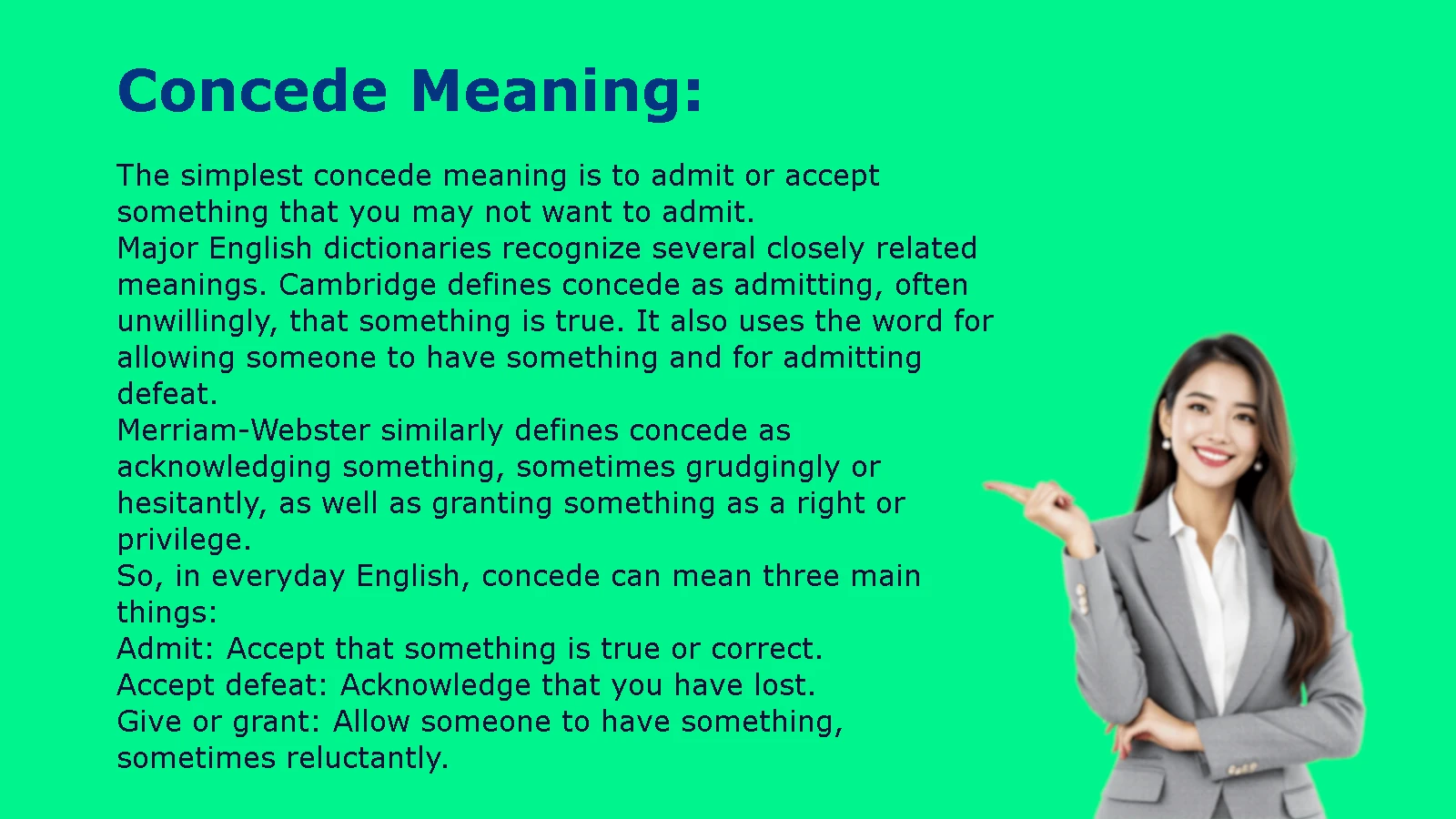
The simplest concede meaning is to admit or accept something that you may not want to admit.
Major English dictionaries recognize several closely related meanings. Cambridge defines concede as admitting, often unwillingly, that something is true. It also uses the word for allowing someone to have something and for admitting defeat.
Merriam-Webster similarly defines concede as acknowledging something, sometimes grudgingly or hesitantly, as well as granting something as a right or privilege.
So, in everyday English, concede can mean three main things:
- Admit: Accept that something is true or correct.
- Accept defeat: Acknowledge that you have lost.
- Give or grant: Allow someone to have something, sometimes reluctantly.
Quick Definition
Concede means to admit something is true, accept defeat, or give something up or grant it to someone.
The word often carries a slight sense of reluctance. You don’t always want to concede. You do it because the facts, circumstances, or situation make it difficult to keep resisting.
For example:
- She conceded that her argument had a weakness.
- The candidate conceded the election.
- The company conceded several demands during negotiations.
Each sentence uses concede differently, yet the underlying idea remains similar: someone gives way in some form.
What Does Concede Mean in Simple Words?
In simple words, concede means to admit, give in, or accept that you cannot continue to argue or win.
Imagine two friends arguing about which route to take on a road trip. After checking the map, one friend realizes the other route really is faster.
The friend might say:
“Okay, I concede. Your route is better.”
That person hasn’t necessarily agreed with everything the other friend said. They have simply admitted that the other person was right about one point.
Now imagine a tennis player who is several sets behind and has no realistic chance of winning. If the player concedes the match, they accept defeat.
The word can also describe a negotiation. Suppose an employer refuses to increase vacation time but eventually agrees to add two days. The employer conceded that part of the workers’ demand.
This gives you a useful mental shortcut:
Concede = admit, yield, or give way.
The surrounding words tell you which meaning applies.
Concede Definition and Core Meanings
The word concede has several dictionary meanings, but they are closely connected.
| Meaning | Explanation | Example |
| Admit | Accept that something is true or correct | He conceded that she was right. |
| Accept defeat | Acknowledge that you have lost | The team conceded defeat. |
| Give or grant | Allow someone to have something | The company conceded the workers’ demand. |
| Allow an opponent to score | Give up a point or goal in sports | The team conceded two goals. |
Collins also identifies the uses of concede for admitting something, granting a right, giving something someone has been seeking, and ending a contest by acknowledging that you cannot win.
Concede as “Admit”
This is one of the most common uses.
When you concede something, you acknowledge that it is true, valid, or correct. The admission may be reluctant.
- She conceded that the criticism was fair.
- He conceded that his original estimate was too low.
- The manager conceded that the mistake should have been caught earlier.
Notice that concede does not necessarily mean complete agreement.
Someone can concede one point while still rejecting the larger argument.
I concede that the proposal is cheaper, but I don’t think it’s better.
Here, the speaker admits one fact but maintains the rest of the argument.
Concede as “Accept Defeat”
In competitions, elections, debates, and conflicts, concede can mean accepting that you have lost.
- The team conceded defeat after the final whistle.
- The candidate conceded the election.
- After hours of negotiation, the company conceded that it could not get the original terms.
This use is especially common in political reporting. When a candidate concedes an election, the candidate publicly acknowledges that the opponent has won or that victory is no longer realistically possible.
Concede as “Give or Grant”
A person can also concede something to another person or group.
- The company conceded several demands.
- The government conceded the right after negotiations.
- The landlord conceded a reduction in the monthly payment.
This meaning often involves negotiation. One side wants something, while the other side initially resists but eventually gives it.
Concede Examples in Sentences
Seeing the word in different situations makes its meaning much easier to understand.
Examples Meaning “Admit”
- Maria conceded that her original plan needed more work.
- The coach conceded that the other team had played better.
- He conceded that the evidence supported her explanation.
- The manager conceded that the deadline was unrealistic.
- After checking the numbers, she conceded that she had made an error.
In each example, someone accepts a fact or point that they might previously have questioned.
Examples Meaning “Accept Defeat”
- The player refused to concede defeat until the final point.
- The team finally conceded after falling far behind.
- The candidate conceded the election after the results became clear.
- The boxer conceded the match after suffering an injury.
- The company conceded defeat in the legal dispute.
This meaning is stronger than simply saying someone agreed.
If someone says “I agree with you,” they are sharing an opinion. If someone says “I concede,” they are often giving way after resistance.
Examples Meaning “Give or Allow”
- The company conceded several benefits during the negotiations.
- The government conceded some of the protesters’ demands.
- The seller conceded a small discount.
- The organization conceded the right after months of discussion.
- The employer conceded on working hours.
Here, the person or organization gives something that it could have continued to withhold.
How to Use Concede in a Sentence
The most useful way to learn concede is to understand the sentence structures that commonly follow it.
Concede That
Use concede that when admitting that something is true.
Pattern:
Subject + concede + that + statement
Examples:
- She conceded that the instructions were unclear.
- He conceded that the other team was stronger.
- The report conceded that the project had serious problems.
- They conceded that the original plan was too expensive.
Cambridge specifically gives concede with a that-clause when someone admits something is true.
You can also use concede before a direct statement:
“Perhaps I was too harsh,” he conceded.
This construction often appears in formal writing, journalism, and careful conversation.
Concede a Point
Concede a point means to admit that someone is correct about a particular argument.
For example:
I concede your point, but I still disagree with your conclusion.
This distinction matters. You can concede a point without conceding the entire argument.
Consider a workplace discussion:
The marketing plan costs less. I concede that point. However, the sales projections still look unrealistic.
The speaker accepts one fact while challenging another.
Concede Defeat
Concede defeat means to admit that you have lost.
Examples:
- The team conceded defeat after the final round.
- The candidate conceded defeat after the vote count.
- The company eventually conceded defeat in the dispute.
The phrase often appears when someone has resisted accepting a loss but eventually recognizes the outcome.
Concede an Election
To concede an election means to acknowledge that you have lost the election.
For example:
The candidate conceded the election after the final results were announced.
This expression has a specific meaning. It describes the candidate’s acknowledgment of the outcome rather than the technical process of certifying the election.
Concede Something to Someone
This structure means allowing another person or group to have something.
Examples:
- The company conceded the demand to the workers.
- The government conceded the right to the organization.
- The negotiators conceded several points to the other side.
The object can be a right, demand, advantage, point, or other benefit.
Concede vs. Agree
Concede and agree overlap, but they aren’t identical.
Agree usually means that you share someone’s opinion or accept a statement as correct.
Concede often suggests that you have admitted a point after some resistance.
| Word | Basic meaning | Example |
| Agree | Share an opinion or accept something | I agree with your conclusion. |
| Concede | Admit that a particular point is valid | I concede that you have a good point. |
Consider these two conversations:
Conversation A:
“The project needs more funding.”
“I agree.”
Both people share the same view.
Conversation B:
“The project needs more funding.”
“I concede that point, but I don’t think we should increase the budget.”
The second speaker accepts the point but still disagrees with the broader conclusion.
Can You Concede Without Agreeing?
Yes.
This is one of the most important details in the concede meaning.
To concede a point doesn’t necessarily mean that you accept everything connected to it.
For example:
I concede that the product is cheaper, but I don’t believe it offers better value.
The speaker accepts the price difference. They don’t accept the conclusion that the cheaper product is better.
That’s why concede can be especially useful in debates, essays, negotiations, and persuasive writing.
Concede vs. Admit
Concede and admit can often replace each other, but their tone isn’t always the same.
Admit is broader. You can admit a fact, mistake, secret, or wrongdoing.
Concede often suggests yielding after hesitation, disagreement, or resistance.
| Word | Typical idea | Example |
| Admit | Acknowledge something | She admitted her mistake. |
| Concede | Acknowledge something despite resistance | She conceded that her argument was weak. |
For instance:
- He admitted that he broke the vase.
- He conceded that his opponent had a stronger argument.
The first sentence focuses on acknowledging responsibility. The second focuses on yielding a point.
Cambridge lists admit and concede in related usage but notes that concede can carry the idea of admitting something even when you don’t want to.
Concede vs. Surrender
These words sometimes overlap when talking about defeat, but surrender usually suggests a more complete act of giving up.
If a team concedes defeat, it acknowledges that it has lost.
If someone surrenders, the emphasis is on giving up resistance or submitting.
Compare:
- The candidate conceded defeat.
- The soldiers surrendered.
The first describes an acknowledgment of an outcome. The second describes giving up resistance.
You can also concede a point without surrendering an entire argument.
That makes concede more flexible in discussions and debates.
Concede Synonyms
The best concede synonym depends on which meaning you intend.
Synonyms Meaning “Admit”
- Acknowledge
- Admit
- Accept
- Recognize
- Grant
- Allow
For example:
She conceded that he was correct.
Possible alternatives include:
- She admitted that he was correct.
- She acknowledged that he was correct.
- She accepted that he was correct.
However, each replacement changes the tone slightly.
Synonyms Meaning “Accept Defeat”
- Yield
- Give in
- Surrender
- Submit
- Accept defeat
For example:
The team conceded defeat.
You could say:
The team accepted defeat.
Or:
The team finally yielded.
The words aren’t perfect substitutes in every sentence.
Synonyms Meaning “Give or Grant”
- Grant
- Allow
- Give
- Yield
- Relinquish
For example:
The company conceded the workers’ demand.
Depending on the context, you might say:
The company granted the workers’ demand.
The original wording may sound more natural when the decision follows resistance or negotiation.
Concede Antonyms
The opposite of concede changes with the meaning.
When Concede Means “Admit”
Possible antonyms include:
- Deny
- Reject
- Dispute
- Challenge
- Refute
Example:
She conceded that the evidence was strong.
Opposite idea:
She disputed the strength of the evidence.
When Concede Means “Accept Defeat”
Possible opposites include:
- Resist
- Persist
- Prevail
- Win
- Continue fighting
Example:
The team refused to concede defeat.
Here, the team continues trying to win.
When Concede Means “Give”
Possible opposites include:
- Withhold
- Keep
- Retain
- Refuse
- Deny
Example:
The company refused to concede the demand.
Concede Word Forms
Understanding the word forms helps you recognize concede in different sentences.
| Word form | Use | Example |
| Concede | Base form | They concede the point. |
| Concedes | Third-person singular | She concedes that he is right. |
| Conceded | Past tense/past participle | He conceded defeat. |
| Conceding | Present participle/gerund | She is conceding the point. |
Collins lists concedes, conceding, and conceded as the main inflected forms of the verb.
Concede
I concede that your argument has merit.
Concedes
The report concedes that the plan has weaknesses.
Conceded
The candidate conceded defeat.
Conceding
By conceding this point, she strengthened the rest of her argument.
Concede Pronunciation
Concede is pronounced:
kuhn-SEED
Its phonetic pronunciation is:
/kənˈsiːd/
The stress falls on the second syllable.
The pronunciation is the same in standard US and UK dictionary entries. Cambridge gives the pronunciation as /kənˈsiːd/.
A useful way to remember it is:
con + SEED
The second part sounds like seed.
Concede as a Verb
Concede is a verb.
It commonly functions as a transitive verb because it can take a direct object:
- concede a point
- concede defeat
- concede a goal
- concede a demand
- concede an advantage
It can also appear with a clause:
- concede that something is true
For example:
The manager conceded that the deadline was unrealistic.
Here, that the deadline was unrealistic functions as the information being admitted.
The verb can also be used without a direct object in contexts where the meaning is clear:
After several hours of debate, he finally conceded.
In this sentence, the reader understands that he gave way or accepted the opposing position.
Common Phrases With Concede
Some combinations appear frequently because they express specific situations clearly.
Concede a Point
Means to admit that another person’s argument is valid in one respect.
She conceded the point but rejected the larger argument.
Concede Defeat
Means to acknowledge that you have lost.
The team eventually conceded defeat.
Concede an Argument
Means to acknowledge that another side has won or made a valid argument.
He conceded the argument after seeing the new evidence.
Concede That
Means to admit that something is true.
The company conceded that the original estimate was inaccurate.
Concede Victory
Means to acknowledge another person’s victory.
The challenger conceded victory to her opponent.
Concede an Advantage
Means to allow another person or team to gain an advantage.
The early mistake conceded a major advantage to the opposing team.
Concede a Goal
In soccer and other sports, concede a goal means to allow the opposing team to score.
The defense conceded a goal in the final minutes.
Concede a Penalty or Free Kick
In sports, a player or team can concede a penalty or concede a free kick by committing an action that gives the opposing side that opportunity.
This sports use fits the broader idea of giving something to the opposition.
Concede Meaning in Sports
Sports provide some of the clearest examples of how the word works.
When a soccer team concedes a goal, it has allowed the opposing team to score.
For example:
The team conceded two goals in the second half.
The team hasn’t necessarily surrendered the match. It has simply allowed two goals.
That’s an important distinction.
Concede a goal ≠ concede defeat.
A team can concede three goals and still win if it scores four.
The word can also describe accepting the final result:
The team conceded defeat after the final whistle.
Here, the meaning changes from allowing a goal to accepting a loss.
Concede Meaning in Politics and Elections
Election coverage often uses concede in a very specific way.
When a losing candidate concedes an election, the candidate acknowledges that the opponent has won or that the candidate can no longer realistically win.
For example:
After the final results became clear, the candidate conceded the election.
This doesn’t mean that the candidate personally approves of every part of the result. It means the candidate has acknowledged the outcome.
The expression concede defeat works in a similar way:
The candidate conceded defeat after the final results were announced.
Collins specifically lists concede an election as a use meaning to acknowledge the outcome as certain.
Concede Meaning in an Argument
In an argument, concede has a useful and precise role.
Suppose two people disagree about whether a new policy will work. One person points out that the policy costs less. The other person might respond:
I concede that the policy would cost less, but I’m concerned about its long-term effects.
The second speaker has conceded one point without abandoning the entire position.
This technique can actually make an argument stronger. Acknowledging a valid opposing point shows that you understand the issue rather than ignoring inconvenient facts.
In formal writing, this can take the form of a concession:
- Acknowledge a reasonable opposing point.
- Explain why it doesn’t change the main conclusion.
- Present the stronger argument.
For example:
Concession: The proposal would reduce short-term costs.
Response: However, the long-term maintenance expenses could outweigh those savings.
That is a classic argumentative use of concede.
Concede Meaning in a Negotiation
Negotiations often involve concessions.
If two sides begin with different demands, each side may eventually give something up.
For example:
| Situation | Initial position | Concession |
| Salary negotiation | Employer offers $60,000 | Employer raises offer to $63,000 |
| Contract terms | Buyer wants 30 days | Seller agrees to 45 days |
| Business deal | Supplier refuses a discount | Supplier reduces the price by 5% |
In these situations, concede suggests that the concession wasn’t freely offered from the beginning.
For example:
The supplier conceded a 5% discount after several rounds of negotiation.
The supplier gave something up because the negotiation pushed it toward a compromise.
Is Concede a Negative Word?
No. Concede is not inherently negative.
Its tone depends heavily on the context.
Sometimes it describes defeat:
The team conceded defeat.
That clearly involves losing.
However, conceding a point can show honesty:
She conceded that her colleague had identified a genuine problem.
In negotiation, a concession can also help both sides reach an agreement:
The company conceded several minor demands to secure the larger contract.
So, while the word often carries a sense of reluctance or yielding, it doesn’t automatically express weakness or failure.
In fact, admitting a valid point can make a speaker sound more reasonable.
Common Mistakes With Concede
Treating Concede as a Perfect Synonym for Agree
This is the most common mistake.
Agree means sharing or accepting an opinion.
Concede often means acknowledging a point despite some resistance.
Incorrect assumption:
Concede always means agree with everything.
Better understanding:
Concede can mean admitting that one particular point is true.
Assuming Concede Always Means Lose
Another common mistake is thinking concede only refers to defeat.
It doesn’t.
Compare:
- She conceded that the plan was expensive.
- She conceded defeat.
- She conceded several demands.
Only the second sentence directly describes losing.
Confusing Concede With Confess
Confess usually involves admitting something, especially a mistake, wrongdoing, or secret.
Concede has a wider range.
Compare:
He confessed to stealing the money.
with:
He conceded that the other proposal was better.
The first involves admitting wrongdoing. The second involves accepting an argument or fact.
Using the Wrong Structure
The following patterns are common and natural:
- concede that + statement
- concede a point
- concede defeat
- concede an election
- concede a goal
- concede something to someone
- concede to a demand
For example:
The company conceded to the workers’ demands.
The preposition to works naturally when the focus is on yielding to a demand or request.
A Practical Way to Remember Concede
If the word still feels slippery, think of concede as having one central idea:
You give way.
That can happen in several ways.
Give way intellectually:
You admit that someone is right.
Give way competitively:
You accept that you have lost.
The surface meaning changes, but the underlying concept stays remarkably consistent.
Mini Case Studies: How Context Changes the Meaning
Case Study: A Debate
A student argues that a school should extend library hours. Another student disagrees but admits that students who work after school need more study time.
The second student says:
I concede that students with after-school jobs need more access to the library.
Here, concede means admit that a point is valid.
The student hasn’t necessarily accepted the entire proposal.
Case Study: A Negotiation
A business wants a supplier to reduce its prices. The supplier initially refuses but later agrees to a small discount.
A report might say:
The supplier conceded a 4% discount after negotiations.
Here, concede means give something up or grant something after resistance.
Case Study: A Competition
A team falls far behind and eventually accepts that it cannot win.
A sports report might say:
The team conceded defeat late in the match.
Here, concede means accept defeat.
These three situations show why context matters more than memorizing a single definition.
Concede Meaning: Quick Reference Table
| Question | Answer |
| What does concede mean? | To admit, yield, accept defeat, or grant something. |
| Is concede a verb? | Yes. |
| What does concede defeat mean? | To acknowledge that you have lost. |
| What does concede a point mean? | To admit that someone is correct about a particular point. |
| Does concede mean agree? | Sometimes, but usually with a stronger sense of yielding or reluctant admission. |
| What is a common synonym? | Admit, acknowledge, accept, yield, or grant, depending on context. |
| What is an antonym? | Deny, reject, resist, retain, or refuse, depending on context. |
| How is concede pronounced? | kuhn-SEED /kənˈsiːd/ |
| What part of speech is concede? | Verb. |
| What does concede a goal mean? | To allow an opposing team or player to score. |
Concede Etymology and Word History
The history of concede helps explain why its modern meanings are related.
Merriam-Webster traces the word through French or directly from Latin concedere, from com- and cedere, meaning to yield or give way. It records the first known English use of concede in 1626.
Collins likewise traces the word to Latin concedere, connected with cedere, meaning to give way or yield.
That history connects neatly with the modern meanings.
When you concede an argument, you give way intellectually.
When you concede defeat, you give way to the reality of the result.
The word’s different uses aren’t random. They developed around the shared idea of yielding or granting.
Frequently Asked Questions About Concede
What does concede mean in simple terms?
Concede means to admit something is true, accept defeat, or give something to someone. It often suggests that the person didn’t want to give way at first.
Does concede mean agree?
Not exactly. Concede can mean admitting that someone is right about a particular point, while agree usually means sharing the same opinion.
For example:
I concede that your plan is cheaper, but I don’t agree that it’s better.
Does concede mean give up?
Sometimes. When someone concedes defeat, they accept that they have lost. However, concede can also mean simply admitting a fact or granting a request.
What does concede defeat mean?
Concede defeat means to acknowledge that you have lost.
Example:
The team conceded defeat after the final round.
What does concede a point mean?
Concede a point means to admit that another person has made a valid argument or observation.
Example:
I concede your point, but I still disagree with your conclusion.
What is the best synonym for concede?
The best synonym depends on the context.
- Admit for acknowledging a fact.
- Acknowledge for recognizing something as valid.
- Yield for giving way.
- Surrender for accepting defeat.
- Grant for giving someone a right or request.
What is the opposite of concede?
The opposite depends on the meaning. Deny, reject, dispute, resist, retain, and refuse can all work in different contexts.
Is concede formal?
Concede is common in both everyday and formal English, although some uses sound more formal than their alternatives.
For example, “I concede your point” sounds more formal than “Okay, you’re right.”
The word is especially common in journalism, politics, business, sports reporting, academic writing, and debates.
How do you use concede in a sentence?
Use concede when someone admits a point, accepts defeat, or gives something to another person.
Examples:
- She conceded that he was right.
- The candidate conceded the election.
- The company conceded several demands.
- The goalkeeper conceded two goals.
Final Takeaway: Concede Meaning
The word concede becomes much easier once you stop treating it as having only one definition.
Its three main meanings are:
- To admit: She conceded that the criticism was fair.
- To accept defeat: The team conceded defeat.
- To give or grant: The company conceded several demands.
The word often suggests yielding after resistance. That’s why concede can sound different from simple words such as agree or give.