
Have you ever heard the word “Juneteenth” and wondered what it means or why it is celebrated? While Juneteenth Meaning may seem straightforward, this important holiday has deep historical and cultural significance rooted in the end of slavery in the United States.
Juneteenth is a federal holiday in the United States that commemorates June 19, 1865, when enslaved people in Galveston, Texas, learned that they were free under the Emancipation Proclamation. The name Juneteenth combines June and nineteenth, the date on which this historic event was announced in Texas.
Examples:
- Juneteenth is celebrated on June 19 every year.
- Many communities hold events to honor Juneteenth and reflect on African American history.
The confusion is understandable. People often search for what does Juneteenth mean, Juneteenth meaning in history, why is Juneteenth celebrated, or even what does Juneteenth stand for because the holiday carries historical, cultural, and social meaning. And here’s the kicker: although freedom was proclaimed years earlier, June 19, 1865, marked a major moment when news of emancipation finally reached enslaved people in Texas.
In this guide, you’ll learn the complete Juneteenth Meaning, its definition, history, pronunciation, and significance. You’ll also discover why Juneteenth is celebrated, when it became a federal holiday, how people observe it today, and why June 19 remains an important date in American history.
What Is the Meaning of Juneteenth?
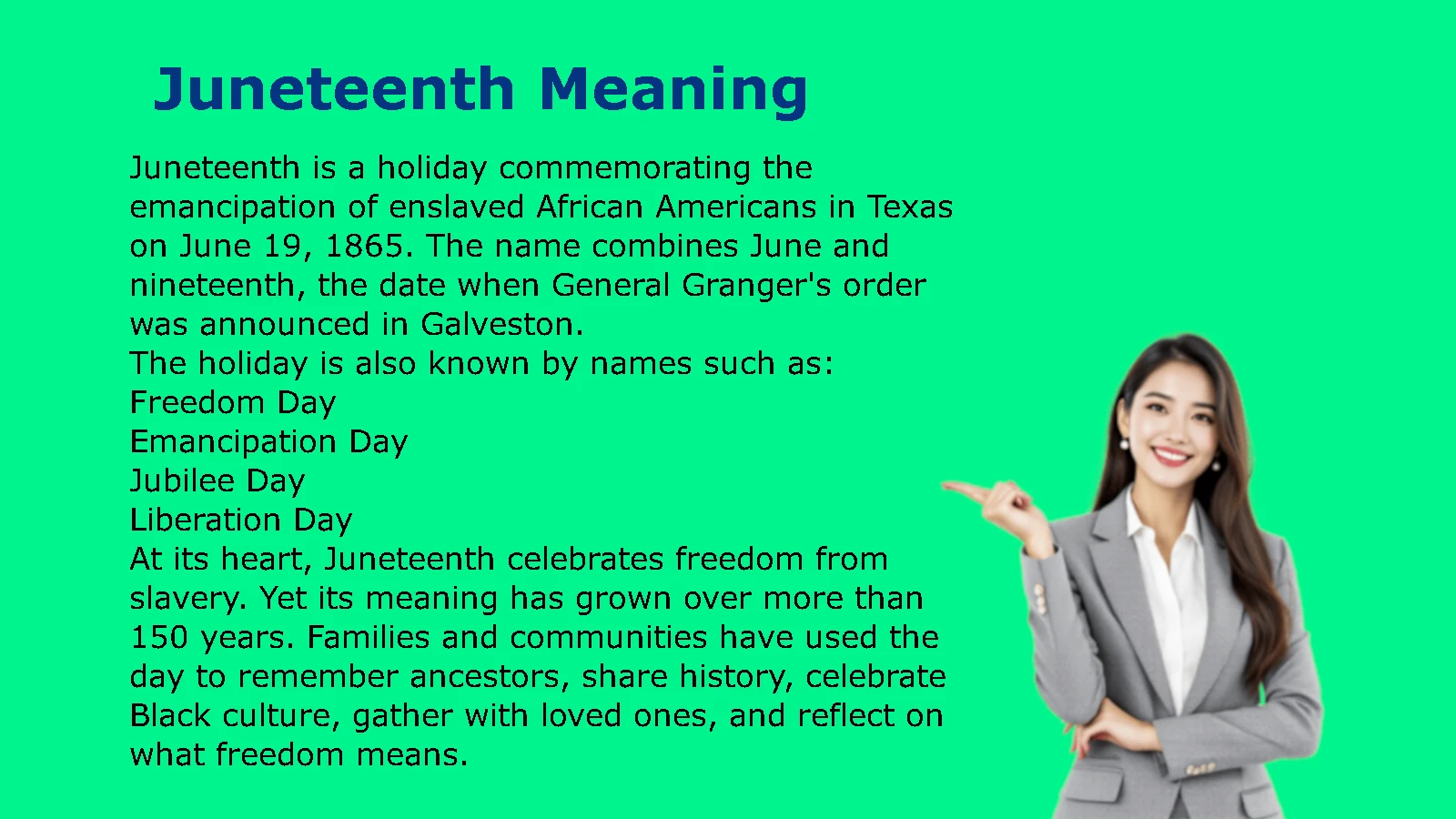
Juneteenth is a holiday commemorating the emancipation of enslaved African Americans in Texas on June 19, 1865. The name combines June and nineteenth, the date when General Granger’s order was announced in Galveston.
The holiday is also known by names such as:
- Freedom Day
- Emancipation Day
- Jubilee Day
- Liberation Day
At its heart, Juneteenth celebrates freedom from slavery. Yet its meaning has grown over more than 150 years. Families and communities have used the day to remember ancestors, share history, celebrate Black culture, gather with loved ones, and reflect on what freedom means.
The Smithsonian’s National Museum of African American History and Culture describes Juneteenth as a significant date in both American history and the African American experience.
A simple way to understand it is this:
Juneteenth marks the day freedom promised to enslaved people in Texas was formally announced and enforced by Union troops.
That distinction matters. Juneteenth did not mark the signing of the Emancipation Proclamation, nor did it legally abolish slavery throughout the entire United States. The Thirteenth Amendment completed nationwide constitutional abolition later in 1865.
Why Is June 19 Important?
June 19, 1865, became important because it represented a dramatic change in the lives of more than 250,000 enslaved Black people in Texas.
On that day, approximately 2,000 Union troops arrived in the Galveston area under General Gordon Granger. Granger issued General Order No. 3, informing Texans that the federal government had declared enslaved people free.
The order connected emancipation with a change in the relationship between formerly enslaved people and enslavers. Instead of forced labor under slavery, the order described the new relationship as one between employers and hired labor.
The date mattered because a legal declaration means little when the people affected cannot exercise the rights it promises. In Texas, Union military power finally arrived to enforce the freedom that Lincoln’s proclamation had promised more than two years earlier.
That is one of the most important ideas behind the Juneteenth meaning: freedom requires more than words on paper. It also requires the power and opportunity to make that freedom real.
What Happened on June 19, 1865?
The story of Juneteenth begins in the final months of the American Civil War.
By 1865, Confederate resistance was collapsing. General Robert E. Lee surrendered to Union General Ulysses S. Grant at Appomattox Court House in April. However, the end of major Confederate military resistance did not instantly transform every plantation, town, or community in the South.
Texas presented a particular challenge.
It was geographically distant from the major theaters of the war and had relatively limited Union military presence. As a result, enslavers in Texas could continue operating under the system of slavery despite the Emancipation Proclamation.
Then came June 19.
General Granger arrived in Galveston and issued General Order No. 3. The order began by informing the people of Texas that, according to the president’s proclamation, “all slaves are free.”
The announcement transformed June 19 into a historic date.
For enslaved Texans, however, freedom did not suddenly erase every hardship. The end of slavery opened a new chapter rather than creating instant equality. Formerly enslaved people still faced discrimination, violence, economic restrictions, political exclusion, and enormous challenges as they built independent lives.
Still, emancipation changed the possibilities available to millions of people.
Families could work toward reunification. Children could pursue education. Communities could establish churches, businesses, schools, and civic institutions. Formerly enslaved people could begin making decisions about their own lives without the legal status of property hanging over them.
That transformation helps explain why Juneteenth became a celebration rather than merely a historical footnote.
Juneteenth and the Emancipation Proclamation
One of the biggest sources of confusion about Juneteenth involves the Emancipation Proclamation.
The two events are closely connected, but they aren’t the same.
President Abraham Lincoln issued the Emancipation Proclamation on January 1, 1863. It declared that enslaved people in areas of the United States that were in rebellion against the federal government were free.
However, the proclamation had important limitations.
It did not abolish slavery throughout the United States. It applied to areas under Confederate rebellion and excluded loyal border states and certain Confederate areas already under Union control. Most importantly, its effectiveness depended heavily on Union military power.
Here’s the timeline in a simpler form:
| Date | Event | Why it matters |
| September 22, 1862 | Lincoln issued the Preliminary Emancipation Proclamation | Announced the coming emancipation order |
| January 1, 1863 | Emancipation Proclamation took effect | Declared enslaved people in rebellious areas free |
| April 1865 | Lee surrendered at Appomattox | A major Confederate army surrendered |
| June 19, 1865 | General Granger issued General Order No. 3 in Galveston | Freedom was announced and enforced in Texas |
| January 31, 1865 | Congress passed the proposed Thirteenth Amendment | Began the constitutional process to abolish slavery nationwide |
| December 6, 1865 | Thirteenth Amendment was ratified | Slavery was constitutionally abolished throughout the United States |
The distinction is crucial. The Emancipation Proclamation started a major legal and military transformation. Juneteenth commemorates a specific moment when that freedom was enforced in Texas. The Thirteenth Amendment then abolished slavery nationwide.
Why Did Enslaved Texans Wait So Long for Freedom?
The short answer is that the Emancipation Proclamation could not enforce itself.
The federal government could issue an order, but Confederate authorities and enslavers still controlled large areas of the South. Until Union forces reached those areas, enforcement remained difficult.
Texas was particularly important because of its geography. It sat far from the main eastern battlefields, and Union military control remained limited.
Some enslaved people had already heard about the Emancipation Proclamation before June 1865. The Smithsonian notes that enslaved Texans were not necessarily hearing the news for the first time when Union troops arrived. The deeper problem was that they lacked the military power needed to make the promise of freedom enforceable.
This creates an important historical lesson.
Knowing that you have a right and being able to exercise that right aren’t always the same thing.
Juneteenth captures that gap between a legal promise and lived reality.
The Thirteenth Amendment and the End of Slavery
If Juneteenth celebrates emancipation in Texas, what officially ended slavery across the United States?
The answer is the Thirteenth Amendment.
Congress passed the amendment on January 31, 1865. The states ratified it on December 6, 1865, and it abolished slavery throughout the United States, with an exception for punishment for a crime after conviction.
This distinction helps prevent a common historical error.
Juneteenth did not constitutionally abolish slavery nationwide.
Instead, the holiday commemorates the June 19, 1865, announcement and enforcement of emancipation in Texas. The Thirteenth Amendment later provided the nationwide constitutional foundation that ended legal slavery across the country.
The sequence matters because emancipation wasn’t one single event. It unfolded through presidential action, military enforcement, individual resistance, political change, and constitutional law.
When Did Juneteenth Celebrations Begin?
Juneteenth celebrations began in Texas soon after emancipation and developed into an enduring community tradition.
Early celebrations often centered on families, churches, food, prayer, speeches, and community gatherings. Over time, people traveled to Galveston and other gathering places to commemorate emancipation.
The celebrations weren’t simply parties. They helped communities preserve historical memory.
For people whose families had experienced slavery, Juneteenth offered a chance to tell stories that might otherwise disappear. Older generations could pass memories to younger ones. Families could gather, reconnect, and celebrate the freedom that earlier generations had fought to achieve.
The Smithsonian reports that Juneteenth celebrations initially focused on family and church gatherings before evolving into larger annual events. The tradition later spread throughout the South and became more commercialized during the 1920s and 1930s.
Emancipation Park and Juneteenth History
One powerful example of this community building can be found in Houston, Texas.
In 1872, Reverend Jack Yates and other Black community leaders helped purchase land that became Emancipation Park. The space gave Black Houstonians a place to gather and celebrate Juneteenth during an era of segregation and racial inequality.
The story of Emancipation Park shows how freedom celebrations became connected to a larger effort to create independent Black institutions and community spaces.
The celebration wasn’t confined to one afternoon. It became part of building a community.
How Did Juneteenth Become a Federal Holiday?
Juneteenth existed for generations before the federal government recognized it.
Texas formally recognized Juneteenth as a state holiday in 1979, and the tradition gradually gained wider national attention. The Library of Congress notes that numerous federal efforts preceded the successful legislation in 2021.
The final legislative process moved quickly.
- The Senate passed the Juneteenth National Independence Day Act by unanimous consent on June 15, 2021.
- The House passed it on June 16, 2021.
- President Joe Biden signed it into law on June 17, 2021.
- The law established June 19 as Juneteenth National Independence Day, a federal legal public holiday.
That means Juneteenth became a federal holiday in 2021, not that Juneteenth itself began in 2021.
The distinction is important.
The holiday is more than 150 years old. Federal recognition is much newer.
What Does Juneteenth Celebrate?
At the most basic level, Juneteenth celebrates emancipation and freedom.
But the holiday carries several connected meanings:
- Freedom: It commemorates the end of slavery in Texas.
- Resilience: It recognizes how formerly enslaved people rebuilt their lives.
- Family: Many celebrations emphasize reunions and community connections.
- Black history: The holiday highlights African American experiences and contributions.
- Culture: Music, food, storytelling, art, and traditions often form part of celebrations.
- Reflection: The day encourages people to consider both the progress made and the struggles that followed emancipation.
- Community: Juneteenth provides a setting for gatherings, education, and civic participation.
The holiday therefore has both a celebratory side and a reflective side.
There is room for joy. There is also room for history.
How Do People Celebrate Juneteenth?
There is no single required way to celebrate Juneteenth.
Different communities have developed their own customs. Some focus on history and education. Others organize large public festivals. Families may prefer a quiet gathering with food, music, and storytelling.
Common Juneteenth activities include:
- Family reunions
- Community festivals
- Parades
- Cookouts
- Church services
- Historical presentations
- Educational programs
- Live music
- Poetry and spoken word
- Dance performances
- Art exhibitions
- Storytelling
- Civic events
- Readings about African American history
The Smithsonian describes Juneteenth as a celebration involving music, food, freedom, family, and community.
For some families, the most meaningful activity might be attending a local festival. For others, it might be reading about an ancestor who lived through emancipation.
Both approaches fit the broader spirit of the holiday.
What Foods Are Associated With Juneteenth?
Food has long played an important role in Juneteenth gatherings.
Because celebrations often involve large family and community gatherings, shared meals naturally became part of the tradition. Barbecue, grilled foods, fruit, desserts, and other dishes can appear at Juneteenth events.
Red foods and drinks are especially associated with Juneteenth.
Examples include:
- Watermelon
- Strawberries
- Red velvet cake
- Red beans
- Hibiscus drinks
- Strawberry desserts
- Barbecue sauces and other red foods
However, there isn’t an official Juneteenth menu.
The red color carries particular cultural associations. The Smithsonian’s National Museum of African American History and Culture explains that red has connections to Yoruba and Kongo cultural traditions and can symbolize sacrifice, transition, and power.
Food can therefore become more than something served at a picnic. It can carry memory, culture, symbolism, and family tradition.
What Does the Color Red Mean on Juneteenth?
The color red has become strongly associated with Juneteenth celebrations.
Its meaning isn’t limited to one universally accepted explanation. Cultural traditions surrounding red include ideas of sacrifice, transition, strength, and power. The Smithsonian connects the use of red in Juneteenth food traditions to cultural influences from Yoruba and Kongo peoples.
This symbolism gives the holiday’s food traditions another layer.
A red drink at a Juneteenth gathering isn’t necessarily just a colorful beverage. In many contexts, it can represent history and cultural continuity.
That said, red isn’t a requirement for observing Juneteenth. The holiday’s central meaning remains emancipation and freedom.
Juneteenth vs. the Fourth of July
Juneteenth and Independence Day are both American holidays associated with freedom, but they commemorate different historical events.
July 4 commemorates the adoption of the Declaration of Independence in 1776.
June 19 commemorates the 1865 announcement and enforcement of emancipation in Texas.
The contrast is particularly meaningful because the United States declared independence while slavery continued to exist.
Juneteenth adds another chapter to the American story of freedom. It recognizes the moment when enslaved Black Americans in Texas learned that the federal government would enforce their emancipation.
The Library of Congress describes Juneteenth as a symbolic date representing the African American struggle for freedom and equality as well as a celebration of family and community.
| Juneteenth | Fourth of July |
| June 19 | July 4 |
| Commemorates emancipation in Texas in 1865 | Commemorates U.S. independence in 1776 |
| Connected to the end of slavery | Connected to independence from Great Britain |
| Became a federal holiday in 2021 | Federal holiday since 1870 |
| Strong roots in African American communities | National American Independence Day |
Calling Juneteenth a “second Independence Day” can help communicate its importance, but the two holidays shouldn’t be treated as interchangeable. They mark different moments in American history.
Why Is Juneteenth Still Important Today?
Juneteenth remains important because history doesn’t disappear simply because an event happened long ago.
The holiday gives Americans an opportunity to understand the complicated path from slavery to emancipation and from emancipation toward citizenship and civil rights.
Freedom in 1865 didn’t immediately produce equal treatment.
The Smithsonian notes that formerly enslaved people faced major obstacles even after emancipation. The Fourteenth Amendment, ratified in 1868, established citizenship and equal protection principles, while the Fifteenth Amendment, ratified in 1870, addressed voting rights for African American men.
The story therefore continued.
Formerly enslaved people pursued education, reunited families, established institutions, sought political office, and worked to build independent communities. The Freedmen’s Bureau also provided assistance such as food, clothing, medical care, education, legal support, and help with marriages.
Juneteenth provides a doorway into that larger history.
It asks a straightforward but powerful question:
What happens after freedom is declared?
The answer includes rebuilding, resistance, community formation, political participation, cultural preservation, and generations of effort.
A Historical Case Study: Texas in 1865
Texas offers a useful case study because it shows why emancipation wasn’t instantaneous.
Imagine the difference between a federal proclamation sitting thousands of miles away and a Union soldier standing in front of a Texas community with an order to enforce it.
The first is a declaration.
The second creates immediate authority on the ground.
By June 1865, Union forces had defeated the Confederacy, and Granger’s arrival gave federal authority a direct presence in Texas. General Order No. 3 connected the freedom of enslaved Texans to the Emancipation Proclamation while also setting expectations for the transition from slavery to wage labor.
That doesn’t mean every problem vanished on June 19.
Formerly enslaved people still had to find housing, work, education, safety, and family members. Many faced efforts to preserve racial control through new systems and discriminatory practices.
Still, June 19 represented a fundamental break.
A person who had been legally enslaved could now claim a different legal status.
That is why the date became worth remembering.
Common Misunderstandings About Juneteenth
Juneteenth is widely discussed today, but several misconceptions continue to circulate.
| Misunderstanding | The historical fact |
| Juneteenth is the date Lincoln signed the Emancipation Proclamation. | Lincoln issued the Emancipation Proclamation on January 1, 1863. |
| Juneteenth marks the nationwide legal abolition of slavery. | The Thirteenth Amendment abolished slavery nationwide in December 1865. |
| Juneteenth began in 2021. | Black Texans had celebrated Juneteenth for generations before federal recognition. |
| Juneteenth only matters to people in Texas. | The holiday began in Texas but became a nationally recognized federal holiday. |
| General Granger created freedom through the order alone. | His order announced and enforced emancipation in Texas under federal authority. |
| Everyone in Texas immediately experienced complete equality after June 19. | Emancipation ended legal slavery, but racial discrimination and inequality continued. |
| Juneteenth is only a festival. | It combines celebration, remembrance, education, cultural expression, and reflection. |
These distinctions make the meaning of Juneteenth clearer. Historical accuracy matters because the holiday itself is about remembering a specific event.
What Is General Order No. 3?
General Order No. 3 is the military order most directly connected with Juneteenth.
Major General Gordon Granger issued it on June 19, 1865, after Union forces arrived in Galveston. The National Archives preserves the original handwritten record.
The order stated that enslaved people in Texas were free and described the transition from slavery to a relationship based on paid labor.
One of its most famous lines states:
“The people of Texas are informed” that all enslaved people are free.
The document matters because it provides direct primary-source evidence for the event Juneteenth commemorates.
It isn’t simply a later story about what happened.
The order itself survives.
That makes General Order No. 3 one of the central historical documents for understanding Juneteenth.
Who Was Gordon Granger?
Gordon Granger was a Union Army major general who commanded the District of Texas in 1865.
He became closely associated with Juneteenth because he issued General Order No. 3 in Galveston on June 19.
His role is important, but the broader story is larger than one military officer.
Union forces made emancipation enforceable. Black soldiers also served in the Union military, and many of the troops involved in the broader Union war effort were African American. The Smithsonian notes that many of the troops arriving in Texas were Black.
The end of slavery therefore resulted from a much larger combination of factors: enslaved people’s resistance, military action, federal policy, abolitionist pressure, political change, and constitutional reform.
Who Celebrates Juneteenth?
Juneteenth has deep roots in African American communities, particularly in Texas.
Over time, its observance expanded. Today, people across the United States and in other countries recognize or celebrate the holiday. The Library of Congress notes that Juneteenth has historically been observed by people of African descent in places including Canada, Jamaica, Nigeria, and the United Kingdom.
The way people observe it varies.
Some communities focus on African American history. Others emphasize family, food, music, art, or civic events. Educational institutions and cultural organizations may organize lectures, exhibitions, performances, or historical programs.
There isn’t one correct way to observe the day.
What matters most is understanding what the day represents.
Juneteenth Meaning in Simple Words
If you need the shortest possible explanation, here’s the answer:
Juneteenth means the celebration and remembrance of freedom from slavery, especially the June 19, 1865, announcement that brought federal enforcement of emancipation to enslaved people in Texas.
The name comes from June + nineteenth.
The holiday represents:
- Freedom
- Emancipation
- Black history
- Resilience
- Family
- Community
- Cultural heritage
- Reflection on America’s history
It also reminds readers that emancipation happened through a process rather than one magical moment.
The Emancipation Proclamation came first. Union military enforcement in Texas came later. The Thirteenth Amendment completed the constitutional abolition of slavery nationwide.
Frequently Asked Questions About Juneteenth Meaning
What does Juneteenth mean?
Juneteenth commemorates June 19, 1865, when Union General Gordon Granger issued General Order No. 3 in Galveston, Texas, announcing that enslaved people in Texas were free. The holiday now represents freedom, emancipation, African American history, and community.
Why is Juneteenth celebrated on June 19?
Juneteenth is celebrated on June 19 because General Granger issued General Order No. 3 in Galveston on June 19, 1865. That order announced the enforcement of emancipation in Texas.
What does the word Juneteenth mean?
Juneteenth combines the words June and nineteenth. The name refers directly to June 19, the date associated with Granger’s 1865 order in Texas.
When did Juneteenth become a federal holiday?
Juneteenth became a U.S. federal holiday in 2021. President Joe Biden signed the Juneteenth National Independence Day Act on June 17, 2021.
Did Juneteenth end slavery in the entire United States?
No. Juneteenth commemorates the announcement and enforcement of emancipation in Texas. The Thirteenth Amendment, ratified on December 6, 1865, abolished slavery throughout the United States.
Is Juneteenth the same as the Fourth of July?
No. July 4 commemorates U.S. independence from Great Britain in 1776. Juneteenth commemorates emancipation in Texas in 1865. Both relate to freedom, but they mark different historical events.
What happened on Juneteenth in 1865?
On June 19, 1865, General Gordon Granger arrived in Galveston, Texas, and issued General Order No. 3. The order informed Texans that enslaved people were free under federal authority.
Why did Juneteenth take place more than two years after the Emancipation Proclamation?
The Emancipation Proclamation took effect in 1863, but Union forces did not control all Confederate territory. Texas remained under Confederate control and had limited Union military presence. Granger’s arrival in June 1865 brought federal military enforcement to the state.
What foods are associated with Juneteenth?
Juneteenth celebrations often feature community meals, barbecue, fruit, desserts, and red foods or drinks. Red foods have cultural and historical symbolism connected with resilience, transition, sacrifice, and power in traditions associated with African cultures.
Why is Juneteenth important?
Juneteenth is important because it preserves the memory of emancipation in Texas while highlighting the broader African American struggle for freedom, equality, community, and self-determination. It also helps people understand that ending slavery was a historical process rather than one isolated event.
Final Thoughts on the Meaning of Juneteenth
The Juneteenth meaning is ultimately rooted in freedom, but the history behind that freedom is far richer than a single date.
On June 19, 1865, General Gordon Granger issued an order in Galveston that announced freedom for enslaved people in Texas. That moment came more than two years after the Emancipation Proclamation and several months after the Confederate surrender. Later that year, the Thirteenth Amendment abolished slavery throughout the United States.
From those beginnings, Juneteenth grew into a lasting tradition.
Families gathered. Communities built institutions. Stories passed from one generation to another. Food, music, faith, education, and celebration became part of the holiday’s identity.
Today, Juneteenth serves as both a celebration of freedom and a reminder of history.
It celebrates what emancipation made possible while remembering the people who endured slavery and the generations that worked to turn legal freedom into lived freedom.
That combination gives June 19 its lasting power. Juneteenth isn’t simply a date to remember. It’s a story about freedom, resilience, community, and the long road toward equality.