
Ever come across the word Controversial Meaning and wondered what it actually means? You’re not alone. Many people search for the meaning of controversial, controversial definition, and how to use controversial because the word often appears in news, social media, and everyday conversations.
Controversial describes a person, topic, statement, or decision that causes strong disagreement or debate because people have different opinions about it. Something controversial often divides public opinion and can lead to discussions or arguments.
Examples:
- The politician made a controversial statement during the interview.
- The movie became controversial because of its ending.
The confusion usually isn’t about the spelling—it’s about the context. Is something controversial always negative? Can a person, opinion, or topic be controversial without being wrong? And here’s the kicker: misunderstanding the controversial meaning can lead to using the word incorrectly or misinterpreting what someone is trying to say.
In this guide, you’ll learn the controversial meaning, discover the definition of controversial, understand its pronunciation, correct usage, and examples of controversial in real-life sentences. You’ll also learn how to use controversial, explore controversial synonyms and antonyms, and understand why certain topics are described as controversial.
What Does Controversial Mean?
The simplest way to understand the controversial meaning is to think about disagreement.
A topic becomes controversial when it causes people to argue, debate, or express opposing opinions. Instead of everyone agreeing, different groups believe different things.
For example:
- Some people support a new law.
- Others strongly oppose it.
That law is controversial because it creates public disagreement.
In everyday English, the word usually describes:
- Topics
- Opinions
- Decisions
- Statements
- Books
- Movies
- Laws
- Public figures
- Scientific claims
The important point is this:
Something is controversial because people disagree about it—not because it is automatically good or bad.
Simple Definition
In plain English:
Controversial means causing disagreement, discussion, or strong differences of opinion among people.
Here’s another easy way to remember it:
| Word | Simple Meaning |
| Controversial | People strongly disagree about it. |
| Non-controversial | Most people generally agree about it. |
Think of controversy as standing at the center of a conversation where everyone has a different opinion.
Dictionary Definition
Major English dictionaries define controversial in nearly the same way.
The common elements include:
- Giving rise to controversy
- Causing public disagreement
- Producing opposing opinions
- Becoming the subject of debate
Although each dictionary uses slightly different wording, they all describe the same basic idea: people cannot easily agree on the subject.
Pronunciation
American English
/ˌkɑːn.trəˈvɝː.ʃəl/
Pronounced like:
kon-truh-VUR-shuhl
British English
/ˌkɒn.trəˈvɜː.ʃəl/
While accents vary slightly, both pronunciations are widely accepted.
When Is Something Considered Controversial?
Not every disagreement makes something controversial.
If two friends argue about where to eat dinner, that usually isn’t considered controversial.
Instead, something becomes controversial when disagreement spreads across a larger group of people.
Several factors often make an issue controversial.
Strong Public Disagreement
The biggest sign of controversy is widespread disagreement.
People hold opposing opinions and often defend them passionately.
Examples include:
- Election policies
- School rules
- Environmental regulations
- Artificial intelligence ethics
These topics rarely produce one unanimous answer.
Different Personal Values
People come from different backgrounds.
Their beliefs are shaped by:
- Family
- Culture
- Religion
- Education
- Life experiences
Because values differ, opinions often differ too.
For example, one advertisement may seem creative to one audience but offensive to another.
Ethical Questions
Many controversial subjects involve morality.
People ask questions like:
- Is it fair?
- Is it ethical?
- Who benefits?
- Who could be harmed?
When ethical concerns appear, debates often become more emotional.
Limited Evidence
Sometimes experts themselves disagree.
Scientific research may still be developing.
New discoveries can lead to competing interpretations before enough evidence becomes available.
Examples include:
- Emerging technologies
- Medical treatments
- Artificial intelligence regulations
Cultural Differences
Something accepted in one country may be controversial elsewhere.
Culture influences opinions on:
- Clothing
- Humor
- Education
- Politics
- Entertainment
- Business practices
That is why controversy often depends on context.
Emotional Reactions
Some issues affect people’s identity, beliefs, or personal experiences.
These discussions naturally produce stronger emotions than ordinary conversations.
As emotions increase, controversy often follows.
Signs That Something Is Controversial
| Sign | Explanation |
| Strong disagreement | People openly oppose each other. |
| Public debate | News, media, and social platforms discuss it. |
| Mixed opinions | There is no clear consensus. |
| Emotional responses | People care deeply about the issue. |
| Ongoing discussion | Debate continues over time. |
How to Use “Controversial” Correctly
Many English learners understand the definition but struggle to use the word naturally.
Fortunately, the grammar is simple.
Controversial is an adjective, meaning it describes a noun.
Examples:
- a controversial book
- a controversial opinion
- a controversial speech
- a controversial decision
- a controversial law
Using “Controversial” Before a Noun
The most common structure is:
Controversial + noun
Examples:
- The professor discussed a controversial theory.
- They released a controversial advertisement.
- The company announced a controversial policy.
- She shared a controversial opinion online.
- The documentary covers a controversial historical event.
Using “Controversial” After Linking Verbs
The adjective can also follow verbs such as:
- is
- are
- was
- were
- became
- remains
- seems
Examples:
- The decision was controversial.
- His comments became controversial after the interview.
- The proposal remains controversial today.
- The issue seems controversial among experts.
This pattern is common in both speaking and writing.
Common Collocations
Certain words naturally appear with controversial more often than others.
These combinations are called collocations.
| Common Phrase | Example |
| controversial issue | Climate policy remains a controversial issue. |
| controversial topic | Religion can be a controversial topic. |
| controversial decision | The board announced a controversial decision. |
| controversial opinion | Everyone respected her controversial opinion. |
| controversial statement | His controversial statement spread quickly online. |
| controversial law | The controversial law faced legal challenges. |
| controversial figure | The author became a controversial figure. |
| controversial policy | Employees debated the controversial policy. |
Learning these combinations makes your English sound more natural.
Sentence Patterns
You can use controversial in several ways.
Pattern 1
Subject + be + controversial
Example:
- The proposal is controversial.
Pattern 2
Controversial + noun
Example:
- It was a controversial article.
Pattern 3
Become + controversial
Example:
- The advertisement became controversial after its release.
Pattern 4
Remain + controversial
Example:
- The issue remains controversial decades later.
Everyday Examples of “Controversial”
Seeing the word in context makes it easier to remember.
Here are practical examples you might hear every day.
News
- The mayor introduced a controversial housing plan.
- The company’s pricing strategy became controversial after public criticism.
School
- Students debated a controversial historical event.
- The class discussed controversial ethical questions respectfully.
Workplace
- Management announced a controversial policy affecting remote work.
- Employees expressed different opinions during the meeting.
Entertainment
- The film became controversial because of its ending.
- Critics praised the movie while audiences remained divided.
Social Media
- A controversial post quickly attracted thousands of comments.
- Her controversial opinion sparked a lengthy online debate.
“Controversy doesn’t necessarily reveal what’s right or wrong. It simply reveals that people see the issue differently.”
Quick Summary
Before moving on, remember these key points:
| Question | Answer |
| What is the controversial meaning? | Something that causes disagreement or debate. |
| Is controversial always negative? | No. It simply means opinions are divided. |
| Part of speech | Adjective |
| Common uses | Issues, opinions, people, decisions, laws, books, movies, and policies |
| Main idea | People strongly disagree rather than share one opinion. |
Real-Life Examples of the Controversial Meaning
Reading a definition is helpful. Seeing the word in action makes it stick.
The adjective controversial appears in news stories, business reports, academic papers, and everyday conversations because people often disagree about important issues.
Let’s explore how the word works in different situations.
Controversial Meaning in Everyday Conversations
In casual speech, people often use controversial to describe opinions, choices, or decisions that divide a group.
Examples
- “Choosing uniforms for the office became a controversial topic.”
- “His opinion about remote work was surprisingly controversial.”
- “The restaurant’s new menu turned out to be controversial among regular customers.”
- “That documentary covers a controversial subject.”
- “The teacher encouraged students to discuss controversial issues respectfully.”
Notice that none of these examples say whether something is right or wrong. They simply show that people disagree.
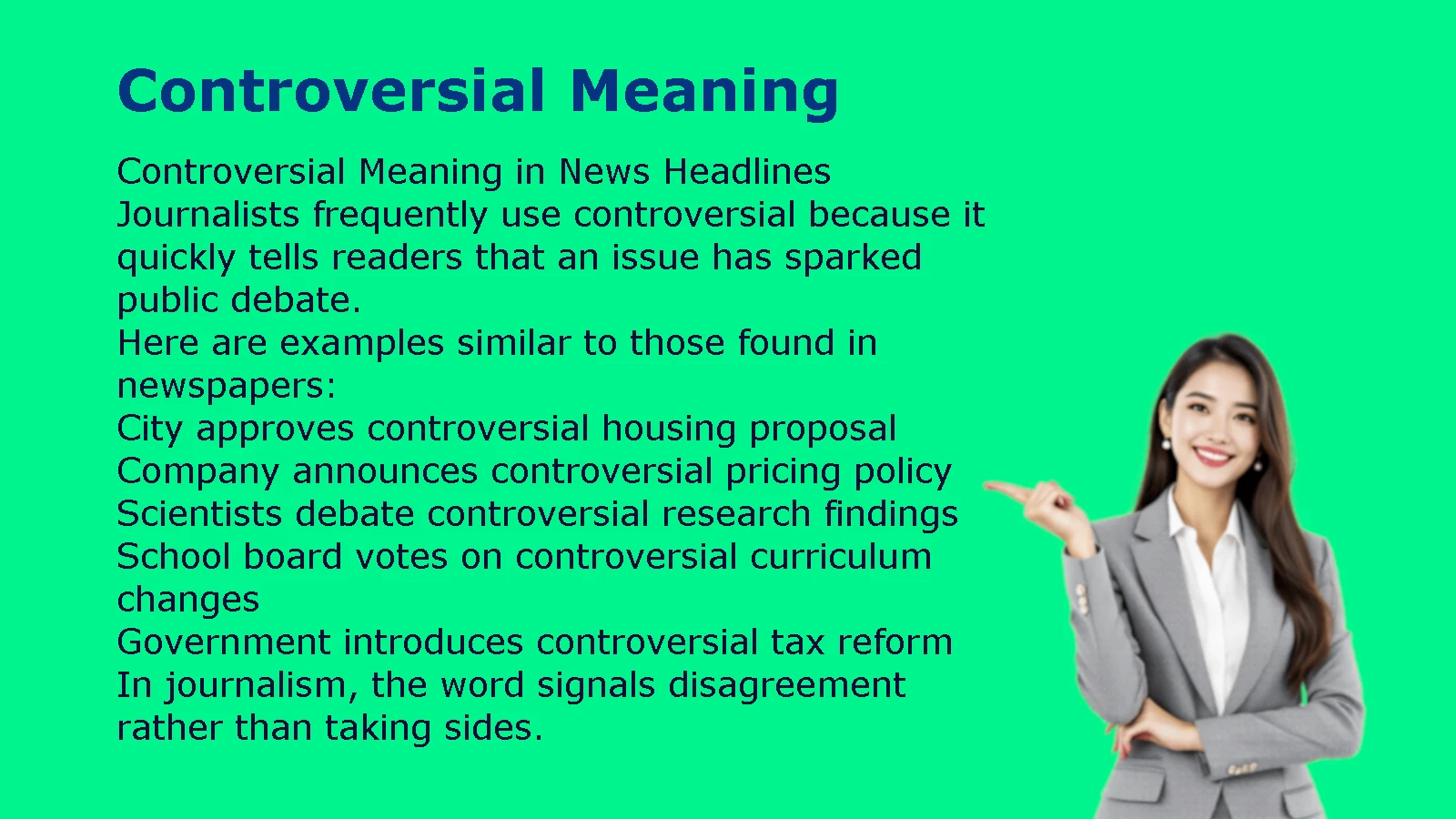
Controversial Meaning in News Headlines
Journalists frequently use controversial because it quickly tells readers that an issue has sparked public debate.
Here are examples similar to those found in newspapers:
- City approves controversial housing proposal
- Company announces controversial pricing policy
- Scientists debate controversial research findings
- School board votes on controversial curriculum changes
- Government introduces controversial tax reform
In journalism, the word signals disagreement rather than taking sides.
Controversial Meaning in School and Academic Writing
Teachers and professors often encourage students to analyze controversial subjects from multiple viewpoints.
For example:
- “The essay examines a controversial environmental policy.”
- “Students discussed several controversial ethical questions.”
- “Researchers explored a controversial scientific theory.”
Academic writing usually avoids emotional language. Instead of arguing, writers explain why different opinions exist.
Controversial Meaning in the Workplace
Businesses also encounter controversial decisions.
Examples include:
- Changing employee benefits
- Introducing artificial intelligence tools
- Closing office locations
- Revising company policies
- Adjusting work schedules
Example sentences:
- “The company’s return-to-office policy proved controversial.”
- “The proposed restructuring remains controversial among employees.”
A workplace controversy often affects morale, productivity, or company culture because different groups have different priorities.
Controversial Meaning on Social Media
Social media can turn a simple opinion into a global discussion within minutes.
Common examples include:
- Viral posts
- Celebrity comments
- Marketing campaigns
- Product launches
- Political opinions
Example:
A creator shares an opinion. Thousands agree, while thousands disagree. The post becomes controversial because it divides the audience.
This doesn’t automatically mean the opinion is false. It simply means people react differently.
Common Types of Controversial Topics
Some subjects naturally generate more debate than others.
Here’s why.
| Topic | Why It Becomes Controversial |
| Politics | Different political beliefs and priorities |
| Religion | Personal faith and traditions vary widely |
| Education | Parents, teachers, and policymakers often disagree |
| Technology | New innovations raise ethical and privacy questions |
| Healthcare | Medical decisions affect individuals and society |
| Environment | Balancing economic growth and conservation can be difficult |
| Business | Company decisions may help some groups while affecting others |
| Entertainment | Creative works often challenge social expectations |
| Sports | Rule changes and officiating decisions can divide fans |
These topics often involve values rather than simple facts. That is why debates can continue for years.
Why Some Issues Stay Controversial
Some disagreements disappear quickly.
Others last for decades.
Several factors keep a topic controversial.
People’s Values Differ
Facts matter, but values influence how people interpret those facts.
For example:
- One person values personal freedom.
- Another prioritizes public safety.
Both may look at the same issue and reach different conclusions.
New Information Appears
Scientific discoveries, legal rulings, or technological advances can change public opinion.
As evidence evolves, discussions continue.
Emotional Investment
Topics connected to family, identity, culture, or religion often generate stronger reactions than ordinary issues.
When emotions run high, consensus becomes harder to reach.
Media Coverage
Continuous reporting keeps controversial issues in public discussion.
Television, podcasts, newspapers, and social platforms all influence how people understand an issue.
Controversial vs. Similar Words
Many English learners confuse controversial with other words.
Although they are related, each has a different meaning.
Understanding these differences helps you choose the right word.
Controversial vs. Unpopular
These words are not interchangeable.
| Controversial | Unpopular |
| People disagree about it. | Most people dislike it. |
| There are supporters and critics. | Very few people support it. |
Example
A new law may be controversial because citizens disagree.
An outdated website design may simply be unpopular because almost everyone dislikes it.
Controversial vs. Offensive
These words describe different ideas.
| Controversial | Offensive |
| Creates disagreement | Causes insult or hurt |
| May be respectful | Usually causes offense |
Something can be controversial without offending anyone.
Likewise, something offensive is often controversial, but the two words are not identical.
Controversial vs. Debatable
A debatable issue is open to discussion.
A controversial issue usually attracts stronger emotions and wider disagreement.
Example:
- “The best study method is debatable.”
- “The government’s proposal became controversial.”
Controversial vs. Divisive
These words are closely related.
However, divisive suggests that people split into opposing groups.
Controversial simply means disagreement exists.
Example:
A sports rule change may be controversial.
A national political issue may become divisive because it separates communities into opposing sides.
Controversial vs. Disputed
A disputed claim usually concerns facts, ownership, or accuracy.
A controversial topic often involves values, beliefs, or opinions.
Example:
- The land ownership remains disputed.
- The proposed policy remains controversial.
Synonyms of Controversial
Choosing the right synonym depends on context.
| Synonym | Meaning | Best Used For |
| Contentious | Likely to cause arguments | Meetings, debates |
| Divisive | Splits people into groups | Politics, society |
| Debatable | Open to discussion | Ideas, theories |
| Disputed | Questioned or challenged | Facts, ownership |
| Polarizing | Creates strong opposite opinions | Public figures, social issues |
| Sensitive | Requires careful discussion | Cultural or personal topics |
| Questionable | Raises doubts | Decisions, ethics |
Example Sentences
- The proposal remains contentious.
- The speech became polarizing.
- The evidence is disputed.
- The issue remains debatable.
- The subject is sensitive in many communities.
Although these words overlap, each carries a slightly different tone.
Antonyms of Controversial
Sometimes you need a word that expresses broad agreement instead.
| Antonym | Meaning |
| Uncontroversial | Rarely debated |
| Accepted | Widely approved |
| Agreed-upon | Supported by everyone involved |
| Undisputed | Not questioned |
| Noncontentious | Unlikely to create conflict |
| Universally accepted | Accepted almost everywhere |
Examples
- The safety guidelines are widely accepted.
- The team’s decision was uncontroversial.
- The scientific principle is undisputed.
Is Controversial Always Negative?
One of the biggest misunderstandings about the controversial meaning is that the word automatically describes something bad.
It doesn’t.
The adjective itself is neutral.
It tells you how people respond, not whether the subject is correct.
Consider these examples.
| Situation | Is It Controversial? | Is It Automatically Bad? |
| New scientific theory | Yes | No |
| School policy | Yes | No |
| Environmental regulation | Yes | No |
| Historical interpretation | Yes | No |
| Public health proposal | Yes | No |
Many ideas that were once controversial later became widely accepted.
Likewise, some controversial ideas eventually lost public support.
The word only describes the presence of disagreement.
Common Phrases That Use “Controversial”
English speakers regularly combine controversial with certain nouns.
Learning these combinations will make your writing sound more natural.
| Phrase | Example |
| Controversial opinion | She shared a controversial opinion during the discussion. |
| Controversial issue | Climate policy remains a controversial issue. |
| Controversial topic | Religion can be a controversial topic in some settings. |
| Controversial statement | The interview included a controversial statement. |
| Controversial law | Citizens challenged the controversial law in court. |
| Controversial decision | The board announced a controversial decision. |
| Controversial policy | Employees debated the controversial policy. |
| Controversial figure | The author became a controversial figure because of public comments. |
These combinations appear frequently in newspapers, books, and formal writing.
Case Study: Why a Simple Decision Can Become Controversial
Imagine a city announces that several downtown streets will become pedestrian-only.
Supporters say the change will:
- Improve air quality
- Increase public safety
- Boost local tourism
Critics argue it will:
- Reduce parking
- Hurt small businesses
- Increase traffic elsewhere
Both sides present reasonable arguments.
The decision becomes controversial because the community remains divided. The word doesn’t tell you who is right. It simply explains that people disagree strongly.
“A controversial issue isn’t defined by the volume of the debate. It’s defined by the depth of the disagreement.”
Quick Recap
Before moving to the final section, here are the key points you’ve learned:
| Topic | Key Takeaway |
| Controversial meaning | Something that causes public disagreement or debate. |
| Common uses | News, education, business, politics, entertainment, and social media. |
| Not the same as | Offensive, unpopular, or disputed. |
| Similar words | Contentious, divisive, debatable, polarizing, disputed. |
| Opposite words | Uncontroversial, accepted, undisputed, noncontentious. |
| Important fact | Controversial does not automatically mean bad. It simply means opinions are divided. |
Common Mistakes When Using “Controversial”
Even fluent English speakers sometimes misuse the word controversial. Most mistakes happen because people assume it always carries a negative meaning or confuse it with similar words.
Understanding these common errors will help you use the word naturally and accurately.
Mistake: Thinking “Controversial” Means “Wrong”
This is the most common misunderstanding.
A controversial idea isn’t automatically false, unethical, or harmful. It simply divides opinion.
Incorrect Thinking
“The proposal is controversial, so it must be a bad idea.”
Better Understanding
“The proposal is controversial because different groups disagree about it.”
Always separate public reaction from objective truth.
Mistake: Using It for Minor Disagreements
Not every disagreement creates controversy.
For example, two friends arguing about which pizza topping tastes better doesn’t usually qualify as a controversial issue.
Instead, the disagreement should involve a larger audience or community.
Better Examples
- A controversial court decision
- A controversial education policy
- A controversial scientific claim
- A controversial advertising campaign
These examples affect many people or generate widespread discussion.
Mistake: Confusing It With “Offensive”
Something offensive often hurts or insults people.
Something controversial simply causes disagreement.
Example
A documentary about a difficult historical event may be controversial because people interpret history differently.
It isn’t necessarily offensive.
Mistake: Overusing the Word
Because controversial attracts attention, some writers use it too often.
Instead, choose more specific words when appropriate.
For example:
| Instead of Always Saying… | Consider Using… |
| Controversial opinion | Divisive opinion |
| Controversial research | Disputed research |
| Controversial statement | Polarizing statement |
| Controversial subject | Sensitive subject |
| Controversial claim | Debatable claim |
Using precise vocabulary makes your writing stronger.
Mistake: Ignoring Context
Whether something is controversial often depends on:
- Time
- Culture
- Location
- Audience
- Social values
For example, an issue that sparks intense debate in one country may receive little attention in another.
Likewise, opinions can change over time as new evidence emerges or social attitudes evolve.
Word Origin and Etymology
Learning where a word comes from often makes its meaning easier to remember.
The adjective controversial has a long linguistic history.
| Language | Word | Meaning |
| Latin | controversia | Dispute or debate |
| Medieval Latin | controversialis | Relating to disagreement |
| English | Controversial | Causing public disagreement |
The Latin word controversia combines ideas related to turning against or opposing viewpoints, which explains why the modern English word refers to disagreement and debate.
Although English has evolved dramatically over the centuries, the core meaning of controversial has remained remarkably consistent.
Real-World Examples of the Controversial Meaning
The word appears in many areas of daily life.
Let’s look at practical examples.
A Controversial Business Decision
Imagine a company decides to replace traditional customer service with AI-powered chatbots.
Some customers appreciate:
- Faster responses
- Twenty-four-hour support
- Lower service costs
Others worry about:
- Reduced human interaction
- Job losses
- Lower service quality
The decision becomes controversial because opinions differ.
A Controversial Scientific Claim
Researchers sometimes publish findings that challenge established beliefs.
Other scientists may:
- Request additional evidence
- Repeat experiments
- Debate the conclusions
Scientific disagreement doesn’t mean the research is invalid. It reflects the process of careful examination.
A Controversial Movie
Films often become controversial because of:
- Sensitive themes
- Historical interpretations
- Social commentary
- Graphic content
- Political messages
Different audiences may interpret the same movie in completely different ways.
A Controversial Advertisement
Marketing campaigns occasionally spark debate.
One audience may praise an advertisement as creative.
Another may criticize it for its message or execution.
Companies often review public feedback before deciding whether to continue or revise a campaign.
A Controversial Public Figure
Public figures sometimes express opinions that divide audiences.
Supporters may admire their honesty.
Critics may strongly disagree.
Describing someone as a controversial figure simply means they generate mixed public reactions.
It does not automatically judge their character.
How to Decide Whether Something Is Truly Controversial
Before using the word, ask yourself a few simple questions.
✔ Are there strong arguments on both sides?
Has it sparked ongoing public discussion?
If the answer to most of these questions is yes, then controversial is probably the correct word.
Quick Checklist for Using “Controversial”
Use controversial when something:
- Creates public debate
- Divides opinions
- Generates discussion
- Has supporters and critics
- Remains widely discussed
- Produces different viewpoints
Avoid using it when something is simply:
- Unpopular
- Incorrect
- Offensive
- Unusual
- Personal
Frequently Asked Questions About the Controversial Meaning
What does controversial mean in simple words?
Controversial means something causes disagreement or debate because people have different opinions about it.
Does controversial always mean bad?
No.
The word itself is neutral. It only tells you that opinions are divided. It does not determine whether something is good or bad.
Can a person be controversial?
Yes.
A public figure, author, athlete, or business leader can become controversial if their actions, decisions, or statements generate strong public disagreement.
What makes an issue controversial?
An issue becomes controversial when people hold opposing views and continue debating it over time.
Is controversial the same as offensive?
No.
An offensive statement insults or upsets people.
A controversial statement creates disagreement.
Sometimes a statement is both, but the meanings are different.
What is another word for controversial?
Common synonyms include:
- Divisive
- Contentious
- Polarizing
- Debatable
- Disputed
- Sensitive
The best choice depends on the context.
Can something be controversial in one country but not another?
Absolutely.
Cultural values, laws, traditions, and historical experiences influence how people respond to different issues.
What sparks debate in one society may receive broad acceptance in another.
How do you use controversial in a sentence?
Here are a few examples:
- The committee approved a controversial proposal.
- Her speech became controversial after the conference.
- The documentary explores a controversial historical event.
- Experts continue debating the controversial research findings.
- The city’s transportation plan remains controversial.
Key Takeaways
Here’s a quick summary of everything you’ve learned.
| Topic | Summary |
| Controversial meaning | Something that causes disagreement or debate. |
| Part of speech | Adjective |
| Common uses | Opinions, decisions, laws, policies, books, movies, people, and issues. |
| Positive or negative? | Neither by itself. It simply describes divided opinions. |
| Common synonyms | Divisive, contentious, debatable, disputed, polarizing. |
| Common antonyms | Uncontroversial, accepted, undisputed, agreed-upon. |
| Best advice | Use the word only when meaningful disagreement exists. |
Final Thoughts on the Controversial Meaning
Understanding the controversial meaning is about more than memorizing a dictionary definition. It requires recognizing why people disagree and how the word functions in different contexts.
Whether you’re reading a news article, writing an academic essay, following public policy, or simply chatting with friends, you’ll encounter this adjective often. Knowing its precise meaning helps you communicate more clearly and avoid common misunderstandings.
Remember the core idea:
A topic is controversial because it divides opinion—not because it is automatically right, wrong, good, or bad.
When you use the word thoughtfully, you describe the nature of a discussion rather than passing judgment. That’s what makes controversial such a valuable and widely used term in modern English.
Conclusion
The controversial meaning centers on disagreement, debate, and differing viewpoints. From politics and science to entertainment and everyday conversations, the word describes subjects that inspire strong opinions from different people. It doesn’t label an idea as correct or incorrect. Instead, it highlights that reasonable individuals may reach different conclusions based on their experiences, values, or interpretation of the facts.
The next time you hear someone describe a decision, opinion, or public figure as controversial, you’ll know exactly what they mean. More importantly, you’ll be able to use the word confidently in your own speaking and writing, choosing it only when genuine disagreement exists. That’s the key to using English with both accuracy and confidence.