
Have you ever noticed that two numbers, records, or statements don’t quite match and wondered what to call the difference? That’s where Discrepancy Meaning comes into play. This useful word describes a difference or inconsistency between things that are expected to match.
Discrepancy is a noun that means a noticeable difference between two things, especially when they should be the same or agree with each other. It is often used when talking about information, records, numbers, reports, or statements that do not match.
Examples:
- We found a discrepancy between the two reports.
- The accountant noticed a discrepancy in the financial records.
The confusion is understandable. People often search for what does discrepancy mean, discrepancy meaning in English, discrepancy meaning in a sentence, or discrepancy synonyms because the word can sound formal and its exact meaning depends on the context. And here’s the kicker: a discrepancy doesn’t always mean someone made a mistake. It simply points to a difference or inconsistency that needs attention.
In this guide, you’ll learn the complete Discrepancy Meaning, its definition, pronunciation, part of speech, correct usage, and examples in sentences. You’ll also discover common synonyms for discrepancy, its meaning in different contexts, and how to use this word naturally in everyday and professional English.
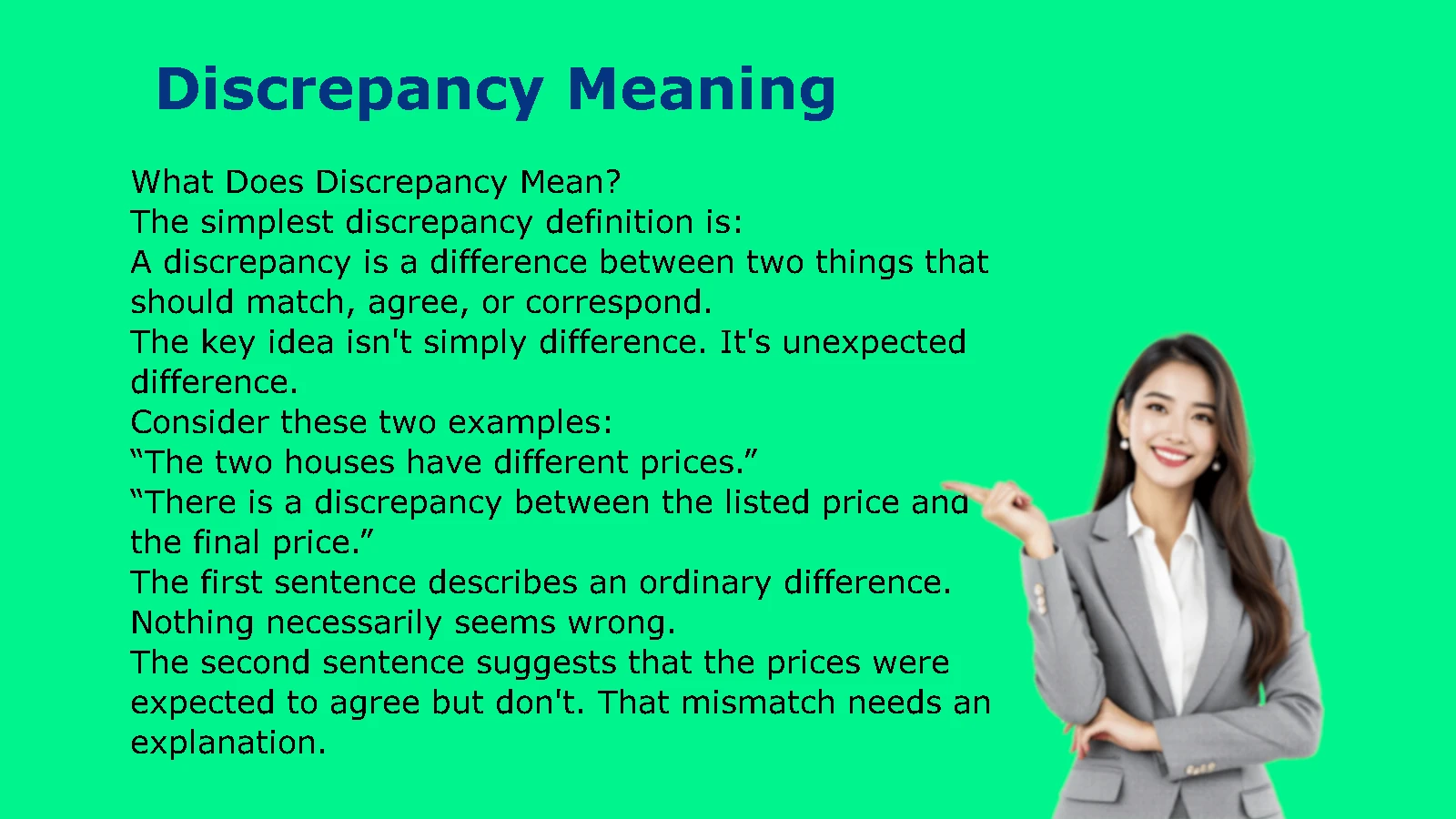
What Does Discrepancy Mean?
The simplest discrepancy definition is:
A discrepancy is a difference between two things that should match, agree, or correspond.
The key idea isn’t simply difference. It’s unexpected difference.
Consider these two examples:
- “The two houses have different prices.”
- “There is a discrepancy between the listed price and the final price.”
The first sentence describes an ordinary difference. Nothing necessarily seems wrong.
The second sentence suggests that the prices were expected to agree but don’t. That mismatch needs an explanation.
Cambridge similarly defines discrepancy as a difference between things that should be the same. Its academic definition adds an important idea: an unexpected difference can suggest that something is wrong and needs to be explained.
Discrepancy Meaning in Simple English
In everyday English, you can think of discrepancy as:
“Something doesn’t match when it should.”
That makes the word much easier to understand.
For example:
The invoice says $500, but the payment record says $450.
There is a discrepancy between the invoice and the payment record.
Or:
One report says 2,000 people attended while another says 2,500.
There is a discrepancy between the two reports.
The mismatch doesn’t automatically tell you why the numbers differ. Someone may have made a calculation error. One source may have used different data. A record may not have been updated. The discrepancy simply tells you that the information doesn’t line up as expected.
Discrepancy Definition and Core Meaning
The word discrepancy works best when you have two or more things that you can compare.
Those things might include:
- Two numbers
- Two reports
- Two statements
- Two records
- Two accounts
- Two sets of data
- A receipt and a payment
- A schedule and an actual time
- A description and the thing it describes
- Information from two different sources
Oxford lists discrepancy as both countable and uncountable and gives discrepancies as its plural form. It also identifies the common patterns discrepancy between and discrepancy in.
The Main Idea Behind the Word
A useful way to remember the meaning is to focus on the expectation.
Expected:
Record A = Record B
Actual:
Record A ≠ Record B
Result:
There is a discrepancy.
The size doesn’t matter by itself. A discrepancy can be tiny or enormous.
For example:
- A receipt is off by $1.
- Two reports differ by 10 people.
- Two financial records differ by $30 million.
All three can involve discrepancies if the figures were expected to match. Cambridge’s Business English examples specifically use discrepancies in financial records and figures.
Discrepancy Pronunciation
The American English pronunciation of discrepancy is:
/dɪˈskrepənsi/
An easy pronunciation guide is:
dis-KREP-uhn-see
The main stress falls on KREP.
Discrepancy Word Forms
| Form | Word |
| Singular noun | discrepancy |
| Plural noun | discrepancies |
| Adjective | discrepant |
For example:
- “We found a discrepancy in the records.”
- “The audit revealed several discrepancies.”
- “The two sets of figures are discrepant.”
Cambridge defines discrepant as describing a difference between things that should be the same.
Is Discrepancy a Noun?
Yes. Discrepancy is a noun.
You normally use it to name a mismatch or inconsistency.
Singular
“There is a discrepancy in the report.”
Plural
“The auditors found several discrepancies in the accounts.”
The plural changes from discrepancy to discrepancies, not discrepancys.
That small spelling point matters because words ending in -y often change to -ies when you form the plural.
What Is an Example of a Discrepancy?
Suppose a store’s inventory system says it has 150 laptops in stock. A physical count finds only 142.
The difference is:
150 − 142 = 8
There is an 8-unit discrepancy between the inventory record and the physical count.
That doesn’t necessarily mean someone stole eight laptops. Several explanations could exist:
- A sale wasn’t entered into the system.
- A shipment was recorded incorrectly.
- A return wasn’t processed.
- Someone entered the wrong number.
- The physical count contained an error.
The word discrepancy describes the mismatch. It doesn’t prove the cause.
Another Simple Example
A school record says a student attended 92 days, while another official record says the student attended 89 days.
There is a discrepancy between the two attendance records.
Again, the discrepancy itself doesn’t tell you which record is correct.
That’s an important part of the discrepancy meaning: the word identifies a conflict or mismatch without automatically assigning blame.
Discrepancy Examples in Everyday English
You don’t need to work in accounting or research to encounter discrepancies. They can appear whenever people compare information.
Financial Discrepancy Examples
“The accountant noticed a discrepancy between the invoice and the payment.”
“We found a small discrepancy in the monthly expenses.”
“The audit revealed several discrepancies in the financial records.”
Financial situations make the meaning especially clear because numbers are often expected to match exactly.
Data Discrepancy Examples
“The researchers found a discrepancy between the two data sets.”
“There is a discrepancy in the reported figures.”
“The team investigated the discrepancy before publishing the results.”
Data discrepancies can happen when different sources collect information at different times or use different methods.
Record Discrepancy Examples
“There was a discrepancy between the employee’s file and the database.”
“The clerk discovered a discrepancy in the customer records.”
“The records contain several discrepancies that need to be corrected.”
Statement Discrepancy Examples
“The investigators noticed a discrepancy between the two statements.”
“There was a discrepancy between his account and the witness’s account.”
Here, the word points to conflicting information rather than necessarily proving that someone lied.
Everyday Examples
“I noticed a discrepancy between the price on the shelf and the price at checkout.”
“There was a discrepancy between the time on my ticket and the time on the schedule.”
“The website lists 10 items, but the package contains only nine. There’s a discrepancy somewhere.”
These examples show why discrepancy meaning is broader than accounting. Anywhere expected information fails to match, the word can fit.
How to Use Discrepancy in a Sentence
Two patterns are especially useful:
- discrepancy between A and B
- discrepancy in something
Oxford specifically lists these preposition patterns in its usage information.
Discrepancy Between
Use between when you want to identify the two things that don’t agree.
Pattern:
a discrepancy between A and B
Examples:
- “There is a discrepancy between the two reports.”
- “We found a discrepancy between the invoice and the receipt.”
- “The auditor identified a discrepancy between the recorded amount and the actual payment.”
- “There was a discrepancy between the witness statements.”
This is one of the most natural and useful constructions.
Discrepancy In
Use in when you focus on the information, record, figure, or system containing the mismatch.
Pattern:
a discrepancy in something
Examples:
- “There is a discrepancy in the records.”
- “The auditor found a discrepancy in the accounts.”
- “The report contains a discrepancy in the figures.”
- “We noticed a discrepancy in the data.”
Both structures are correct. The choice depends on what you want to emphasize.
Explain a Discrepancy
You can also use explain with discrepancy when someone needs to account for the difference.
“Can you explain this discrepancy?”
This phrasing works particularly well in professional settings because it draws attention to the mismatch without immediately accusing anyone of making an error.
Other useful verbs include:
- identify a discrepancy
- find a discrepancy
- discover a discrepancy
- investigate a discrepancy
- resolve a discrepancy
- address a discrepancy
- account for a discrepancy
Oxford’s collocation information includes verbs such as account for, explain, and discover with discrepancy.
Common Collocations With Discrepancy
A collocation is a group of words that naturally appear together. Learning these combinations makes your English sound more natural.
Common Adjectives
- slight discrepancy
- minor discrepancy
- small discrepancy
- significant discrepancy
- major discrepancy
- large discrepancy
- glaring discrepancy
- wide discrepancy
- growing discrepancy
For example:
“The auditor found a significant discrepancy in the accounts.”
Oxford lists combinations such as big, glaring, and great discrepancy, while Cambridge gives examples such as huge, growing, and wide discrepancy.
Common Noun Combinations
You may also see:
- accounting discrepancy
- financial discrepancy
- data discrepancy
- numerical discrepancy
- inventory discrepancy
- record discrepancy
- reporting discrepancy
- price discrepancy
The exact combination depends on the context.
Discrepancy vs. Difference
Discrepancy and difference overlap, but they aren’t interchangeable in every situation.
The easiest distinction is this:
| Word | Basic meaning | Usually suggests a problem? |
| Difference | Two things aren’t alike | No |
| Discrepancy | Two things don’t match when they should | Often |
| Disparity | Two things differ significantly, often in equality or fairness | Often |
A difference can be completely normal.
For example:
“There is a difference between a cat and a dog.”
Nothing is wrong. They’re simply different animals.
But consider:
“There is a discrepancy between the two medical records.”
The records were expected to contain consistent information. Their mismatch needs attention.
A Quick Rule
Use difference for a broad, neutral comparison.
Use discrepancy when the difference represents an unexpected mismatch.
That’s the heart of the distinction.
Discrepancy vs. Disparity
These two words can cause confusion because both describe differences.
However, discrepancy usually focuses on a mismatch between information or things that should agree. Disparity generally focuses on inequality or a significant difference between people, groups, amounts, or conditions.
Oxford defines disparity as a difference and gives examples involving differences in performance and economic circumstances. Cambridge adds the idea of a lack of equality or similarity, especially when the difference is unfair.
Compare:
“There is a discrepancy between the two salary reports.”
The reports should contain matching figures.
Now:
“There is a disparity between the salaries of the two groups.”
The sentence focuses on unequal pay.
Side-by-Side Comparison
| Term | Main focus | Example |
| Discrepancy | Unexpected mismatch | “There is a discrepancy between the two reports.” |
| Disparity | Inequality or substantial difference | “There is a disparity in income between the groups.” |
| Difference | Any way things are unlike | “There is a difference between the two plans.” |
The distinction becomes much easier once you ask what the comparison is doing.
Is something supposed to match? Think discrepancy.
Are two groups or conditions unequal? Think disparity.
Are you simply pointing out that two things aren’t alike? Think difference.
Discrepancy vs. Inconsistency
Inconsistency is another close synonym, but it has a slightly different emphasis.
Oxford explains that an inconsistency can occur when two statements give facts in different ways and therefore cannot both be true. It can also describe something that fails to match a particular standard or set of ideas.
Compare:
“There is a discrepancy between the two records.”
This highlights the mismatch.
“There is an inconsistency between his two statements.”
This highlights the fact that the statements don’t agree.
In many situations, the words overlap. However, inconsistency often works particularly well for behavior, arguments, statements, rules, and claims.
Synonyms for Discrepancy
The best discrepancy synonym depends on the context.
Difference
The broadest and most common alternative.
“There is a difference between the two figures.”
However, difference doesn’t necessarily imply that anything is wrong.
Mismatch
A more informal word for things that don’t correspond.
“There’s a mismatch between the order and the delivery.”
This works well in everyday speech.
Inconsistency
Useful when information, statements, behavior, or arguments don’t agree.
“The report contains several inconsistencies.”
Contradiction
Stronger than discrepancy. A contradiction occurs when two statements directly oppose each other.
“His second statement contradicted his first.”
Not every discrepancy is a contradiction.
Irregularity
Useful when something doesn’t follow an expected pattern, rule, or process.
“The audit uncovered several irregularities.”
Anomaly
An anomaly is something unusual or unexpected that differs from a normal pattern.
“The researchers noticed an anomaly in the data.”
An anomaly may be a discrepancy, but the two words aren’t exact substitutes.
Synonym Comparison
| Synonym | Best used when… |
| Difference | You simply mean that two things aren’t alike |
| Mismatch | Two things don’t correspond |
| Inconsistency | Statements, information, or behavior don’t agree |
| Contradiction | Two claims directly conflict |
| Irregularity | Something doesn’t follow an expected rule or pattern |
| Anomaly | Something unexpectedly differs from the normal pattern |
| Discrepancy | Things expected to match don’t agree |
Choosing the right synonym isn’t about finding the fanciest word. It’s about choosing the word that describes the exact relationship between the things you’re comparing.
Antonyms of Discrepancy
There isn’t one perfect opposite in every context. Still, several words can express the idea of matching or agreement.
Common discrepancy antonyms include:
- agreement
- consistency
- correspondence
- conformity
- match
- harmony
- accuracy
For example:
“There was no discrepancy between the two records.”
You could also say:
“The two records were consistent.”
Or:
“The figures matched.”
The best choice depends on the sentence.
Common Types of Discrepancies
A discrepancy can appear in almost any system that depends on accurate information.
Financial Discrepancies
Financial discrepancies occur when amounts in financial documents don’t agree.
For example:
- An invoice says $2,400.
- The payment record says $2,200.
- The difference is $200.
Before anyone assumes an error, the records need to be checked.
Financial discrepancies can result from incorrect entries, fees, refunds, timing differences, duplicate transactions, or other bookkeeping issues.
Data Discrepancies
A data discrepancy occurs when two data sources contain different information where consistency is expected.
For example, one database may list:
Customer orders: 4,820
while another lists:
Customer orders: 4,790
The 30-record difference is a discrepancy that needs investigation.
The important question isn’t simply “Which number is different?” It is “Why are these numbers different?”
Inventory Discrepancies
Inventory systems provide another straightforward example.
Suppose a warehouse database says there are 1,200 units of a product. A physical count finds 1,185.
That creates a discrepancy of 15 units.
Possible causes include:
- Unrecorded sales
- Damaged products
- Incorrect receiving records
- Counting mistakes
- Data-entry errors
- Returns that weren’t processed
The discrepancy provides a starting point for investigation.
Record Discrepancies
Records can contain different names, dates, addresses, amounts, or other details.
For example:
One record lists the customer’s birth year as 1988 while another lists 1989.
That is a discrepancy between the records.
It doesn’t necessarily mean either record was deliberately falsified. A simple typing error could explain it.
Statement Discrepancies
Statements can conflict when different people describe the same event differently.
Person A says the meeting began at 9:00 a.m.
Person B says it began at 9:30 a.m.
If both accounts were expected to describe the same event accurately, the conflicting times represent a discrepancy.
Why Do Discrepancies Happen?
A discrepancy doesn’t automatically mean fraud, dishonesty, or incompetence.
In many cases, ordinary mistakes create the mismatch.
Common causes include:
- Human error
- Incorrect data entry
- Calculation mistakes
- Outdated records
- Different reporting dates
- Missing information
- Duplicate entries
- Different measurement methods
- Unrecorded changes
- Communication errors
- Software or database problems
A Simple Case Study
Imagine that a small business’s accounting system reports $48,500 in sales for the month. The bank records show $47,900 in deposits.
At first glance, the $600 gap looks like a discrepancy.
But several explanations are possible.
Perhaps:
- A $600 payment arrived on the last day of the month but didn’t reach the bank until the following month.
- The accounting system included a transaction that was later canceled.
- A refund wasn’t recorded correctly.
- Someone entered the wrong amount.
- The bank statement covers a slightly different reporting period.
The discrepancy tells the business where to look. It doesn’t tell the business what happened.
That’s an important practical lesson: identify the mismatch first, then investigate the cause.
How to Identify and Resolve a Discrepancy
When you find a discrepancy, don’t jump straight to conclusions. Follow the evidence.
Compare the Two Sources
Start by putting the conflicting information side by side.
For example:
| Source | Amount |
| Invoice | $1,250 |
| Payment record | $1,150 |
| Difference | $100 |
Now the problem is concrete.
Check the Original Records
Look beyond summaries.
Review the original invoice, receipt, transaction record, report, or source document. A summary can contain an error that doesn’t exist in the original data.
Check Dates
Timing causes many apparent discrepancies.
One report might cover January 1 through January 31 while another includes transactions through February 2.
The numbers can differ without either report being incorrect.
Check Calculations
Simple arithmetic errors can create surprisingly large problems when they appear repeatedly.
Verify:
- Totals
- Subtotals
- Percentages
- Taxes
- Discounts
- Quantities
- Currency conversions
Check Data Entry
A single misplaced digit can create a discrepancy.
For example:
$1,580 vs. $1,850
The numbers look similar at a glance, but they’re $270 apart.
Determine the Correct Information
Once you’ve found the source of the mismatch, determine which information accurately represents the underlying facts.
Don’t simply change the larger or smaller number because it looks more plausible.
Document the Resolution
If the discrepancy matters professionally, record:
- What differed
- Which sources you compared
- What caused the discrepancy
- What correction was made
- When the correction occurred
That creates a useful trail for future reviews.
Is Discrepancy a Negative Word?
Not necessarily.
The word itself is fairly neutral. It describes a mismatch.
However, it often appears in situations involving problems, errors, investigations, or conflicting information. That’s why it can carry a slightly serious tone.
Compare:
“We noticed a discrepancy in the report.”
with:
“We discovered deliberate fraud in the report.”
The first sentence identifies a mismatch. The second makes a much stronger claim.
A discrepancy might turn out to be something harmless.
For example, a website could list an old price while the checkout system uses the updated price. That’s still a discrepancy even if nobody intended to mislead customers.
Is Discrepancy a Formal Word?
Yes. Discrepancy is generally considered a formal word.
Cambridge labels it formal, and the word appears frequently in professional, academic, financial, administrative, and business contexts.
In casual conversation, people often choose simpler alternatives.
Formal
“There appears to be a discrepancy between the two figures.”
Casual
“Those two numbers don’t match.”
Both communicate the same basic idea. The first sounds more professional and precise.
Where You’ll Commonly See Discrepancy
You may encounter the word in:
- Business reports
- Accounting documents
- Financial statements
- Academic papers
- Research reports
- Audits
- Official records
- Legal or administrative documents
- Data analysis
- Workplace emails
That doesn’t mean you should avoid it in conversation. It simply means that discrepancy naturally fits more formal settings.
Common Mistakes When Using Discrepancy
Knowing the definition isn’t enough. You also need to know when not to use it.
Calling Every Difference a Discrepancy
This is probably the most common conceptual mistake.
If two people have different favorite foods, that’s a difference.
You wouldn’t normally say:
“There is a discrepancy between their favorite foods.”
The word sounds strange because there is no expectation that their preferences should match.
Assuming Every Discrepancy Means an Error
A discrepancy means something doesn’t match. It doesn’t automatically reveal why.
For example:
“There is a discrepancy between the two reports.”
That’s a reasonable statement.
But:
“There is a discrepancy because someone made a mistake.”
That’s an additional claim that requires evidence.
Assuming Discrepancy Means Fraud
A discrepancy can result from fraud, but it can also result from a typo, timing issue, outdated information, or ordinary human error.
The word itself doesn’t establish intent.
Confusing Discrepancy With Disparity
A disparity often describes inequality.
A discrepancy usually describes an unexpected mismatch.
For example:
“There is a discrepancy between the two invoices.”
versus:
“There is a disparity between the incomes of the two groups.”
Those sentences describe different situations.
Discrepancy in Business and Professional English
Professional communication often uses discrepancy because the word lets you raise a problem without making an immediate accusation.
Compare these messages:
Too blunt:
“Your numbers are wrong.”
More professional:
“There appears to be a discrepancy between the figures in the report and the attached spreadsheet.”
The second version identifies the issue while leaving room for investigation.
You can then ask:
“Could you please review the figures and clarify the difference?”
That approach is especially useful when the cause isn’t known yet.
Useful Professional Phrases
- “We noticed a discrepancy in the records.”
- “There appears to be a discrepancy between the two figures.”
- “Could you help explain this discrepancy?”
- “We need to investigate the discrepancy.”
- “The discrepancy has now been resolved.”
- “Please review the discrepancy in the attached report.”
- “The figures contain a discrepancy that requires clarification.”
These phrases work well because they focus on the information rather than assigning blame.
Discrepancy in Academic and Research Writing
Researchers frequently compare measurements, datasets, studies, and reported findings. When expected results don’t align, discrepancy can describe the difference precisely.
For example:
“The researchers identified a discrepancy between the original measurements and the later observations.”
The word doesn’t necessarily mean that one study is wrong. Different methods, sample sizes, measurement conditions, or data-processing techniques may explain the difference.
This is one reason discrepancy is useful in careful writing. It allows you to identify a conflict without claiming more than the evidence supports.
Discrepancy vs. Contradiction
These words are related but shouldn’t be treated as identical.
A contradiction generally involves two claims that cannot both be true.
A discrepancy can be much milder.
For example:
Report A: 1,002 customers
Report B: 1,000 customers
That’s a discrepancy.
But it isn’t necessarily a contradiction. The difference could come from rounding or a reporting cutoff.
Now consider:
Statement A: “The meeting happened on Monday.”
Statement B: “The meeting never happened.”
Those statements directly conflict. Contradiction is the stronger and more precise word.
Discrepancy vs. Anomaly
An anomaly is something that differs from what is normal, expected, or typical.
A discrepancy usually involves a comparison between sources, figures, records, or things that should correspond.
For example:
“The database contains a discrepancy between two customer records.”
That’s a direct mismatch.
“The temperature reading was an anomaly compared with the rest of the day’s measurements.”
That’s an unusual observation within a pattern.
An anomaly can point to a discrepancy, but the concepts aren’t identical.
What Is the Plural of Discrepancy?
The plural is discrepancies.
Correct
“The audit found several discrepancies.”
Incorrect
“The audit found several discrepancys.”
The spelling changes from -y to -ies.
You can use discrepancies when referring to multiple mismatches:
“The report contains several discrepancies in the financial figures.”
Oxford lists discrepancies as the plural form.
Discrepancy Meaning: Quick Reference Table
| Question | Answer |
| What does discrepancy mean? | A difference between things that should match or agree |
| Part of speech | Noun |
| Plural | Discrepancies |
| Pronunciation | /dɪˈskrepənsi/ |
| Tone | Formal |
| Common pattern | Discrepancy between A and B |
| Another pattern | Discrepancy in something |
| Common synonym | Difference, mismatch, inconsistency |
| Common contrast | Agreement, consistency, match |
| Related adjective | Discrepant |
| Typical contexts | Business, accounting, records, data, research |
Frequently Asked Questions About Discrepancy Meaning
What does discrepancy mean in simple words?
Discrepancy means a difference between two things that are supposed to match.
For example, if one receipt says $40 and another record says $50, the $10 difference is a discrepancy.
What is a good example of a discrepancy?
A good example is a difference between two financial records.
If an invoice says $800 but the payment record shows $750, there is a $50 discrepancy between the two records.
Is discrepancy the same as difference?
Not exactly.
Difference is a broad, neutral word. Discrepancy usually describes an unexpected difference between things that should agree.
Is discrepancy a negative word?
Not inherently. It simply identifies a mismatch. However, people often use it in situations involving errors, problems, or information that needs investigation.
What is a synonym for discrepancy?
Depending on the context, possible synonyms include difference, mismatch, inconsistency, irregularity, anomaly, and contradiction. They aren’t perfect substitutes in every sentence.
What is the opposite of discrepancy?
Possible opposites include agreement, consistency, correspondence, conformity, and match.
How do you use discrepancy in a sentence?
A common structure is:
“There is a discrepancy between the two reports.”
You can also say:
“There is a discrepancy in the records.”
Is discrepancy formal or informal?
Discrepancy is formal. It works especially well in professional, academic, financial, and administrative writing.
What is the plural of discrepancy?
The plural is discrepancies.
“The auditor found several discrepancies.”
Does discrepancy always mean someone made a mistake?
No. A discrepancy can come from many causes, including different reporting periods, outdated information, data-entry errors, calculation mistakes, or incomplete records.
What is the difference between discrepancy and disparity?
A discrepancy usually involves an unexpected mismatch between things that should agree.
A disparity usually refers to inequality or a significant difference, especially between people, groups, amounts, or conditions. Cambridge specifically associates disparity with a lack of equality or similarity, particularly when the difference is unfair.
Final Takeaway: Discrepancy Meaning
The easiest way to remember the discrepancy meaning is:
A discrepancy is an unexpected difference between things that should match or agree.
The word commonly describes mismatches in numbers, records, reports, statements, accounts, data, and other information.
The most useful sentence patterns are:
- a discrepancy between A and B
- a discrepancy in something
- explain a discrepancy
- identify a discrepancy
- investigate a discrepancy
- resolve a discrepancy
Remember the distinction between difference and discrepancy. A difference can be perfectly normal. A discrepancy usually catches your attention because something that should line up doesn’t.
Think of it like two pieces of a puzzle. If they were never meant to fit together, their difference isn’t surprising. If they’re supposed to connect but leave a gap, you’ve found a discrepancy.