
Have you ever been told that someone was curt and wondered exactly what it meant? While Curt Meaning may seem simple, this word often describes more than just a short response. It can suggest that someone is brief, direct, or seemingly rude, depending on the tone, conversation, and context in which it is used.
Curt is an adjective used to describe speech or behavior that is very brief and direct, sometimes in a way that seems unfriendly or impolite. It is commonly used when someone gives a short answer without showing much warmth or explanation.
Examples:
- His curt reply made it clear that he didn’t want to continue the conversation.
- She gave me a curt answer and walked away.
The confusion is understandable. People often search for what does curt mean, curt meaning in text, curt meaning in chat, or what does it mean when someone is curt because the word can describe anything from simple brevity to a noticeably cold or rude tone. And here’s the kicker: a short answer isn’t always curt. The speaker’s attitude and tone often make the difference.
In this guide, you’ll learn the complete Curt Meaning, its definition, pronunciation, correct usage, and examples in sentences. You’ll also discover curt meaning in texting, synonyms and antonyms of curt, whether curt means rude, and the difference between curt, brief, blunt, and rude.
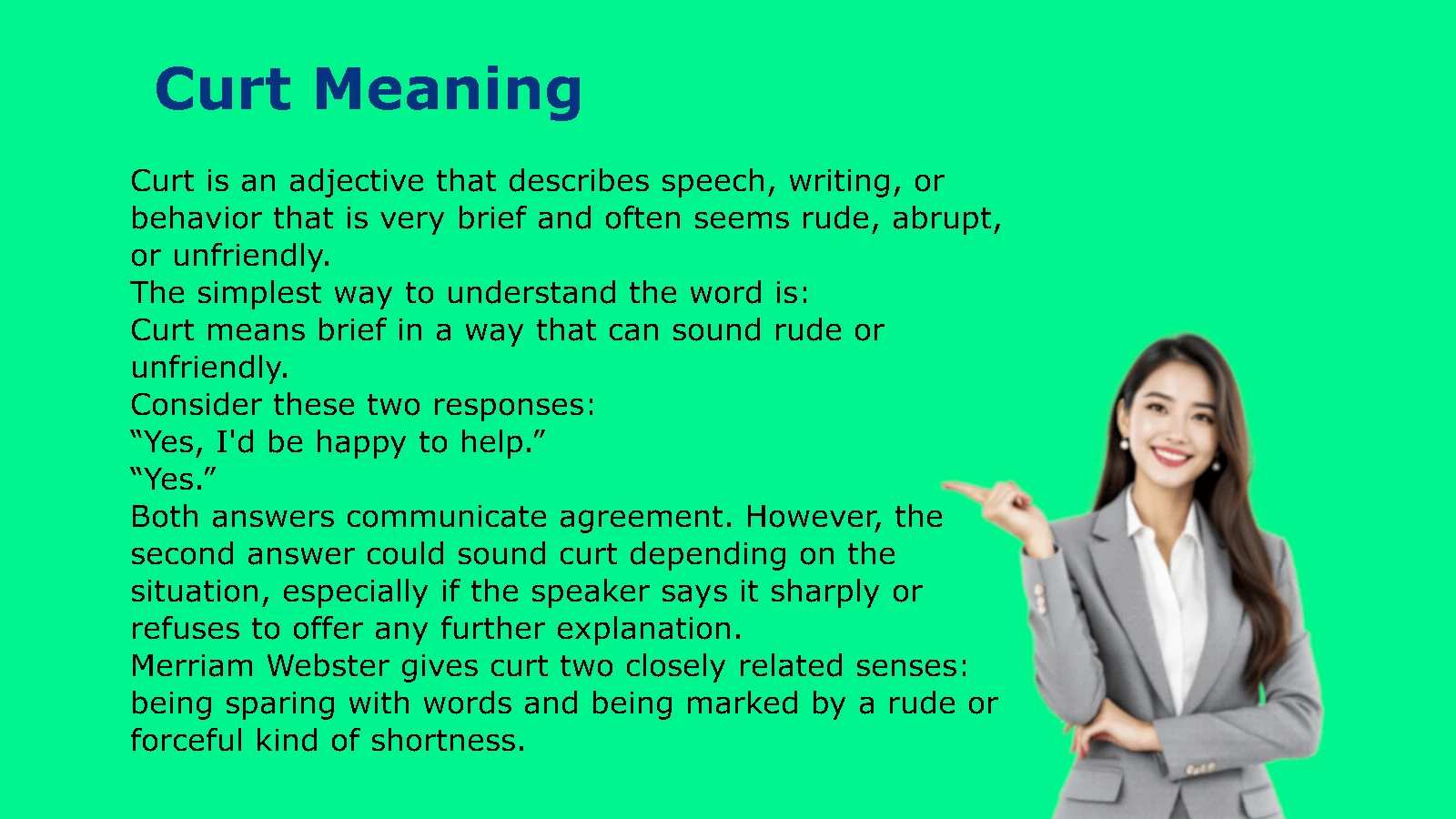
Curt Meaning
Curt is an adjective that describes speech, writing, or behavior that is very brief and often seems rude, abrupt, or unfriendly.
The simplest way to understand the word is:
Curt means brief in a way that can sound rude or unfriendly.
Consider these two responses:
- “Yes, I’d be happy to help.”
- “Yes.”
Both answers communicate agreement. However, the second answer could sound curt depending on the situation, especially if the speaker says it sharply or refuses to offer any further explanation.
Merriam Webster gives curt two closely related senses: being sparing with words and being marked by a rude or forceful kind of shortness.
Curt Definition at a Glance
| Word | Meaning | Example |
| Curt | Very brief and often abrupt or unfriendly | She gave a curt reply. |
| Brief | Short in length or duration | We had a brief meeting. |
| Terse | Using very few words | His explanation was terse. |
| Concise | Short but clear and efficient | Her answer was concise. |
| Abrupt | Sudden or unexpectedly direct | His abrupt response surprised me. |
| Brusque | Brief, blunt, and unfriendly | The clerk was brusque. |
The key distinction is tone. Being brief isn’t automatically negative. Being curt usually carries some suggestion of social coldness or impatience.
What Does Curt Mean in Simple Terms?
In everyday English, curt means very short and possibly rude.
Imagine asking someone a question and receiving only a one word answer:
“Did you finish the project?”
“No.”
That answer isn’t necessarily curt. The speaker might simply be busy or answering quickly.
Now imagine the same person rolls their eyes, turns away, and says:
“No.”
That response is much more likely to seem curt because the shortness combines with an unfriendly manner.
This distinction matters. Curt describes more than the number of words someone uses. It describes how those few words come across.
A person can communicate an entire idea in five words without sounding curt:
“Sure, I’d love to help.”
Another person can use five words and sound curt:
“Just do it yourself, please.”
The words, tone, context, and behavior all contribute to the impression.
Curt Pronunciation
The word curt is pronounced like “kurt.”
The American English pronunciation is /kɝːt/. Cambridge gives the same basic pronunciation and breaks it down into the initial /k/, the stressed vowel sound found in words such as bird, and the final /t/.
How to Say Curt
Say it in one short syllable:
curt → /kɝːt/
It rhymes closely with:
- hurt
- shirt
- dirt
- flirt
- alert
Don’t pronounce curt as two syllables. It is a one syllable adjective.
Is Curt an Adjective?
Yes. Curt is an adjective.
You use it to describe a person, response, answer, tone, message, remark, manner, or similar form of communication.
For example:
- She gave me a curt answer.
- His curt tone caught me off guard.
- The manager sent a curt email.
- Her curt response ended the discussion.
- He was curt with the customer.
The related forms include curtly, an adverb, and curtness, a noun. Merriam Webster and Oxford both list these forms.
Curt in a Sentence
Here are several natural examples:
He gave a curt answer and returned to his desk.
She sounded curt on the phone.
The receptionist was polite at first, but her responses became increasingly curt.
His curt message made me wonder whether something was wrong.
“Fine,” she said in a curt voice.
Curt Meaning in a Sentence
The meaning of curt becomes easiest to understand when you see it in different situations.
Curt in Everyday Conversation
Everyday conversations often reveal the word’s emotional meaning.
- “Are you coming with us?” “No.” His curt response surprised everyone.
- She gave me a curt nod and walked away.
- He was unusually curt this morning.
- “I don’t know,” she replied curtly.
- His curt manner made the conversation uncomfortable.
Notice that the word doesn’t necessarily tell you why the person acted that way. Someone might be annoyed, tired, distracted, rushed, or simply unaware of how their behavior sounds.
Curt in the Workplace
Professional communication can become curt when someone feels pressured or frustrated.
- The supervisor gave a curt response to the employee’s question.
- His curt email sounded more hostile than he probably intended.
- She became curt when the meeting ran over time.
- The client was curt during the final call.
- His curt refusal ended the negotiation.
In a workplace, a curt message can create unnecessary tension because written communication doesn’t provide facial expressions or vocal tone to soften the words.
Curt in Text Messages
Texting makes the distinction especially important.
Consider this exchange:
Person A: “Hey! Are we still meeting at 7?”
Person B: “Yes.”
That could be completely neutral.
Now compare:
Person A: “Hey! Are we still meeting at 7?”
Person B: “Obviously.”
The second response sounds much more dismissive. It isn’t simply short. The wording carries an attitude.
A text such as “K.”, “Fine.”, or “Whatever.” can also sound curt depending on the relationship and context.
However, context matters. Someone who normally sends short texts may not intend to sound unfriendly at all.
What Does It Mean When Someone Is Curt?
When you describe someone as curt, you’re usually commenting on their manner of communicating.
A curt person may:
- use very few words
- answer questions without explanation
- sound impatient
- avoid conversation
- give short replies
- appear dismissive
- speak in a sharp tone
- seem uninterested in continuing the interaction
For example:
Maria wasn’t angry with anyone, but she was curt because she had an important deadline.
This sentence doesn’t say Maria intended to be rude. It simply describes how she appeared to others.
That distinction is useful because curt describes perceived communication style rather than proving someone’s intention.
Someone can sound curt without meaning to offend you.
Is Curt Always Negative?
Usually, yes.
Curt generally carries a negative or disapproving tone when it describes someone’s manner or speech. Cambridge explicitly labels this use as disapproving.
Still, negative doesn’t always mean deliberately rude.
Suppose a doctor is running behind schedule and answers a patient’s question with a very short response. The patient might describe the doctor’s manner as curt. That doesn’t necessarily mean the doctor wanted to insult anyone.
Similarly:
I didn’t mean to sound curt. I was just rushing to catch my flight.
The speaker recognizes that their short response may have sounded unfriendly even though that wasn’t the intention.
A Useful Rule
Think of curt as:
short + abrupt tone
rather than simply:
short
That small distinction explains most of the word’s everyday use.
Curt vs. Brief: What’s the Difference?
Curt and brief can both describe something short, but they don’t carry the same emotional weight.
Brief usually describes length.
Curt often describes length plus tone.
Compare:
We had a brief conversation.
This simply means the conversation didn’t last long.
Now:
We had a curt conversation.
This suggests the conversation was short and perhaps cold, abrupt, or unfriendly.
| Word | Focus | Typical tone |
| Brief | Short duration or length | Neutral |
| Curt | Short and potentially unfriendly | Negative |
| Concise | Few words with clear meaning | Positive or neutral |
| Terse | Very few words | Neutral to negative |
| Abrupt | Sudden or unexpectedly direct | Often negative |
Example
Brief:
She gave a brief explanation before leaving.
Curt:
She gave a curt explanation before walking away.
The first sentence focuses on length. The second suggests something about her manner.
Curt vs. Terse
Curt and terse overlap considerably, but they’re not perfect substitutes.
Terse focuses strongly on the small number of words used. Curt more clearly suggests that the shortness can feel rude or unfriendly.
Compare:
His answer was terse.
This means he used very few words.
His answer was curt.
This suggests he used very few words in an abrupt or unfriendly way.
Cambridge lists terse and brusque among synonyms of curt, while Merriam Webster distinguishes curt by its implication of “disconcerting shortness” or rude conciseness.
Quick Comparison
| Word | Very few words? | Can suggest rudeness? | Main emphasis |
| Curt | Yes | Yes | Brief and unfriendly |
| Terse | Yes | Sometimes | Very few words |
| Concise | Yes | Rarely | Efficiency and clarity |
| Brief | Yes | No | Shortness |
Curt vs. Rude
Curt doesn’t mean exactly the same thing as rude.
A person can be rude without being curt.
For example:
“You’re completely useless.”
That’s rude, but it isn’t especially curt because it contains several words and expresses a direct insult.
On the other hand:
“No. Leave.”
That’s both short and potentially rude, so curt fits well.
In other words, rude describes disrespectful behavior broadly, while curt specifically highlights a brief, abrupt, or clipped manner.
Curt and Rude Compared
| Word | Core idea | Example |
| Curt | Brief and abrupt | “No. That’s all.” |
| Rude | Disrespectful or impolite | “That’s a uninformed question.” |
| Brusque | Abrupt and ungracious | “What do you want?” |
| Blunt | Direct without much softening | “Your plan won’t work.” |
Curt vs. Concise
This is one of the most useful distinctions to understand.
Concise communication is usually a good thing. Curt communication can create friction.
If your boss asks for a project update, you might write:
The report is complete. I’ve attached the final version for review.
That’s concise. It gives the necessary information without wasting time.
Now compare:
Done. Attached.
That’s also short. Depending on the relationship, it could sound curt.
The difference isn’t always about word count. Courtesy, context, and tone matter.
Curt vs. Concise Examples
| Curt | Concise and polite |
| “Send it again.” | “Could you send it again, please?” |
| “No. That’s wrong.” | “No, that’s not correct.” |
| “I don’t know.” | “I’m not sure, but I’ll check.” |
| “Call me.” | “Could you give me a call when you’re free?” |
| “Fix this.” | “Could you make this correction?” |
You don’t need to write a paragraph every time you want to sound polite. Often, one small courtesy marker makes a difference.
Curt vs. Abrupt
Curt and abrupt often appear together because both can describe communication that feels sudden or unfriendly.
However, abrupt has a broader meaning.
An abrupt action can happen suddenly:
The meeting came to an abrupt end.
A curt response, by contrast, focuses more specifically on short and potentially unfriendly communication:
He gave an abrupt and curt reply.
Oxford lists abrupt and brusque as close synonyms for curt.
Curt vs. Blunt
Blunt means direct and lacking in softness or tact.
For example:
“You’re not qualified for this position.”
That’s blunt.
A blunt statement doesn’t necessarily have to be short. A person can give a long explanation and still be blunt.
Curt, however, places more emphasis on brevity.
“No. You’re not qualified.”
That could be both blunt and curt.
Merriam Webster notes that blunt suggests directness that may disregard other people’s feelings, while curt emphasizes rude or disconcerting shortness.
Synonyms for Curt
The best synonym depends on the exact shade of meaning you want.
Synonyms That Emphasize Brevity
- Terse
- Brief
- Concise
- Laconic
- Short
- Short-spoken
These words focus mainly on the limited number of words.
Synonyms That Emphasize Unfriendliness
- Abrupt
- Brusque
- Blunt
- Clipped
- Cold
- Dismissive
- Gruff
- Snappish
- Unfriendly
These words bring more attention to tone or manner.
Synonyms With Stronger Negative Meanings
- Rude
- Impolite
- Discourteous
- Tactless
- Snippy
- Crass
These can sound stronger than curt, so you shouldn’t swap them automatically.
Merriam Webster’s thesaurus includes words such as blunt, abrupt, gruff, brusque, snippy, terse, and laconic among related terms. It also points out important differences in nuance between these words.
Antonyms of Curt
The opposite of curt depends on whether you’re focusing on length or tone.
If you mean the opposite of a short response, useful words include:
- Detailed
- Elaborate
- Extended
- Expansive
- Lengthy
If you mean the opposite of an unfriendly manner, consider:
- Friendly
- Warm
- Polite
- Courteous
- Pleasant
- Patient
- Considerate
For example:
She gave a curt response.
The opposite in tone could be:
She gave a warm and thoughtful response.
It doesn’t have to be extremely long. A warm response can still be concise.
Curt Word Forms
The word family is small and easy to remember.
| Word | Part of speech | Meaning | Example |
| Curt | Adjective | Brief and often abrupt | He gave a curt answer. |
| Curtly | Adverb | In a curt manner | She replied curtly. |
| Curtness | Noun | The quality of being curt | His curtness surprised me. |
What Does Curtly Mean?
Curtly means in a curt manner.
For example:
“I know,” she said curtly.
He nodded curtly and returned to work.
The adverb tells you how someone performed an action.
What Does Curtness Mean?
Curtness refers to the quality or behavior of being curt.
For example:
His curtness made the customer feel unwelcome.
She apologized for the curtness of her response.
Common Collocations With Curt
A collocation is a combination of words that naturally appear together.
Some of the most common combinations with curt include:
- curt reply
- curt response
- curt answer
- curt tone
- curt manner
- curt remark
- curt message
- curt refusal
- curt dismissal
- curt nod
- curt command
- curt exchange
Oxford specifically lists combinations such as curt dismissal and curt nod among its usage information.
Curt Reply
He gave a curt reply and ended the call.
This is probably one of the most common ways you’ll encounter the word.
Curt Response
Her curt response made it clear that she didn’t want to discuss the matter.
Curt Tone
His tone became curt when I asked the same question again.
Here, curt describes not the words themselves but the manner in which they were delivered.
Curt Nod
A person can even behave curtly without saying anything.
She gave him a curt nod and walked into the office.
The nod is quick and carries a sense of dismissal or limited engagement.
Why Might Someone Sound Curt?
A curt response doesn’t always come from anger.
People may sound curt because:
- they’re in a hurry
- they’re tired
- they’re stressed
- they’re distracted
- they’re frustrated
- they’re uncomfortable
- they want to end a conversation
- they don’t know what else to say
- they’re naturally reserved
- they intentionally want to be direct
- they don’t realize how their tone sounds
This is why interpreting a curt message requires caution.
A text that says “Fine.” could mean anger. It could also mean the person is driving, working, distracted, or simply typing quickly.
A Simple Communication Rule
Don’t automatically turn brevity into hostility.
Look at the larger context.
Ask yourself:
- Is this person normally brief?
- Did their tone suddenly change?
- What happened immediately before the response?
- Does the wording contain an obvious insult or dismissal?
- Is there another reasonable explanation?
A single short message isn’t always enough evidence to determine someone’s feelings.
Curt Communication in the Workplace
Professional settings create a tricky balance. You want to communicate efficiently, but you also don’t want your messages to sound dismissive.
Consider this message:
“Send the report today.”
It’s understandable. It’s also potentially curt.
A slightly warmer version could be:
“Could you send the report by the end of the day? Thanks.”
The second message remains concise. It simply adds context and courtesy.
Why Curt Emails Can Cause Problems
Email removes many of the cues people rely on in conversation.
When you speak face to face, your:
- facial expression
- voice
- eye contact
- gestures
- timing
can soften a short statement.
Email removes most of that.
As a result, a message intended to be efficient can look curt on the screen.
Case Study: The Two Line Email
Imagine an employee asks:
“Could you clarify which version of the spreadsheet you’d like me to update?”
The manager replies:
“The latest one. Fix the totals.”
The manager may simply be busy. Yet the employee could read the message as impatient.
A more helpful response would be:
“Please use the latest version and update the totals in columns C and D. Thanks.”
Both messages are short. The second one provides clarity and courtesy without unnecessary padding.
When Is Being Curt Useful?
Although curt usually describes something negatively, being extremely concise can sometimes serve a practical purpose.
For example, during an emergency:
“Get out. Now.”
That’s extremely brief and forceful. Calling it curt might be possible in some contexts, but the main purpose is urgency rather than ordinary rudeness.
Similarly, a person who needs to end a conversation quickly might say:
“I have to go. We’ll talk later.”
Short communication isn’t inherently bad.
The problem arises when brevity makes other people feel dismissed without a good reason.
That’s why curt and concise shouldn’t be treated as interchangeable.
Common Mistakes With Curt
Mistake: Thinking Curt Means Only Short
Not every short response is curt.
“Yes, please.”
That’s short but polite.
“Yeah, whatever.”
That’s short and dismissive.
The difference lies in tone and context.
Mistake: Assuming Curt Always Means Angry
A curt person may be annoyed, but anger isn’t required.
Someone can be curt because they’re:
- busy
- tired
- distracted
- shy
- impatient
- under pressure
Mistake: Using Curt as a Noun
Curt is an adjective.
Don’t write:
His curt was obvious.
Instead, use:
His curtness was obvious.
Or:
His response was curt.
Mistake: Confusing Curt With Court
Curt and court sound different in meaning even though their pronunciation can be confusing for some learners.
- curt = brief and potentially rude
- court = a place where legal cases are heard, or a verb meaning to seek someone’s favor or attention
Examples:
His answer was curt.
The case went to court.
Don’t let the spelling trip you up.
Curt Meaning in Different Contexts
The word takes on slightly different shades depending on where you encounter it.
In Conversation
It usually describes a short, abrupt, or unfriendly response.
She was curt with me during lunch.
In Email
It can describe wording that feels cold or dismissive.
His email was surprisingly curt.
In Customer Service
It often suggests a lack of patience or warmth.
The representative gave a curt response to the complaint.
In Management
A curt instruction may sound authoritative but can also feel unnecessarily harsh.
The supervisor gave a curt command to the staff.
In Literature
Writers often use curt to reveal a character’s emotional state.
A character who suddenly becomes curt might be:
- angry
- defensive
- impatient
- nervous
- emotionally distant
- eager to end a conversation
For example:
“Leave me alone,” he said curtly.
The adverb gives the dialogue a different emotional texture than simply writing:
“Leave me alone,” he said.
That one word can help a writer signal tone without explaining it directly.
Curt Meaning and Tone: Why Context Matters
Words don’t exist in a vacuum.
The sentence “Fine.” can communicate several different things:
| Situation | Possible meaning |
| Friend asks if you’re ready | Simple agreement |
| Argument with a partner | Frustration |
| Boss asks for confirmation | Neutral acknowledgment |
| Customer complains | Dismissive response |
| Someone is rushing | Quick acknowledgment |
The same words can therefore sound neutral, irritated, sarcastic, or curt depending on the circumstances.
This is one reason dictionaries often define curt in terms of manner, speech, and perceived rudeness rather than simply counting words. Cambridge and Oxford both connect the word with briefness that appears rude or unfriendly.
The History and Origin of Curt
The history of curt explains why the word connects shortness with cutting something off.
Oxford traces the word to Late Middle English, from the Latin curtus, meaning “cut short” or “abridged.”
Merriam Webster gives the Latin source as curtus, associated with something shortened or curtailed, and records the English word’s first known use in the sense listed today as 1630.
The modern meaning developed from the basic idea of something being shortened. Over time, that idea became connected with speech that was so short it could seem abrupt or rude.
The development makes intuitive sense: when someone cuts a conversation short, their response may feel cold or dismissive.
Curt Meaning: Synonyms and Related Words at a Glance
The following comparison helps separate words that often appear together.
| Word | Main meaning | Tone | Example |
| Curt | Brief and often unfriendly | Negative | He gave a curt reply. |
| Terse | Using very few words | Neutral to negative | Her answer was terse. |
| Brief | Short | Neutral | We had a brief meeting. |
| Concise | Short and clear | Positive/neutral | His explanation was concise. |
| Abrupt | Sudden or unexpectedly direct | Often negative | Her abrupt response shocked me. |
| Brusque | Blunt and unfriendly | Negative | The clerk was brusque. |
| Blunt | Direct without softening | Neutral to negative | His blunt comment hurt her feelings. |
| Laconic | Using very few words | Usually neutral | His laconic reply ended the discussion. |
| Rude | Disrespectful or impolite | Negative | His rude comment offended her. |
| Dismissive | Showing that something is unimportant | Negative | She gave a dismissive response. |
Which Word Should You Choose?
Use curt when the important idea is:
“The person was very brief, and the brevity seemed unfriendly.”
Use concise when you want a positive or neutral sense:
“The explanation was short and clear.”
Use terse when you mainly want to emphasize the lack of words:
“His answer was extremely short.”
Use blunt when directness matters:
“She gave me a direct answer without softening it.”
Use brusque when the manner feels particularly sharp or ungracious.
How to Use Curt Correctly
The most natural patterns are easy to learn.
Curt + Noun
This is one of the most common structures.
- a curt reply
- a curt answer
- a curt response
- a curt message
- a curt tone
- a curt remark
- a curt refusal
- a curt nod
Examples:
He gave a curt reply.
Her curt refusal surprised me.
I received a curt message from the manager.
Be + Curt
You can describe a person’s behavior directly.
He was curt with me.
She was unusually curt today.
The receptionist was curt with the customer.
The construction curt with someone is especially useful when you want to identify the person who received the unfriendly treatment.
Verb + Curtly
Use curtly when describing the manner of an action.
She replied curtly.
He answered curtly.
The manager nodded curtly.
Frequently Asked Questions About Curt Meaning
What does curt mean?
Curt means very brief and often abrupt, cold, or unfriendly in speech, writing, or manner. The word usually has a negative or disapproving tone.
Is curt a positive or negative word?
Curt is generally negative. It often suggests that someone communicates so briefly that their response seems rude or dismissive.
Does curt mean rude?
Not exactly. Curt can imply rudeness, but the two words aren’t identical. Curt focuses on brief and abrupt communication, while rude describes disrespectful behavior more broadly.
What is an example of a curt response?
Examples include:
- “No.”
- “Fine.”
- “Whatever.”
- “Not now.”
- “Do it yourself.”
However, context determines whether a short response is actually curt.
What is the difference between curt and terse?
Terse emphasizes the use of very few words. Curt emphasizes shortness that may sound rude or unfriendly.
What is the opposite of curt?
Depending on what you mean, opposites include warm, friendly, polite, courteous, patient, detailed, and elaborate.
How do you use curt in a sentence?
You can say:
She gave me a curt reply.
His tone was curt.
The manager was curt with the customer.
What does curtly mean?
Curtly means in a curt manner.
He answered curtly and left the room.
What does curtness mean?
Curtness means the quality or behavior of being curt.
The curtness of her response surprised everyone.
Is “curt response” correct?
Yes. Curt response is a natural and common collocation.
His curt response ended the conversation.
Is “curt reply” correct?
Yes. Curt reply is also very common.
She gave a curt reply to the question.
Can a person be curt without being angry?
Yes. Someone can be curt because they’re busy, tired, distracted, stressed, or simply in a hurry. The word describes how the behavior comes across, not necessarily the person’s hidden intention.
Final Takeaway on the Meaning of Curt
The easiest way to remember the curt meaning is this:
Curt = very brief, often in a way that sounds abrupt or unfriendly.
The word describes more than shortness. Tone is the heart of the meaning.
If someone gives you a short answer that remains warm and polite, brief or concise may be the better word. If the same short answer feels cold, impatient, dismissive, or rude, curt is much more accurate.
Remember these four distinctions:
| Word | What it tells you |
| Brief | It is short. |
| Concise | It is short and clear. |
| Terse | It uses very few words. |
| Curt | It is very brief and may sound unfriendly. |
Once you understand that difference, words such as curt reply, curt response, curt tone, curt manner, curtly, and curtness become much easier to use naturally.
The word also offers a useful lesson about communication: being short isn’t the same as being rude, but shortness can create a rude impression when you remove warmth, context, or courtesy. That’s exactly where curt fits.